
GAMETI E GAMETOGENESI - Fig. 4. Diagram of spermiohistogenesis. Transformation from spermatid (1) to spermatozoon (7). Radiating dots: cytoplasm; dense dots: acrosome; shading: the nucleus; solid black: the chondriosomes and centrioles.
(from Images de Belgique. Collection publiée sous les auspices du Commissariat général du Tourisme, Gand - Bruxelles 1918, pp. 5) GAND, DIOCESE of. - Cathedral of S. Bavone, built where the ancient chapel of S. Giovanni Battista stood in the 10th century.
and 392 religious in regular orders; 65 male communities with 1,631 professed members and 564 female communities with 9,103 professed members, two seminaries (1949). It is a suffragan see of Malines.
S. Amando (7th century) founded in the territory now occupied by G. two abbeys, one at S. Pietro on Mont Blandin and the other of S. Bavone in the place called Ganda. Eginardo was abbot of both monasteries from 814 to 840; subsequently the abbey of S. Bavone became autonomous (N. Grisson, The early abbots of St. Bavos of Ghent, in Revue bénédictine, 49 [1937], p. 37 ff.; F. Gansshof, Eginhard à Gand, in Bulletin de la Société d'histoire et d'arch. de Gand, 1926, p. 14).
These two abbeys of S. Pietro and S. Bavone functioned simultaneously as monastic and parish institutions; but around the end of the 11th century the increase in population was such that the monks of S. Bavone built the new abbey church, while those of S. Pietro erected the church of S. Maria for the faithful; thereafter, a chapel was built in the castle, and in the port the churches of S. Giovanni, S. Giacomo, and S. Nicola.
On 22 July 1536, Paul III granted Charles V the secularization of the abbey of S. Bavone, and the monks transferred their Chapter to the parish church of S. Giovanni Battista.
S. Salvatore was the parish church of the ancient village of S. Bavone, distinct from that of the neighboring abbey from the beginning of the 12th century. Charles V had it demolished in 1540 in order to build the citadel, also called S. Farallde by the Spaniards. [The church of] S. Farallde, a parish and collegiate church, was plundered in 1566 and destroyed in 1579.
G. was erected as a diocese by Paul IV on 12 May 1559. Among the bishops of G., Cornelio Jansenius (1568) and Antonio Triest (1622-57) are especially noteworthy, the latter for his great generosity and for establishing charitable foundations.
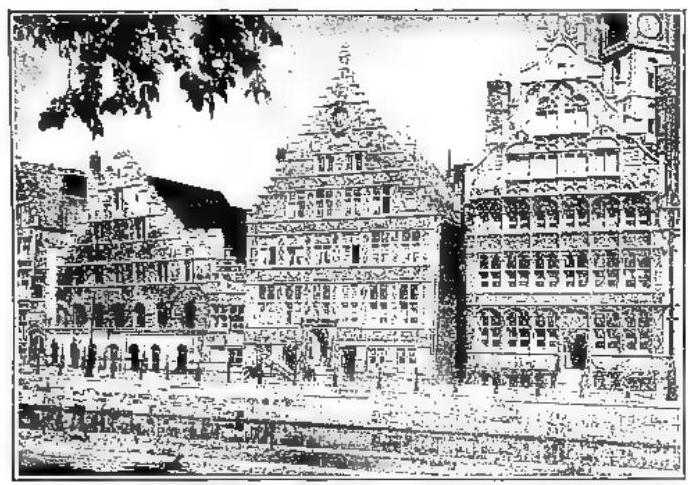
(for the printing works of the Commissariat-General of Tourism of Belgium) GAND, DIOCESE of - The houses on the Quai aux Herbes.
The beffroi, erected around 1330, is 118 m. high, and in 1378 was surmounted by a gilded bronze dragon 3.50 m. high. The hôtel de ville consists of two buildings: the old house of the aldermen, designed by Rombaut Keldermans and Ermanno de Waghemakers (1518) in the ogival style; adjoining it is the new house of the aldermen, called Parchone, designed in a style inspired by the Italian Renaissance (1600-22).
In the Brock district, the church of the Great Beguinage, dedicated to S. Elisabetta, was erected in the 12th century; it served as a parish only for the Beguines. When they were transferred to the new Great Beguinage of Mount St. Amand, the church of S. Elisabetta became a parish church on 24 September 1874. The church of S. Nicola was begun in the 12th century but rebuilt in the 15th.
The church of S. Michele, in the Gothic style, begun in 1445, was completed in the 17th century; its interior was restored in 1893; in the transept is van Dyck’s painting of the Crucifixion (1629). The church of S. Giacomo was begun in the Romanesque style in the 12th century and completed in the Gothic style at the end of the 15th, after which it was modified several times. The church of S. Pietro was erected between 1629 and 1719; its dome is 57 m. high.
The Archaeological Museum occupies the former church of the Discalced Carmelites. The Museum of Fine Arts offers a rich collection of sculptures and paintings, ranging from the primitives to the moderns. The State University, in the Flemish language, was founded in 1816 by Willem I, king of the Netherlands, and includes all the faculties.