
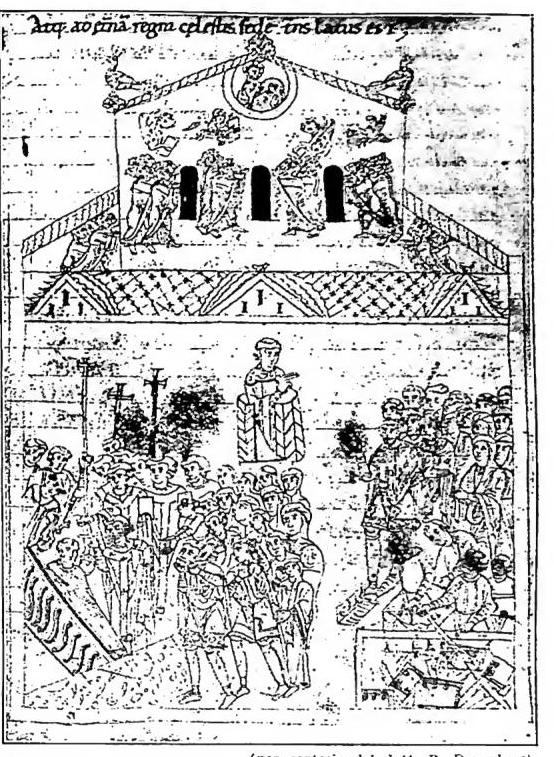
GREGORY I, POPE, saint — Burial of St. Gregory and legendary slander against his memory after the Pope’s death; the deacon Peter testifies to St. Gregory from the ambo while the common people burn the Pope’s books. The façade of old St. Peter’s is of interest. Discographer of the Life of St. Gregory, contained in an 11th-century codex from Farfa — Windsor, Eton College, ms. 124.
St. Peter (Prosperi auctarii Avicensis novissima, 17). All this, however, serves to reinforce the Gregorian concept of Rome’s protection through the Prince of the Apostles, who acted in the person of his successor (cf. O. Bertolini [V. BIBLICA.], p. 283).
The good relations between the Pope and Queen Theodolinda were frustrated in their peace-making effects by the stubbornness of the Byzantines, who viewed the Lombard problem with different eyes. In 595 Agilulf was disposed toward a general truce with the Exarch and, failing that, toward another with the Pope, but on far less advantageous terms. Gregory informed the imperial representative in Ravenna of this (Reg., V, 34) but to no avail; indeed, the Exarch took the occasion to accuse the Pope in Constantinople of negotiating separately with the Lombard king. The Emperor had the impudence to reproach Gregory with the naïveté of a fatuous man, but the Pope did not lose his composure; he replied as a man painfully wounded but in no way intimidated, firm in his patriotism and confident in his good conscience (Reg., V, 36). The Exarch even had an anonymous libel posted in Ravenna in which Gregory’s work for peace was stigmatized as a crime. The Pope responded with a threat of excommunication unless the slanderer could prove his charges—an impossibility, as Gregory was utterly certain of his position (Reg., VII, 42).
The death of the Exarch Romanus, which occurred when the Pope had even greater cause to complain of Lombard ferocity, brought a change in affairs. His successor, Callinicus, proved more reasonable, and through Gregory’s mediation a truce was signed in October 598, intended by the Pope to benefit both peoples—Lombards and Romans—and to lay the foundation of the “Christian republic.”
In this sense must be understood the Pope’s congratulations and thanks to Agilulf and Queen Theodolinda (Reg., IX, 66–67). Gregory’s policy had skillfully preferred negotiation to the intransigence of Emperor Maurice, at once safeguarding the interests of Italy and those of the Church, and drawing the Lombards—still Arians—closer to Catholicism.
The truce of 598 was broken by Callinicus’s imprudence in taking prisoner at Parma the daughter and son-in-law of the Lombard king, but the new Eastern Emperor Phocas understood that Gregory’s policy was the only one to follow in Italy. He therefore sent the aged Exarch Smaragdus, a friend of the Pope, to restore the situation. Gregory maneuvered the thirty-day truce signed in June 603 (Reg., XIII, 36), which could be renewed and, according to the new agreement, was to last until April 605. A letter written by the Pope in December 603 to Queen Theodolinda (Reg., XIV, 12) asks her to thank the king for the truce granted and expresses Gregory’s joy at the birth of the prince Adaloald, who was baptized and in June 604 was proclaimed king (Paulus Diaconus, Hist. Lang., IV, 25, 27, 30): he was to be the first Catholic king of the Lombards, but Gregory was no longer among the living.
b) With the Byzantines. — In his relations with Byzantium Gregory always regarded himself as the emperor’s subject, and in his epistolary correspondence he did not in the least alter the protocol formulas of his predecessors. Yet conscious of his responsibility, he was not afraid to oppose even an empress when she interfered with the authority of the Church and the Holy See.
He affirmed the principle of independence in the face of civil power and resolutely vindicated the rights of St. Peter, which he declared more than once to rest on the Holy Gospel (Reg., V, 37; cf. P. Batiffol, St Grégoire le Grand, 3rd ed., Paris 1928, p. 207, note 1). He energetically opposed anything that might diminish the authority of the Roman primacy, whether the Roman primacy or the ecumenical primacy; he maintained and extended the right of appeal to the Holy See over all diocesan matters, as well as the right to intervene in the disciplinary questions of every diocese.
He held, moreover, that the Emperor had a duty to defend Rome and Italy against the Lombards; but if necessity so required or imperial aid failed to come, nothing prevented him from assuming the defense himself.
Thus Gregory did not hesitate to remonstrate with Emperor Maurice when he judged civil legislation to be in conflict with ecclesiastical law (cf. Reg., III, 61, 64). He strongly censured the patriarch of Alexandria, Eugenius, for not having approved the four General Councils and Leo the Great’s Tomus ad Flavianum, for not having condemned Eutyches and Dioscorus and Severus with sufficient clarity, and for not having defined with theological precision the two natures in Christ (cf. O. Bardenhewer, Ungedruckte Excerpte einer Schrift des Patriarchen Eulogius von Alexandrien (580–607) über Trinität und Incarnation, in Theologische Quartalschrift, 78 [1896], pp. 353–401). In a letter to the bishop of Syracuse, Gregory himself clearly affirmed that “the Church of Constantinople is subject to the Apostolic See, a fact which the most pious Emperor and our brother, the bishop of that city, do not cease to acknowledge” (Reg., IX, 26).
4. Administrative action
Imperial legislation and the special conditions created by Lombard occupation, Byzantine misrule, and disasters had gradually imposed on the bishops of Rome duties extending beyond the merely religious sphere and entering, as we have seen, not only into the political but also into the administrative and economic realms. In this field too, despite his profession of total detachment from earthly things, Gregory showed that his personal experience in youth and maturity had been truly fruitful.The most substantial part of the administrative and economic activity of the Church of Rome derived from its vast landed properties, which made it the largest landowner in Byzantine Italy. The aggregate of these properties was designated by the term “patrimonium Sancti Petri,” inasmuch as it was asserted that the owner was the Prince of the Apostles himself.
BIBL.:
P. Batiffol, St Grégoire le Grand, 3rd ed., Paris 1928.
O. Bardenhewer, Ungedruckte Excerpte einer Schrift des Patriarchen Eulogius von Alexandrien (580–607) über Trinität und Incarnation, in Theologische Quartalschrift, 78 (1896), pp. 353–401.
O. Bertolini, Roma di fronte a Bisanzio e ai Longobardi, Florence 1941.
At the time of GREGORIO, the landed estates of the Church of Rome were: the “patrimony of the Alpes Cottiae,” between the Maritime and Cozie Alps, the Po, the Tusco-Emilian Apennines, and the sea (Giovanni Diacono, Vita Greg., II, 53); the “patrimony Romanum Venante et Histriae” (Reg., XI, 8); the “patrimony of Picenum,” between the Adriatic and the Umbro-Marchigian Apennines (Giovanni Diacono, loc. cit.); the “patrimony of Tuscia,” between the Arno, the Tiber, and the Tyrrhenian Sea (Reg., IX, 66); the “patrimony of Sabinum and Carseolanum” (Reg., XIII, 38; 111, 21); the “patrimony of Appia,” along the Via Appia and Via Ostiense (Reg., XIV, 14); the “patrimony Urbanum,” the real estate within the city of Rome (Giovanni Diacono, loc. cit.); the “patrimony of Samnium,” which was almost entirely lost with the Lombard occupation (id., ibid.); the “patrimony of Apulia,” much damaged (id., ibid.); the “patrimony of Calabria” (Reg., IX, 205-206); the “patrimony of Campania,” which included properties on the neighboring islands (Reg., XIII, 29); the “patrimony of Lucania and Bruttium,” which, with the Lombard occupation, could practically be spoken of as only the “patrimony of Bruttium,” the Lucanian part having disappeared. On the other hand, the “patrimony of Sicily” remained intact, distributed throughout the entire island (Reg., IX, 29), which induced GREGORIO to facilitate its administration by dividing it into two districts: the “patrimony of Panormus” in western Sicily and the “patrimony of Sicily” in eastern Sicily (Reg., IX, 38).
There were also the “patrimony of Sardinia” and the “patrimony of Corsica,” on their respective islands (Giovanni Diacono, loc. cit.); the “patrimony of Germanicianum,” from the city of Germania in Numidia (id., ibid.); the “patrimony of Dalmatia” and the “patrimony of Illyricum,” both greatly reduced by the incursions of the Avars and Slavs (Reg., II, 23); the “patrimony of the Gauls,” not very extensive (Reg., VI, 6).
Each patrimony constituted a separate administration, managed by a rector, appointed by the Pope, usually chosen from among the deacons or subdeacons for the more important patrimonies, and from among the notaries of the Apostolic See and the defenders of the Roman Church for the others. GREGORIO, as has been seen, conferred upon the rectors such broad powers, even in the spiritual sphere, as to make them true papal legates.
The rector was assisted by officials of various kinds, called notarili, chartularii, defensores, and by other minor employees, called actionarii.
The link between the rector and his office staff on one side and the mass of rural workers on the other was a category of tenants known as conductores; factors, overseers, who managed the agricultural units (condumae, massa), from which the elementary units (fundi) depended, along with their respective minor tenants and the workers of the land in general (coloni, rustici Ecclesiae).
All the various local administrations of the patrimonies were subordinate to Rome, to the central administration of the Church in the Lateran Palace. At the time of GREGORIO, the treasury of the central administration was managed by a deacon with the title of “dispensator Ecclesiae Romanae.” All income and expenditure, the pensions in silver and gold paid by tenants and coloni, were recorded in a large register, established by Pope Gelasius I, hence called the Gelasianum polyptychnum (Reg., II, 38; IX, 199; Giovanni Diacono, Vita Greg., II, 24). This admirable organization functioned regularly under GREGORIO’s supervision, and the letters in which he issued his directives to the conductores are true models of enlightened administrative wisdom (cf. Reg., I, 39 a, 42; II, 38).
Immense sums of money and enormous quantities of produce flowed into Rome so that the Holy See could provide not only for the expenses of the Church, the staff of the central and provincial offices, but also for the needs of the city. Justly did Giovanni Diacono (Vita Greg., II, 26), after describing the copious general distributions and the offerings that GREGORIO had arranged to be made on the first day of every month, say that the Church was “nihil aliud quam communia quaedam horrea” and that he who “discretissime” presided over such distributions was the “paterfamilias Domini.”
III. WRITER
GREGORIO is the first great writer of the Middle Ages and among the popes the most prolific. His literary activity spans the years from his nunciature in Constantinople to his death. All his works reflect the eminently practical character of the social, disciplinary, and moral work he carried out.The Epistles are the richest and most valuable source of information on everything relating to his multifaceted activity as Pope. Eighty-five have come down to us, collected and arranged chronologically according to the years of his pontificate in fourteen books or registers, addressed to emperors, kings, patriarchs, bishops, monks, laypeople of every rank and condition, for whom he exercised an apostolate of zeal, full of prudence, wisdom, and goodness. The simple yet dignified, intuitive, and effective style, though not refined in form, contributed greatly to the formation of ecclesiastical Latin, particularly of curial and juridical protocol.
The Expositio in beatum Iob libri XXXV, better known by the name of Moralia, was begun in Constantinople during his nunciature but completed in Rome around 595. GREGORIO’s exegesis firmly upholds the triple sense of Sacred Scripture but gives precedence to moral consideration over historical interpretation. This is why in the Middle Ages this work was adopted as a manual of applied morality for all conditions of life, particularly for the priesthood (cf. F. Liebling, Grundfragen der mystischen Theologie nach Gregors des Grossen «Moralia» und Ezechielhomilien, Freiburg in Br. 1934).
The Regula pastoralis falls under this same perspective. In four books, it sets forth GREGORIO’s program upon assuming the pontificate, and it is a kind of examination of conscience: the ideal figure of a good shepherd is projected within II. The extraordinary success of this little work is well known; while the author was still alive, it was translated into various languages at the request of emperors and kings, and councils imposed it upon priests as a code of life (cf. S. C. Hedley, Lex levitarium, Paris 1922).
The forty Homiliae in Evangelia, which are preserved in the collection published by GREGORIO in 593, were probably delivered by the Pope during the liturgical year 590–91. The first twenty were dictated during his illness and read in his stead to the people who loved to hear him (cf. Reg., IV, 17 a). The twenty-two Homiliae in Ezechielem were pronounced by the Pontiff during the Lombard siege, recorded by stenographers, and later revised by him a few years afterward (cf. Reg., XII, 16 a).
The four books of the Dialogorum de vita et miraculis patrum Italicorum et de aeternitate animarum were composed during the same years as the Homiliae in Ezechielem, 593–94, almost as a relief from the heavy burdens of office. In the form of a dialogue with the deacon Peter, Books I and III narrate the wondrous deeds of Italian saints, while Book II is entirely devoted to the life of St. Benedict, and Book IV to the account of apparitions of the dead, to prove the immortality of the soul; in IV, 55, the foundation is laid for the devotion known as the “Gregorian Masses,” recognized by the Church.
The Dialogues that GREGORIO offered to Queen Theodolinda (Paolo Diacono, Hist. Lang., IV, 5) met with immediate and extraordinary success. In the 8th century, Pope Zacharias, a Greek by birth, translated them into his native language; later, there followed translations into Arabic (8th c.), Saxon (9th c.), French (13th c.), and Italian (14th c.). The Greeks and Slavs, to distinguish GREGORIO from others of the same name, called him “the Dialogist” (cf. XII. 1075).
Among the works that bear the name of G. we must recall the Sacramentarium and the Antiphonarium. Ancient tradition, going back to John the Deacon (Vita Greg., II, 6-10, 17) and the Venerable Bede (Hist. ecc. gentis Anglorum, I, 25; II, 20; IV, 2, 12, 18; V, 20), attributes to G. a liturgical activity centered on both the aforementioned works.
The so-called Gregorian Sacramentary contains the prayers of the Mass. In the copies known today, it has undergone retouching, additions, and transformations that, nonetheless, have left intact the importance of the Pope as its organizer.
C. Mohlberg has clarified the development of the Gregorian Sacramentary by classifying the manuscripts into two groups: in the first group are the codex of Padua D. 47 of the 9th century (C. Mohlberg-A. Baumstark, Die älteste erreichbare Gestalt des «Liber Sacramentoorum» in circa 1000, 112, Münster in V. 1927), and the liturgical codex of Kiev, likewise from the 9th century (C. Mohlberg, Messele glagolitico di Kiew [sec. IX] e il suo prototipo romano del sec. VI-VII, in Memorie della Pont. Accad. romana di archeologia, 2 [1928], pp. 207-20); in the second group are placed, but in two classes, the manuscripts published by H. Lietzmann (Das «Sacramentarium Gregorianum» nach dem Aachener Urexemplar, Münster in V. 1921) and H. A. Wilson (The Gregorian Sacramentary, London 1915).
The compilation of the Antiphonarium, which contains the chants to be performed during Mass, followed, at a distance, the same development. G. knew the chants used before him in the Roman Church, ordered them according to the liturgical cycle, moderated the exuberance of the neumes, and added missing parts. It is not certain that he founded the Schola cantorum; however, his constitution of it, which rightly led to the rapid adoption of the name “Gregorian” for the chant of the Roman Church.
IV. CONCLUSION
G. lived and worked in a period of profound political and religious transformation in society. He may be said to have been the last of the Romans and the first of the Middle Ages, as well as the last of the classical masters of the Church and the first of the scholastics. He possessed a clear intelligence, a vast and profound mind, a pure conscience, thus uniting the qualities of the true Roman. His pontificate was a true providence for the Church and for Italy. Western Christendom was just emerging from the chaos of barbarian disorganization: Gaul, then unified in the Catholic faith of the Franks, was struggling with every kind of difficulty; Spain saw the conversion of the Visigoths only in the early years of G.’s pontificate; England was still immersed in the darkness of superstition and error. Italy, moreover, invaded by Arian Lombards and poorly protected by Catholic Byzantines, was in a state of true political-religious disorder. The only force capable of acting amid such varied and conflicting tendencies, armed against one another with the aim of mutual destruction, was the Church, an element of central moral moderation. G. inaugurated the medieval work of this force of civil and religious production and regeneration.With his eminently practical spirit, he immediately had a clear vision of the duties and rights of the papacy. He was not a theologian, philosopher, or man of letters in the strict sense of the word. He was a master of discipline, a monk, an apostle, a profound connoisseur of Roman law, endowed with uncommon organizational abilities.
As a master of discipline to the people, the clergy, and the bishops, he laid down laws and established the foundations of preaching, which he considered the first duty of the episcopate. With strict and austere customs, he was a vigilant guardian of the moral life of the clergy, correcting its abuses and restoring a more exact observance of evangelical precepts and counsels. As an apostle, he brought the provinces on the borders of the ancient Empire to the light of the Gospel, combated the remnants of paganism and heresy. As an organizer, he saved Rome from famine, improvised a military commander, and negotiated truces. As an administrator, he reorganized the complex management of the “patrimonium S. Petri,” establishing the administrative hierarchy, eliminating abuses, and restoring justice.
The preeminent position he acquired for the papacy in the world, together with the reorganization of the immense patrimony of the Church, united with his spirit of initiative in the face of circumstances, created the proximate preparation for the establishment of the temporal dominion of the papacy.
As a writer, G. stands out for his practical tendency, which had an effect not only on the practical direction of scholasticism but on the entire life and progress of the Church during the Middle Ages. His dogmatic importance is rather pedagogical, for having adapted traditional doctrine—particularly that of St. Augustine—to the average intelligence of his time and of the peoples.
In his liturgical activity, he appears as a reorganizer of the patrimony of the past, to which he imprinted the importance of his character.
G. is one of the four Doctors of the Western Church. His feast is celebrated on March 12.
John the Deacon finally wrote the S. Gregori Magni vita (PL 75, 59-242) in Rome between 872 and 873. In all these lives, there are few elements that do not come from the works of G.
Information about G. is also found in the Historia Francorum of Gregory of Tours, completed in 591; in De viris illustribus of Isidore of Seville (d. 636); in De virorum illustrium scriptis of Ildefonso of Toledo (d. 667); in the Historia gentis Anglorum of Bede (d. 735).
Literature: on G. there exist not a few monographs, but until that of Ed. Clauss, St. Gregorie le Grand, pape et Docteur d'Église, Paris 1886-91, they are all of little critical value. Worthy of note are those by C. Wolfgruber, Gregor der Grosse, Ravensburg 1897; H. Dudden, Gregory the Great, his place in history and in thought, London 1905; H. Grisar, S. G. Magno, Italian trans. by A. De Santi, Rome 1928 (reprint); P. Batiffol, St. Gregorie le Grand, Paris 1928.
It is not rare that in the great histories of the Church there are chapters on G. of considerable importance, such as in J. P. Kirsch, Kirchengeschichte, I, Freiburg in Br. 1930; E. Caspar, Geschichte des Papsttums von den Anfängen bis zur Höhe der Weltherrschaft, II, Tübingen 1933 (by the same author V. also the study: Gregor der Grosse, in Meister der Politik, 3 (1923), p. 327 seq.); Fr. X. Seppelt, Das Papsttum im Frühmittelalter, Leipzig 1934; Fliche-Martin-Frutaz, V, pp. 19-83. Likewise the general histories: The Cambridge Medieval History, II, Cambridge 1913; A. Fliche, La chrétienté médiévale, Paris 1929; L. Halphen-Ph. Sagnac, Peuples et civilisations, V, 2nd ed., ibid. 1930.
Likewise, this applies to literary histories such as those by O. Bardenhewer, U. Morice, and M. Manitius. On the pastoral activity of G., particularly in Italy, see L. Duchesne, *Les évêches d'Italie et l'invasion lombarde*, in *Mélanges d'archéologie et d'histoire*, 23 (1903), pp. 83–116 and 25 (1905), pp. 365–99; C. Giuriani, *L'italianità nell'opera di G. Magno*, Como 1934. On his political dealings with the Lombards and the Byzantines, see O. Bertolini, *Roma di fronte a Bisanzio e ai Longobardi*, Bologna 1941, pp. 241–59. On his administrative activity, see P. Fabre, *De patrimonii Romanae Ecclesiae usque ad aetatem Carolinorum*, Lille 1892; R. Aigrain, *Le patrimoine de l'Eglise romaine*, in Fliche-Martin-Frutaz, V, pp. 565–75.
On the literary activity of G., see the relevant bibliography in Morica, III, II, Turin 1934, pp. 1563–67; on his liturgical activity, see the relevant bibliography in B. Altaner, *Patrologia*, Italian trans. of the 3rd rev. ed. by A. Ferrua, Turin 1944, pp. 329–40, note 3.
Benedetto Pesci
V. S. G. IN ART. — From the earliest times (fresco in S. Maria Antiqua in Rome, 8th century) he is depicted in pontifical vestments; from the 12th century (fresco at Nonnberg) also wearing the tiara. He carries the crozier with a simple or double cross, and, as a Doctor of the Church, a book.
Since German miniatures of the late 10th century, as well as the Sacramentary of Ivrea, depict him with the dove of the Holy Spirit dictating his writings, this dove became his distinctive attribute. Among isolated representations of the Saint, noteworthy are: a painting by Antonello da Messina (in the Civic Museum there), a relief by Luca della Robbia (Florence, Duomo), the statue by Cordier (1602, S. Gregorio al Celio in Rome), and, in German art, the painting by M. Pacher from the "Altarpiece of the Four Doctors" in Munich, where, beside S. G., appears the figure of the Emperor Trajan, whom he rescued from hell. Other episodes from the legend frequently chosen by figurative art include the liberation of the monk Giusto from purgatory (relief by G. Capponi, Rome, S. Gregorio al Celio), the dinner for the poor (paintings by P. Veronese in Vicenza and by Vasari in Bologna), and the bleeding brand (painting by A. Sacchi in the Vatican Pinacoteca, with a musical setting in S. Pietro in Rome). An independent image was formed by the so-called Mass of S. G. with the appearance of the wounded Christ on the altar, represented chiefly by Northern artists of the 15th century.
VI. S. G. IN FOLKLORE. — Popular imagination from the Middle Ages onward has attributed to the figure of the great Pope the legendary motif of the "unwitting incestuous," already reflected in the myth of Oedipus. This adaptation, in an hagiographic context, of a theme drawn from ancient mythology and popular fable was shaped by the Christian idea "that there is no sin so great that it cannot be washed away before God by rigorous and sincere penance" (D'Ancona), and chose S. G. as its exemplary figure par excellence. In France (where it may have originated as a literary work), Germany, England, and even Italy, the legend inspired numerous verse and prose narratives, from the *Vie du pape Grégoire le Grand* (early 12th century) to the poem *Gregorius auf dem Stein* by Hartmann von Aue (1150–1220) and the old English romance *Sir Degore* (13th century). It enjoyed extraordinary diffusion also in Eastern Europe and descended into the oral tradition of the common people, where it is still preserved. In Italy it appears both as a fairy tale and as an epic narrative in hendecasyllabic verse: the latter derived from an ancient poem, of which an Abruzzese version was published by G. Ciccone (see bibliography). The same mythical-fairy-tale motif also gave rise to the legend of "Vergogna." See plate LXXXI.