
I. Civil and Religious History
Spanish sovereignty over GUATEMALA was proclaimed at Almolonga in 1524 by Pedro de Alvarado, one of the lieutenants of Fernando Cortés. The evangelization of the indigenous population, for the most part peaceful, of the present-day State of Guatemala was begun shortly after the conquest, in the years 1523 and 1524, by the Franciscans, the Dominicans, and the Mercedarians. Among the warlike Indians of Tuztulan, Bartolomé de las Casas from 1537 carried out his pacifying mission, for which the region received the name of Vera Paz. In 1534 the diocese of Santiago de Guatemala was erected.
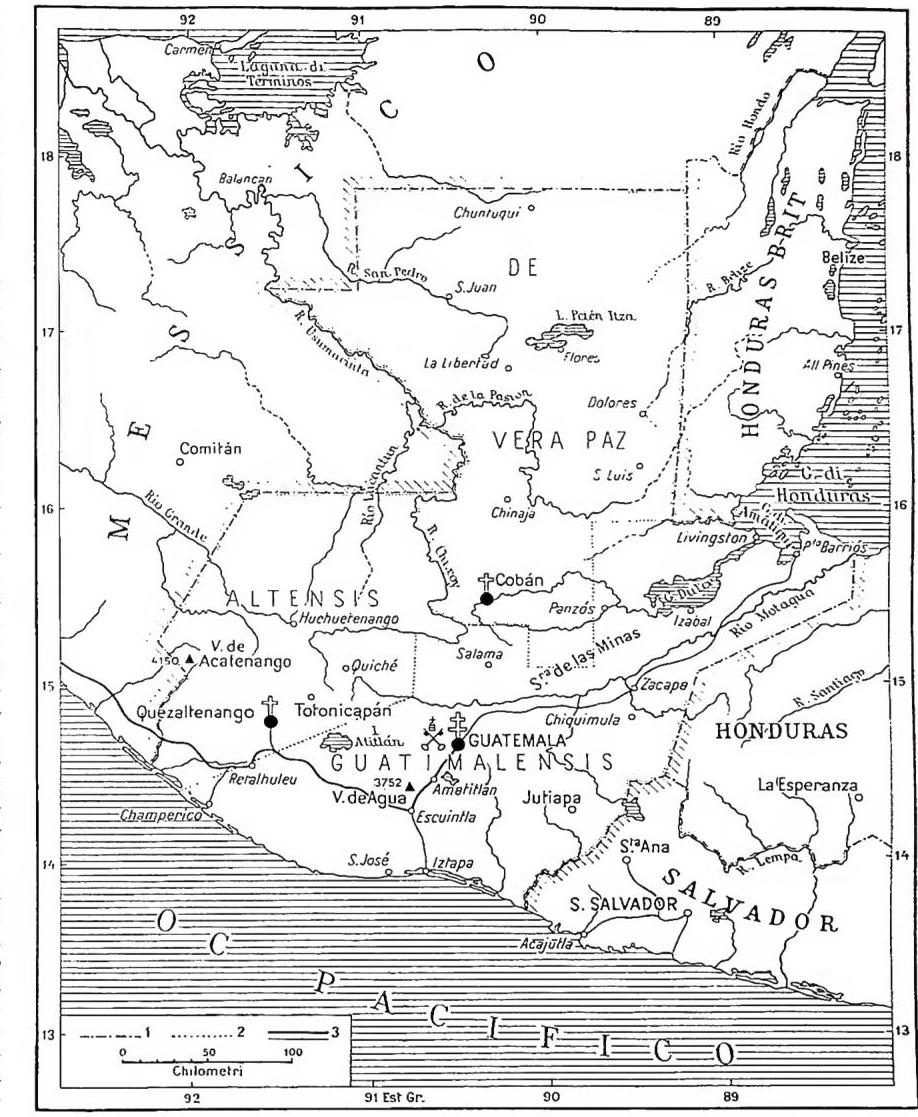
The first Franciscan bishop, Marroquín (1534-65), worked strenuously for the conversion of the Indians and was the author of the first catechism in the indigenous language of the country. In this way, by the end of the 16th century the conversion of Guatemala was substantially complete. Even today the peaceful, farming Indians form the majority of the population of Guatemala.
In 1821 independence from Spain was proclaimed, and the following year Guatemala was annexed to Iturbide’s Mexican Empire.
From 1824 to 1839 Guatemala was part of the Federal Republic of Central America, and during this period relations with the Holy See became very strained because of the illegal creation of a schismatic see at San Salvador. Once constituted as a republic, Guatemala, under the presidency of R. CARMEIA (v.), sent a plenipotentiary to Rome to sign a concordat with the Holy See. This Concordat, concluded on 7 Oct. 1852 by Cardinal Antonelli with the Marquis Lorenzana di Belmonte, was ratified by Carrera on 24 Dec. 1852.
By virtue of this agreement, the Catholic religion was declared the religion of the Republic (art. 1); instruction given in all State schools, including the university, was to conform to Catholic doctrine, under the supervision of the diocesan ordinaries (art. 2); the exclusive competence of ecclesiastical authority in matters concerning faith, the sacraments, sacred functions, and rights pertaining to the sacred ministry was recognized (art. 15); and the Church was permitted to acquire and possess temporal goods in any just manner (art. 18).
It shows traces of national patronage in ecclesiastical matters, as, for example, in the appointment of bishops.
III. Educational System
Article 18, Title II, of the Constitution of Guatemala stipulates that education for children from 6 to 14 years of age must be compulsory, free, and secular. The secular character of the school system is further confirmed by Article 24 of the same Constitution (Title II, “De las garantías”), which establishes that religious instruction may be given only in churches. The Constitution does not, however, prohibit the founding of private schools provided they maintain the secular character of the school.
The State seeks to reduce the number of illiterates, to spread education—particularly practical and rural education—by fostering the establishment of practical schools, rural schools, and evening classes. The tropical climate and poor communications have led the State to found numerous schools in order to educate the youth, who are 60% indigenous; thus a country of 2,500,000 inhabitants has 3,500 State schools, divided into 1,580 for boys and 1,920 for girls, in addition to 236 private schools for boys and 137 for girls. Teachers are trained in 22 teacher-training academies and in the central normal school for teachers.
Higher education is provided in the School of Agriculture, the Academy of Fine Arts, the National Conservatory of Music, and the Universidad Nacional de Guatemala, founded on 15 Sept. 1918 after the suppression of the higher schools of medicine, law, and engineering by decree of 2 May 1918. The education of the Catholic clergy is provided for in the “Seminario de Santiago” in Guatemala City.
IV. Archdiocese of Guatemala
Archdiocese and capital city of the homonymous State in Central America. The archdiocese, also called Santiago de Guatemala, has an area of 36,370 sq. km. with a population of 1,980,000, of whom 1,922,000 are Catholic; it comprises 65 parishes served by 47 diocesan priests and 40 regulars, one seminary, 6 male religious communities, and one female community (1949).
The diocese was created by Paul III on 18 Dec. 1534, and its first bishop was Monsignor Francisco Marroquín. Benedict XIV raised it to metropolitan status on 16 Dec. 1743. Between 1872 and 1874 the religious communities were suppressed; of the female communities only the Sisters of Charity of St. Vincent de Paul remain.
The cathedral is dedicated to the Apostle St. James the Greater. The suffragan sees of Guatemala are Quetzaltenango and Vera Paz.