
GABRIELE INCINTO. — Preacher, canon regular of the Lateran, b. at Vicenza in 1548, d. there c. 1608.
The sermons he preached in various Italian cities were published and translated into Latin and French on several occasions: *Conciones de quatuor hominis novissimis* (Venice 1593, 1596, 1601; Cologne 1632; French ed. Lyons 1609 and 1610); *Le vie celesti* (Venice 1603; Latin ed. Cologne 1609 and Venice 1610; French ed. Paris 1604).
Among other engravers active at this time the Venetians Domenico delle Greche, N. Boldrini, and G. Scolari are remembered, who worked especially on designs by Titian. In the 17th c. notable engravings were produced by Coriolano, Tiarini, and Guido Reni. In the 18th c. this art began to decline, only to revive at the end of the 19th and early 20th c., especially through the work of the group associated with the journal *Leonardo*, which included, among others, A. Spadini and A. De Carolis. A large number of wood-engravers derived from De Carolis, and the work of many contemporary artists is also noteworthy.
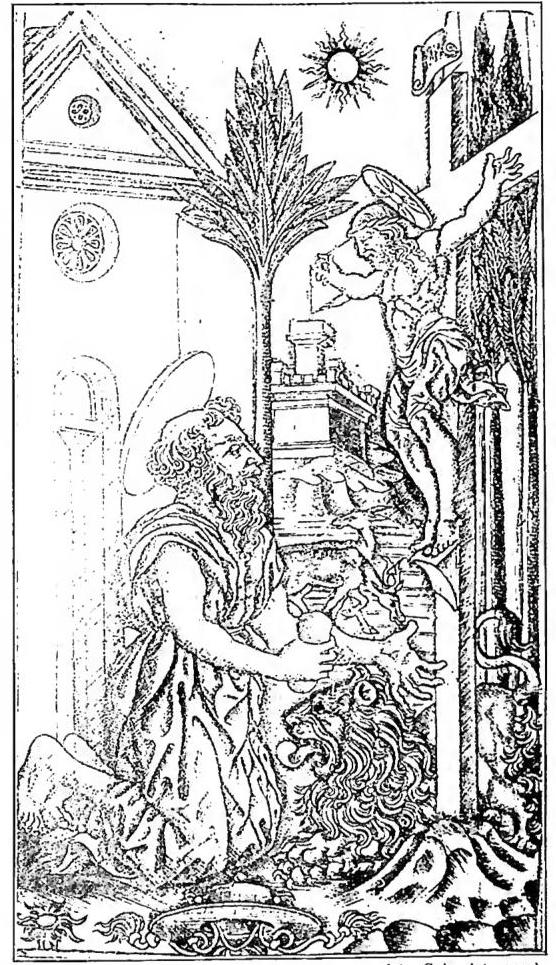
HISTORY OF ENGRAVING. — The thesis of Vasari, who wished to trace the origin of engraving to Maso Finiguerra and the impressions of his nielli (since German prints have been found dating from several years before 1460), has been disproved; yet the problem of the origins of engraving has not been completely solved. In Vasari’s account, however, one might find an indication that the workshops of Florentine goldsmiths were among the first centers of this new illustration technique. Niello impressions are now extremely rare, and among the most precious surviving proofs are those of A. Pollaiuolo. In this field, as in that of woodcut, the earliest engravings clearly show the influence of the most famous artists of the Quattrocento: notable among these are those of the Master of the Great Passion, influenced by Andrea del Castagno (cf. the *Penitent Jerome* in the Uffizi). A famous engraving by A. Pollaiuolo is *The Battle of the Ten Nudes*, and worthy of mention is the large *Assumption of the Virgin*, of Botticellian inspiration, which for a long time was even attributed to Botticelli himself. Among the interpreters of Botticelli’s designs, the name of Baccio Baldini has been handed down; to him are attributed the illustrations of the volume *Il Monte Santo di Dio* (Florence 1487) and those of the *Decima Commedia* (ibid. 1481). Among other engravers, mention should be made of C. Robetta, who engraved from designs by Filippino Lippi, Pollaiuolo, Ghirlandaio, and also showed the influence of compositions by Dürer. In northern Italy many of the most renowned artists, including A. Mantegna, devoted themselves to engraving: among these are Niccolotto da Modena, Benedetto Montagna, Jacopo de’ Barbari, Girolamo Mocetto, and Giulio Campagnola, who
HISTORY OF WOODCUT. — Woodcut preceded metal engraving: playing cards, printed fabrics, and above all religious images, abound already in the 14th c. Indeed, it is these latter that are the earliest woodcuts of some importance, although very little now remains of them, printed on loose sheets and destined, as objects of devotion, to rapid wear. Among these simple outline images, often hand-colored, without hatching or chiaroscuro, mention may be made of *The Way to Calvary* (c. 1400, Albertina, Vienna) and *The Madonna and Four Saints* (1488, Print Room, Brussels). Among Italian woodcuts, also extremely rare and generally produced by Florentine or Venetian artists, one should recall one of the earliest xylographic books, illustrating *The Passion* (Print Room, Berlin), in which both text and vignettes are printed using a single woodblock for each page. This primitive printing system was especially widespread in Germany, and it does not seem unreasonable to think that the invention of movable type may have found in this kind of book production its occasion and origin. After the invention of printing, woodcut became its greatest aid for the decoration and illustration of volumes: mention should be made of the famous *De re militari* by F. Valturio (Verona 1472), for whose illustrations the name of Matteo de’ Pasti has been suggested; the *Aesop* of Verona (1479) and that of Naples (1485). Important too are the Florentine publications, adorned with woodcuts reflecting the style of the best local artists, and those of Venice, very numerous, among which at least the *Hypnerotomachia Poliphili* (1499) by the Dominican Francesco Colonna should be remembered, whose illustrations have also been attributed to Giambellino and Mantegna. At the beginning of the 16th c. the first woodcuts in several tones appear; they were used in Germany, among others, by L. Cranach, and ARPI (v.), who for some time was even considered the inventor of the new process. Followers of Ugo da Carpi included A. Fantuzzi and G. Nicolò.