
IRLAND
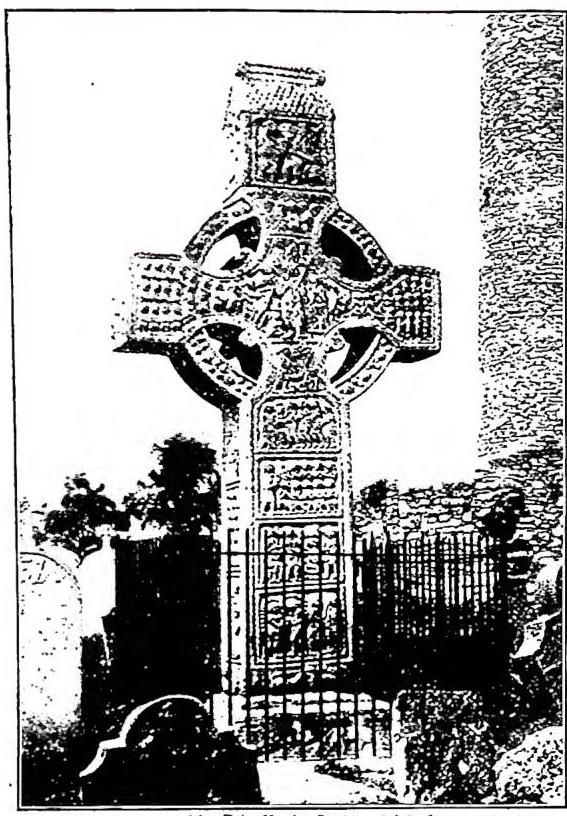
(a) Eric H. L. Sexton, Irish figure sculptured, Portland, Maine 1946, tav. 15)
IRLAND — Cross of Muirzdach (10th century) — Monasterboice.
The struggle among the “Anglo-Irish,” descendants of the first invaders and favourable to a compromise with the English crown, prevented a peaceful solution, even after about seven years of government by the Irish Confederation, and despite the fact that King Charles I, engaged in conflict with the Parliament of London, had guaranteed religious freedom in exchange for an Irish army to be sent to England.
To resolve the issue by force, Oliver Cromwell landed in Ireland after the execution of the King (1649). After slaughtering the Irish at Drogheda and Wexford and capturing Kilkenny and Clonmel, he returned to England, leaving his lieutenants to subdue the country. The conquest was completed in 1652; the conquered territories were distributed to Cromwell’s soldiers (Act of Settlement, 1653), and the remaining landless Irish were confined to Connaught.
Under Charles II, conditions improved slightly, as he took care to distinguish between the families of the old Anglo-Norman planters, the Elizabethan and Caroline planters, and the Cromwellian planters (Act of Settlement, 1663). His successor, James II, seeking to regain the lost English throne (1688) as a Catholic opposed to Parliament, relied on France under Louis XIV and on Ireland.
V. IRELAND UNDER THE PENAL LAWS
His son-in-law, William III of Orange, then landed with an army in the island and defeated the royal forces on the River Boyne (30 June 1690). The consequence of this defeat for Ireland was a new plantation of Orangemen, who replaced the proscribed Jacobites, and a period of clear Protestant predominance, enforced by “laws and words,” with the complete disappearance of the tribal system due to the final expropriation and the subsequent Act of Resumption (1700). Under this act, all lands confiscated or granted in Ireland after 1689 were to revert to the State, which then resold them at public auction. Meanwhile, the wool industry was uprooted from the country to the advantage of England, and no compensation was provided by the introduction of the linen industry, which only benefited Orangemen in Ulster.The suppression of the tribal system, by removing the cause of internal disputes, facilitated the rise of the idea of Irish unity, uniting the Irish—now equalized as Catholics (except for Orangemen in Ulster)—against the English and Protestant dominator. At the same time, the tolerant ideas of the 18th century, the century of Enlightenment, led the English to relax the Penal Laws. It was the Protestant Henry Grattan who proposed to the English Parliament the equalization of Catholic rights with those of Protestants. The War of American Independence, which led to the formation of an Irish volunteer army of 42,000 men, later rising to 100,000, contributed to easing the harsh grip of the English, while a national uprising (1798), quickly suppressed and inspired by the French Revolution, persuaded the English Prime Minister Pitt to proclaim (1800) the union of Great Britain and Ireland into a single kingdom with a single Parliament seated in London.
VI. THE UNION OF IRELAND WITH GREAT BRITAIN
The union, opposed by Irish Protestants who saw it as a reduction of their privileged position, was not unwelcome to Catholics, who viewed it as a means to facilitate their emancipation, freeing them from isolation and enabling them to make their voice heard in the English Parliament.The 19th century indeed laid the solid foundations for Irish independence. However, the path was still long and arduous, as: 1) the Protestant Church still held a privileged position, not only of honour but also economically, due to tithes that the population was required to pay; 2) most of the territory was in the hands of English landlords (landlords) resistant to any modification of the system from which they benefited at the country’s expense.
Thus, immediately after the union, the struggle for emancipation began, led by D. O’Connell (q.v.), who, by organizing the peasantry, obtained from Parliament the approval of the Emancipation Act (1829), which equalized the rights of Catholics and Protestants.
The terrible famine that struck Ireland in 1848, following a poor harvest and causing the death of hundreds of thousands and the emigration of over a million and a half to America, due to government mismanagement, convinced the liberal government led by Gladstone to abolish (1870) the privileges of the Protestant Church, to address agrarian reform, and to consider granting Ireland the right to self-government (Home Rule). This movement, initiated by S. Butt and championed by the Irish patriot C. S. Parnell, failed twice (1886 and 1893) due to opposition from Conservatives and would have failed a third time (when presented by the deputy Redmond) because of the opposition of Ulster Protestants, who feared compromising their privileged position and threatened civil war. However, the outbreak of the First World War (1914–18), in which Ireland sided with England, temporarily quelled the sources of conflict. This ideal was kept alive by the political association of the Sinn Féiners, “those who act for themselves,” founded by A. Griffith. They participated in the 1916 uprising, coordinated with Germany and brutally suppressed by England. They triumphed in the 1918 elections and consolidated their position by forming the Irish Republican Army. In 1919, the Sinn Féiners constituted themselves as the “Assembly of Ireland” (Dáil Éireann) and proclaimed the country’s independence under the presidency of É. de Valera.
VII. INDEPENDENT IRELAND
The English Prime Minister Lloyd George eventually negotiated with them, recognizing (6 December 1921) Ireland’s status as a Dominion, with the obligation of an oath of allegiance to the King of England and the payment of an annual rent to compensate the English landlords for the lands returned to Ireland. Ireland received the title of the Irish Free State (Saorstát Éireann), comprising the 26 Catholic counties of central and southern Ireland, while the 6 Protestant counties of Ulster remained united with England. Irish extremists did not approve of this arrangement, and a struggle ensued in which A. Griffith and M. Collins were killed; W. Cosgrave succeeded them. Order was restored in 1923, but the dispute gave rise to a new party called Fianna Fáil, “Soldiers of Destiny,” founded by de Valera, which aimed to amend the 1921 Constitution in two key points: abolishing the oath of allegiance to the King of England and the annual payment to English landlords.The new Constitution, approved by Parliament and confirmed by a popular plebiscite, came into force on 29 Dec. 1937. With it, Ireland achieved the goal of its independence as a sovereign State, so much so that it was able to declare its neutrality in the face of England at the outbreak of the Second World War (2 Sept. 1939). Yet to make independence complete there still remains, from a territorial and political standpoint, the annexation of the six counties of Ulster. In the 1948 elections, in place of E. De Valera, Thomas O’Kelly rose to the presidency of the Irish Republic.
2) Parents are given full liberty to have their children educated at home, in private schools, or in State-recognised or State-established schools. 3) The State, taking account of parents’ consciences and legitimate preferences, does not compel them to send their children to State schools; yet, as guardian of the public welfare, it requires that children, according to their social condition, receive a minimum of moral, intellectual and social education. 4) The State provides free primary instruction and seeks to assist, with suitable subsidies, private and corporate educational initiatives; and when public demand requires it, it provides other educational facilities and institutions, always keeping in view the rights that belong to parents, especially in matters of religious and moral formation. 5) Only in exceptional cases, as guardian of the public good, will the State substitute itself for the parents if they, for moral or physical reasons, fail in their duty towards their children. The State will always respect the natural and imprescriptible rights of children.
The Irish people attained these results through a struggle that began in 1612 with the foundation of the Royal Free Schools, followed by the Penal Laws which proscribed Catholic education in the Empire. The decree, founded by Lorde, and the law of 1797, establish that parents, as parents, are bound to educate their children so that they may be educated at home and at school. 6) The State, as guardian of the public good, will substitute itself for the parents if they, for moral or physical reasons, fail in their duty towards their children. The State will always respect the natural and imprescriptible rights of children.
Irish narrative prose, interspersed with summarising poems, is conducted in fluent dialogue and the individual characters are vigorously delineated. The epic and dramatic elements of a national literature are here extremely numerous; yet this abundant material never found literary expression, probably because of the irregular course of Irish history. Many secondary tales cluster around the central Táin. One of these, The Tragic Death of the Sons of Usnech, captured the popular imagination more than the others and still survives in the folk memory. There are other minor stories, such as The Sack of the Inn of Dá Derga, and a series of tales describing mortal visits to the Land of Promise: The Voyage of Bran, The Voyage of Maelduin, etc.
b) The Fenian cycle belongs to a later age and is composed in ballad form. Its principal figure, Finn Mac Cumhaill, and his companions, display more humanity, good and evil, and there is a heightened awareness of the delight given by natural beauty and the dangers of the chase. Many of the Fenian tales survive in the Gaelic-speaking provinces of modern Ireland. The oldest version of these Fenian legends is in the Agallamh na Seanórach, preserved in the Book of Lismore (15th cent.). Later ballads can be found in the Duanaire Finn (compiled early 17th cent.). Prose romances on the Fenian theme appeared in the 16th and 17th centuries: The Pursuit of Diarmuid and Gráinne, etc.
The first prose narrative is Cogad Gaedel re Gallaib (The Wars of the Gaels with the Foreigners), written soon after the Battle of Clontarf (1014). Other prose works are Caithréim Cellaig Caisil and Leabhar Gabhála (The Book of Invasions), which gathers many legends of ancient Irish history. Annalistic literature is more abundant than historical narrative. The oldest annalistic compilation comes from the southern province of Munster: the Annals of Nisfallen (1009). Later compilations include the Annals of Tigernach (14th cent.), the Annals of Ulster (1490), the Annals of Loch Cé (1588) and the Annals of the Four Masters (1632–36). The last-named compilation was the work of a group of Irish Franciscan scholars who copied all the older material they could find in the annals kept at the Franciscan monastery of Donegal.
The most important collection of genealogies was assembled at Galway from ancient material by Duaid Mac Fíirbhis (1650–66). Here too is found a large quantity of manuscript material by professional scholars of this period on topography, history, genealogy, grammar, metrics and law. Only a small part of the Irish legal system, known as the Brehon laws, has yet been studied. There are also Irish translations from the classical histories of Greece and Rome. Religious writings are well represented in this period. Notable lives of Irish saints are contained in the Leabhar Breac and the Book of Lismore. A large body of texts deals with visits to Paradise and Hell. The most famous of these are The Vision of Adamnán (12th cent.), The Vision of Fursa and The Vision of Tundal (12th cent.). It is said that Dante was influenced by the Vision of Fursa. The Vision of Mac Conglinne differs from these texts: it is a satirical entertainment of 12th-century Irish monks. The love poetry of this period shows the influence of the European tradition of courtly love. The best of these love poems were collected by T. F. O’Rahilly in Dánta Grádha (Dublin 1916).
III. MODERN PERIOD
The 17th century saw the progressive rise of English power and culture in Ireland and a corresponding decline of the old Gaelic tradition. For lack of patrons the bardic schools decayed, and poets abandoned the old classical metres in favour of the simpler verse of the spoken language. David O Bruadair, Piaras Feiritéar and Eoghan O’Rahilly are the most important poets of the 17th century. A school of religious prose arose in the Irish colleges on the Continent, especially in the Irish Franciscan convent of St Anthony at Louvain, where the first printed books in Irish were produced.The earliest biography, in modern Irish and of some pretension, is the Life of Colmcille by Manus O’Donnell, written in 1536. Tadhg Ó Cánainn
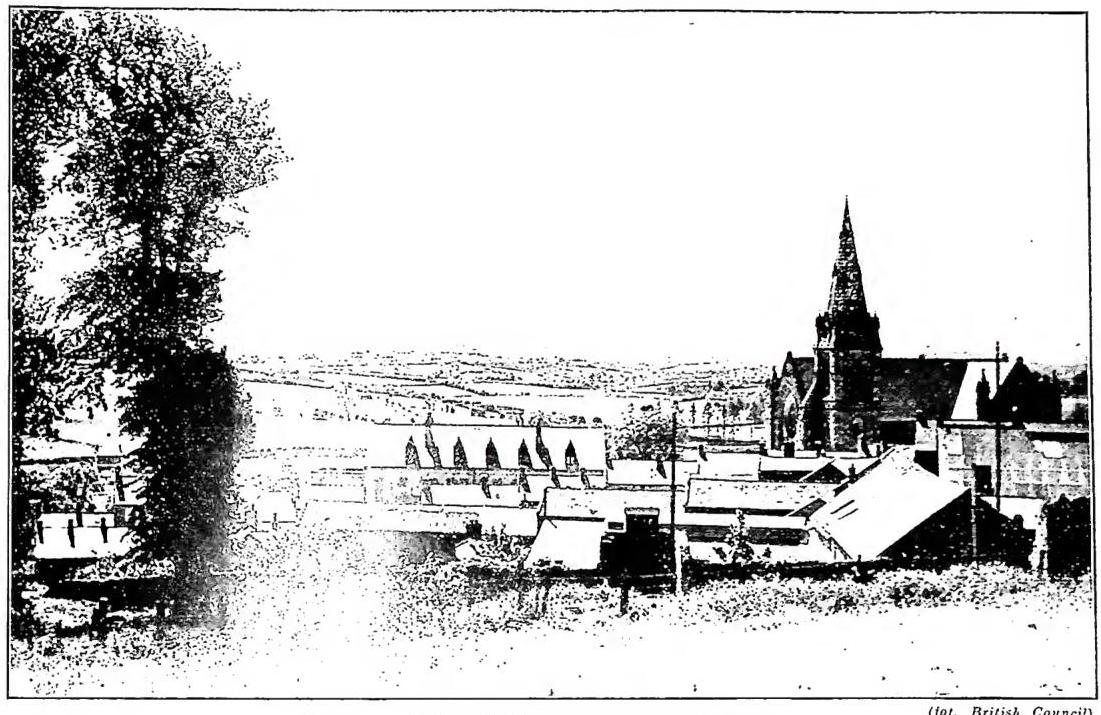
Ireland – View of Dungannon, County Tyrone.
(Int. British Council)
(† 1608) wrote *The Flight of the Earls*, an account of the tragic fate of the two Ulster leaders, O’Neill (who died in Rome) and O’Donnell, after their defeat at the battle of Kinsale (1601). Geoffrey Keating (1570–1646) is the greatest writer of historical narratives and the leading exponent of modern Irish prose. A priest, he was under excommunication when he composed *Foras Feasa ar Éirinn* (*History of Ireland*), as well as a number of fine poems and two religious works: *A Defence of the Mass* and a moral treatise on *The Three Layers of Death*.
In the 18th century Gaelic literature consisted chiefly of folk-songs and religious poetry, many of them of the highest artistic quality. The two most notable poems are *The Songs of Ossian* by Michael Comyn and *The Midnight Court*, a satirical poem by Brian Marriman. Yet the ancient literary tradition began to decline.
In the mid-19th century a renewed interest in Gaelic literature manifested itself. Comparative philologists turned their attention to the oldest Irish linguistic forms, and many of the oldest Irish manuscripts were printed for the first time. This was followed, toward the end of the century, by a movement to revive the spoken language, which was rapidly disappearing throughout the country. The Gaelic League was founded in 1893; its first president was Douglas Hyde, later first President of Ireland. His collaborator was Eoin MacNeill, later professor of ancient Irish history at the National University of Ireland, one of the most learned Irishmen of his time. Since 1893 there has been a vast literary output, including modern editions of ancient Irish tales and translations of contemporary literary works from other European countries. The Irish Folklore Institute aims to preserve the oral tradition of the Gaelic-speaking districts. A school of Anglo-Irish writers has also arisen, dedicated to translating Ireland’s ancient Gaelic literary heritage for English readers.
It is too early to say whether the attempt to revive Gaelic as a universally spoken language in Ireland will succeed. It is still freely spoken by Gaelic-speaking groups along the north-western, western and south-eastern coasts. Irish is taught in all the country’s schools, and by 1950 it was far from being a dead language. Never since the 17th century has there been such general interest in the Irish language and literature as is now evident in Ireland. Several major English writers (J. Swift, O. Goldsmith, E. Burke, S. Butler, O. Wilde, W. B. Yeats, J. M. Synge, J. Joyce, B. Shaw, etc.) were born or lived in Ireland; without entering here into particular aspects of their work, it may be noted that certain traits of their character and art—perhaps above all a distinctive form of irony and a taste for paradox—reveal the Irish soul.
IRELAND – View of Cobh (by courtesy of Mons. A. P. Frutas) (Queenstown), County Cork.
V. LITURGY AND ART.
For Celtic liturgy v.: CELTS, IV. Liturgy. For Celtic art up to the 12th century, v.: CELTS, V. ARTE. Celtic or Irish artistic production from the late 12th to the 18th century is of minor importance. During this long period the numerous Gothic churches are almost all plain and unadorned. In the 18th century, however, the Irish genius once more found itself, especially in the field of secular architecture; in Dublin and throughout the country there sprang up an extraordinary number of houses that, while resembling English ones, were at the same time distinctively different. These houses also featured fine stucco decorations, and the minor arts flourished alongside architecture; noteworthy is the production of furniture and, in particular, mirrors. During the 18th century religious architecture also flourished in Ireland, but the churches were simpler than the houses, and the religious art of that period is of only local importance. Subsequently much was built, especially under the aegis of the Catholic Church, but little of it can be distinguished by international significance, except perhaps some of the more recent stained glass. See plates XIII–XIV. Davide Talbot Rice