
ISTRUTTORIA. — This is the activity intended to submit, from the evidentiary standpoint, to the judge’s examination the body of knowledge necessary for the resolution of the dispute.
This activity takes the form of genuine collaboration between the judge, who has the power and duty to take evidence, and the litigating parties, upon whom, as a rule, the burden of initiating the evidentiary process falls.
Leaving aside the notions relating to the definition, classification, and assessment of evidence (v. PROCESSO), the examination here is limited to those aspects of i. that concern the mechanics of the proceedings.
The taking of evidence must normally be carried out during the so-called evidentiary period, which opens ex officio after the litis contestatio (CIC, can. 1371, n. 2) and closes with the conclusio in causa (can. 1860 § 1).
Before the litis contestatio, evidence may be taken only for the exceptional reasons indicated by the CIC (can. 1730), whereas after the conclusio in causa this is permitted only in cases in which the judgment is not susceptible of becoming res judicata, where there is a legitimate impediment (can. 1861 § 1).
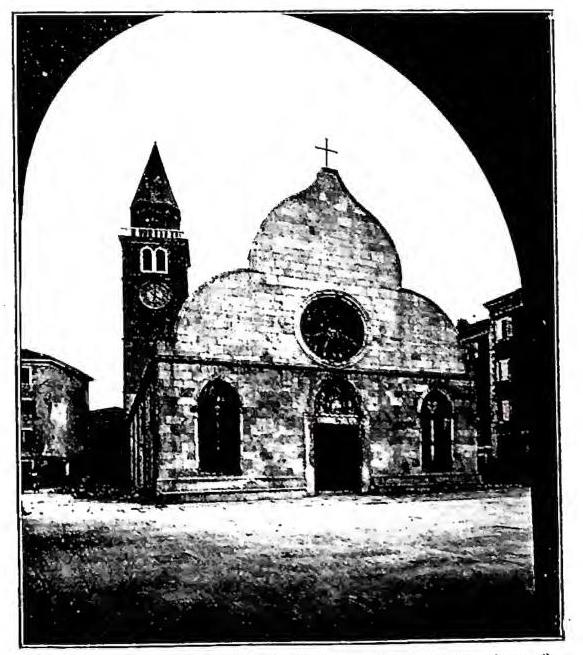
(courtesy of Prof. Mirabella Roberti)
ISTRIA – Façade of the cathedral of Muggia. Founded in 1263, rebuilt in 1467.
within which they must present the judicial evidence that they deem it in their interest to provide; this period is procedural and, as such, may be extended by the judge at the request of the parties. The taking of evidence naturally concerns only evidence that has been declared, or is simply deemed, admissible and relevant. The same judge appointed to take it—the office of whom, in the case of a collegiate tribunal, ordinarily enjoys its own independence—makes a preliminary determination regarding the admissibility of the evidence; should disputes arise on this matter, they will be decided according to the procedures for incidental proceedings. This preliminary judgment on the admissibility of the evidence, whether made by the investigating judge or, conversely (as happens rarely), by the judge who will have to decide the merits, does not, however—even when it has taken the form of a judicial order in response to the incidental issue that has arisen—exercise any influence on the assessment of the results thereof. The evidence must be supplied by the party by its own means and not by means belonging to the opposing party; recourse may nevertheless be had to the latter when the matter is common to both parties (e.g., can. 1822).
With regard to the admissibility of evidence, can. 1749 should be borne in mind, according to which the judge has the power to reject evidence whose admission would cause excessive delays in the proceedings, giving preference to evidence that can be obtained promptly, unless the latter is necessary because of the manifest influence of evidence already acquired (cf. cann. 1754–62). In this matter, the concern of the canon legislator remains ever present: it is important to him that lawsuits be decided by the judge in the shortest possible time (can. 1731 § 2). The initiative in the taking of evidence, however, does not always belong to the parties; as will be seen, in fact, certain specific means are ordered directly by the judge (cann. 1806, 1832).
When the initiative belongs to the party, the latter requests, by means of a specific judicial petition, the admission of the evidentiary means in which it is interested; and the judge, after hearing the other parties and, where appropriate, resolving any specific incidental issue, grants or rejects the petition by an order of his own, which must be notified to the opposing party.
The rules governing the taking of evidence apply to evidence being constituted in the proceedings; for evidence already constituted, it is sufficient for the parties to submit it directly to the tribunal registry. Once the evidence has been admitted, as regards its examination, the judge appointed for this purpose—among other things, the private parties not being present during the conduct of these procedural activities—is granted the broadest powers by canon law.
As a rule, evidence is collected in the courtroom, unless its nature (e.g., a judicial inspection) makes it necessary to take it elsewhere, in one or more sessions, with separate records which must, insofar as they concern the participation of the interested parties, be read to those concerned and signed by them.