
HISTRIONES. — From the Latin histrio -onis (also minus), that is, comedian or mime, the actor in the Roman theater was so designated.
Their original homeland seems to have been Sicily; from there they passed to the mainland and settled in Rome, where their success compromised that of tragic and comic poets. The profession of the h. was one of those that entailed the minima capitis deminutio for anyone who practiced it, as a degrading occupation.
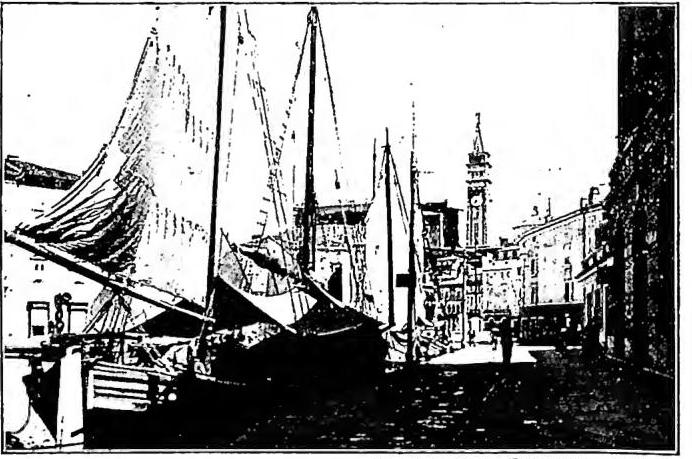
(photograph: Compagnia Fotoculere — Turin)
ISTRIA – The harbor and bell tower of S. Giorgio (16th century) – Pirano.
The actors were excluded from the Sacraments and from ecclesiastical ministry, but also from legitimate ecclesiastical acts. A cleric had to leave immediately any place where an actor was performing some scene (Councils of Laodicea [ca. 343–80], can. 54; of Carthage [419], can. 2; of Agde [506], can. 39; Trullan [692], can. 24).
The Christian emperors Theodosius the Elder (386) and Theodosius the Younger (424) prohibited performances on solemn days, and an entire body of restrictive legislation was enacted (Cod. XI, 40).
The Church triumphed fully only when it replaced the scandalous theatrical performances of paganism with the medieval performances, a creation of Christianity. The Church’s condemnations of the actors did not, however, amount to a condemnation of amusement in itself or of the art of one who makes himself an instrument of others’ amusement. A game may be licit or illicit by reason of its subject matter, the time, the place, and other circumstances. Thus, St. Thomas says, the profession of acting is not in itself evil, provided that the game, in itself and in its circumstances, is not contrary to honesty, since play is necessary to refresh a person and relieve him of the burdens inseparable from human life (Sum. Theol., 2a-2ae, q. 168, a. 3 ad 3). On the other hand,
actors who mock modesty and exalt shamelessness in their public performances sin against charity and against modesty, or against the virtue they ridicule in the specific case, since they are guilty of direct scandal.
This judgment, although it has merely historical value with regard to the ancient actors, has, by analogy, present-day value for the conduct of those who are in some way their artistic heirs in the art of entertaining: extras, variety performers, film stars and celebrities, theatre artists, radio commentators, etc.