
LEO OF OSTIA, also known as LEO MARSICANUS. — Benedictine, cardinal-bishop of Ostia, born in the territory of the Marsi around 1060, died on 22 March 1115.
At the age of 14 he entered the monastery of Monte Cassino, where he was received by Abbot Desiderius, who directed him to the study of Holy Scripture and appointed him librarian of the monastery.
By order of Abbot Oderisius, he wrote a *Chronica monasterii Casinensis* in three books, from St Benedict to Abbot Desiderius, who later became Pope Victor III (1086–87). The life of Victor III from chapter 34 of the third book was continued by Peter the Deacon (first edition, Venice 1513, but incomplete; the first complete edition, Paris 1668, reproduced by L. Muratori in RIS, IV).
V. MONTECASSINO; ODERISIO DI MONTECASSINO; PIETRO DIACONO.
---
LEO I, called the Great. — Pope from 29 September 440 to 10 November 461.
At the age of 40 he was already archdeacon of the Roman Church and enjoyed great prestige for his learning and holiness. When Sixtus III died, the clergy and people of Rome, with one accord, summoned him to the pontifical throne. Contemporary chroniclers note that, whereas papal elections sometimes gave rise to long disputes, Leo’s was marked by “remarkable peace” and the Roman people waited with “remarkable patience” for forty days until his return from Gaul. On 29 September 440 the deacon Leo was consecrated bishop of Rome and supreme pontiff.
The main thrust of Leo’s pontificate was to preserve the integrity of the faith by combating various heresies, to reorganize and strengthen ecclesiastical discipline, to oversee the conduct of clergy and laity, and to issue norms regarding the administration of property and liturgical functions. Evidence of this vast activity survives in his letters and sermons, which are also a primary historical source.
Because of the Vandal invasion of Africa, many Manichees had taken refuge in Italy, and several were discovered in Rome. The Pope energetically set about suppressing them. He secured an imperial decree renewing ancient edicts and banishing Manichees from the Empire; in his sermons he refuted their doctrines; and he promoted a rigorous investigation of their assemblies, uncovering serious scandals. In a circular letter (Epist., VII) he informed the Italian bishops of what had occurred and urged them to ensure that the tares of Manichaeism, uprooted in Rome, would not take root elsewhere.
The doctrines of Priscillian’s heresy were spreading widely in Spain. Bishop Turibius informed the Pope, who in a lengthy letter (Epist., XV) refuted the errors of the Priscillianists and set forth with precision and clarity the true Catholic doctrine.
Leo also intervened effectively against the Pelagian heresy, both by having its errors refuted and by urging the bishop of Aquileia to convene a synod to investigate priests infected with Pelagianism.
Most of Leo’s activity, however, was devoted to combating the Eutychian or Monophysite heresy, which admitted only one nature in the Redeemer. Eutyches, having been condemned, appealed to the Pope and the Emperor. The latter proposed summoning a council at Ephesus to settle the matter. At that gathering, which Leo branded as the “Robber Synod of Ephesus,” Eutyches was rehabilitated through the underhanded intervention of imperial envoys. Leo protested. Meanwhile, Emperor Theodosius II, Eutyches’ protector, having died and the pious Empress Pulcheria succeeding to the throne, Leo secured the convocation of a new ecumenical council at Chalcedon. There the errors of Eutyches were condemned and a definition of faith was issued affirming the existence in Christ of two natures, divine and human, in one person. The Pope’s letter to the patriarch of Constantinople, commonly called the *Tomus ad Flavianum*, was fully accepted by the Council Fathers, who acknowledged that “through the mouth of Leo, Peter has spoken.” It always enjoyed great authority in East and West, and the bishops of Gaul, writing to the Pope, declared that they accepted it as a symbol of faith.
Collections of decretals have preserved several letters of Leo that reveal his vigilant and solicitous care in correcting abuses creeping into ecclesiastical organization.
Bishops were elected by clergy and people; some bishops attempted to designate their own successors, a practice that could eventually turn dioceses into more or less hereditary principalities. Leo energetically intervened to put an end to this abuse. He also intervened to reprove irregular priestly elections, bishops elected against their will, or those imposed by force. The Council of Nicaea had established that every bishop should remain for life in the see to which he had been elected. Some Spanish bishops had tried to transfer from a humbler see to a richer one. Here too Leo intervened, decreeing that a bishop who, scorning his own village, sought a larger see should end up with neither.
With firm and steadfast resolve he defended the rights of the Church of Rome against the pretensions of the patriarchs of Constantinople; he threatened severe penalties against Sicilian bishops who had alienated church property; he forbade a bishop to take a cleric from another bishop and ordered metropolitans to convene provincial synods twice a year. He displayed equal firmness toward Hilary, bishop of Arles, a man certainly zealous but who sometimes exceeded the bounds of his authority. He issued norms regarding the administration of baptism, holy orders, penance, and marriage.
The most glorious episode of Leo’s pontificate was his encounter with Attila. The king of the Huns had unleashed his hordes against the Western Roman Empire, pushing as far as the center of Gaul. Defeated by the Roman general Aetius and the Visigoths under Theodoric in the summer of 451, he had withdrawn to Pannonia.
There he reorganized his forces, and in the following spring, crossing the Julian Alps—carelessly left undefended by Aetius—he advanced to sack the Po Valley and from there to march on Rome. After destroying Aquileia, he encamped near Mantua and pushed his hordes to seize the principal cities of Upper Italy. Vicenza, Verona, Brescia, Bergamo, Pavia, and even Milan had fallen into his power. The imperial court and the citizens of Rome were seized by the deepest terror and despair. In this dire strait, Emperor Valentinian III, the Senate, and the Roman people saw no better recourse than to send an embassy headed by Leo to negotiate with the king of the Huns. Leo accepted the difficult mission and, together with the senators Gennadius, Avienus, and Trigetius, set out from Rome in confident hope, as Prosper of Aquitaine says, in the aid of Heaven, which never abandons the good in their misfortunes.
Contemporary chroniclers affirm that Attila showed great joy and satisfaction at the arrival of the Supreme Pontiff, head of the Roman Church, who had left his see to come to him.
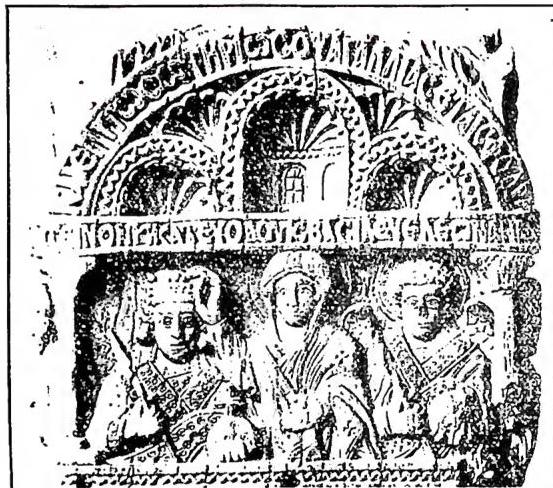
(from A. Grabar, *L’Empereur dans l’art byzantin*, Paris 1936, pp. 151–628, and in MGH, *Scriptores*, VII, 574 ff.) Leo VI, Emperor of the East, called the Wise — Marble coronation relief (10th century) — Berlin, Friedrich Museum.
The historian Priscus, who was then in the camp of the Huns, says that Attila and his court were seized by great terror recalling the sudden end of the Gothic king Athalaric after the taking of Rome; it was feared that Attila might incur divine wrath were he to sack the Holy City. It may be conjectured with a high degree of probability that this was one of the arguments which the eloquence of Leo employed to induce the “Scourge of God” to renounce his plan of marching against Rome. However that may be, the fact remains that, immediately after his meeting with the Pope, Attila ordered his forces to cease all hostilities against the regions of northern Italy. Moreover, having promised to conclude peace with the Emperor, he withdrew across the Danube.
The disorders that broke out in Rome following the murder of Valentinian III and the elevation of his successor Petronius Maximus induced the Vandal king Gaiseric to carry out the plan, long cherished, of invading Italy and sacking the capital of the Empire. Setting out with a large fleet from
The disorders that broke out in Rome following the murder of Valentinian III and the elevation of his successor Petronius Maximus induced the Vandal king Gaiseric to carry out the plan, long cherished, of invading Italy and sacking the capital of the Empire.
The theme of the new Rome, successor to the ancient pagan city founded by Romulus and Remus, is the predominant motif in a group of sermons delivered on the solemn commemoration of SS. Peter and Paul.
Leo is the first pope of whom sermons remain. His eloquence is calm and dignified, though not lacking in lyrical flights and vivid imagery. His discourse proceeds in a tone that is serene and affectionate, yet at the same time firm and solemn. His periods unfold in a series of propositions marked by sonorous cadence and sometimes by rhyme and assonance. Leo is the most classical and elegant writer of his age, for he succeeded in uniting in his discourses and letters the steadfastness and dignity of the ancient Roman with the affability and piety of the Christian bishop. His writings are of particular importance for the study of the relations between Church and State and for the primacy of the Roman See. Some prayers in the Leonine Sacramentary, whose Roman origin is certain, undoubtedly go back to Leo, revealing affinities of language and style with his authentic works.
Leo died on 10 November 461 and was buried in the portico of the basilica of St Peter. Pope Sergius I, in 688, transferred his body into the interior of the basilica, placing an epitaph upon the tomb which has come down to us. Now his ashes repose beneath the altar of the chapel dedicated to him in the new basilica of St Peter. His feast is celebrated in the West on 11 April and in the East on 18 February.
LEO III, pope, saint – Ciborium of the time of Leo III (705–816).