
MARIA MADDALENA (Magdalene), Saint. — A woman so called because of her origin from Magdala. Luke (8:1-2) mentions her among the pious women healed of evil spirits and infirmities who followed Jesus, listing her without reference to the sinful woman. Later (Luke 10:38-42), he speaks of the sisters Martha and Mary without identifying the latter with any of those previously mentioned. He will mention Mary Magdalene again among the pious women who went to the tomb (Luke 24:10), calling her by the same name as in 8:2, without identifying her with others.
Matthew 26:6-13 and Mark 14:3-9 speak of a woman who, in the house of the Pharisee Simon the leper, anointed Jesus’ head, provoking comments about the waste. St. John specifies that the woman who anointed the Lord was Mary, sister of Lazarus and Martha; the banquet had been offered at Bethany in thanksgiving for Lazarus’ resurrection (John 12:1-8; cf. 11:2). There is no mention of a sinful woman or of Mary Magdalene. It is not possible to identify this anointing, which occurred shortly before the Passion, with that recounted by Luke 7:36-50, due to the differences in time and place.
Those who support the identity of Mary of Bethany with the sinful woman base their argument especially on the fact that John (11:2), when first introducing Mary, sister of Lazarus, states that she was “the one who had anointed the Lord and wiped his feet with her hair.” From the aorist participles (ἀλεξίωσα, ἐκμάξασα), it might seem that John is alluding to a previous action, namely that of Luke 7:36-50. Thus, Mary of Bethany is identified with the anonymous sinful woman! In response, those who uphold the distinction argue that the aorist participles may refer to an action not yet narrated (specifically the anointing recounted in chapter 12) but already known to all. Even Judas is presented as the one who would betray (ὁ μέλλων παραδιδόναι) before his betrayal is recounted (Matt. 10:4; cf. Mark 3:19; Luke 6:16). A comparison of the Synoptics with John shows that Mary of Bethany had anointed the Lord (John 11:2), beginning with his head (Matt. 26:7; Mark 14:3) and ending with his feet (John 12:3).
A common trait among the three women, emphasized by those who support their identification, is their love for Jesus. Fr. Prat (see bibliography) responds (p. 500-501): “This same love, when examined carefully, does not have the same character in the three women: penitential love in the anonymous sinful woman of Luke, love of gratitude in Mary Magdalene, and ecstatic contemplative love in Mary of Bethany.”
The fact that Mary Magdalene was delivered from seven demons does not imply that she was stained by sin; in the account of the sinful woman in Luke, there is no mention whatsoever of demonic possession. Other reasons for distinguishing Mary, sister of Lazarus, from Mary Magdalene are based on differences in the names of the persons and places: the former is always called simply Mary by both Luke and John, while the latter is distinguished by the epithet “Magdalene,” which seems to indicate her native city (Magdala). The Synoptics recall Mary Magdalene among the pious women who had followed Jesus from Galilee to Jerusalem (Matt. 27:55; Mark 15:40).
The fact that M. M. was delivered from seven demons does not imply that she was stained by sins; in the account of the sinful woman in Luke there is no mention whatsoever of diabolical possession. Other reasons for distinguishing Mary, the sister of Lazarus, from M. M. are based on the differences in the names of the persons and places: the former is always called simply Mary by both Luke and John, while the latter is distinguished by the epithet Magdalene, which seems to indicate her native city (Magdala). The Synoptics recall M. M. among the pious women who had followed Jesus from Galilee to Jerusalem (Mt 27:55; Mk 15:40); but she was already known to all. Even Judas is presented as the one who betrayed (ὁ περὶ ἁρμοδόξ) before the account of his betrayal is given (Mt 10:4; cf. Mk 3:19; Lk 6:16). A comparison of the Synoptics with John shows that Mary of Bethany had anointed the Lord (Jn 11:2), beginning with his head (Mt 26:7; Mk 14:3) and ending with his feet (Jn 12:3).
A common trait of the three women, emphasized by those who support their identification, is their love for Jesus. Fr. Prat (v. BIBLICA), p. 500 ff., replies: “This same love, when examined carefully, does not have the same character in the three women: penitent love in the anonymous sinful woman of Luke, love of gratitude in M. M., and love of ecstatic contemplation in Mary of Bethany.”A common trait shared by the three women, emphasized by those who support their identification, is their love for Jesus. Prat (v. BIBLICA), p. 500 sg., responds: “This same love, when examined closely, does not exhibit the same characteristics in the three women: penitent love in the anonymous sinner of Luke, love of gratitude in M. M., and love of ecstatic contemplation in Mary of Bethany.”
The fact that M. M. was delivered from seven demons does not imply that she was stained by sins; in the account of Luke’s sinful woman, there is no mention whatsoever of diabolical possession. Other reasons for distinguishing Mary, the sister of Lazarus, from M. M. are based on the differences in the names of the persons and places: the former is always called simply Mary by both Luke and John, whereas the latter is distinguished by the appellation “of Magdala,” which seems to indicate her native city (Magdala). The Synoptics recall M. M. among the pious women who had followed Jesus from Galilee to Jerusalem (Mt 27:55; Mk 15:40); yet she was already well known to all. Even Judas is presented as the one who would betray (ὁ περὶ ἁρμοδόξ) before the account of his betrayal is given (Mt 10:4; cf. Mk 3:19; Lk 6:16). A comparison of the Synoptics with John shows that Mary of Bethany had anointed the Lord (Jn 11:2), beginning with His head (Mt 26:7; Mk 14:3) and ending with His feet (Jn 12:3).
A common trait shared by the three women, emphasized by those who support their identification, is their love for Jesus. Prat (v. BIBLICA), p. 500 sg., responds: “This same love, when examined closely, does not exhibit the same characteristics in the three women: penitent love in the anonymous sinner of Luke, love of gratitude in M. M., and love of ecstatic contemplation in Mary of Bethany.”
The fact that M. M. was delivered from seven demons does not imply that she was stained by sins; in the account of Luke’s sinful woman, there is no mention whatsoever of diabolical possession. Other reasons for distinguishing Mary, the sister of Lazarus, from M. M. are based on the differences in the names of the persons and places: the former is always called simply Mary by both Luke and John, whereas the latter is distinguished by the appellation “of Magdala,” which seems to indicate her native city (Magdala). The Synoptics recall M. M. among the pious women who had followed Jesus from Galilee to Jerusalem (Mt 27:55; Mk 15:40); yet she was already well known to all. Even Judas is presented as the one who would betray (ὁ περὶ ἁρμοδόξ) before the account of his betrayal is given (Mt 10:4; cf. Mk 3:19; Lk 6:16). A comparison of the Synoptics with John shows that Mary of Bethany had anointed the Lord (Jn 11:2), beginning with His head (Mt 26:7; Mk 14:3) and ending with His feet (Jn 12:3).
A common trait shared by the three women, emphasized by those who support their identification, is their love for Jesus. Prat (v. BIBLICA), p. 500 sg., responds: “This same love, when examined closely, does not exhibit the same characteristics in the three women: penitent love in the anonymous sinner of Luke, love of gratitude in M. M., and love of ecstatic contemplation in Mary of Bethany.”
The fact that M. M. was delivered from seven demons does not imply that she was stained by sins; in the account of Luke’s sinful woman, there is no mention whatsoever of diabolical possession. Other reasons for distinguishing Mary, the sister of Lazarus, from M. M. are based on the differences in the names of the persons and places: the former is always called simply Mary by both Luke and John, whereas the latter is distinguished by the appellation “of Magdala,” which seems to indicate her native city (Magdala). The Synoptics recall M. M. among the pious women who had followed Jesus from Galilee to Jerusalem (Mt 27:55; Mk 15:40); yet she was already well known to all. Even Judas is presented as the one who would betray (ὁ περὶ ἁρμοδόξ) before the account of his betrayal is given (Mt 10:4; cf. Mk 3:19; Lk 6:16). A comparison of the Synoptics with John shows that Mary of Bethany had anointed the Lord (Jn 11:2), beginning with His head (Mt 26:7; Mk 14:3) and ending with His feet (Jn 12:3).
A common trait shared by the three women, emphasized by those who support their identification, is their love for Jesus. PRAT (v. BIBLICA), p. 500 ff., replies: “This same love, when examined closely, does not exhibit the same characteristics in the three women: penitent love in the anonymous sinner of Luke, love of gratitude in M. M., and love of ecstatic contemplation in Mary of Bethany.”
The fact that M. M. was delivered from seven demons does not imply that she was stained by sins; in the account of Luke’s sinful woman, there is no mention whatsoever of diabolical possession. Other reasons for distinguishing Mary, the sister of Lazarus, from M. M. are based on differences in the names of persons and places: the former is always called simply Mary by both Luke and John, while the latter is distinguished by the epithet “of Magdala,” which seems to indicate her native city (Magdala). The Synoptics recall M. M. among the pious women who had followed Jesus from Galilee to Jerusalem (Mt 27:55; Mk 15:41). But she was already well known to all. Even Judas is presented as “the one who betrayed” (ὁ περὶ ἁρμοδόξ) before the account of his betrayal is given (Mt 10:4; cf. Mk 3:19; Lk 6:16). From a comparison of the Synoptics with John, it emerges that Mary of Bethany had anointed the Lord (Jn 11:2), beginning with His head (Mt 26:7; Mk 14:3) and ending with His feet (Jn 12:3).
A common trait shared by the three women, emphasized by those who support their identification, is their love for Jesus. PRAT (v. BIBLICA), p. 500 ff., replies: “This same love, when examined closely, does not exhibit the same characteristics in the three women: penitent love in the anonymous sinner of Luke, love of gratitude in M. M., and love of ecstatic contemplation in Mary of Bethany.”
The fact that M. M. was delivered from seven demons does not imply that she was stained by sins; in the account of Luke’s sinful woman, there is no mention whatsoever of diabolical possession. Other reasons for distinguishing Mary, the sister of Lazarus, from M. M. are based on differences in the names of persons and places: the former is always called simply Mary by both Luke and John, while the latter is distinguished by the epithet “of Magdala,” which seems to indicate her native city (Magdala). The Synoptics recall M. M. among the pious women who had followed Jesus from Galilee to Jerusalem (Mt 27:55; Mk 15:41). But she was already well known to all. Even Judas is presented as “the one who betrayed” (ὁ περὶ ἁρμοδόξ) before the account of his betrayal is given (Mt 10:4; cf. Mk 3:19; Lk 6:16). From a comparison of the Synoptics with John, it emerges that Mary of Bethany had anointed the Lord (Jn 11:2), beginning with His head (Mt 26:7; Mk 14:3) and ending with His feet (Jn 12:3).
A common trait shared by the three women, emphasized by those who support their identification, is their love for Jesus. PRAT (v. BIBLICA), p. 500 ff., replies: “This same love, when examined closely, does not exhibit the same characteristics in the three women: penitent love in the anonymous sinner of Luke, love of gratitude in M. M., and love of ecstatic contemplation in Mary of Bethany.”
The fact that M. M. was delivered from seven demons does not imply that she was stained by sins; in the account of Luke’s sinful woman, there is no mention whatsoever of diabolical possession. Other reasons for distinguishing Mary, the sister of Lazarus, from M. M. are based on differences in the names of persons and places: the former is always called simply Mary by both Luke and John, while the latter is distinguished by the epithet “of Magdala,” which seems to indicate her native city (Magdala). The Synoptics recall M. M. among the pious women who had followed Jesus from Galilee to Jerusalem (Mt 27:55; Mk 15:41). But she was already well known to all. Even Judas is presented as “the one who betrayed” (ὁ περὶ ἁρμοδόξ) before the account of his betrayal is given (Mt 10:4; cf. Mk 3:19; Lk 6:16). From a comparison of the Synoptics with John, it emerges that Mary of Bethany had anointed the Lord (Jn 11:2), beginning with His head (Mt 26:7; Mk 14:3) and ending with His feet (Jn 12:3).
A common trait shared by the three women, emphasized by those who support their identification, is their love for Jesus. PRAT (v. BIBLICA), p. 500 ff., replies: “This same love, when examined closely, does not exhibit the same characteristics in the three women: penitent love in the anonymous sinner of Luke, love of gratitude in M. M., and love of ecstatic contemplation in Mary of Bethany.”
The fact that M. M. was delivered from seven demons does not imply that she was stained by sins; in the account of Luke’s sinful woman, there is no mention whatsoever of diabolical possession. Other reasons for distinguishing Mary, the sister of Lazarus, from M. M. are based on differences in the names of persons and places: the former is always called simply Mary by both Luke and John, while the latter is distinguished by the epithet “of Magdala,” which seems to indicate her native city (Magdala). The Synoptics recall M. M. among the pious women who had followed Jesus from Galilee to Jerusalem (Mt 27:55; Mk 15:41). But she was already well known to all. Even Judas is presented as “the one who betrayed” (ὁ περὶ ἁρμοδόξ) before the account of his betrayal is given (Mt 10:4; cf. Mk 3:19; Lk 6:16).
BINL.: Faber Stapulensis (Lefèvre d'Estaples), De Maria Magdalene, Parigi 1516; J. Sickenberger, Ist die Magdalenen-frage wirklich unlosbar?, in Biblische Zeitschrift, 17 (1925), pp. 67-74; G. Mezzacasa, De tribus et unica Magdalena, in Perfice munus, 3 (1928), pp. 434-38; U. Holzmeister, S. M. Magdalena estue una eademque cum peccatrix et Maria sorore Lazari?, in Verbum Domini, 16 (1936), pp. 193-90; F. Prat, Gesù Cristo, trad. di T. Pelizzari, II, Firenze 1948, pp. 490-
504. La questione delle tre Marie nella tradizione fu studiata accuratamente da M
J. Lagrange, Gesù a-t-il été oint plusieurs fois et par plusieurs femmes?, in Rev. bibl., 9 (1912), pp. 504-32 e da U. Holzmeister, Die Magdalenenfrage in der christlichen Überlieferung, in Zeitschrift. f. kath. Theol., 46 (1922), pp. 406-22, 504-32. Per altri particolari bibliografici V. H. Simón - G. G. Dorado, Prat. bibl. Nov. Test., I, Torino 1947, nn. 398-505.Pietro De Ambroggi
ARCHEOLOGIA. - Secondo G. Wilpert l'apparizione di Gesù risorto a M. M. sarebbe scolpita in uno dei fianchi d'un sarcofago trovato nel sec. XVI in S. Pietro in Vaticano (Sarcofagi, tav. 121, 2-4).
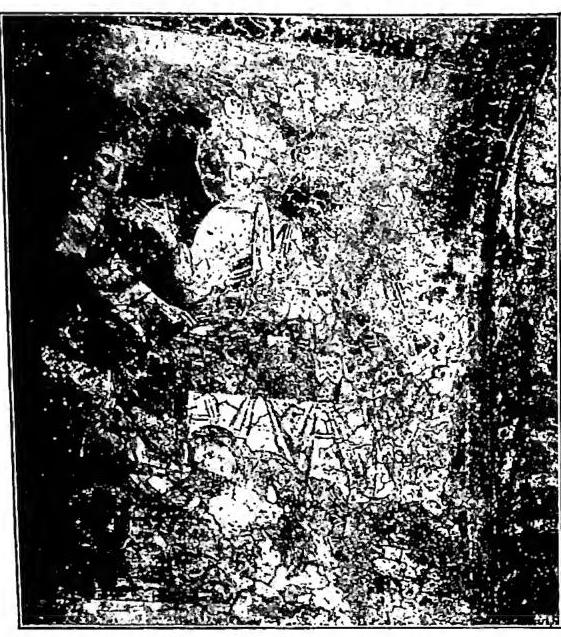
In una capsella marmorea in S. Giovanni Battista a Ravenna, Gesù appare a M. M. e all'altra Maria (R. Bartocini, La capsella marmorea cristiana rinvenuta a Ravenna, in Riv. di archeol. crist., 8 [1930], pp. 299-302; riprodotta alla V. MARIA [varie donne bibliche]; la stessa scena è in una miniatura dell'evangelario di Rabbùl dell'anno 586 (H. Leclercq, Croix et Crucifix, in DACL, III, 11, fig. 3380).
L'apparizione dell'angelo a M. M. e all'altra Maria presso il sepolcro, secondo i testi evangelici (Mt. 28, 1-10; Mc. 16, 1-13; Lc. 24, 1-12; Io. 20, 1-18), è quella che si rappresenta più spesso nell'arte cristiana antica.
La si trova infatti in sarcofagi cristiani, come nello scomparso sarcofago Vaticano edito da A. Bosio (Roma sotterranea, Roma 1632, p. 79; Wilpert, Sarcofagi, p. 325) e nel sarcofago di S. Celso a Milano (id., loc. cit., p. 330; e tav. 243, 6); nel sarcofago di Servanne invece c'è anche M. Salome ricordata da S. Marco (16, 1-7; id., loc. cit., tav. 15, 2). Si ha anche in una serie di ampolle di Bobbio e di Monza (H. Leclercq, Ampolles, in DACL, I, 11, figg. 457, 458, 459; id., Monza, ibid., XI, 11, fig. 8439). Ricorre poi in uno dei pannelli della porta lignea di S. Sabina in Roma (sec. v); in una valva del dittico eburneo di Monaco (sec. v); nel dittico eburneo del duomo di Milano (Venturi, I, fig. 390); in uno dei musei di S. Apollinare nuovo in Ravenna (a. 493-526); in una copertura metallica di libro liturgico con figure a sbalzo (sec. ix) nel museo del Louvre a Parigi (Venturi, II, p. 643 e fig. 483); nel sec. ix nella custodia d'argento di Pasquale I del tesoro del «Sancta Sanctorum» (Ph. Lauer, Le trésor du Sancta Sanctorum, in Mémoires et Monuments Piot, 15 [1907], tav. 9); in un avorio della collezione Saltkoff (H. Leclercq, Ascension dans l'art, in DACL, I, 11, fig. 989), e più tardi in uno dei musei del duomo di Monreale.
Lazzaro (v.) fiorì in Provenza quella di S. M. M. In Provenza, presso St-Maximin, esisteva una grande caverna detta S. Maria de Balma o Ste Marie-de-la-Baume. In questo luogo dalla metà del sec. XIII fu localizzato l'episodio della penitenza di S. M. M. desunto dalla leggenda fiorita sulla vita di S. Maria Egiziana a Vezelay, dove dalla metà del sec. XI era apparso il culto di S. M. M., immaginando che M. M. e Massimino fossero venuti dalla Palestina in Provenza dove si additavano i loro sepolcri che dal 1279 si ritenne fossero invece a St-Maximin (L. Duchesne, La légende de ste Marie Madeleine, in Fastes épiscopaux de l'ancienne Gaule, I, 2ª ed., Parigi 1907, pp. 321-59).
ICONOGRAFIA. - Giotto e la sua scuola eseguirono due importanti serie di affreschi sempre con la storia di M. M., nella cappella della Santa ad Assisi e nel Bargello di Firenze. Mentre questi ultimi sono ormai perduti, la serie di Assisi è tuttora conservata, e presenta scene della vita, fra cui notevole iconograficamente quella in cui porge
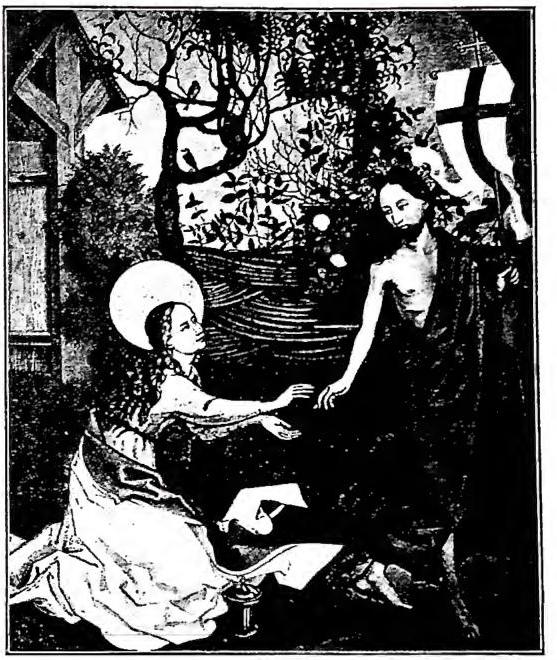
Maria Magdalena, santa - Gesù appare a M. M., dipinto di M. Schongauer - Colmar, Museo.
la mano al vescovo Pontano, fondatore della Cappella. Dagli affreschi di Firenze derivò il ciclo della Cappella Rinuscini in S. Croce, opera di Giovanni da Milano e datato nel 1365, nel quale compare un raro miracolo della Santa, che avrebbe fatto ritrovare viventi ad un principe o mercante, al suo ritorno a Marsiglia, la moglie ed i figlioleti abbandonati cadaveri in un'isola. I cicli con storie della Santa si diffusero in tutto l'Occidente. Si sa da fra' Nicolò da Poggibonsi, nel 1346, che presso il S. Sepolcro a Gerusalemme esistevano affreschi ed una tribuna a musea con la figura della Santa. Ma se ne trovano numerosi esempi anche in Germania: così l'importantissimo altare di Tiefenbronn nel Baden, che porta al centro un gruppo plastico e che nel 1431 venne decorato sulle cuspidi e sugli sportelli da Luca Moser, con la cena in casa del fariseo, il viaggio di M. M. e di Lazzaro in una nave, il riposo dopo l'arrivo a Marsiglia, la Comunione di M. M.; così le set tavole di un altare Donaeuschingen e due a Rottweil sul Neckar, dovute ad un anonimo svizzero; così due rilievi con episodi della leggenda nel celebre altare di Riemenschneider, e così in quello in Mariastern, opera del sec. XV, come in un trittico di Gillis Van Coninxloo del 1508 a Bruxelles.
In scene della Crocifissione M.M. sta accanto alla Croce, pregando con le mani alzate (si veda l'affresco di Giotto ad Assisi e la cuspidi del polittico di Pisa, del Masaccio, nel Museo di Napoli). Luca da Leyda in una incisione di Marco Koffemann in un grande quadro la raffigurano, nel Cinquecento, come danzatrice.
Nelle immagini devote, risalenti al sec. XV, M. M. viene raffigurata inizialmente come portatrice del vaso d'unguenti. Così Piero della Francesca nel duomo di Arezzo, Carlo Crivelli in una tavola del Kaiser Friedrich Museum di Berlino, il Chiodarolo a Bergamo nell'Accademia Carrara, Timoteo Viti nella cattedrale di Gubbio Bartolomeo Montagna nella chiesa di S. Corona a Vicenza (M. M. qui è raffigurata in sacra conversazione con altri santi), inoltre in quadri di Piero di Cosimo, del Luini, del Giampietrino, ecc. Frequenti sono le immagini della Santa anche nei paesi nordici e frequenti sono in quelle