
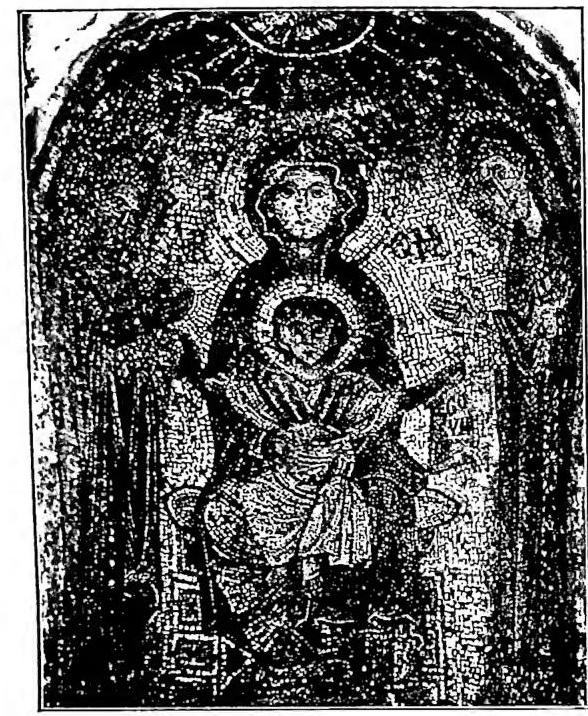
MARIA, Most Holy – M. with the Child. Italo-Byzantine mosaic art (9th century) – Rome, church of S. Prassede, chapel of S. Zenone.
---
The development of Mariology up to the 16th century. — The study of the person and role of the Blessed Virgin Mary, which began in the early centuries of Christianity, reached a notable degree of maturity in the Middle Ages. Among the most important medieval writers who dealt with Mariology are: St. Albert the Great (cf. J. Bittremieux, *S. Albertus M. Ecclesiae doctor praestantissimus mariologus*, in *Ephemerides theologicae Lovanienses*, 10 [1933], pp. 217-31), St. Bonaventure (cf. E. Chietini, *Mariologia s. Bonaventurae*, Sebenico-Rome 1942), St. Thomas Aquinas (cf. G. Roschini, *Mariologia di s. Tommaso d'Aquino*, Rome 1950), Bl. John Duns Scotus (cf. C. Balic, *Ioannis Duns Scotti doctoris Mariani theologiae Marianae elementa*, Sebenico 1933), Raymond Lull, Raymond Jordan, John Gerson, St. Bernardino of Siena (cf. G. Folgarait, *La Vergine Bella in s. Bernardino da Siena*, Milan 1939), Ambrose Spiera (cf. A. Poka, *Doctrina Mariana in sermonibus magistri Ambrosii Spiera Tarvisini*, Rome 1943), Denis the Carthusian, and Bernardino de Bustis (cf. F. Cucchi, *La mediazione universale della S.ma Vergine negli scritti di Bernardino de Bustis*, Milan 1943). The question of the Immaculate Conception, resolved in the negative by St. Bernard and the great Scholastic doctors, made such progress that by the mid-15th century it achieved full triumph. Likewise, the question of Mary’s mediation, from St. Bernard onward, saw significant developments. The Assumption of Mary, body and soul, into heavenly glory, after some doubts raised in the 9th–12th centuries, was commonly accepted as certain from the 13th century onward.
Mariology had reached these milestones when the Protestant opposition of the 16th century arose. Traditional Mariology was violently attacked by Luther, Calvin, Zwingli, and their followers. Against the innovators, valiant defenders emerged: St. Robert Bellarmine, St. Peter Canisius with his polemical work *De B. Virgine incomparabili*, St. Lawrence of Brindisi with his golden *Mariale* (cf. G. Roschini, *La mariologia di s. Lorenzo da Brindisi*, Padua 1951), G. B. Novati with *De eminentia Deiparae*, and Fr. Ippolito Marracci, author of numerous Mariological works and a staunch defender of the Immaculate Conception.
After the Protestant opposition came an even more dangerous, because more insidious, Jansenist opposition, which can be divided into three periods: the initial phase of the Jansenists of Port-Royal, the codification of various Jansenist errors through the notorious *Monita salutaria B. Mariae ad cultores suos indiscretos* of A. Windenfeldt (placed on the Index in 1676), and the implementation of the *Monita salutaria* in the Gallican liturgical reform. Among the Jansenists are to be counted Launoy (1603–78), Baillet (1649–1706), Tillemont (1637–1750), and in some respects also L. A. Muratori (1672–1750). The Jansenist Mariology was combated by St. Louis Grignion de Montfort (1716), St. Alphonsus Maria de’ Liguori (1787), G. Grasset (1618–92), E. Boudon (1624–1702), Bossuet (1628–1704), Bourdaloue (1632–1704), T. Raynaud (1583–1632), Giorgio De Rhodes (1661), Contenson (1641–174), and P. Poiret (1584–1637). Once Jansenism was defeated, the idea of defining the Immaculate Conception took shape, culminating in the proclamation of Pius IX in 1854. This was, after the definition of the divine Maternity at Ephesus, the second milestone of Mariology, a point of departure and, even more, a point of arrival. In this new period, rigorously scientific Mariology began to flourish, nourished above all and most abundantly by the Church’s Magisterium through its encyclicals and other documents.
Among the encyclicals of Leo XIII are *Magnae Dei Matris* (8 Sept. 1892), *Tacenda semper* (8 Sept. 1894), *Adiutricem populi* (5 Sept. 1895), and *Augustissimae Virginis* (12 Sept. 1897), in which Marian doctrine is summarized under the main aspects of Mother of God, our Mother, and Mediatrix (cf. J. Bittremieux, *Doctrina mariana Leonis XIII*, in *Ephemerides theologicae Lovanienses*, 4 [1927], pp. 359 ff.); of Pius X, the encyclical *Ad diem illum laetissimum* (2 Feb. 1904), in which, on the occasion of the 50th anniversary of the definition of the Immaculate Conception, he expounds the fruits and duties arising therefrom; of Benedict XV, the apostolic letters *Inter sodalicia* (22 March 1918) and *Locarni intra fines* (3 Jan. 1919), which dwell on the themes of Mary’s mediation, her maternity, spiritual motherhood, and the dispensation of graces; of Pius XI, the encyclicals *Lux veritatis* (25 Dec. 1931) and *Ingravescentibus malis* (29 Sept. 1937) on the divine maternity of Mary and the Rosary (cf. G. M. Roschini, *La Madonna nel pensiero e negli insegnamenti di Pio XI*, in *Marianum*, 1 [1939], pp. 121–72); of Pius XII, the encyclicals *Mystici Corporis* (29 June 1943) and *Auspicia quaedam* (10 May 1948), the apostolic constitution *Munificentissimus Deus* (1 Nov. 1950, defining the Assumption of Mary), and numerous speeches and radio messages in which he develops, in a marvelous doctrinal synthesis, the themes of Mary’s divine maternity, holiness, mediation, assumption, queenship, and cult (cf. *Le encicliche mariane*, ed. A. Tondini, Rome 1950, with a complete list of Marian documents from 1849 to 1950 at pp. 579–626). To these must be added the publication of patristic and liturgical documents, Marian study congresses, and various theological journals.

---
III. The Present State
Mariology is currently in full development. In various university institutes and theological faculties, special chairs have been established where the *Tractatus de B. Maria Virgine*, separated from the treatise *De Verbo incarnato*, has become an organic and independent discipline. Thus have arisen various treatises on the Madonna, among which those by Scheeben, Jamar, Van Crombruggh, Lépicier, Campana, Müller, Alastruey, Merkelbach, Neubert, Lennarz, Ceuppens, Roschini, Boyer, and Bertetto deserve mention. Numerous monographs on various Mariological questions have been published by J. Bittremieux, Godts, M. Jugie, Lebon, J. M. Bover, C. Balic, G. Philips, and A. Luis. With the aim of further promoting the scientific development of Mariology, Mariological societies have been founded in various countries, including France, Spain, Portugal, Canada, and the United States of North America.The studies of these societies are published in their respective bulletins, which constitute a veritable mine of Marian scholarship. To these is added the journal *Marianum* (*Ephemerides mariologiae*), published since 1939 by the Servants of Mary of the International College of St. Alexis Falconieri in Rome, where an International Mariological Center with various initiatives has been established since 1940. Another Mariological center is the Franciscan Mariological Commission, instituted in 1946 and which has already organized various Assumptionist Mariological congresses.
---
IV. MARIOLOGICAL QUESTIONS IN THEOLOGY
The Mariological questions treated in theology can be divided into two series: questions of a general nature and questions of a particular nature. Among the questions of a general nature, those concerning the organization of a Mariological treatise, the sources of Mariology, and the principles governing it—especially the first principle of the entire Marian science—prevail. The questions of a particular nature deal with: a) Mary’s privileges: divine maternity, Immaculate Conception, immunity from all sin, fullness of grace, perpetual virginity, Assumption and glorification, and cult; b) her mission: spiritual motherhood, universal mediation in its twofold phase, inasmuch as it signifies cooperation both in the acquisition (corredemption) and in the distribution of all graces, and queenship.III. MARIAN CULT
Marian cult, considered in itself—that is, in its intimate constitution—embraces the questions that treat its nature, its constitutive elements, its legitimacy, its utility, and its necessity.
I. NATURE OF MARIAN CULT
This is expressed by the technical term hyperdulia (cf. Sum. Theol., 3a, q. 25, a. 5), which signifies a special honour, superior to that given to the saints, rendered to the Blessed Virgin on account of her singular excellence as Mother of God and Queen of the saints (cf. Denz-U, nn. 1225, 1316, 1570; CIC, can. 1255). This cult of hyperdulia, rendered to Mary, differs only in degree from the cult of simple dulia if one takes as the motive for such cult her singular holiness, which is superior in degree, not in kind, to that of the other saints; it differs, however, in kind if one takes as the motive for such cult her singular dignity as Mother of God, which places her in an order of her own, specifically superior to that in which all other saints are found (cf. Sum. Theol., 2a-2a, q. 103, a. 3, a. 4, ad 2). Those who, like the Collyridians, erred by excess—as attested by St Epiphanius (Adv. haer., III, haer. 78; PG 42, 735)—rendered to the Virgin a cult of latria or adoration due to God alone. Those who erred by defect, on the other hand, were the Antidicomarianites (4th century), the Protestants (16th century onwards), and the Jansenists, who rejected as superstitious, idolatrous, or at least excessive the cult rendered to Mary.
II. CONSTITUTIVE ELEMENTS
Three, above all, are the acts or constitutive or integral elements of Marian cult, corresponding to the three principal titles of excellence proper to the Blessed Virgin, namely: veneration, invocation, and imitation. As Mother of the Creator and of creatures, she is worthy of a special veneration; as mediatrix between the Creator and creatures, she is to be invoked with the most unlimited confidence; as the All-Holy par excellence, full of grace and virtue, she is to be imitated in a particular way.The cult of special veneration, founded upon the singular greatness of Mary, has its solid bases both in Holy Scripture and in tradition. From the Gospel it appears that the angel Gabriel (Lk 1:28) and St Elizabeth (Lk 1:42) address her with words full of profound veneration, words echoed then by all Christian centuries in the rough paintings of the catacombs from the 2nd–3rd century, in the liturgy, in the various temples erected in her honour from the 4th century onwards, and especially in the writings of the Fathers and Doctors of every age.

The cult of special invocation, founded upon the singular greatness of Mary, finds solid bases in the ancient tradition of the Church. In an Egyptian papyrus which, according to the palaeographic examination of Lobel, dates to the 3rd century and was published by Roberts (in Catalogue of the Greek and Latin Papyri in the John Rylands Library, III, Manchester 1938, no. 470), is contained the well-known prayer Sub tuum praesidium, which later entered the Roman, Ambrosian, Byzantine, and Coptic liturgies; this prayer is entirely an invocation, confidently appealing to the protection of the Mother of God to be delivered from all dangers. In the 4th century, St Gregory Nazianzen (d. 389) recounts the confident recourse of a Christian virgin to Mary (Or. XXIV in laudem s. Cypriani: PG 35, 1181). Towards the end of the same century, St Ambrose exhorted virgins to have recourse to the Virgin par excellence (De instit. virg., nn. 86–88: PL 16, 339 sg.).
The cult of special imitation, founded upon the singular holiness of Mary, was strongly emphasised by St Ambrose, who asserted that “the life of Mary alone is a school for all,” and therefore exhorts everyone to imitate her (De Virgin., II, c. 2, n. 9, 15; c. 3, n. 19: PL 16, 221–23). In a particularly notable way, the Blessed Virgin, in early Christianity, was proposed as a model for virgins. Thus, in the catacombs of Priscilla, on the Via Salaria, in a cubicle of the 3rd century, there is a representation of a bishop, in the act of imposing the sacred veil upon a virgin, pointing to the Blessed Virgin as a model, depicted there with the Child Jesus in her arms. There have not lacked those, such as Erasmus of Rotterdam, followed by Luther and others, who exaggerated this element of cult to the point of saying that the present imitation of the Blessed Virgin belongs to the essence of Marian cult. Catholics commonly hold, however, that although true cult of Mary without the intention or at least a certain desire to imitate her is not even conceivable, the actual imitation of her is not essential to her cult, but is rather its fruit.
III. LEGITIMACY OF MARIAN CULT
The legitimacy of the cult rendered to the person of Mary appears from her most singular and unparalleled excellence, being Mother of God, “full of grace,” “blessed among women.” For the legitimacy of the cult of the Heart of Mary V. the relevant entry. The legitimacy of the (relative) cult rendered to the relics of the Virgin (should their authenticity be proven), denied with particular acrimony by Protestants, appears from that psychological law which impels one to venerate not only the person but also the things that belonged to her (Sum. Theol., 3ª, q. 25, a. 6). The legitimacy of the (relative) cult rendered to the images of the Blessed Virgin (denied by the Iconoclasts [8th century] and by Protestants), besides being confirmed by the decisions of the Councils (Second Council of Nicaea and Council of Trent, sess. XXV), by the most ancient usage of the Church, and by the miracles worked through them, is also legitimised by the fact that the image, as image (not as a material thing), constitutes one thing with the person it represents, to whom, therefore, the act of cult is directed.IV. UTILITY
The utility of Marian cult is clearly evident from the innumerable benefits, both individual and social, deriving therefrom. The individual benefits extend to life (source of graces, sign of predestination), to death (special assistance), and after death. The social benefits, on the other hand, concern the domestic society (source of grace), civil society (progress in the true, the beautiful, and the good, through the advancement of the sciences, the arts, and good morals), and religious society—that is, the Church (progress and safeguarding of the true faith and good morals).But beyond being useful, Marian cult is also morally necessary for attaining eternal salvation, contrary to what was taught by Ludovico Antonio Muratori (Epistolario, ed. by Michele Campori, IV, Modena 1901, letter 1273, pp. 1471–80), refuted especially by St Alphonsus Maria de’ Liguori, who concluded: “Whence one may well take a poor prognosis of anyone who habitually lives alienated from such devotion” (Selva, Neapolitan ed., 1871, appendix, point II, p. 230). That a certain cult towards the Blessed Virgin is necessary for salvation appears from the CIC (can. 1276), from liturgical practice, and from the fact that such cult constitutes a fundamental element in Christian life” (Pius XII, in the radio message to the Argentine National Marian Congress of 12 October 1947), since the Blessed Virgin is the true Mother of God and our mother, mediatrix of all graces.
V. LITURGY OF MARY.
I. ORIGIN AND EARLY DEVELOPMENT OF THE LITURGICAL CULT OF M. IN THE EAST AND WEST. — The history of the primitive liturgical cult of the Madonna may be divided into two periods: I. From the apostolic age to the Council of Ephesus (431); II. From the Council of Ephesus to the Carolingian era.
1941. From the apostolic age to the Council of Ephesus (431)
This is the preparatory period that culminates in a true liturgical cult. In this evolution one must clearly distinguish between veneration, forms of cult—even liturgical ones—and proper feasts. It must be said at once that to find a true Marian feast one must go as far as the second half of the 4th century in the East, and the 6th century in the West. For those who reflect on how the ecclesiastical calendar was formed in ancient Christianity, this delay is not surprising; nor is it necessary to explain it, as some have thought, by alleged precautions aimed at preventing dangerous confusions in a world where the cult of the Great Mother of the gods, Cybele, was widespread. The ecclesiastical calendar was formed from the apostolic age onward around a central point: Christ and the mysteries of Redemption; only later, from the 2nd century onward, were the witnesses of Christ, the martyrs, added to II. Nor did all the mysteries of the Redemption immediately receive liturgical expression; suffice it to recall Christmas, which as a liturgical feast does not predate the 4th century.If, then, there was no liturgical feast of the Madonna in the first three centuries, there was certainly, and from apostolic times, great veneration for her, regarded as the Mother of the Savior. This veneration was grounded in Holy Scripture itself. The Acts of the Apostles present her united with the disciples in awaiting the Holy Spirit (Acts 1:14). The Apostolic Fathers (Ignatius, Ephes., VII, 2; Smyrn., 1, 1) emphasize her divine maternity. During the 2nd century, Justin in Rome, Irenaeus in Lyons, and Tertullian in Carthage, starting from the Adam-Christ parallel so forcefully inculcated by St. Paul (Rom 5:12-21), develop the analogous parallel: Eve-M. (B. Capelle, La liturgie mariale en Occident, in Maria. Etudes sur la ste Vierge, Paris 1949, p. 217; for the patristic tradition before the Council of Ephesus, the principal testimonies have been collected by A. D’Ales, in DFC, III, cols. 155-87). The most ancient formula of the baptismal symbol (2nd century) continually recalled to the faithful the greatness of M. as Virgin and Mother of the Savior: *Natum ex Maria Virgine*. Various apocryphal works of the New Testament, especially the Protoevangelium of James, contain legendary pages, yet full of poetry and admiration for the Madonna. All this demonstrates the singular veneration of the early Christian generations toward her. A significant reflection of this veneration, and at the same time a testimony to trust in the Madonna’s intercession, is offered by the abundant funerary monuments of Roman catacombs from the 2nd and 3rd centuries, with images of the Madonna (cf. G. Belvederi-G. Bovini, La catechesi di S. Pietro e il «Credo» della Chiesa antica dell’arte paleocristiana, Città del Vaticano 1950, pp. 48-53). Of particular significance regarding the invocation of the Madonna is the prayer *Sub tuum praesidium*, found in a Coptic papyrus of the 3rd century, and therefore considered the oldest Marian prayer (cf. C. Cecchelli, op. cit. in bibl., I, Roma 1946, pp. 305-308).

Nor should we overlook certain golden glasses, dating from shortly afterward, in which the Virgin is depicted amid two saints, sometimes amid the apostles Peter and Paul as a figure superior to them (R. Garrucci, Vetri ornati di figure in oro, Roma 1858, tav. IX, 6, 7).
Moreover, from the 3rd century onward, with the spread of the ideal of ascetic life, the Madonna was regarded—especially for her virginity and obedience—as the model of Christian virgins. In a famous fresco in the Priscilla catacomb, known as a representation of a *velatio virginis* (3rd century), the bishop points to the consecrated virgin as a model to imitate, showing the Madonna enthroned with the Child Jesus in her lap. The words that St. Ambrose addressed to consecrated virgins regarding the Madonna could well serve as a commentary on this painting: *«Hanc imitamini, filiae»* (De instit. virgini, cap. 14: PL 16, 340). Another observation: the development of theological thought about Christ during the 4th century increasingly highlighted the essential role played by the Madonna in the Redemption, and at the same time the concept of her supreme holiness grew ever stronger. From the first half of the 4th century comes the expression *πανταχής* (= all-holy), used for the Madonna (first example in Eusebius, De ecclesiastica theologia, III, 16: CB, XIV, p. 174, lin. 31), an expression that would later become common in Byzantine literature. To gain a final idea of the development that Marian piety attained during the 4th century,
1942. From the Council of Ephesus to the Carolingian era
The Council of Ephesus, with its solemn proclamation of the divine maternity of M., marks a decisive turning point in the development of Marian cult. This development can be observed through three principal elements: churches dedicated to her; images of her venerated in churches; and the various Marian feasts.### a) The Churches
From the Council of Ephesus onward, in both the East and the West, churches dedicated to the Madonna arose and multiplied everywhere. Some of the principal ones are recorded. Two churches in Palestine during the 5th century, one in Jerusalem on the site indicated as the Virgin’s tomb, and one on Mount Garizim. In Alexandria of Egypt, the ancient patriarchal church, erected under Patriarch Alexander (313–54), was certainly dedicated to the Madonna by the 5th century. In Ravenna, the basilica of Santa Maria Maggiore dates to the time of Archbishop Ecclesius (521–34). More extensive details on the various post-Ephesian Marian churches, both in the East and West, have been compiled by C. Cecchelli (op. cit., 1, pp. 243–73).
In Rome, the oldest catalog of churches, appended to the *Itinerarium De locis sanctis martyrum* of the 7th century (R. Valentini–G. Zucchetti, *Codice topografico della città di Roma*, II, Rome 1942, pp. 119–22), lists four Marian churches: *Basilica quae appellatur Sancta Maria Maior*, i.e., Santa Maria Maggiore, the famous basilica on the Esquiline, erected by Liberius (352–66) and renovated by Sixtus III (432–40), who adorned it with the marvelous mosaics still extant and which must be regarded as the historical monument of the Council of Ephesus; *Basilica quae appellatur Sancta Maria antiqua*, erected in the Roman Forum, which seems to be the oldest Marian church in Rome; *Basilica quae appellatur Sancta Maria Rotunda*, i.e., the Pantheon, transformed into a church by Boniface IV (608–15) and dedicated by him to the Blessed Virgin and all the martyrs; *Basilica quae appellatur Sancta Maria Transtiberim*, i.e., the ancient title of Callixtus, which by at least the 6th century was already dedicated to the Virgin.
During the 7th and 8th centuries, there was no city in the East or West without a church dedicated to the Madonna. A homily once attributed to St. Cyril of Alexandria (d. 444) but which is instead a compilation from the 7th–9th century (cf. A. Ehrhard, *Eine unechte Marienhomilie des hl. Cyrill V. Alexandrien*, in *Röm. Quart.*, 3 [1889], pp. 97–113) offers this valuable testimony: *«Salve, Maria Deipara,... propter quam in civitatibus, in pagis et insulis orthodoxorum fundatae sunt ecclesiae»* (PG 77, 1034).

### b) The Images
With the erection and dedication of churches to the Madonna, the veneration of her images also came into use. In the East, the most famous was that attributed to St. Luke, which the Empress Eudocia sent from Jerusalem to Pulcheria in Constantinople in 451 (the *Hodegetria*), which later became the prototype of countless Marian images. In Rome, a recent discovery in the church of Santa Maria Nova has brought to light an image of the Madonna that must have come from Santa Maria Antiqua and is dated to the 5th century (cf. P. Cellini, *Una Madonna molto antica*, in *Proporzioni* [estratto], 1950, no. 3). From this time onward, images of the Madonna placed in veneration became increasingly numerous, both in the West (see, for example, that in the mosaic apse of Parenzo, 5th century) and even more so in the East.
### c) The Feasts
The pre-Ephesian Marian feast in Syria and Constantinople was connected with Christmas. During the 5th and 6th centuries, various other Marian feasts appeared in the East: the Purification (v.), and the Annunciation (v.), though these were considered feasts of the Lord; the feast of the Nativity (v.) and that of the Dormition and Assumption of Mary (v.). The latter quickly assumed a place of prominence among Marian feasts, and Emperor Maurice, around the year 600, prescribed its celebration throughout the Empire on August 15.
In the West, no Marian feast is found before the 5th century. One is attested in Gaul in the 6th century, as evidenced by St. Gregory of Tours (d. 594): *«Huius Mariae festivitas sacra, mediante mense undecimo celebratur»* (*De gloria martyrum*, cap. 9; PL 71, 713).
Since the year began with March, the "undecimo" month was January. Indeed, in some recensions of the *Martyrologium Hieronymianum* (p. 34), under January 18, we find this notice: *Depositis sanctae Mariae*; however, as is known from Gallican liturgical texts, the feast referred to the Madonna in general, without relation to any particular mystery. In Spain, too, a *Festivitas Sanctae Mariae* was celebrated on a fixed day, thus within the framework of Advent. The 10th Council of Toledo (646) imposed its observance on January 18, eight days before Christmas.
In Rome, the *feria IV quattuor temporum Adventus*, whose celebration dates to the 6th century, contains evident Marian elements. Around the same period, there was a particular commemoration of the Madonna on the octave of Christmas (January 10). The *Octabas Domini*, celebrated in Santa Maria Rotunda (the Pantheon), featured distinctly Marian formulary, some of which still survive and pertain chiefly to the divine maternity. However, as regards the four great Marian feasts—Candlemas, Annunciation, Assumption, and Nativity—these were still absent from the Roman liturgy in the time of St. Gregory the Great. By the close of the 7th century, not only had they been received into the liturgical books of the Urbe, but they had also attained great solemnity. Evidence of this is found in a decree of Sergius I (687–701), recorded in the *Liber Pontificalis* (I, p. 379): *«Constituit, ut diebus adnunciationis Domini, dormitionis et nativitatis Dei genitricis semperque virginis Mariae ac sancti Simeonis, quod Ypapanti Greci appellant, litania exeat a sancto Hadriano et ad sanctam Mariam populos occurat.»* Sergius I thus rendered these feasts more solemn, though they must already have been in use for some time.
Attempts have been made to determine precisely how and when these feasts entered Rome. The most probable explanation seems to be this: in the early decades of the 7th century, various groups of Eastern monks, fleeing the Persian and Arab invasions, migrated from Palestine, Syria, and Asia Minor to Rome. It is a fact that while no Eastern monastery existed in Rome in the time of St. Gregory the Great, the Roman Synod of 649 saw the abbots of three Eastern monasteries established in the city (Mansi, X, pp. 903–904). It is clear that these monks brought with them their books and liturgical usages. Thus, it seems logical to suppose that the four great Marian feasts, already observed in the East, were introduced into Roman usage by these Eastern monastic communities around the middle of the 7th century (cf. F. Antonelli, *La festa dell’Assunzione nella liturgia romana*, in *Studia Mariana*, Atti del Congresso nazionale mariano dei Frati Minori d’Italia, Rome 1948, pp. 232–233).
However this may be, the introduction of these feasts into the Roman liturgical books, given their wide diffusion—especially following their adoption by Charlemagne—was a decisive factor in the rapid spread of these same feasts throughout the West.
In summary, it may be said that the Council of Ephesus determined a flourishing and rapid development of the liturgical cult of the Madonna in both East and West. Churches dedicated to her arose everywhere, so much so that by the Carolingian era they could be counted in every city or town; Marian images placed in veneration multiplied in the West and even more so in the East. By the 6th century, a *Festivitas Sanctae Mariae* is also found in Gaul, Spain, and Rome. At the same time, the four great Marian feasts were organized in the East, and during the 7th century they found a wide welcome in the Roman liturgy, from which, in the following century, they spread rapidly throughout the West.
II. M. IN WESTERN LITURGY FROM THE MIDDLE AGES TO THE PRESENT DAY. —
I. The Middle Ages
For the cult and devotion to M., the Middle Ages constitute a golden age: on the one hand, theological inquiry, especially by the great Scholastics, delved ever more deeply into the unique position of M. in the divine plan of Redemption, arriving at establishing4. — ENCYCLOPEDIA CATHOLICA.

MOST HOLY MARY — Madonna Orans. Byzantine marble relief (11th cent.) — Ravenna, church of S. Maria in Porto.
MOST HOLY MARY — Madonna Orans. Byzantine marble relief (11th cent.) — Ravenna, church of S. Maria in Porto.
On the other hand, the Christian sensibility of the people was ever more drawn to the greatness and magnificence of the Mother of God, and thus, in the Middle Ages, a vast array of Marian devotions arose which deeply permeated all aspects of religious and secular life, both ecclesiastical and civil.
From the 9th century onward, churches dedicated to Our Lady multiplied without limit; it is noteworthy that many cathedrals in particular bore the title of Mary’s Assumption. Even churches dedicated to other titles had one or more altars in her honor. Bells were also dedicated in her name. As a baptismal name (from the time this custom arose), the name of M. far surpassed even that of the most popular saints. In the late Middle Ages, the gentle custom of erecting Marian wayside shrines spread across wide regions of Europe, both in cities and in the countryside. Marian shrines arose, destinations of numerous pilgrimages, ordinarily of a local or regional character; among the more famous, besides others, are Puy-en-Velay in France and Loreto (from the 15th century) in Italy.
Even before the invention of printing, Marian devotional literature proliferated endlessly; preaching delighted in highlighting the greatness and piety of the Madonna; the most renowned medieval orators and missionaries—St. Bernard, St. Bernardino of Siena, and many others—devoted entire cycles of sermons or conferences to M. Pious legends fostered trust in M.; the crafts and trades organized themselves into Marian confraternities, solemnized her feasts, and erected churches, oratories, and altars in her honor; the arts (painting, sculpture) drew from Marian piety some of their greatest and most beautiful inspirations.
Entire religious families took pride in a particular Marian devotion, such as the Cistercians and Premonstratensians; above all, the two great mendicant Orders, the Dominicans and Franciscans, became the strongest Marian propagators of the age, spreading certain particular devotions (the Crown, the Gaudete of M.); the Servites were founded with the purpose of spreading devotion to the Sorrows of M.; other religious families or knightly orders also placed themselves under her protection.
All this immense medieval Marian movement, of a rather private devotional or paraliturgical nature, clearly had a significant direct influence on the liturgy itself. From the 9th century onward, a day of the week, namely Saturday, began to be considered as particularly dedicated to Our Lady. From the 10th century onward, the first traces of the *Officium parvum* appear, to be recited initially every Saturday, especially by lay devotees. Later, the Cistercians and Camaldolese began to recite it in common after the Divine Office, followed by canons and other ecclesiastical communities; St. Peter Damian became a fervent promoter of it, and Urban II prescribed it in choir after the Divine Office for all Saturdays. The *Officium parvum* remained throughout the Middle Ages the most popular form, even for confraternities, of venerating M. Then, in the 12th century, the first popular litanies of Our Lady began to appear in various forms, while the one called “the Loretan,” because it spread from Loreto, dates only from the 15th and 16th centuries.

Among the formulas of Marian devotion, the *Ave Maria* and the *Salve Regina* stood preeminent in the Middle Ages. The former (composed only of the words of Holy Scripture, with the addition of “Jesus”) is found as a usual prayer formula from the 12th century onward; it began to be completed with various invocations, which then took on their current form from the 13th century; but its official introduction into the liturgy is due to St. Pius V (1568). The Greeks and the Servites still retain the primitive medieval usage, without the “Sancta Maria….”
The laity, imitating the Psalter of David, soon took to reciting 150 *Aves* in one prayer; and also other smaller numbers with various invocations and additions; hence arose the origin of the various Crowns and of the Rosary, which by the end of the Middle Ages had reached their current form and remained most beloved by the people. The other Marian formulary especially beloved in the Middle Ages was the *Salve Regina*, already known before St. Bernard; many medieval confraternities arose under the title of the *Salve*; the Dominicans still solemnly sing it at the end of Lauds and Vespers. Nor should we forget the countless hymns, sequences (most famous the *Stabat Mater*), rhythmic Offices in honor of Our Lady, and, more popularly, lauds and sacred plays. From the 13th century onward, the practice now known as the *Angelus Domini* also began; initially there was only the ringing of bells in the morning, but especially since Callixtus III expressly prescribed it at midday in 1456 to pray against the Turkish peril, its purpose, with the added invocations, was to venerate the mystery of the Incarnation; yet it was only during the 16th century that the evening bell was also considered, along with the morning and midday bells, as a unified Marian devotion. It goes without saying that during this deeply Marian period, the ancient Marian feasts became ever more solemn, often with vigils and octaves, while new ones were added everywhere under the most varied titles, bearing witness to the trusting piety of Christians toward M.
II. The Recent Epoch and the Present State
This period, marked by the great apostasy of the 16th century, by the Catholic Reformation of the 16th and 17th centuries, by the definitive repression of the Turkish peril (17th and 18th centuries), and then by the profound revolutions that from the 18th century onward convulsed peoples and states, is nonetheless marked in a most consoling and providential manner by a remarkable Marian movement, which continues to grow. It is based, as is fitting, on a more careful speculative-theological elaboration of the mystery of Christ and of the Church, from which the figure of the Mother of God necessarily emerges ever clearer and more sublime.Great theologians, among whom were several Marian saints—such as St. Robert Bellarmine, St. Francis de Sales, St. Louis Marie Grignion de Montfort, and St. Alphonsus Mary de’ Liguori—prepared the ground for the later Marian definitions of the Immaculate Conception and the Assumption of the Blessed Virgin Mary in soul and body (Pius IX, 1854; Pius XII, 1950), truths already widely believed and professed, as attested by liturgy, art, and popular piety. The Immaculate Conception, in particular, became the favored object of Christian devotion (also in reaction against Lutheranism), especially during the Catholic Restoration and the Baroque era. Eloquent witnesses to this are the countless images of the Immaculate, even by great artists, and, in many regions, the characteristic monuments (statue-topped columns) in the squares, often erected during the period of Turkish danger. Above all, however, the living and constructive monument is the Marian congregations, born in Rome in 1563, which constitute a continuous and ever-renewed Marian apostolate throughout the world and among all social classes. Thus, devotion to the Immaculate came to form, in these last centuries, a particular and very fruitful and popular section of Marian piety. Innumerable are the associations, the recent religious families under her invocation, the churches dedicated to this mystery, and the special prayers and devotions, enriched with indulgences.
After the solemn definition of 1854, a grand heavenly confirmation came in the apparitions at Lourdes (1858), which rapidly became a shrine of worldwide renown, continuing, with its scientifically verified healings, to be a beacon of Marian piety. Parallel to devotion to the Immaculate, devotion to her most pure and immaculate Heart also developed, already venerated privately and in various places beforehand. It was St. John Eudes (d. 1680) who first introduced public liturgical cult to the Heart of Mary; this devotion took deep root among the Christian people, and many flourishing confraternities, especially for the conversion of sinners (Paris, Montmartre), scattered throughout the world, bear witness to II. Finally, during the Second World War, Pius XII, with the solemn and public consecration of the world to the Immaculate Heart of Mary (1942) and the consequent extension of the feast to the universal Church (1944), gave full liturgical public recognition to this Marian devotion as well.
During the Baroque era, the cult of Our Lady of Loreto spread widely, even beyond Italy; the “Lauretan” chapels, always with a statue conforming to the original and brought from Loreto, are found throughout the world. At the same time, the “Lauretan” litanies spread, which later became the only official Marian litany of the Church. In the 18th century, from Italy, the image of the Mother of Good Counsel (Genzano di Roma) spread on a large scale, embraced by the people with great trust.
In this same period, also in Italy, the pious practice of the May devotion to Mary originated; it spread, at the beginning of the 19th century, to Belgium, Switzerland, the Austro-Hungarian territories, and then throughout Christendom, and it still draws the people to the altars of the Mother of God today. Among Southern European emigrants (South America), the same pious practice is carried out in December, a spring month in those regions, while May falls in the depths of winter there.
But certain popular medieval Marian practices also continued to flourish in the modern era. First among these is the Marian Rosary, the most popular Marian prayer in existence, continually revitalized in times of great public distress for Christendom. Victories over the Turks—the centuries-old latent danger—are linked to the prayer of the Rosary. The victory at Lepanto (1571), the expulsion of the Turks from Vienna (1683) and Hungary (1716), are the high points of this Rosary epic. Its feast was granted in 1571 and extended to the universal Church in 1716. Even in our own grave dangers, a vigorous revival of the Rosary can be seen. Leo XIII strongly recommended it in a series of encyclicals (1881, 1891, 1895, 1896), and most recently Pius XII (1951), and from that time the custom of dedicating a second month of the year, October, as the month of the Rosary, has become universal. Innumerable are the pious associations dedicated to the Rosary, even with various purposes (reparation, suffrage, etc.). The Rosary Shrine at Pompeii, founded by the pious layman Bartolo Longo (1887), has gained worldwide fame, and it is well known that the Virgin herself, appearing at Fatima (1917) and elsewhere, expressly recommended the pious recitation of the Rosary.
Another medieval devotion that has endured is that of the scapular. To the original Carmelite scapular, various others in honor of the Virgin Mary have been added, and their use has been made easier by the substitution of a medal, permitted by Pius X (1910, 16 Dec.), and it remains alive and fruitful. The official collection of indulgences (*Enchiridion indulgentiarum*, 1950 ed.) presents an immense variety of particular devotions and indulgenced prayers in honor of Mary. Christian piety never ceases to produce new blossoms, and it is impossible to mention them all. It is equally impossible to list or enumerate every initiative of every kind: scientific, charitable, and educational institutes, or religious families—congregations, sodalities, associations, secular institutes, etc.—with aims encompassing every possible human and Christian activity, born in the modern era and placed under one or another of the thousand possible Marian titles or invocations. Christian piety continues to venerate the divine Mother with unchanging trust, even under new titles. To conclude, mention may be made of an international Marian institution: the International Marian Congresses, begun in 1902 and held every two years until 1914, then resumed, the last of which was celebrated in Rome in 1950.
One thing is certain: the cult paid to the divine Mother in the Catholic Church, in its vastness and grandeur, truly presents itself as a cult of perdurance, while always remaining distinctly separate from the cult of latria due to God alone. It is one of the greatest phenomena in the internal history of the Church, and in its historical development through the centuries—constant and logical, from the first scriptural seed to its present position—it constitutes a most valid argument for the perennial vitality of the Church itself.
3. **Marian Feasts of the Universal Church (Current Status).** — At present, the universal Church celebrates a total of 17 Marian feasts (excluding vigils and octaves); January, April, May, and June are entirely without them.
**FEBRUARY:** 2, Purification, among the four primitive feasts, double of the 2nd class. 11, Apparition of the Immaculate (Lourdes), double major; first granted (for Lourdes) 1890; extension to the universal Church: Pius X, 1907 (13 Nov.).
**MARCH:** 25, Annunciation, among the four primitive feasts, double of the 1st class. Seven Sorrows (movable feast, Friday of Passion Week), double.

**June:** 24, Nativity of St. John the Baptist, double of the first class. — July: 2, Visitation, double of the second class, a feast of Eastern origin introduced by the Friars Minor in 1263 and extended to the universal Church in 1389 (April 6). 16, Our Lady of Mount Carmel, double major, originally a proper feast of the Carmelites, extended to the universal Church in 1726 (September 23). — August: 5, Dedication of St. Mary “ad Nives,” double major, a particular feast of the basilica of St. Mary Major in Rome, commemorating its dedication, later assumed by other churches and extended to the universal Church by St. Pius V. — 15, Assumption, the greatest Marian feast, double of the first class with common octave, one of the primitive Marian feasts; it has had a vigil and octave since the 8th century. 22, Immaculate Heart of Mary, double of the second class, a feast already celebrated on various dates and places but extended to the universal Church by Pius XII in 1944 (May 4); it supplants the octave day of the Assumption. — September: 8, Nativity of Mary, among the primitive feasts, double of the second class, with simple octave. 12, Holy Name of Mary, double major, a feast imposed on the universal Church by Innocent XI in 1683 (November 25) in memory of the liberation of Vienna from the Turkish siege; it was celebrated on the Sunday within the octave of the Nativity of Mary, fixed by Pius X to the historical date of the liberation. 15, Seven Sorrows, double of the second class. A medieval feast, promoted by the Servites, celebrated on the third Sunday of September, extended to the universal Church by Pius VII in 1814 (September 18); raised to double of the second class by Pius X in 1908 in memory of his priestly jubilee and then fixed to September 15, replacing the octave day of the Nativity. 24, Our Lady of Mercy, double major, a particular feast of the Mercedarians, extended to the universal Church by Innocent XII in 1696 (February 22). — October: 7, Most Holy Rosary, double of the second class. A feast born in the Confraternities of the Holy Rosary, celebrated on the first Sunday of October by concession of Gregory XIII on April 1, 1573, in memory of the victory of Lepanto (October 7); extended to the universal Church by Clement XI on October 13, 1716, in memory of the victory over the Turks at Peterwardein (August 5, 1716); raised to double of the second class by Leo XIII on August 5, 1888; fixed to the historical date of October 7 by Pius X in 1914. 11, Maternity of Mary, double of the second class. The divine maternity of Mary was proclaimed at the Council of Ephesus on June 22, 431; a particular feast on various dates appears during the 8th century; Pius XI, in memory of the 15th centenary of the Council, extended the feast to the universal Church, fixing it to October 11 (January 6, 1932). — November: 21, Presentation, a feast of Eastern origin, perhaps as the anniversary of the dedication of “Santa Maria Nuova” in Jerusalem under Justinian in 543; it appears in the West in the 11th century, was celebrated in the papal curia of Avignon in 1373, and gradually accepted by the whole Church; double major. — December: 8, Immaculate Conception, double of the first class, with common octave; a feast imposed on the universal Church by Sixtus IV in 1476 (February 27); the octave is from 1693, the vigil from 1879. After the definition of the dogma of the Immaculate Conception (1854), it became one of the most popular Marian feasts.
4. Some Marian feasts, “pro aliquibus locis.” — After the reform of Pius X (1911–14), the number of Marian feasts in the appendix of the Roman Missal, “pro aliquibus locis,” was reduced to 21; the most notable among them are (by date): Marriage of Mary (January 23), a feast already appearing in 1413 in Chartres and approved by Paul II; Mother of Good Counsel (April 26), a title enjoying great devotion, especially in the 18th century: it concerns a frescoed image of Mary miraculously appearing in Genazzano, as tradition holds, on April 25, 1467; the first concession of the feast is from 1727; Mary Help of Christians (Auxilium christianorum, May 24), a feast introduced by decree on September 16, 1815, by Pius VII in memory of his happy return to Rome (May 24, 1814); this title enjoyed immense diffusion thanks to St. John Bosco; Mediatrix of All Graces (May 31): first concession, at the request of Cardinal Mercier, Archbishop of Mechelen, on January 21, 1818, a feast accepted by many churches and religious families; Our Lady of Graces (and similar titles, June 9 and other dates), a title of many Marian shrines, sometimes renowned even in the late Middle Ages; Patronage of Mary (2nd or 3rd Sunday of November, but also on various other dates): granted since the beginning of the 18th century, often in memory of certain public graces attributed to the Madonna; Translation of the Holy House of Loreto (December 10): the feast was granted only in 1632 and extended to the Papal States in 1725; suppressed by Pius X, it was restored by Benedict XV in 1916 and imposed on all Italy; Expectation of Childbirth (December 18), also called the Feast of the O (on this date the “O” antiphons begin); a feast commemorating one of the oldest Marian festivities of the West; it continues in Spain and from there spread to many places. After the suppression of many particular Marian feasts during the reform of Pius X, they have been resumed by many churches and religious families. The noted liturgist F. G. Holweck has succeeded in collecting in a monumental work, *Calendarium liturgicum festorum Dei et Dei Matris Mariae* (Philadelphia 1925), almost all Marian feasts existing in the Catholic world with historical information: there are more than 1,025.
For the history, and even more for the psychology of popular Marian devotion, it is very interesting to note the Marian titles most venerated with proper feasts: Mary of the Agonizing (Agonizantium), Helper (Auxiliatrix), Mother of Good Counsel (Mater boni Consilii), Consoler (Consolatrix [de Consolatione]): countless were the feasts, under various names, of the Heart of Mary (Cor purissimum, immaculatum, etc.), before their extension to the universal Church; of Graces (Gratiarum); of Humility (Humilitas), of Itria (concerning the famous Constantinopolitan icon of the Hodigitria), Mother of Light (Mater nitas), of Peace (Regina Pacis), Patronage (Patrocinium), of Piety (de Pietate [Mater dolorosa]), of Providence (de Providentia), Refuge of Sinners (Refugium peccatorum), Health of the Sick (Salus infirmorum), of Victory (de Victoria); but the titles with the greatest diffusion are: Mother of the Divine Shepherd (Divini Pastoris Mater), of Miracles (Miracolorum); of Mercy (de Misericordia) and of Succor (de bono et perpetuo succursu). From these titles, it is clear that the Madonna is venerated above all as the great benefactress of Christendom, in both corporal and spiritual difficulties, the true Mother of mankind.
III. MARY IN THE EASTERN LITURGY FROM THE 5TH CENTURY ONWARD
If the beginnings of Mariological doctrine and the first outpourings of Marian piety are to be sought in Eastern Christianity, the same must be said of the liturgical cult of the Mother of God. The first Marian feast is known from an Armenian lectionary (cf. F. C. Conybeare and A. J. Maclean, *Rituale Armenorum*, and the East Syrian Epiphany rites, Oxford 1905, p. 526).For use by Armenians settled in Jerusalem; it was written around the year 450 and contains the notice: “15 August is the day of M. Theotokos. At the third mile from Bethlehem Psalm 132:8; Isaiah 7:10-15; Galatians 3:29–4:7; alleluia, Psalm 110:1; Luke 2:1-7 are recited.” Moreover, a homily by Chrysippus, priest of Jerusalem, delivered on a feast day of the Madonna to his brother monks of St Euthymius, expounds the three readings of the Mass—Isaiah, Paul and Luke—which correspond exactly to the pericopes of the Armenian lectionary. Chrysippus was ordained priest about 455 and died in 479. The homily was published by M. Jugie (PO 19, 336-43). On this question V. B. Capelle, La fête de la Vierge à Jérusalem au V° siècle, in Le Muséon, 56 (1943), pp. 1-33. Perhaps even older is the “memoria of the Theotokos” celebrated after the feast of Epiphany or after that of Christmas when this was introduced in the East, first in Syria and then among the other Eastern peoples, a feast which, like that of Jerusalem, celebrates the divine maternity of the most pure Virgin (cf. A. Raes, Aux origines de la fête de l'Assomption en Orient, in Orient. christ. per., 12 [1946], pp. 268-74). In the East the great feasts arose and became established earlier: the Annunciation in the 6th century, the Assumption about the year 600, the Nativity, the Presentation, the Conception in the 7th century. Invocations and hymns to M. were introduced into the Eastern liturgy; the hymn Sub tuum praesidium, for example, is the version of a Greek original of the 3rd century (cf. F. Mercener, L'Antienne mariale grecque la plus ancienne, in Le Muséon, 52 [1939], pp. 229-33), and the insertion of M.’s name in the Memento of the saints at Mass is attested by Philoxenus of Mabbug (after 522). The great mystery of the divine maternity of M., solemnly proclaimed at the Council of Ephesus (431), filled the souls of the Easterners with wonder and admiration: how can M. contain the Infinite within herself? How can the Unbegotten be born of her? How can she call the Son of God her son? Equal sentiments are aroused by her virginal maternity and her inviolate purity. Hence arises the immense confidence with which her intercession is invoked before God for all the needs of men. These are the three ideas that permeate the invocations, prayers and hymns of the Eastern liturgies. Yet not all have reached the same level of piety nor the same development in liturgical worship. The Chaldean liturgy celebrated by the Nestorians, who denied to M. the title of Mother of God, is the least rich; the Armenian liturgy, already very rich, is surpassed by the Syriac and Maronite, as these are in turn surpassed by the Coptic and Ethiopian; the Byzantine, definitively elaborated in Constantinople, the true city of M., transcends all other liturgies in its cult of the Mother of God.
I. Byzantine Liturgy
The common Marian feasts of the rite are: the Nativity (8 Sept.), the Presentation (21 Nov.), the Meeting with Simeon and the Purification (2 Feb.), the Annunciation (25 March), the founding of Constantinople (11 May), the Deposition of the precious robe in the church of the Blachernae (2 July), the Dormition (15 Aug.), the Translation of the belt to the church of the Chalkoprateia (31 Aug.), the Saturday of the Acathist Hymn (5th week of Lent). Many images venerated in shrines have their own feast and liturgical office; among the most celebrated among the Greeks are the “Evangelistria” at Tinos, the “Source of Life” in Constantinople (cf. L. Petit, Bibliographie des acolouthies grecques, Brussels 1926, pp. 151-79). Among the Russians: the Iberian (13 Oct.), the Kazan (22 Oct. and 8 July), the Consolation of the Afflicted (24 Oct.), the Apparition of the Mother of God at Novgorod (27 Nov.), the Vladimir (21 May, 22 June and 26 Aug.), the Tikhvin (26 June), the Hodigitria of Smolensk (28 July), the Don (19 Aug.); added is the great feast of the “Pokrov,” no longer in the Greek calendar but much celebrated by the Slavs. Among the Ruthenians: the Pochaev (8 Sept.), the Zirovitsk (7 May). Among the Italo-Albanians: the Hodigitria and the Madonna of Grottaferrata. In the weekly office, the Mother is celebrated on Sunday beside her Son, and also on Wednesday and Friday; but Wednesday is more especially dedicated to the Mother of God. In the daily office there is now no hour in which one or more troparia are not sung in her honour. Thus a devoted exuberance is shown in singing her praises or in supplicating her: in every litany she is the object of a petition, in every ode she is celebrated in the final stanza; therefore no ceremony exists without an invocation to M.; in the Holy Mass she is commemorated already in the Prothesis with the placing of a loaf in her honour on the diskos beside the Lamb, then in the numerous litanies, with a theotokion after the little Introit, with the singing of the “Ἀξιοῦ ἐστι” at the Memento of the Saints during the anaphora; and at every incensation of the iconostasis honour is paid to her image. Among the Marian hymns special mention should be made of the “dogmatic” verses, so called because they proclaim the doctrine of the two natures in Christ, of his incarnation and of the divine maternity of M. The month of M. is August, in which the people love to sing the small office called “Paraclisis.”1943. Armenian Liturgy
Fixed feasts: Nativity, Presentation, Conception, Purification, Annunciation. Moveable feasts: Assumption (the Sunday nearest 15 Aug.), Translation of the Veil of the Mother of God (6th Sunday of the Pentecost period), Translation of the Belt (3rd Sunday of the Assumption period). During the week, the Wednesday office more particularly recalls M. S. Ma. In the daily office her mentions are found at almost every Hour; the Magnificat is sung at the Morning Hour; even in the Holy Mass there are some brief supplications. But above all in the hymns of the seven feasts the privileges of the Mother of God are celebrated with ardent words and abundant variety of expression.1944. Liturgia, or Maronite
The liturgical season preceding Christmas is called the Annunciation and commemorates, over six successive Sundays, the announcement to Zechariah, the announcement to Mary, the Visitation to Elizabeth, the Nativity of St John the Baptist, the revelation to St Joseph, and the genealogy of the Messiah. The annual feasts are: the Nativity, the Presentation, the Conception, the Felicitations (26 Dec.), the Purification, the Annunciation, the Visitation (among the Maronites alone, 2 July), and the Assumption. More particular are the Marian feasts that fall on the 15th of the month: Our Lady of the Seeds (Jan.), of the Ears or of the Harvest (May), of the Vines (Aug.), the Dedication of the first church to the Madonna (June), and her Memorial (Sept.).Every Wednesday the Mother of God is specially celebrated in Vespers, at the hour of Matins and at Terce. In the daily Divine Office there is found in her honour a hymn at Vespers, the seda of the first Nocturn and of the Visitation (the latter on 21 June). The Malabarese follow the calendar of the Roman Church in its entirety. Among the Nestorians, a single Divine Office serves for the various Marian feasts. In the Hours of the Divine Office supplications to the Most Holy Mary are rather rare; often a stanza of a hymn, sometimes a petition in the karazita, and regularly an invocation in the closing prayers. On Wednesday a hymn to the Madonna is sung at Nocturns, and where it is necessary to sing one of the seventy-one qale de-iurane, the penultimate stanza celebrates the Most Holy Mary. In the Holy Mass a brief commemoration of her is made after the placing of the gifts upon the altar, in the Memento of the Saints, and in the final huttama for the dead. The Nestorians never give to Mary the title of Mother of God; they call her Mother of Christ, but since they see in Him more than a mere man, they do not hesitate to exalt His mother with the most varied and splendid titles and to acknowledge her outstanding privileges, especially in the work of George Wardà, a thirteenth-century poet (cf. G. P. Badger, The Nestorians and their Rituals, II, London 1852, pp. 70-71).
1945. Coptic and Ethiopian Liturgy
Not content with celebrating all the great Marian feasts, such as the Nativity, etc., the Copts and Ethiopians keep the feast of the Mother of God on the 21st of every month and have a considerable number of special feasts. Even in the daily office, no Hour or Nocturn is recited without singing at least one very ancient theotokion (cf. O. H. E. Burmester, The Canonical Hours of the Coptic Church, in Or. Christ. per., 2 [1936], pp. 78-100). Among the Ethiopians, the invocations and greetings (salām) are even more numerous, partly because they freely introduce into their Offices all kinds of liturgical poetry (at least among the dissidents). There is, however, a book containing solely hymns dedicated to the Mother of God, and hence called Theotokia or Wèddàsè Màrìàm, arranged according to the seven days of the week; these hymns are sung first in the month of Chioak (Dec.; cf. A. Mallon, Les Theotokies, in Rev. de l'Orient chrét., 9 [1904], pp. 17-31, and in imitation of this, another book composed in Ge'ez by George the Armenian, L'Argànona Dèngèl; cf. the German version by S. Euringer, Die Marienhafte, in Oriens Crist., 3rd ser., 2 [1927], pp. 120-45, 338-55; 3-4 [1929], pp. 79-108, 248-78; 5 [1930], pp. 202-31; 6 [1931], pp. 60-89, 209-39).In the Holy Mass, besides a commemoration in the Memento of the Saints, in the Creed before Communion and in the final blessing, there is a notable hymn: “You are the golden censer,” which is sung during the incensation at the beginning of the Lessons. More curious still is the fact that the Ethiopians have composed two of their anaphoras in honour of the Madonna, one called the common anaphora, the other that of Cyriacus of Behnesa, a bold manner of associating the Mother with the eucharistic sacrifice of her Son.

1946. The “Mother of God”
In ancient Christian iconography the image of Mary appears as the “Mother of God” in the Epiphany (q.v.) painted on the arch of the so-called Greek chapel in the Priscilla catacomb (J. Wilpert, Practio panis, Paris 1866, pp. 24-25, pl. 7; Enc. Catt., V, col. 422). In this scene, so frequent in funerary art both in painting and sculpture, Mary, veiled, is seated on a throne in profile, while in the Domitilla catacomb (Wilpert, Pitture, pl. 116, 1 and 141) she is shown full-face presenting the Child Jesus to the Magi. In the same Priscilla catacomb there are also: a) an image of Mary, veiled and seated, holding the Child Jesus, with a prophet (Balaam or Isaiah) at her right pointing to the star (loc. cit., pp. 52, 175, pl. 22; for the dating of the painting, P. Styger’s view is preferable, namely the end of the 2nd century [Die römischen Katakomben, Berlin 1933, p. 123 ff.]); b) the image that offers the oldest example of the Annunciation (Wilpert, Pitture, p. 187 and pl. 45, 2); c) the image in the cubicle called that of the veiled woman (dated by Wilpert to the end of the 3rd or beginning of the 4th century) which represents1. 2. 3. 4. 5. 6. 7. 8. 9. 10. 11. 12. 13. 14. 15. 16. 17. 18. 19. 20. 21. 22. 23. 24. 25. 26. 27. 28. 29. 30. 31. 32. 33. 34. 35. 36. 37. 38. 39. 40. 41. 42. 43. 44. 45. 46. 47. 48. 49. 50. 51. 52. 53. 54. 55. 56. 57. 58. 59. 60. 61. 62. 63. 64. 65. 66. 67. 68. 69. 70. 71. 72. 73. 74. 75. 76. 77. 78. 79. 80. 81. 82. 83. 84. 85. 86. 87. 88. 89. 90. 91. 92. 93. 94. 95. 96. 97. 98. 99. 100. 101. 102. 103. 104. 105. 106. 107. 108. 109. 110. 111. 112. 113. 114. 115. 116. 117. 118. 119. 120. 121. 122. 123. 124. 125. 126. 127. 128. 129. 130. 131. 132. 133. 134. 135. 136. 137. 138. 139. 140. 141. 142. 143. 144. 145. 146. 147. 148. 149. 150. 151. 152. 153. 154. 155. 156. 157. 158. 159. 160. 161. 162. 163. 164. 165. 166. 167. 168. 169. 170. 171. 172. 173. 174. 175. 176. 177. 178. 179. 180. 181. 182. 183. 184. 185. 186. 187. 188. 189. 190. 191. 192. 193. 194. 195. 196. 197. 198. 199. 200. 201. 202. 203. 204. 205. 206. 207. 208. 209. 210. 211. 212. 213. 214. 215. 216. 217. 218. 219. 220. 221. 222. 223. 224. 225. 226. 227. 228. 229. 230. 231. 232. 233. 234. 235. 236. 237. 238. 239. 240. 241. 242. 243. 244. 245. 246. 247. 248. 249. 250. 251. 252. 253. 254. 255. 256. 257. 258. 259. 260. 261. 262. 263. 264. 265. 266. 267. 268. 269. 270. 271. 272. 273. 274. 275. 276. 277. 278. 279. 280. 281. 282. 283. 284. 285. 286. 287. 288. 289. 290. 291. 292. 293. 294. 295. 296. 297. 298. 299. 300. 301. 302. 303. 304. 305. 306. 307. 308. 309. 310. 311. 312. 313. 314. 315. 316. 317. 318. 319. 320. 321. 322. 323. 324. 325. 326. 327. 328. 329. 330. 331. 332. 333. 334. 335. 336. 337. 338. 339. 340. 341. 342. 343. 344. 345. 346. 347. 348. 349. 350. 351. 352. 353. 354. 355. 356. 357. 358. 359. 360. 361. 362. 363. 364. 365. 366. 367. 368. 369. 370. 371. 372. 373. 374. 375. 376. 377. 378. 379. 380. 381. 382. 383. 384. 385. 386. 387. 388. 389. 390. 391. 392. 393. 394. 395. 396. 397. 398. 399. 400. 401. 402. 403. 404. 405. 406. 407. 408. 409. 410. 411. 412. 413. 414. 415. 416. 417. 418. 419. 420. 421. 422. 423. 424. 425. 426. 427. 428. 429. 430. 431. 432. 433. 434. 435. 436. 437. 438. 439. 440. 441. 442. 443. 444. 445. 446. 447. 448. 449. 450. 451. 452. 453. 454. 455. 456. 457. 458. 459. 460. 461. 462. 463. 464. 465. 466. 467. 468. 469. 470. 471. 472. 473. 474. 475. 476. 477. 478. 479. 480. 481. 482. 483. 484. 485. 486. 487. 488. 489. 490. 491. 492. 493. 494. 495. 496. 497. 498. 499. 500. 501. 502. 503. 504. 505. 506. 507. 508. 509. 510. 511. 512. 513. 514. 515. 516. 517. 518. 519. 520. 521. 522. 523. 524. 525. 526. 527. 528. 529. 530. 531. 532. 533. 534. 535. 536. 537. 538. 539. 540. 541. 542. 543. 544. 545. 546. 547. 548. 549. 550. 551. 552. 553. 554. 555. 556. 557. 558. 559. 560. 561. 562. 563. 564. 565. 566. 567. 568. 569. 570. 571. 572. 573. 574. 575. 576. 577. 578. 579. 580. 581. 582. 583. 584. 585. 586. 587. 588. 589. 590. 591. 592. 593. 594. 595. 596. 597. 598. 599. 600. 601. 602. 603. 604. 605. 606. 607. 608. 609. 610. 611. 612. 613. 614. 615. 616. 617. 618. 619. 620. 621. 622. 623. 624. 625. 626. 627. 628. 629. 630. 631. 632. 633. 634. 635. 636. 637. 638. 639. 640. 641. 642. 643. 644. 645. 646. 647. 648. 649. 650. 651. 652. 653. 654. 655. 656. 657. 658. 659. 660. 661. 662. 663. 664. 665. 666. 667. 668. 669. 670. 671. 672. 673. 674. 675. 676. 677. 678. 679. 680. 681. 682. 683. 684. 685. 686. 687. 688. 689. 690. 691. 692. 693. 694. 695. 696. 697. 698. 699. 700. 701. 702. 703. 704. 705. 706. 707. 708. 709. 710. 711. 712. 713. 714. 715. 716. 717. 718. 719. 720. 721. 722. 723. 724. 725. 726. 727. 728. 729. 730. 731. 732. 733. 734. 735. 736. 737. 738. 739. 740. 741. 742. 743. 744. 745. 746. 747. 748. 749. 750. 751. 752. 753. 754. 755. 756. 757. 758. 759. 760. 761. 762. 763. 764. 765. 766. 767. 768. 769. 770. 771. 772. 773. 774. 775. 776. 777. 778. 779. 780. 781. 782. 783. 784. 785. 786. 787. 788. 789. 790. 791. 792. 793. 794. 795. 796. 797. 798. 799. 800. 801. 802. 803. 804. 805. 806. 807. 808. 809. 810. 811. 812. 813. 814. 815. 816. 817. 818. 819. 820. 821. 822. 823. 824. 825. 826. 827. 828. 829. 830. 831. 832. 833. 834. 835. 836. 837. 838. 839. 840. 841. 842. 843. 844. 845. 846. 847. 848. 849. 850. 851. 852. 853. 854. 855. 856. 857. 858. 859. 860. 861. 862. 863. 864. 865. 866. 867. 868. 869. 870. 871. 872. 873. 874. 875. 876. 877. 878. 879. 880. 881. 882. 883. 884. 885. 886. 887. 888. 889. 890. 891. 892. 893. 894. 895. 896. 897. 898. 899. 900. 901. 902. 903. 904. 905. 906. 907. 908. 909. 910. 911. 912. 913. 914. 915. 916. 917. 918. 919. 920. 921. 922. 923. 924. 925. 926. 927. 928. 929. 930. 931. 932. 933. 934. 935. 936. 937. 938. 939. 940. 941. 942. 943. 944. 945. 946. 947. 948. 949. 950. 951. 952. 953. 954. 955. 956. 957. 958. 959. 960. 961. 962. 963. 964. 965. 966. 967. 968. 969. 970. 971. 972. 973. 974. 975. 976. 977. 978. 979. 980. 981. 982. 983. 984. 985. 986. 987. 988. 989. 990. 991. 992. 993. 994. 995. 996. 997. 998. 999. 1000. 1001. 1002. 1003. 1004. 1005. 1006. 1007. 1008. 1009. 1010. 1011. 1012. 1013. 1014. 1015. 1016. 1017. 1018. 1019. 1020. 1021. 1022. 1023. 1024. 1025. 1026. 1027. 1028. 1029. 1030. 1031. 1032. 1033. 1034. 1035. 1036. 1037. 1038. 1039. 1040. 1041. 1042. 1043. 1044. 1045. 1046. 1047. 1048. 1049. 1050. 1051. 1052. 1053. 1054. 1055. 1056. 1057. 1058. 1059. 1060. 1061. 1062. 1063. 1064. 1065. 1066. 1067. 1068. 1069. 1070. 1071. 1072. 1073. 1074. 1075. 1076. 1077. 1078. 1079. 1080. 1081. 1082. 1083. 1084. 1085. 1086. 1087. 1088. 1089. 1090. 1091. 1092. 1093. 1094. 1095. 1096. 1097. 1098. 1099. 1100. 1101. 1102. 1103. 1104. 1105. 1106. 1107. 1108. 1109. 1110. 1111. 1112. 1113. 1114. 1115. 1116. 1117. 1118. 1119. 1120. 1121. 1122. 1123. 1124. 1125. 1126. 1127. 1128. 1129. 1130. 1131. 1132. 1133. 1134. 1135. 1136. 1137. 1138. 1139. 1140. 1141. 1142. 1143. 1144. 1145. 1146. 1147. 1148. 1149. 1150. 1151. 1152. 1153. 1154. 1155. 1156. 1157. 1158. 1159. 1160. 1161. 1162. 1163. 1164. 1165. 1166. 1167. 1168. 1169. 1170. 1171. 1172. 1173. 1174. 1175. 1176. 1177. 1178. 1179. 1180. 1181. 1182. 1183. 1184. 1185. 1186. 1187. 1188. 1189. 1190. 1191. 1192. 1193. 1194. 1195. 1196. 1197. 1198. 1199. 1200. 1201. 1202. 1203. 1204. 1205. 1206. 1207. 1208. 1209. 1210. 1211. 1212. 1213. 1214. 1215. 1216. 1217. 1218. 1219. 1220. 1221. 1222. 1223. 1224. 1225. 1226. 1227. 1228. 1229. 1230. 1231. 1232. 1233. 1234. 1235. 1236. 1237. 1238. 1239. 1240. 1241. 1242. 1243. 1244. 1245. 1246. 1247. 1248. 1249. 1250. 1251. 1252. 1253. 1254. 1255. 1256. 1257. 1258. 1259. 1260. 1261. 1262. 1263. 1264. 1265. 1266. 1267. 1268. 1269. 1270. 1271. 1272. 1273. 1274. 1275. 1276. 1277. 1278. 1279. 1280. 1281. 1282. 1283. 1284. 1285. 1286. 1287. 1288. 1289. 1290. 1291. 1292. 1293. 1294. 1295. 1296. 1297. 1298. 1299. 1300. 1301. 1302. 1303. 1304. 1305. 1306. 1307. 1308. 1309. 1310. 1311. 1312. 1313. 1314. 1315. 1316. 1317. 1318. 1319. 1320. 1321. 1322. 1323. 1324. 1325. 1326. 1327. 1328. 1329. 1330. 1331. 1332. 1333. 1334. 1335. 1336. 1337. 1338. 1339. 1340. 1341. 1342. 1343. 1344. 1345. 1346. 1347. 1348. 1349. 1350. 1351. 1352. 1353. 1354. 1355. 1356. 1357. 1358. 1359. 1360. 1361. 1362. 1363. 1364. 1365. 1366. 1367. 1368. 1369. 1370. 1371. 1372. 1373. 1374. 1375. 1376. 1377. 1378. 1379. 1380. 1381. 1382. 1383. 1384. 1385. 1386. 1387. 1388. 1389. 1390. 1391. 1392. 1393. 1394. 1395. 1396. 1397. 1398. 1399. 1400. 1401. 1402. 1403. 1404. 1405. 1406. 1407. 1408. 1409. 1410. 1411. 1412. 1413. 1414. 1415. 1416. 1417. 1418. 1419. 1420. 1421. 1422. 1423. 1424. 1425. 1426. 1427. 1428. 1429. 1430. 1431. 1432. 1433. 1434. 1435. 1436. 1437. 1438. 1439. 1440. 1441. 1442. 1443. 1444. 1445. 1446. 1447. 1448. 1449. 1450. 1451. 1452. 1453. 1454. 1455. 1456. 1457. 1458. 1459. 1460. 1461. 1462. 1463. 1464. 1465. 1466. 1467. 1468. 1469. 1470. 1471. 1472. 1473. 1474. 1475. 1476. 1477. 1478. 1479. 1480. 1481. 1482. 1483. 1484. 1485. 1486. 1487. 1488. 1489. 1490. 1491. 1492. 1493. 1494. 1495. 1496. 1497. 1498. 1499. 1500. 1501. 1502. 1503. 1504. 1505. 1506. 1507. 1508. 1509. 1510. 1511. 1512. 1513. 1514. 1515. 1516. 1517. 1518. 1519. 1520. 1521. 1522. 1523. 1524. 1525. 1526. 1527. 1528. 1529. 1530. 1531. 1532. 1533. 1534. 1535. 1536. 1537. 1538. 1539. 1540. 1541. 1542. 1543. 1544. 1545. 1546. 1547. 1548. 1549. 1550. 1551. 1552. 1553. 1554. 1555. 1556. 1557. 1558. 1559. 1560. 1561. 1562. 1563. 1564. 1565. 1566. 1567. 1568. 1569. 1570. 1571. 1572. 1573. 1574. 1575. 1576. 1577. 1578. 1579. 1580. 1581. 1582. 1583. 1584. 1585. 1586. 1587. 1588. 1589. 1590. 1591. 1592. 1593. 1594. 1595. 1596. 1597. 1598. 1599. 1600. 1601. 1602. 1603. 1604. 1605. 1606. 1607. 1608. 1609. 1610. 1611. 1612. 1613. 1614. 1615. 1616. 1617. 1618. 1619. 1620. 1621. 1622. 1623. 1624. 1625. 1626. 1627. 1628. 1629. 1630. 1631. 1632. 1633. 1634. 1635. 1636. 1637. 1638. 1639. 1640. 1641. 1642. 1643. 1644. 1645. 1646. 1647. 1648. 1649. 1650. 1651. 1652. 1653. 1654. 1655. 1656. 1657. 1658. 1659. 1660. 1661. 1662. 1663. 1664. 1665. 1666. 1667. 1668. 1669. 1670. 1671. 1672. 1673. 1674. 1675. 1676. 1677. 1678. 1679. 1680. 1681. 1682. 1683. 1684. 1685. 1686. 1687. 1688. 1689. 1690. 1691. 1692. 1693. 1694. 1695. 1696. 1697. 1698. 1699. 1700. 1701. 1702. 1703. 1704. 1705. 1706. 1707. 1708. 1709. 1710. 1711. 1712. 1713. 1714. 1715. 1716. 1717. 1718. 1719. 1720. 1721. 1722. 1723. 1724. 1725. 1726. 1727. 1728. 1729. 1730. 1731. 1732. 1733. 1734. 1735. 1736. 1737. 1738. 1739. 1740. 1741. 1742. 1743. 1744. 1745. 1746. 1747. 1748. 1749. 1750. 1751. 1752. 1753. 1754. 1755. 1756. 1757. 1758. 1759. 1760. 1761. 1762. 1763. 1764. 1765. 1766. 1767. 1768. 1769. 1770. 1771. 1772. 1773. 1774. 1775. 1776. 1777. 1778. 1779. 1780. 1781. 1782. 1783. 1784. 1785. 1786. 1787. 1788. 1789. 1790. 1791. 1792. 1793. 1794. 1795. 1796. 1797. 1798. 1799. 1800. 1801. 1802. 1803. 1804. 1805. 1806. 1807. 1808. 1809. 1810. 1811. 1812. 1813. 1814. 1815. 1816. 1817. 1818. 1819. 1820. 1821. 1822. 1823. 1824. 1825. 1826. 1827. 1828. 1829. 1830. 1831. 1832. 1833. 1834. 1835. 1836. 1837. 1838. 1839. 1840. 1841. 1842. 1843. 1844. 1845. 1846. 1847. 1848. 1849. 1850. 1851. 1852. 1853. 1854. 1855. 1856. 1857. 1858. 1859. 1860. 1861. 1862. 1863. 1864. 1865. 1866. 1867. 1868. 1869. 1870. 1871. 1872. 1873. 1874. 1875. 1876. 1877. 1878. 1879. 1880. 1881. 1882. 1883. 1884. 1885. 1886. 1887. 1888. 1889. 1890. 1891. 1892. 1893. 1894. 1895. 1896. 1897. 1898. 1899. 1900. 1901. 1902. 1903. 1904. 1905. 1906. 1907. 1908. 1909. 1910. 1911. 1912. 1913. 1914. 1915. 1916. 1917. 1918. 1919. 1920. 1921. 1922. 1923. 1924. 1925. 1926. 1927. 1928. 1929. 1930. 1931. 1932. 1933. 1934. 1935. 1936. 1937. 1938. 1939. 1940. 1941. 1942. 1943. 1944. 1945. 1946. 1947. 1948. 1949. 1950. 1951. 1952. 1953. 1954. 1955. 1956. 1957. 1958. 1959. 1960. 1961. 1962. 1963. 1964. 1965. 1966. 1967. 1968. 1969. 1970. 1971. 1972. 1973. 1974. 1975. 1976. 1977. 1978. 1979. 1980. 1981. 1982. 1983. 1984. 1985. 1986. 1987. 1988. 1989. 1990. 1991. 1992. 1993. 1994. 1995. 1996. 1997. 1998. 1999. 2000. 2001. 2002. 2003. 2004. 2005. 2006. 2007. 2008. 2009. 2010. 2011. 2012. 2013. 2014. 2015. 2016. 2017. 2018. 2019. 2020. 2021. 2022. 2023. 2024. 2025. 2026. 2027. 2028. 2029. 2030. 2031. 2032. 2033. 2034. 2035. 2036. 2037. 2038. 2039. 2040. 2041. 2042. 2043. 2044. 2045. 2046. 2047. 2048. 2049. 2050. 2051. 2052. 2053. 2054. 2055. 2056. 2057. 2058. 2059. 2060. 2061. 2062. 2063. 2064. 2065. 2066. 2067. 2068. 2069. 2070. 2071.
M seated with the Child Jesus in her arms (ibid., loc. cit., pl. 81), which some have instead considered a simple scene of motherhood (O. Mitius, Ein Familienbild aus der Priscillakatakombe, Freiburg in Br. 1895; thesis contested by Wilpert in Erlebnisse und Ergebnisse im Dienste der christl. Archiol., ibid. 1936, pp. 86-93).
These funerary images of M. with the Child show how early iconography always represented the Virgin M. as “Mother of God,” Theotokos, “MHTHP ΘEOY,” “Sancta Dei Genetrix,” as is read in two other later representations: a) that of M. with the Child and the inscription “Sancta Dei Genetrix,” discovered by A. Bosio in a niche in the cemetery of S. Valentino on the Flaminia (A. Bosio, Roma sotterr., Rome 1632, pp. 576 and 579) and attributed by Marucchi to the time of Pope Theodore (642-49); b) a similar one, also within a niche, with the same inscription, and presumably from the same period, in the cemetery of Panfilo on the Via Salaria vetus (E. Josi, Il cimitero di Panfilo, in Riv. di arch. crit., 1 [1924], pp. 75-79).
“M. ADVOCATA” — In the mid-4th century, in the Coemeterium Maius (v.) on the Via Nomentana, there is a frontal image of M. in prayer, dressed in tunic and dalmatic, with a necklace of pearls and precious stones and pearl earrings; and before her the Child in a purple tunic, between two confronted R monograms (Wilpert, Pitture, pls. 207-209). This is the image of “M. advocata” as indicated by St. Irenaeus (Contra Haeres., 5, 19; PG 7, 1175). To this image another must be added, much later, life-sized, COMMODIANO (v.), on the tomb of the widow Turtura: M., seated on a jeweled throne, holds the Child on her lap between the two local martyrs Felix and Adautto; the latter is shown presenting the deceased.
III. “M. REGINA” — In non-funerary art, i.e., in the mosaics of the triumphal arch of S. Maria Maggiore, M. appears as “Regina,” dressed like the daughter of Pharaoh in the mosaics of the nave, i.e., with diadem, necklace, earrings, and garments studded with gems, both in the Annunciation and in the Adoration of the Magi, in the Presentation in the Temple, and before King Afrodisius (v. EFESO, Enc. Catt., V, plate outside text). M. among the martyrs and thus “Regina Martyrum” appeared on the inner wall of the entrance to the basilica of S. Maria Maggiore in Rome, as attested by the poem of Sixtus III (432-40), preserved in epigraphic collections (G. B. De Rossi, Inscr. Christ., II, 1888, p. 71). J. Strzygowski proposed to recognize the type of “M. Regina” in a gold coin representing Flavia Maxima Fausta Augusta, dated between 317-24 (others instead see an analogy with a gold coin from the mint of Constantinople depicting the empress Licinia Eudoxia, wife of Valentinian III (437-55)). Belonging to the second half of the 6th century is the unfortunately fragmentary fresco of “M. Regina” in S. Maria Antiqua in the Roman Forum, seated on a throne between two adoring angels (Wilpert, S. Maria Antiqua, in L'Arte, 13 [1910], pp. 1-20; id., Mosaiken, pls. 133-34). There too is another image of M., seated, bearing the vertical inscription MARIA REGINA (W. De Grüneisen, S. te Marie Antique, Rome 1911, p. 110, fig. 84). The image of M. Regina is also found in the silver chapel of Grado, from the 6th century (A. Morassi, Antica oreficeria italiana, Milan 1936, pp. 33, 67).
Fr. L. Bruzza noted that, according to a document of 587, in the basilica of S. Maria in Trastevere there was a chapel dedicated to the B. Virgin (Regesto della chiesa di Tivoli, in Studi e Documenti di Storia e Diritto, 1 [1880], p. 130). Later, in the itinerary De locis sanctis martyrum, it is attested that in the mid-7th century a “imago sanctae Mariae, quae per se facta est” was venerated in that basilica (R. Valentini and G. Zucchetti, Codice topogr. della città di Roma, II, Rome 1942, p. 122); evidently this is the same as that mentioned in the previous document. The present image, known as S. Maria della Clemenza, existing in the Altemps Chapel, represents M. Regina seated on a throne between two angels; at the feet of the Virgin a pope is prostrate, perhaps John VII. The image is attributed to the 8th century with later restorations from the 12th and 15th centuries (Wilpert, Mosaiken, pl. 274). An image of the Madonna “quae Antiqua dicitur” is also recorded near the Vatican Basilica in a description from the second half of the 8th century (R. Valentini and G. Zucchetti, op. cit., p. 9).
On the ampullae of Monza there are examples of M. on a throne, holding the Child between the Magi and the shepherds (R. Garrucci, op. cit., pls. 433, nos. 7, 9; 434, 1). The subject would have been taken, according to Ch. Diehl, from the representation existing on the façade of the basilica of Bethlehem (Manuel d'art Byzantin, I, 2nd ed., Paris 1926, pp. 311-312). Typical is the representation in the museums of S. Martino “in caelo aureo,” later S. Apollinare Nuovo, in Ravenna (496-523) where the Virgin is seated on a throne with the Child on her lap between four angels. To this type are connected: the ivory of Berlin (Venturi, I, pp. 506-508, fig. 384); the apse museum of the cathedral of Parenzo (535-543); the apse museum of S. Maria in Domnica, in Rome, where she is on a throne, between two choirs of angels and at the feet the restorer pope, Paschal I (817-824; G. B. De Rossi, Musici cristiani, Rome 1872-93, pl. 23); the contemporary museum of the chapel of S. Zeno in S. Prassede, where M. is on a throne between the Apostles Peter and Paul (Wilpert, Mosaiken, pl. 115); the Virgin on a throne with the Child, in Constantinople, to whom Constantine offers the model of the city and Justinian that of Hagia Sophia (A. M. Schneider, Die Hagia Sophia zu Konstantinopel, Berlin 1938, figs. 59-60); the Virgin, between the angels Michael and Gabriel (11th century), at Daphni. In the vault of the presbytery of Notre-Dame-la-Grande, in Poitiers, on the eastern side, is M. on a throne, with the Child on her lap, within an oval frame containing an inscription, of which only the word Matri remains, to be completed perhaps with “in gremio Matris resident sapientia Patris”; as at Notre-Dame-des-Pommiers, in Beaucaire in the Gard, where two angels fly above and below stand three saints on each side; the fresco is from the 12th century (P. Deschamps, Les peintures du chœur de Notre-Dame-La-Grande de Poitiers, in Comptes Rendus de l'Acad. des Inscr. et Belles Lett., 1949, pp. 288-292). M. on a throne is also found in S. Demetrio in Salonica (Ch. Diehl, op. cit., p. 102, fig. 91); and in the apse of Hagia Sophia in Constantinople (id., loc. cit., p. 473, fig. 230). Thus M. between two adoring angels is found again in the silver panel of Cividale, donated by Patriarch Pellegrino II (1195-1204); in the gilded bronze triptych of the Victoria and Albert Museum, with the inscription MP ΘY (12th century); in the painting, from the time of Honorius III (1216-127), on the entrance wall of the so-called Platonica “in Catacumbas” (Wilpert, Mosaiken, pl. 262, 3). M. on a throne, with the crowned Child (Christ the King) on her lap, between two angels, is found in Modena in a 13th-century miniature of the Biblioteca Estense (cod. lat. 461). The same image also appears on seals, such as those of Cardinal Ranieri (d. 1252) and of the University of the Pisani prisoners in Genoa (1284-1300). A statue of M. Regina is that of the cathedral of Solsona (A. Kingsley Porter, Spain or Toulouse? and other questions, in Art Bulletin, 7 [1924-25], pp. 3-25) and the wooden one of the cathedral of Altari (P. Toesca, Storia dell'arte italiana, II, Turin 1927, fig. 556).

The type of the Virgin Mary enthroned between adoring angels is also found on one of the ivory plaques of the ciborium of Salerno Cathedral from the first half of the 13th century. Around 520, Constantinople had three centers of veneration of the Blessed Virgin: at Blachernae, at Chalkoprateia, and at the Hodegoi (Theodore the Reader, Hist.: PG 86, 165-68). At the first two sites, the girdle or belt of the Blessed Virgin was venerated; at the Hodegoi, the image of the Virgin with the Child in her arms, which Eudoxia is said to have sent from Jerusalem to Empress Pulcheria. This is the image known as the Hodigitria (Ὁδηγήτρια, “She who shows the way”), later attributed to St. Luke (Theophanes Kerameus, Homily 20: PG 132, 410; Nicetas Acominatus: PG 139, 744). Cl. Henze, in discussing the current interpretation of the passage from St. Augustine’s De Trinitate (8, 5, 76: PL 42, 932), has recently attempted to attribute the first image of the Hodigitria to St. Luke (Lucas der Muttergottes-maler. Ein Beitrag zur Kenntnis des christlichen Orients, Louvain 1948). Recently, beneath a panel painting of the Virgin with the Child in the Church of Santa Maria Nova, fragments of canvas were detached that revealed an earlier representation of the Virgin with the Child, attributed by some to the 5th century; however, this dating is still debated (P. Cellini, Una Madonna molto antica, in Proporzioni, 1 [1950], pp. 1-6).
To this type belongs the panel in Santa Maria Maggiore (12th–13th century), now in the Pauline Chapel. It enjoyed immense veneration in the Middle Ages as the “Salus populi Romani.” The icon participated in the procession of the acheropita icon of the Holy Savior on the night of August 15. In 1264, the Insignis Societas Recommendatorum B. M. Virginis (the Archconfraternity of the Gonfalone) was established to guard the image. It is therefore understandable how this icon was copied for smaller centers in Lazio, such as the Madonna della Carbonara in Viterbo, from the first half of the 13th century, and how it was widely disseminated, especially by St. Francis Borgia, who, around 1566, obtained from Pope St. Pius V permission to have copies made in painting and on copper, which were then sent to Portugal, India, China, Brazil, and Ethiopia, where it became the archetype of the Abyssinian Madonna from the beginning of the 17th century (P. Suau, Hist. de st François Borgia, Paris 1910, p. 414; P. M. D’Elia, Le origini dell’arte crist. cinese, Rome 1939, p. 49, n. 2; U. Monneret de Villard, La Madonna di S. Maria Maggiore e l’illustraz. dei miracoli di M. in Abissinia, in Ann. Lateranensi, 11 [1947], pp. 9-90). To the same group belong the panels of the Madonna del Popolo (Wilpert, Mosaiken, pl. 299, 2); of Tivoli (ibid., loc. cit., pl. 208), the fresco in Santi Cosma e Damiano (pl. 299, 1); the Madonna with the Child standing, in the Civic Museum of Padua, etc. It is also found in enamel, as in the image of Santa Maria in Campitelli, or in embroidery, such as that donated by Boniface VIII to Anagni, or another from Santa Maria in Zara (13th century). From the Byzantine Hodigitria, the type of the Virgin Eleousa then developed, that is, the Virgin embracing or caressing the Child she holds in her arms. Also Byzantine is the type of the Virgin “Galaktotrophousa” or “Virgo lactans,” who nurses the Child, a type later developed in the Renaissance and which some instead consider of Egyptian origin, typologically derived from pagan representations of the “nutrix.”
The Virgin in prayer between the apostles Peter and Paul is found in one of the panels of the wooden door of Santa Sabina (C. Cecchelli, Note iconografiche su alcune ampolle bobbiesi, in Riv. di arch. crist., 4 [1927], p. 134, fig. 11); and it recurs in some gold-glass vessels. Similarly, the praying Virgin appears in the scene of the Ascension in the Rabbula Gospels (586); in those of a fragment of a Bobbio ampulla (G. Celi, Cimeli Bobbiesi, in Civ. Catt., 1923, III, pp. 37-39); in the mosaic apse of the oratory of San Venanzio at the Lateran from the time of John IV (640-42); in the Ascension scene in San Clemente from the time of Leo IV (847-55; Wilpert, Mosaiken, pl. 210); in Ravenna in the mosaic of 1112, formerly in the Cathedral, where the Virgin is distinguished by the inscription SCA MARIA (G. Gerola, Il mosaico absidale della Ursiana, in Felix Ravenna, 1 [1912], pp. 185-190); the praying Virgin is also found in the ivory of Saint Gall from the 10th century, attributed to the monk Tuotilo, with the Ascensio sanctae Mariae (J. Schlosser, Quellenbuch zur Kunstgeschichte des abendländischen Mittelalters, Vienna 1896, p. 151, 3-5); in Murano in the apse of San Donato and in Torcello, where the praying image is accompanied by the inscription MP ΘΥ (12th century).
IV. MARY OF CHALCOPRATEIA
The type of the Virgin of Chalkoprateia is the same as that recalled from the catacombs of Albano (q.v.). It recurs in scenes of the Crucifixion, such as the Virgin at the foot of the Cross in the Rabbula Gospels (586); in the fresco discovered by A. Bosio in San Valentino on the Via Flaminia, attributed by O. Marucchi to the time of Pope Theodore (642-49), and in the well-known fresco in Santa Maria Antiqua in the Roman Forum; in the lower church of San Clemente in the time of Leo IV (Wilpert, Mosaiken, pl. 209, 2), in the Crucifixion of the ivory triptych of Constantine Porphyrogenitus, now in the Palazzo Venezia Museum; in the Crucifixion of the cycle of Sant’Angelo in Formis; in the cross, formerly of Maastricht, now in the Treasury of the Vatican Basilica; in the gold and enamel reliquary cross of the cathedral of Cosenza (12th century). The panel from Tivoli of the 13th century bears the legend: “Ave gratia plena, Dominus tecum” (Wilpert, Mosaiken, pl. 273). The same image recurs in some scenes of the Last Judgment (e.g., Torcello). In all these representations, the Virgin is depicted “stantem non flentem,” according to the expression of St. Ambrose.V. MARY OF BLACHERNAE
Another Constantinopolitan type is that of the Blachernitissa: the Blessed Virgin standing holds the Child with both hands and presses him to her breast, as in the image of the three holy Mothers in the niche of Santa Maria Antiqua, where are represented St. Anne with the Virgin as a child, the Blessed Virgin with the Child, and St. Elizabeth with the precursor; and in that outside the chapel of San Zeno, in Santa Prassede, from the time of Paschal I (817-824), surrounded by ten medallions (two saints and eight female saints). Also of this type is the standing Virgin with the Child, as in the north portal of Notre-Dame in Paris (1257).As for the events and episodes of the life of the Virgin represented in non-cemetery iconography, these include: the Nativity of the Virgin Mary (q.v.), the Virgin in the arms of St. Anne; the Virgin serving in the Temple of Jerusalem, the Annunciation (q.v.), the Espousals, the ordeal of the bitter waters; the journey to Bethlehem, the Nativity of the Savior (q.V. CRISTO), the adoration of the shepherds, that of the Magi (q.V. EPIPHANY), the Flight into Egypt (q.v.), the Finding of Jesus in the Temple among the doctors, the Wedding at Cana (q.v.), the Crucifixion of the Lord, the Depositions from the Cross (q.v.) and in the sepulcher, the Ascension (q.v.), Pentecost (q.v.), the death or Dormition of the Blessed Virgin (q.V. KOIMESIS), her Assumption into heaven, her Coronation (q.v.); the Virgin also appears in the Last Judgment or in the Tree of Jesse (q.v.).
V.
I. ICONOGRAPHY
The iconographic development of the figure of the Virgin unfolded in the early centuries of Christianity and then during the early Middle Ages at a relatively slow pace. But when the year 1200 was reached, this evolution assumed a much faster rhythm, while alongside the ancient themes new ones became defined which, at least in part, must be understood as their derivation or branching. This, naturally, is also connected with the new sense of life affirmed in that age, when profound spiritual upheavals and vast reforms in the field of civil life marked the beginning of a new era. And it is this same individualistic sense, now predominant in consciences, that tends to differentiate sacred representations, aided in this also by that “sanctification of all aspects of life” which would reach its fullest expression in the 15th century. On the other hand, the widespread taste for the unusual or new, and the great value placed on originality of expression, contributed to or encouraged the renewal of ancient schemes. Thus the ancient themes of the Madonna in prayer, the Madonna in glory, the interceding or presenting Madonna, the Madonna with the Child in her arms, whether standing or seated, and therefore the Madonna in the various moments of her earthly life and her celestial glory, gradually evolved. And while her figure, by the very power of art—which was decisively moving toward naturalistic expression—assumed ever more real and vivid aspects, rendering her almost familiar to the faithful, to their eyes she soon appeared as the sublime being who, together with the loftiest movements of the spirit, embodies the noblest ideas and the sweetest human sentiments.
nderla quasi familiare ai fedeli, agli occhi di costoro essa presto apparirà quale l'essere sublime che insieme ai più eletti moti dello spirito assomma le più nobili idee e i più dolci sentimenti umani.
In the Mother of Jesus, in the Queen of Heaven, men recognized, reflected in the mirror of art, above all the common Mother.
In this sense, the iconographic development of the various themes proper to antiquity can be summarized less in a continuous surpassing of previous figurative schemes than in their perfection. Thus the isolated standing figure of the Virgin Mary soon became the imposing architectural “Madonna of Mercy,” who under the broad wings of her mantle gathers and protects kneeling faithful and entire cities. Splendid examples of this type are found, in addition to the panel by Lippo Memmi in the Chapel of the Corporal in the Duomo of Orvieto, GONFALONE (v.) of Umbrian confraternities of the 15th century and in the panel by Piero della Francesca in the Museo of Borgo San Sepolcro.
The type of the Virgin in the act of indicating or interceding became ever less frequent. Instead, she is found more and more often in full figure in scenes of the Crucifixion (v.) and in those of the Pietà (v.), as well as in others where she herself, in the glory of Heaven, presents or commends with a maternal gesture of pity to the Redeemer saints or the faithful.
More closely adhering to the usual ancient schemes is the scene of the Assumption. In it, during the 13th, 14th, and even 15th centuries, the image of the Virgin is depicted standing or seated within a radiant mandorla surrounded by flying angels as she ascends toward the empyrean.
In this aspect she is often encountered in Romanesque and Gothic sculpture, even beyond the Alps (Paris, Notre-Dame), but is also very frequent in Italy, where one might cite the relief by Andrea Orcagna in the ciborium of Orsanmichele in Florence, and in painting, as in the panel by Perugino, likewise in Florence at the Uffizi Gallery. Then that image is freed from the schematic radiant mandorla, a remnant of medieval conventions, to shine resplendent in the sky (Titian, Venice, Santa Maria dei Frari). Iconographically related to the Assumption is also the representation of the Madonna of the Holy Girdle, of which fine examples are found in a series of 14th-century predellas and in a panel attributed to Filippo Lippi preserved in the Pinacoteca of Prato.
However, the theme most intensely and poetically developed throughout Christian art is undoubtedly that of the Virgin and Child. Whether depicted standing, seated, or kneeling in the act of adoring him, sculpture of the Romanesque and Gothic ages has left admirable examples in every region, and it suffices here to recall, alongside the ivory sculptures of French and German work of that period (Notre-Dame and the Louvre Museum in Paris), the masterpieces of Nicola da Bari, Arnolfo di Cambio, and Giovanni Pisano, respectively in Pisa, Orvieto, Siena, and Padua, depicting the Virgin holding the Child affectionately in her arms. It was in the years when Giotto affirmed his new ideals of beauty and majesty in the great panel at the Uffizi, where the Madonna, with the blessing Child on her lap, is above all the image of the Mother; of a most human woman, yet superior to all others in moral grandeur. At that time, the Sienese masters, from Duccio to Simone Martini to the Lorenzetti brothers, gave of the theme an interpretation in which, depending on whether the image was depicted amid angelic choirs and the splendor of celestial majesty or in tender human attitude, they enriched it with the glories dreamed of in their fervent imagination or with the treasures of their affectionate sentimentality.
Already in Eastern art the type of the Madonna pressing her cheek to that of the little Jesus had been treated, as had the other in which the little Jesus is seen caressing the face of the Mother; but now these themes were taken up and treated with the greater freedom that artistic achievements permitted (Unknown Sienese artist, Turin Civic Museum; Simone Martini, Rome, Palazzo Venezia; Pietro Lorenzetti, Florence, Uffizi), while in the same direction the representation of a true and proper conversation between Mother and Son was being defined. A telling example, sometimes frescoed, is found in the Lower Church of Assisi, a work by Pietro Lorenzetti, where the Madonna, holding the Child in her arms, points him out to St. Francis, while St. John witnesses the scene. This type of composition would provide the impetus for those very frequent Sacred Conversations in art, not only Italian, at the end of the 15th century and in the early years of the 16th, in which saints and the faithful surround the Virgin as she engages with them, almost always against a backdrop of splendid landscapes.
Thus too did Oriental art hint, amid the tender outpourings of the infant Jesus toward His Mother, at a true embrace, which in the Trecento is expressed with ever greater naturalism (Rimini Master of the 1300s, Munich, Pinacoteca; Ugolino Lorenzetti, Lucca, Pinacoteca). Likewise, in the 1300s the theme of the Madonna Lactans spread widely, reaching a truly admirable example in the panel by Ambrogio Lorenzetti in Siena’s Seminario chapel near San Francesco; this theme underwent countless variations (Francescucchio Ghissi) and would endure until Andrea Solario’s splendid Madonna of the Pillow, now in the Louvre, Paris.
On the other hand, the Child is sometimes no longer held in His Mother’s arms but stands upon her knees, lending ever greater fluidity and vitality to compositions that include other figures such as Saint Anne and Saint John the Baptist, who even engages the infant Jesus in childish play (Raphael, Madonna of the Goldfinch, Florence, Pitti; Leonardo, Virgin of the Rocks, Paris, Louvre). Yet by the second half of the Quattrocento—and more so in the Cinquecento—the image of the Virgin, as narrated with increasingly naturalistic accents in the various episodes of her life (v. Annunciation; Assumption; Flight into Egypt; Immaculate Conception; Coronation; Presentation; Priesthood), seems truly to break free from every preconceived schema and to be entrusted instead to the devout interpretation of patrons and artists.
Listing the innumerable sculptures and paintings of those and later ages in which the representation of the Virgin assumes a distinctive interpretation of the ancient theme would be nearly impossible. Yet one cannot fail to recall the sublime moral grandeur reflected in the Virgin’s images as interpreted by Michelangelo, the ideal beauty in those of Raphael, and the most human tenderness in those of Correggio. Thus a particular theme gradually takes shape: that of the Madonna of the Rosary, which may in part be iconographically linked to the Madonna of the Holy Girdle and which would come to be clearly defined in its most widespread form during the Seicento and Settecento through the works of Michelangelo da Caravaggio (Vienna, Museum) and Sassoferrato (Rome, Santa Sabina). Yet it was precisely in the Baroque age, when artists’ imaginative freedom—directed toward realistic representation—so often lapsed into bombast and rhetoric, that sacred images of the Virgin increasingly strayed from traditional motifs.
The theme of the Immaculate Conception (v.), whose dogma was proclaimed in 1854, had already inspired artists from the 1300s onward with remarkably rich representations.
During the 1800s, after a return to ancient figurative schemas (v. MODERN SACRED ART; NAZARENES; PURISM), the naturalistic tendency continued its course. But in very recent times—especially within the last thirty years—one may discern in the sacred images of the Virgin, painted or sculpted by the finest artists (notably in France), a clear aspiration to restore to her figure the spirituality that medieval and primitive art once infused into it, even if now expressed in forms proper to the most dramatic language of modern art (H. Matisse, G. Rouault). See plates VI–XI.
VI. MARIAN FOLKLORE
Popular devotion manifests itself through countless forms of piety inspired by an ardent trust in the miraculous power and mercy of the Mother of God. She is venerated by the people both in her principal attributes (Our Lady of Sorrows, the Annunciate, the Assumed, Helper, Immaculate, etc.—or also Our Lady of Good Counsel, of Mount Carmel, of Divine Love, of Graces, of Mercy, of Peace, of Pity, of Succor, of suffrages, etc.) and in the particular aspects under which she is honored through her miraculous images, sanctuaries, or places associated with her, or for other reasons. Hence the titles Our Lady of Aspromonte, of Caravaggio, of Loreto, of Monte Nero, of Oropa, of Piedigrotta, of Pompeii, of Schiavonia, of Trapani, of Valverde, etc., in Italy; of Lourdes, of Montserrat, etc., abroad; or also Our Lady of the Chain, of the Girdle, of the Crown, of the Cross, of Fever, of Tears, of Light, of the Militia, of Miracles, of Childbirth, of Prayer, of the People, of the Rosary, of Solitude, etc. Each of these titles corresponds to particular aspects of popular devotion, beliefs, and practices.
The dedication of churches to *Santa Maria ad Nives* dates to the Middle Ages and is widespread in France and Germany as in Italy. More recent is the tradition of churches and chapels erected on sites allegedly indicated by the Virgin herself. The themes and motifs