
**POMPONAZZI (Pompacius, de Pomponacii), MAESTRO PIETRO.** — Aristotelian philosopher, born in Mantua on 16 Sept. 1462, son of Gian Niccolò, died in Bologna on 18 May 1525, and commonly called the “Little Man of Mantua” because of his small stature. At Padua, before 1487, he VERONICA (v.) and Pietro Trapolino, metaphysics under Francesco Securo da Nardò, a Dominican, and medicine under Pietro Roccabonella.
In 1488 he began teaching as *magister artium* in the second extraordinary chair of philosophy, then moved to the first, and in 1492 to the second ordinary chair. It was during this period that he began his commentary on the *De anima*, which he had to interrupt after a few lessons because that year he was to lecture on the *Physica*. After three years he moved to the first ordinary chair, NIO (v.) was promoted to the second, thus becoming his rival, and their first disputes began. But barely a year later he resigned to go, as Olivia has convincingly shown, to the court of Alberto Pio da Carpi, whom he followed into exile in Ferrara. With Pio he discussed the fashionable doctrines of the *calculatores*. In October 1499, after Vernia’s death, he was called to succeed him at Padua, and in 1500 he dictated the commentary on the *De anima* preserved in the Biblioteca Nazionale di Napoli, ms. VIII. D. 81, in the hand of Antonio Surian, nephew of the Patriarch of Venice, already noted by Kristeller. From these years must also date the short treatise *De maximo et minimo* (Biblioteca Ambrosiana, ms. R. 96 sup.), concerning the well-known doctrine of Heytesbury. In 1504 he composed a second commentary on the *De anima*, of which only the part concerning Book I is preserved in the same Neapolitan manuscript, together with a *quaestio* on the immortality of the soul (v.), another on the unity of the intellect, another on the act of understanding in the doctrine of Averroes, and another still drawn from a commentary on Book VIII of the *Physica* of 1500. During these years his pupil was Gaspare Contarini, who was perfectly justified in recalling later that his master had changed his opinion on the question of the immortality of the soul, as on other topics. In 1507 he commented on Averroes’ *De substantia orbis* (ms. Vat. Reg. lat. 1279). In 1509, because of the siege of Padua and the consequent closure of the Studium, he accepted an invitation to go to Ferrara, where he taught philosophy for only a year, and then to Bologna, where he remained uninterruptedly until his death.
To the Paduan period, besides the works mentioned, belong also fragments of a commentary on the *Physica* in the hand of his pupil and later faithful friend and colleague Lazzaro Bonamico (Ambros. ms. J. 220 inf., ff. 89–149). All the other known writings, both published and unpublished, belong to the Bolognese period, in the following order: 1) The commentary on the first 22 texts of Book XII of the *Metaphysics* (preserved in two distinct reports: one in the ms. of the Bibliothèque nationale de Paris, lat. 6537 and in Ambros. ms. A. 52 inf., and another in the ms. of the Fraternità dei Laici in Arezzo, 390, and in the same Ambrosian ms. where sheets from two different manuscripts have been stitched together), dated 1511–1522. The commentary on the *Physica* in the Paris ms. lat. 6533, for the first five books, and in the Arezzo ms. 389 for Book I and part of Book II, and 390 for Book III, is from 1513–14. From the summer of 1514 dates an accusation of heresy, which however came to nothing. 3) Also from 1514 is the *Quaestio de intensione et remissione formarum*. 4) In the *De reactione* of 1515, dedicated to Gaspare Contarini, the doctrines of Suisset, Heytesbury, Giovanni Marliani, Giacomo da Forlì, etc., are discussed again. 5) Between 1511 and 1515 was dictated the commentary on the *De anima* (Paris, Bibliothèque nationale, mss. lat. 6448–49; the Angelica ms. of Rome 1317 is an extract of *quaestiones* from this commentary and from later ones; the same is true of the Magliabechiano ms. XII, 16). The problem of the immortality of the soul is treated at length, pro and contra; at the end it seems that P. still considers a rational demonstration of immortality possible. 6) From 1515 are the *Quaestiones breves XXIV* (Ambros. ms. R. 96 inf.). 7) Also from 1515 is the *Quaestio an actio realis immediate fieri possit per species spirituales*. 8) From 1515–16 is the commentary on Book I of the *De caelo* (Paris, Bibliothèque nationale, ms. lat. 6534). 9) *De immortalitate*, dedicated to M. A. Flaminio Contarini, September 1516. 10) *Apologia*, finished on 21 Dec. 1517 and published together with the *Tractatus contradictorius* in February 1518. In June of the same year Leo X threatened to have P. prosecuted unless he recanted, but Cardinal Bembo averted the storm. 11) In November 1517 P. began the commentary on Book VII of the *Physica* (Arezzo ms. 389; Paris mss. lat. 6533; Osimo, Campana collection ms. 45). 12) The commentary on Book VIII of the *Physica* seems to date from 1518–19 (in the aforementioned Arezzo and Paris manuscripts, which also contain an important fragment of an earlier commentary [1514]). 13) In May 1519 appeared the *Defensorium* against Nifo. 14) Between 1519 and 1520, P. commented on the last three books of the *De caelo* (Paris, Bibliothèque nationale, ms. lat. 6534). 15) From 1520 are the *Quaestiones* on the *De anima* (Angelico ms. 1317, ff. 248–67; the date of those preceding, ff. 1937–2477, is uncertain). 16) In 1520 appeared the *De fato*, etc. 17) In the same year was completed the *De incantationibus* (Basel 1556). 18) In September 1521 was finished the *De nutritione et augmentatione*, dedicated to Cardinal Domenico Grimani. 19) The commentary on the *De generatione et corruptione*, begun in 1519, resumed from April 1521 to May 1522 (Vat. Regin. lat. 1279 and, for Book I, Osimo, Campana ms.). 20) In November 1521 P. began the commentary on the *De partibus animalium*, left unfinished (Paris, ms. lat. 6537, for Books I and II; Ambros. ms. D. 417 inf. for all three books, but in a shorter report). 21) In May 1522 dates
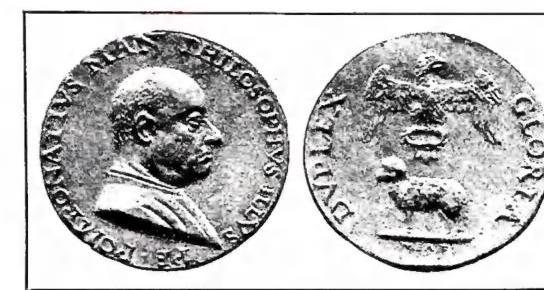
Pomponazzi, Pietro – Engraved medal by Mea.
the commentary on the *Meteora*, probably extended to December 1523 and perhaps beyond (Paris, ms. lat. 6535, for the first three books; Paris, ms. lat. 6448 for Book IV; another report of Books II and III in Ambros. ms. R. 96 sup. Excerpts in the Osimo ms.). The lectures on the *Meteora* were attended by the young son of the Marquis of Mantua, the future Cardinal Ercole Gonzaga. 22) The *Dubitationes in quartum Meteor.* (Venice 1563) are something else; their date of composition is uncertain, but they seem to belong to the Bolognese period. 23) The last work of P. appears to be the commentary on the *De sensu et sensato*, finished by Easter 1525 (Paris, ms. lat. 6536; identical with that in Osimo, Biblioteca, Campana collection, no. 45; Arezzo, ms. 390, incomplete and in a different report). Shortly before his death, he was able to see gathered into a single volume the *De intensione et remissione*, the *De reactione*, the *Quaestio an actio realis*, the *De immortalitate*, the *Apologia*, the *Defensorium*, and the *De nutritione et augmentatione* (Venice 1525). Other writings mentioned by Tomasini (*Bibl. patav.*, Udine 1639, pp. 97 ff.) remain unknown.
As can be seen, the activity of P. encompasses the entire Aristotelian philosophy of nature, although he particularly insists on certain problems that were then most debated, such as that of the eternity of the world, the immortality of the soul, the unity of the intellect (v.), the freedom of the will, and others no less important, such as that of periodic floods and the "great cosmic year" or that of the Averroistic *copulatio* of the possible intellect with the agent intellect. But historians' attention has focused above all on the problem of the immortality of the soul (v. ALESSANDRISMO) and on the violent controversy that arose from it, as if P. had denied immortality rather than the impossibility of demonstrating it with Aristotelian arguments: "Dico Aristotelem errasse, et tu plus erras dicendo Aristotelem omnia scivisse" (In VII Phys., Arezzo, ms. 389, f. 228v). Obliged by academic statutes to explain the Aristotelian text and the Averroistic commentary in Bologna, Nifo, who was striving to induce Leo X to condemn it, replied (Defens., 29): "Ex mandato D. n. Leonis decimi et Senatus Bononiensis tener legere et interpretari et secundum iudicium meum sententiae quid senserit Aristoteles quod per principia naturalia haberi potest: et de hoc quaesito et de aliis adstrictus sum ex iuramento fideliter mentem Aristoteleis aperire...". And the Pope left him in peace.
Aristotelian though he was, he did not have the stubbornness of the Averroist; indeed, he maintained a certain independence even in relation to Aristotle, which often led him to declare that he did not understand him, so much so that on one occasion, regarding the habitability of the southern zone, he exclaimed: "Ea quae hic dicuntur ab Aristotele sunt fatuitates" (In 2ma Meteor., ms. Ambros. R. 96 sup., f. 69v). Ignorant of Greek, he surpassed other Aristotelians in his particular acumen in interpreting the text; he despised the "lectio fucata" of the humanists and did not disdain being considered a "Bergomensis subtilis ingenio, grossus verbis" (Paris, ms. lat. 6533, f. 426v), which he truly was. In the lectures of P., one senses something that tells us that Aristotelianism is now about to dissolve; a serious problem looms: when there is a conflict between reasoning and experience, "cui standum"? It is already the problem of method. And P. feels it, or at least senses II.