
PSALTER (SALTERO). This is what was called
(from ψαλτήριον, psalterium, a stringed musical instrument, and hence by analogy the collection of hymns to be sung on the "psaltery") Psalms (v.), which later became a liturgical book and a manual of private devotion.
I. THE PSALTER IN THE WESTERN CHURCH
The Psalter occupies a place of preeminence in the religious life of antiquity and the Middle Ages and was soon extracted from the Bible to become a book of prayers, both liturgical and private, in its own right.In antiquity and for much of the Middle Ages the Psalter was almost the only manual of devotion for the laity (cf., for example, the characteristic passage in the letter of Paula and Eustochium to Marcella: PL 22, 491). It was also used as a schoolbook for reading exercises (various Psalters are bound with the alphabet), whence the term psalteratus as a synonym of litteratus. For clerics and monks the Psalter was and still is the book of prayer par excellence. In the early Middle Ages clerics, before being ordained, were required to learn it by heart; this explains the custom that arose among many of reciting it in its entirety, in addition to the portion assigned to the sacred office, once or twice a day. At Farfa and Cluny the last hours of a dying person were accompanied by the recitation of the Psalter; elsewhere it was sung or recited during vigils over the dead, especially those of bishops and abbots.
Partial or complete recitation of the Psalter was prescribed by the Penitentials (cf., for example, those of Egbert of York [735–66], Alitgarius of Cambrai [817–31], Burchard of Worms [1000–25]) as a substitute for severe corporal penances that had to be performed for certain offenses. The Psalter was also used for the so-called sortes sanctorum, divinatory practices prohibited by the Carolingian Capitularies and by the Penitential of Burchard, which consisted in seeking an answer to any question in the first verse of a psalm at random.
1. Types of Psalter. - We shall not discuss here its contents (for which V. PSALMS), but only the Psalter as a book in its own right, of which there are two main categories, namely biblical Psalters and liturgical Psalters, subdivided into various types.
SALTERIO
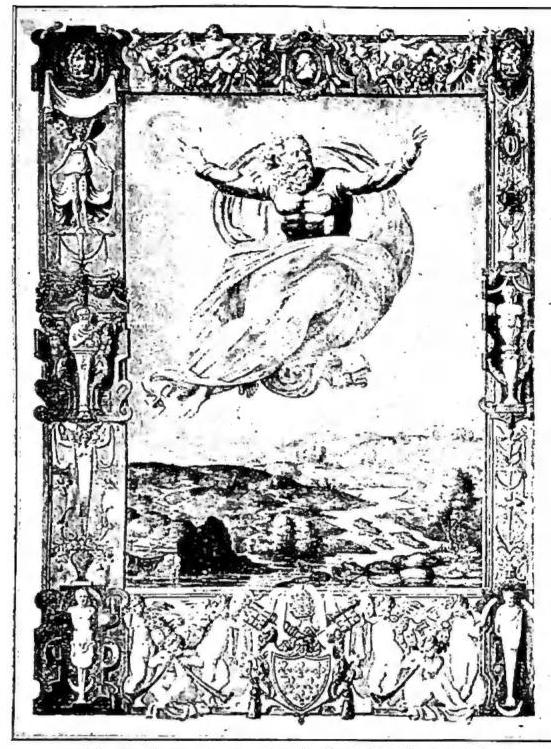
The creation of the stars. Miniature from the Psalter of Paul III copied by Federico Mario da Perugia in 1542 and illuminated by Vincenzo Raimondo da Lodève – Paris, Bibliothèque nationale, ms. lat. 888o, f. 182v.
A) The various types of Psalters. – The name Psalter (Salterio) derives from the Greek ψαλτήριον, the instrument of King David, and was applied to the collection of 150 psalms. The Latin Church inherited three versions from St Jerome: the Roman (384, a simple revision of the Roman Psalter based on the Septuagint; it is debated whether this is the Psalter still used in the basilica of St Peter), the Gallican (c. 389; first used in the Gallic churches, hence its name; it is the Psalter of the Vulgate, a revision of the Roman Psalter based on the Hexaplar text for study purposes), and the “iuxta Hebraeos” (392–93, a translation from the Hebrew text) with rare musical or liturgical annotations (διάψαλμα, or Et = responsum), sometimes also with critical signs: the asterisk or obelus. Another type includes the collect Psalters, in which each of the 150 psalms is followed by a collect inspired by its content, without any reference to liturgical cycles or feasts. These Psalters trace back to the origin of the Divine Office (4th–6th centuries), when a soloist would sing a psalm in the midst of the choir, while the others listened in silence; once the psalm was finished, the choir would sing the Gloria Patri, then, after a few minutes of silent prayer, the celebrant would improvise or recite a collect. Three series of these collects, which later became private prayers but were still copied until the 13th century in Psalters of monastic origin, date back to the 5th–6th centuries: the Visita nos, African; the Domine apud quem, Mozarabic; and the Effice, Roman, according to the classification by Wilmart (cf. A. Wilmart–L. Brou, The psalter collects from V–VIth sources [Henry Bradshaw Society, 83], London 1949; review by H. de Sainte Marie in Eph. lit., 65 [1951], pp. 105–10; Chr. Mohrmann, A propos des collectes du psautier, in Vigiliae christianae, 6 [1952], pp. 1–19). There follow the double, triple, or quadruple Psalters, which, for study purposes, contained on separate pages or columns two or three of the Hieronymian versions, sometimes also the Greek text or a vernacular translation, and the Psalters with marginal or interlinear glosses, which, as is obvious, have nothing in common with Commentaries, Postillae, and Enarrationes in Psalmos. The Psalters were often preceded by prefaces composed of letters by St Jerome, Damasian verses, excerpts from other Fathers or ecclesiastical writers, collected by D. De Bruyne in Préfaces de la Bible latine, Namur 1920. See, for example, the long preface prefixed to the double Psalter, followed by biblical canticles and 21 hymns, known as the Psalter of Everard, Count of Friuli (ms. Reginensis lat. 11, mid-8th century), which comprises as many as 20 folios (cf. A. Wilmart, Codices Reginenses Latini, I, Vatican City 1937, p. 26).
B) Liturgical Psalters. – The classic type of liturgical Psalter, the psalterium per ferias or psalterium feriale, contains the 150 psalms distributed according to the various canonical hours for each day of the week, along with the Ordinary of the Divine Office, namely the invitatories, hymns, antiphons, chapters, responsories, and collects. Alongside this complete type, there are others that are less comprehensive. It is not uncommon to find manuscript Psalters with invitatories, antiphons, and collects marked in the margins, often only with their incipits; after the psalms, there are generally the biblical canticles for Lauds and, if it is a monastic Psalter, also for the third Nocturn. They may also include the Te Deum, the Gloria in excelsis, the Apostles’ and Athanasian Creeds, the Litany of the Saints, and the Penitential Psalms, etc. Depending on their content, they can be classified as: 1) hymn Psalters, with a varying number of hymns for ferias and feasts; 2) Books of Hours Psalters, with private prayers recited after the Office (v. LIBRI D’ORI); 3) diurnal Psalters, with antiphons, chapters, hymns, and collects for the day; 4) antiphon Psalters, with the parts to be sung; 5) ritual Psalters, with prayers and rubrics for the administration of the Sacraments. Besides liturgical Psalters, the medieval period saw the rise of the Virgin’s Psalter (from the 12th century onwards), a poetic or prose composition of 150 strophes, and the Psalter of St Jerome, which included a certain number of verses taken from the psalms without any logical connection.
2. Criteria for dating and identification
Among liturgical manuscripts, Psalters, generally antepenultimate in the manuscript, present the greatest difficulties for dating and identifying the Church to which they belonged. In addition to paleographic evidence, one must rely on any local elements inserted in the calendar, in the Litany of the Saints, in the hymns dedicated to certain saints, in the series of antiphons and biblical canticles, or in the Office of the Dead.3. Decoration
The Psalter, like other liturgical books, received special care from scribes and illuminators, resulting in a rich series of Psalters executed with exquisite artistic taste, ranging from those transcribed in fine uncial and semi-uncial scripts on purple parchment (5th–7th centuries; Carolingian era) to those finely illuminated from the 16th century onwards. Notable examples include the 6th-century silver-and-gold uncial Psalter of St Germain (cf. Leroquais [V. BIBLICA.], II, pp. 110–11); the 8th-century uncial Psalter of Stuttgart (A. Dold, in Röm. Quartalschrift, 1934); the Psalter of Hautvillers Abbey, known as the Utrecht Psalter of the 9th century (cf. E. T. De Wald, The illustrations of the Utrecht Psalter, London–Leipzig 1932); the Psalter of Egbert of Trier in Cividale, executed between 977 and 993 (cf. H. V. Sauerland–H. Haseloff, Der Psalter Erzbischof Egberts von Trier. Codex Gertendianus in Cividale, Trier 1901); the 13th-century Psalter of St Louis (cf. Leroquais, II, pp. 101–105); the c. 1490 Psalter of Charles VIII (Leroquais, II, pp. 57–58); the 1542 Psalter of Paul III (L. Dorez, Le psautier de Paul III, Paris 1909), etc. Some of the earliest printed editions are also notable for their harmony. The most ornate parts of manuscript Psalters are: 1) the calendar, which often features depictions of the months and the zodiac; 2) certain pages placed before the psalms; and 3) the section reserved for the text of the psalms themselves. From the 8th century onwards, the pages preceding the psalms prominently feature David and Christ in Majesty or even on the Cross; David, with his musical instrument, is sometimes accompanied by other psalmists playing with him. From the 12th century, scenes related to Christ take on greater development; in the 13th–14th centuries, these pages are decorated with entire cycles of scenes drawn from the Old and New Testaments. Various systems were used to illustrate the text of the psalms: each psalm is adorned with scenes related to its content, or the Psalter is divided into three or five books and illuminated, in the first case with psalms 1, 51, 101; in the second, with psalms 1, 41, 72, 89, 106; at other times, the first psalm of each ferial day is adorned (1, 26, 38, 51, 52, 68, 80, 97, 101, 109), though not always does the figure relate to the content of the psalm. In addition to fully or partially illuminated pages, there is a whole range of large and small initial letters and marginal decorations executed with rare skill and unrestrained imagination.4. Weekly liturgical division of the Psalter — In the weekly distribution of the Psalter (Psalterium dispositum per hebdomadam), a distinction is made between the monastic cursus and the Roman cursus for the use of secular clergy. The monastic cursus, ordered by St. Benedict in his monastic Rule (chapters 8–18), assigns the psalms to be recited in a week, 12 at Matins (a number already sanctified by the early monks), beginning on Sunday with Psalm 20 and ending on Saturday with Psalm 108; Psalms 109–147 are reserved for Vespers, Psalms 1–19 for Prime, and for the minor Hours of Sunday, as well as for Terce, Sext, and None on Monday, the 22 sections of Psalm 118 are used, while on the other days the gradual psalms are recited.
Other Western monastic cursus refer to St. Caesarius of Arles (c. 502: Ordo psallendi) and to St. Columbanus (d. 615). The Roman cursus, said to have been ordered by Pope Damasus (d. 384), also recites the Psalter in a week, beginning at Matins on Sunday with Psalm 1 and ending on Saturday with Psalm 108; in the Sunday Matins, the number of psalms was reduced by St. Gregory the Great (d. 604) to 12 + 3 + 3 (formerly 14 + 6 + 6), while on weekdays it was arranged as 12 psalms; the 22 sections of Psalm 118 were repeated daily in the minor Hours; Psalms 109–147 were reserved for Vespers. This order was maintained even in the reform of Pius V (d. 1572) until Bl. Pius X, who, on 1 November 1911, ordered a new distribution of the psalms, assigning nine to Matins, respecting the ancient order of two large sections of Psalms 1–108 at Matins and 109–144 at Vespers, assigning the others to the minor Hours and dividing the longer ones following the example of the Egyptian monks and St. Benedict.
The liturgical text of the Psalter until St. Pius V was that of the Psalterium Romanum, which St. Pius V replaced with that of the Psalterium Gallicanum. Pius XII introduced (14 March 1945) a new version made from the Hebrew text.
The term salterio is sometimes used to denote the Rosary because of its 150 Ave Marias, which correspond to the number of psalms.
II. THE PSALTER IN EASTERN RITES
In the Byzantine rite the Psalter is divided into twenty cathismata, and each cathisma into three staseis; each stasis may include three or more psalms and concludes with the Gloria Patri. Nine biblical canticles are added; this arrangement is already found in the 5th-century Codex Alexandrinus, though that manuscript contains fourteen. The Psalter was the first Greek liturgical book to be printed: Venice, probably 1494.In the Slavonic Psalter the Athanasian Creed and other doctrinal texts precede the psalms, and the final canticle is followed by prayers for the dying and the dead; in other Psalters, selected psalms are appended for private reading of a cathisma. In Moscow as in Kiev another type of Psalter was compiled and published, called Psaltir s posliedovaniem; besides the ordinary Psalter it includes three supplements: the Horologion, the Troparia and kontakia for the entire year, the Office of Holy Communion, and other acathists.
The Psalter is recited in continuous reading, at the rate of one cathisma at Vespers and two or three at Matins, once a week, twice during Lent (cf. E. Mercenier - F. Paris, La Prière des Eglises de rite byzantin, I, Chevetogne 1947, p. 14, note 2, pp. 207-209; H. Schneider, Die biblischen Oden..., in Biblica, 30 [1949], pp. 28-65, 239-72, 432-52, 479-500).
Among Psalters illuminated with marginal images, the 9th-century Khludov Psalter and the Vatican Barberini Psalter are important.
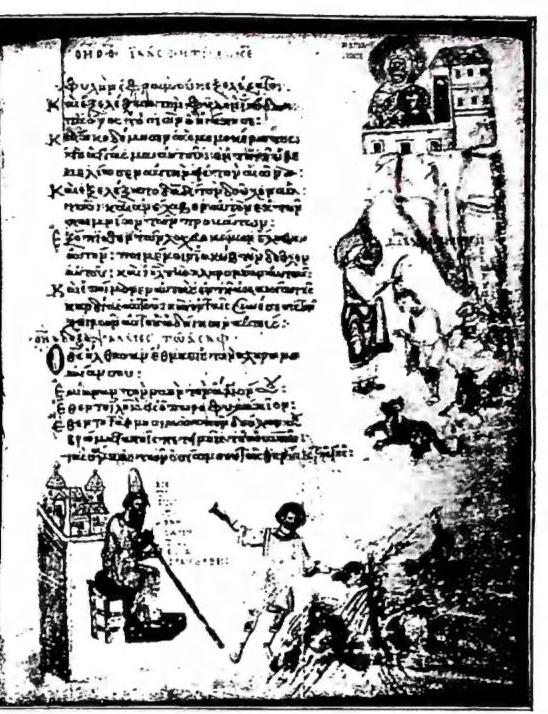
Greek Psalter 372 from the 11th century, etc. (cf. N. Kondakov, Miniaturi... [in Russian], Moscow 1878), and the Litsevaja Psaltir of the year 1397 (reproduced, St. Petersburg 1890; see also J. Strzygowski, Die Miniaturen des serbischen Psalters der Königl. Hof- und Staatsbibliothek in München, Vienna 1906, and L. Mariès, L'irruption des Saints dans l'illustration du pautier byzantin, in Anal. Boll., 68 [1950], pp. 153–62). Among the illuminated psalters with full-page miniatures, the Paris Psalter from the 10th century is well known (cf. H. Buchthal, The Miniatures of the Paris Psalter, London 1938).
In the Armenian rite the psalter is divided into eight sections called “canons”; each section comprises a biblical canticle. Each “canon” corresponds to one of the eight musical tones. Since in the Night Office a “canon” is recited each day, the reading of the psalter is completed in eight days. The cursus begins on the 1st Sunday of Lent, starting with the first tone. Each “canon” is divided into seven sections ending with the Gloria Patri. This system already existed at least from the 7th century. Many manuscripts and editions, however, add the Canticle of Daniel, the Magnificat, the Benedictus, the Nunc dimittis, and the Prayer of Manasseh (cf. F. C. Conybeare, Rituale Armenorum, Oxford 1905, p. 446).
In the West Syrian rite the psalter is today divided into twenty sections (= marmijātā) and sixty doxologies (= Gloria Patri). They always add three canticles: Moses (Exodus), Isaiah, Moses (Deuteronomy), and often three others: Magnificat, Beatitudes, Gloria in excelsis; at the end the Nicene Creed is not infrequently found; sometimes, under Byzantine influence, the psalter has also included other canticles. Anciently a marmijā was recited in every Nocturn of the Night Office; for many centuries liturgical poems have taken its place, yet the psalter still had an edition as late as 1912 in Sharfeh.
In the East Syrian rite the psalter is divided into twenty hullābē, and each hullābē into two or more marmijātā; each of these includes two or three psalms, with interspersed prayers. The cursus is recited assiduously in the Night Office. Catholic editions: Rome 1842, Mosul 1912. For the distribution of the psalms cf. A. J. Maclean, East Syrian Daily Offices, London 1894, pp. 260–63.
In the Coptic rite the psalter comprises twenty cathismata and sixty doxologies (= Gloria Patri). Eleven odes are added, then the Canticle of Daniel, the Magnificat, the Benedictus, the Nunc dimittis, and the Gloria in excelsis (according to the Greek recension). Each liturgical hour begins with the recitation of twelve psalms. Editions by R. Tuki (q.v.) in Rome in 1744. Ethiopian manuscripts not infrequently add the Song of Songs as well (cf. S. Grébaut, Manuscrits éthiopiens appartenant à M. N. Bergey, in Rev. de l'Orient Chrét., 25 [1925–26], pp. 196–219). — See plates CVII–CVIII.