
SHOCK THERAPY (ELECTROSHOCK). — It is among the most important methods for the organic treatment of mental disorders; its various procedures developed not logically but empirically, an understandable fact, moreover, in a field in which the various etiopathogeneses are almost entirely unknown. The beginning of s. may be traced to the independent and almost simultaneous discovery of the curative action of hypoglycemic coma (that is, associated with a marked decrease in the glucose content of the blood) and of convulsant pharmacological therapy.
Introduced into psychiatry by Steck, insulin was initially administered with the dual purpose of increasing the patient’s weight and influencing states of excitement, especially in morphine addicts. The decisive step in the transition from a purely symptomatic medication to a curative treatment was taken by Sackel, of the Vienna clinic, in 1933, when he made the important observation that profound hypoglycemic states, which arose involuntarily during the symptomatic treatment of psychotics with insulin injections, had an evident beneficial effect on the psychosis itself: hypoglycemic coma, which Sackel’s predecessors had sought to avoid by moderating the quantity of the drug administered, became the focus schizophrenia (v.), a treatment now universally widespread and adopted in the form of insulin shock therapy (IST). A few years earlier, in 1928, von Meduna had reported on his attempts to treat schizophrenia with epileptic convulsions artificially induced by cardiazol. He had been prompted by two observations (subsequently shown to be only relatively correct): that epilepsy and schizophrenia are antagonistic to one another; and that schizophrenic symptoms may disappear, at least temporarily, after spontaneous convulsions. The same observation had previously led Nyiro to attempt, without any success, the treatment of schizophrenics with transfusions of blood from epileptics (von Meduna had been preceded, as early as 1785, by Oliver, who in the London medical journal reported a case of “mania” successfully treated by convulsions induced with camphor).
The widespread use and importance of convulsant treatments in psychiatric therapy were demonstrated at the First International Congress for the Modern Treatment of Schizophrenia, held at Moensingen (Switzerland) in 1937; it was there that Cerletti and Bini mentioned for the first time the possibility of using electric current as a convulsant stimulus in the treatment of schizophrenia. After a long period of experiments on animals, the two Roman scholars induced convulsions by means of electricity in mental patients and published their first works in 1938: this was the birth of electroshock therapy (EST), which rapidly spread from Rome throughout the world.
The electric discharge producing the shock, delivered by special apparatus at a voltage of 100–120 volts, is applied to the temporal regions for approximately 2–4 tenths of a second (for details of method, technique, and pathophysiology, see Cerletti and Bini’s volume on ES).
It has not yet been firmly established whether the attack should be regarded as a phenomenon of release or as a positive phenomenon of excitation. There has been much discussion as to whether electrically induced convulsant therapy (ES) can produce irreversible alterations in the nerve cells. Bini and Cerletti, after examining the brains of a large number of dogs subjected to ES for a long period, stated that lesions of this kind never occur, whereas they had been demonstrated in animals subjected to insulin or cardiazol shock. The more recent authors likewise agree with this important assertion: after an average of 10 ES treatments, electroencephalographic alterations resemble those observed in cerebral concussion, but the tracing returns to normal after approximately one month of rest.
The indications for IST consist almost exclusively of schizophrenic syndromes; given its complexity and delicacy, this treatment must be administered under rigorous medical supervision, by specialized medical personnel, in a suitable hospital.
The indications for EST are as follows: 1) affective psychoses (v.), which in fact constitute the group of illnesses in which the most striking results are obtained, especially in depressive forms: the episode currently present is rapidly cured (with 3–10 ES treatments); its efficacy is also considerable in “involutional melancholias,” in which, however, a greater number of applications is necessary. 2) Schizophrenic syndromes, when IST cannot be carried out for particular reasons; in this extensive group of patients, the results are undoubtedly better with IST. The two s. may be combined by carrying out the mixed treatment when there is intense affective involvement or marked psychomotor agitation, and in cases that have previously responded poorly to IST alone; ES treatments may be administered during the first phase of insulin coma, or alternately with the comas themselves. In catatonic states, a few applications of ES often succeed in releasing patients from their blockage. 3) In psychoneuroses, EST is justified only in very severe cases resistant to psychotherapy, and in those obsessive forms accompanied by a strong anxious charge: indeed, in such cases Bini and Bazzi propose “annihilation,” that is, closely spaced ES applications, even twice a day, until a complete or nearly complete amnestic syndrome is induced in the patient: anxiety generally disappears, while the anancastic and phobic mechanisms remain unaltered; these, however, fade in their affective resonance, that is, they lose their obsessive character.
psychopathic personalities (v.), the results are not at all brilliant, and the same is true of psychopathic developments.
The principal contraindications are cardiovascular diseases, infections, febrile states of any kind, active tuberculosis, chronic lung disorders, severe thyrotoxicosis, organic diseases of the central nervous system, and marked hypertension. When these limitations are observed rigorously, the dangers become very slight, being practically reduced to fractures alone, which are somewhat more frequent in EST and in melancholias than in IST and schizophrenia.
In general, s. do not contraindicate psychological treatments, which may sometimes, on the contrary, be facilitated by the psychic modifications induced by these organic methods; finally, it should be noted that the practical and economic value of ES is considerable: many thousands of manic-depressive subjects can be spared certification as mentally ill, since, when necessary, they can be kept in good mental condition by means of an occasional shock; in addition, lengthy hospitalization is avoided, that is, the need to feed and supervise innumerable apparently demented subjects, who in earlier times required continuous care services, is avoided.
(Fides photograph)
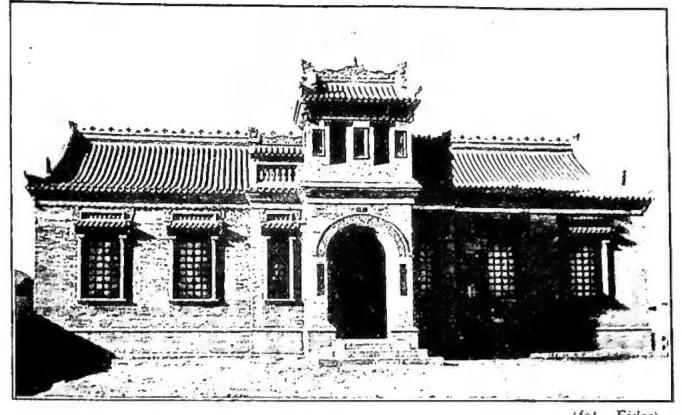
SHOHCHOW, DIOCESE of — The Missionary Residence.
therapy of schizophrenia, Halle 1937; U. Cerletti - L. Bini, L'elettroshoch, in Arch. Neur. Psich. Psicoanal., 19 (1938), p. 266, sgg.; id., Le alterazioni istopatologiche del sistema nervoso nell'elettroshoch, in Riv. sperim. freniatria, 64 (1940), p. 2 sgg.; F. Giorgi, The problem of convulsions and insulin therapy, in Amer. J. Psychiatr., 94 (1939), p. 67 (suppl.); U. Cerletti, L'elettroshoch, in Riv. sper. freniatria, 66 (1942), p. 209 sgg.; L. B. Kalinowsky - P. H. Hoch, Shock treatments and other somatic procedures in psychiatry, New York 1946; W. Russel Brain - E. B. Straus, Recenti progressi in neurologia e in neuropsychiatria, Rome 1949; I. Meschan - J. B. Scruggs - J. D. Calhoun, Convulsive fractures of the dorsal spine following electric-shock therapy in Radiology, 54 (1950), p. 180 sgg.; Ch. S. Pool, I. Meschan, Fractures of the spine during insulin shock therapy, in Arch. Neur. and Psychiat., 67 (1952), p. 797 sgg. Bruno Callieri