
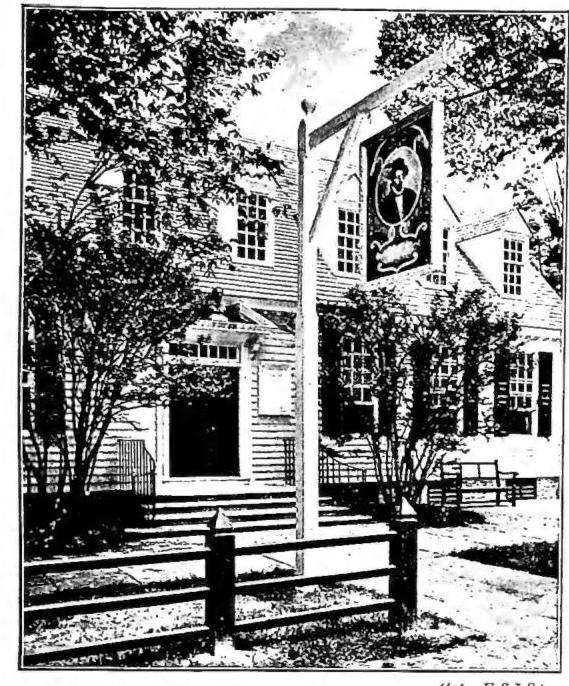
The United States (U.S.A.) — The Raleigh Tavern, bearing the portrait of the explorer Sir Walter Raleigh as its sign — Williamsburg (Virginia).
In the circum-Pacific belt, rainfall is more abundant and generally falls in winter, though tending to diminish again toward the south (California). In general, the coastal countries here have a Mediterranean-type climate, milder and more uniform than those on the Atlantic, whose conditions, in turn, prove less mild and more changeable than those of European countries at the same latitude. Moreover, the regions near the Atlantic are often devastated by the terrible cyclones that form in the Caribbean Sea and sweep across the West Indies, the western United States, and the North Atlantic. Toward the south, along the Atlantic coast (Florida and the Gulf of Mexico), the climate assumes an increasingly distinctly subtropical character, with intense heat and rather abundant precipitation.
From a physical-economic standpoint, the territory of the U.S.A. can be divided into four major units: in the north, east, and center, a temperate-humid region with well-developed agriculture, particularly cereal cultivation and livestock raising; in the south, a subtropical region producing cotton, rice, and tobacco; in the west, an arid region where, despite livestock raising, cereal cultivation is possible through artificial irrigation; and on the Pacific coast, a Mediterranean-type region where citrus fruits, vines, and fruit trees thrive. Each of these regions possesses mineral reserves to a greater or lesser extent. However, the exploitation of these resources has not everywhere reached the same level, so that, despite the great impetus given to all kinds of economic activity—especially as a result of the last two world wars—the U.S.A. still retains, over fairly extensive areas, the appearance of a new country.
On the other hand, mass colonization began rather late. At the time of the discovery, the Indians living in the territory of the U.S.A. did not exceed one million, and the total population, which was about 3 million in 1776 (at the time of the proclamation of independence), barely surpassed 23 million in 1853, when the metropolitan territory reached its current expanse. But from 1820 to 1930, more than 37 million individuals immigrated to the U.S.A. (8 million in the single decade 1900-11), among whom the English, Scots, Irish, Germans, Scandinavians and Finns initially predominated, and later Italians, Slavs, Jews and Hungarians. According to the latest census (1950), the population amounts to 150.7 million inhabitants, of whom the Negroes (numerous especially in the regions of the South and Southeast) form about 10%, the Indians (reduced to a few hundred thousand individuals) barely 2%, while a high percentage (impossible to calculate exactly) is represented by those born abroad or by foreign parents (almost 7 million Germans, 4½ million Italians, over 3 million Irish and as many Poles and Canadians, etc.). The population density (19 per sq. km.) is rather low (slightly higher than that of Sweden), but the differences from region to region are notable: while the western highlands are almost uninhabited (less than 1 inhabitant per sq. km. in the State of Nevada), the Atlantic States have indices exceeding even 200 inhabitants per sq. km. (Rhode Island, New Jersey, Massachusetts). Taking into account the territories controlled by the U.S.A., their population rose (1951) to 155.4 million inhabitants, of whom 2.5 million in America (2.2 in Puerto Rico) and 635,000 in Oceania.
As for economic development (and indeed also from the political-military point of view), there is no doubt that the U.S.A. today represent the greatest world power, which is the result not only of the proportion of natural resources of every kind that fall to their share in a new and open country, at least initially open to mass collaboration, and imbued from the outset with an unlimited spirit of initiative, as well as of the scale of magnitude on which these resources could be exploited, but also of a technical progress that general prosperity and the aspiration to individual gain have brought to a very high level, both in relative and absolute terms.
The tendency to achieve the maximum output with the minimum expenditure of human labor in every form of activity—and thus on the basis of rational planning that takes into account all production factors and stimulates them through increasingly widespread and efficient mechanization—is also evident in agriculture. Despite the remarkable industrial development, agriculture remains one of the most solid foundations of the national economy. In 1950, agriculture employed only 17% of the active population (10% during World War II), yet the 8.3 million workers utilized approximately 10 million motorized machines. Less than one-fifth of the U.S. territory is cultivated (and four-fifths of that in the eastern half of the country alone); yet the United States, among other things, produces between 50% and 60% of the world’s corn, one-fifth to one-third of its cotton, more than one-fourth of its tobacco, one-fifth to one-fourth of its oats, and one-sixth to one-seventh of its wheat. More than half of the cultivated area (184.1 million hectares) is devoted to cereals, primarily corn (from 35 million tons in 1934–38 to 79 million in 1950; subsequent figures will be given in millions of tons), followed in descending order of production by wheat (19.5–27.5), oats (14.0–21.5), barley (4.5–6.53), rice (9.6–17.2), and rye (10.3–5.7). While all corn is consumed domestically, wheat allows for significant exports (6.5 million tons, the highest figure among all global exporters in 1950).
Following cereals in importance is cotton, grown in the southeastern states (2.8–2.1 million tons of fiber; 4.9–6.0 million tons of seed). Half of the fiber production and nearly the entire seed (oil) production are absorbed by the domestic market. Also notable are the cultivation of soybeans (1.2–7.8 million tons) and flax (0.2–1 million tons). The United States leads both in tobacco production (0.6–0.9 million tons) and in its global export, while for sugar, production from both sugar beets and sugarcane still fails to meet national consumption. Fruit growing has seen significant development (California, Florida, the Great Lakes region), supporting a thriving industry; alongside citrus fruits, California produces grapes (16 million hectoliters, equivalent to Spain’s 1950 production), partly destined for winemaking. Due to intense deforestation, the output of forests—now limited to the Pacific states (Douglas fir) and Florida (pitch pine)—has declined, though it still supports substantial industries (paper, furniture), even if not sufficient for domestic demand.

United States (U.S.A.) - The Raleigh Tavern, which features a portrait of the explorer Sir Walter Raleigh - Williamsburg (Virginia).
Agriculture and livestock raising are closely linked: in terms of the number of head (78.3 million; a figure surpassed only by India) and the importance of the related industrial production, cattle come first, raised especially in the central states (for meat) and the northeastern states (for milk), followed by swine (57.1 million; the world’s leading producer), which are characteristic of the corn belt, then sheep (31.7 million), equines (6.0 million horses; 2.3 million mules), and goats (2.4 million). Fishing is also flourishing: for certain specialties (oysters, sardines, salmon), the U.S.A. ranks among the top, or even first in the world.
This solid agricultural structure and the ancillary activities that complement it are accompanied by an even more grandiose industrial expansion, whose possibilities appear practically limitless, given the extraordinary abundance and variety of mineral resources available to the U.S.A. First among productive energy sources are fossil fuels: coal (the U.S.A. extracts more than one-third of the world’s total; 505 million tons in 1950, half of which came from leased deposits), petroleum (270 million tons, 52% of the world total), to which must be added hydroelectric resources, estimated at 45 million horsepower and yielding, in 1950, a production of 590 million horsepower (1st place in the world).
Of the more important minerals destined for industrial processing, the U.S.A. lacks, either entirely or in part, only tin, manganese, chromium, nickel, and uranium; for all others, domestic production is normally equal to demand, and in many cases exceeds II. Iron, copper, and zinc are produced in quantities that reach or surpass half of the world’s total. The first comes mostly from the regions of Lake Superior and Alabama; the second mainly from the western highlands, which also yield lead (from one-quarter to one-third of the world total) and silver (of which the U.S.A. is the world’s second-largest producer after Mexico); the third comes from Missouri. Bauxite, sulfur, phosphate rock, and potash are also produced in abundance, in addition to California, now also in Colorado and South Dakota (60,000 kg; 4th place in the world).
For their industrial development the U.S.A. have left far behind all other countries of the world: there is no branch of production in which their supremacy has not been established with those characteristics which distinguish it: standardization, rationalization, mechanization and the concentration of enterprises (trusts), all of which have, more or less, a world-wide echo. While certain branches of activity stand out among others—e.g., the metallurgical industries (steel: 2/5 of world production) and the mechanical industries (4/5 of automobiles, 3/4 of typewriters produced throughout the world)—especially because of their localization in certain districts, their distribution over the vast metropolitan territory obeys criteria of economic convenience which make it possible to provide first and foremost for the exceptional dimensions of the internal market: which is another of the distinctive features of United States industry. The result is a multiplicity of industrial regions, each of which has, or accentuates, its own peculiar character: iron and steel works and metallurgical industries in the area near the Great Lakes, textile industries in the central-Atlantic States, those of timber in the northern and southern Atlantic States, around the Great Lakes and along the Pacific; food industries almost everywhere, but especially in the States of the north-eastern centre.
This gigantic industrial organization of the U.S.A. would not be conceivable without an adequate development of the means of communication. The railways measure over 360,000 km. (1/3 of the world network), but they are now in the process of being overtaken by the expansion of the automobile, which has at its disposal an imposing road network (5.3 million km.; 48 million motor vehicles, i.e. one for every three inhabitants approximately, as against one for every 70 in Italy), and by aerial transport, which is increasing rapidly (738.7 million km. covered; 14.2 million passengers). Equally marked, after the Second World War, has been the supremacy of the mercantile marine, which in 1950 registered as much as 25.2 million tons of mechanically propelled shipping, thus surpassing Great Britain and representing by itself about 1/3 of the world total.
Typical of present-day U.S.A. are the dimensions and the economic and political importance of urbanization; it may be reckoned that about 60% of the population lives concentrated in towns, many of which have had a rapid topographical and demographic development. Of those which exceed 100,000 inhabitants (the so-called “large towns,” which in 1950 were 10 out of the 876 existing throughout the world) there are now more than a dozen which, with or without their immediate surroundings (metropolitan districts), exceed a million inhabitants.

United States (U.S.A.) — View of a farm in Arizona.
The distribution of large urban centers, like that of the population in general, still shows a marked contrast between the northeastern sector of the country, between the Atlantic and the Mississippi, upstream from the confluence of the Ohio, on the one hand, and the inland regions, where large cities are still exceptional occurrences, on the other; while other urban concentrations, certainly expanding, have developed along the Pacific, both in the South (California) and in the North (between Puget Sound and the lower Columbia). These cities, all of more or less recent origin, are clearly distinguished from the old European urban centers by certain common characteristics that make them resemble one another: the vastness of the city area, much of which is made up of parks, gardens, and public and private lawns; the regular layout of the plan; the absence of walls and clear boundaries toward the periphery; and the separation between the inner core (the City), or business district, dense with public buildings and monuments and crowned by skyscrapers, and the more extensive residential neighborhoods, where detached houses predominate and large buildings are rare. It is worth noting that state capitals do not usually coincide with the most populous, active, or economically important cities; sometimes centers with fewer than 10,000 inhabitants perform this function. This was done to ensure that the centers chosen as seats of government had a suitable position relative to the territory of each state and also conditions of tranquility and isolation, so that the administration of the states would not be disturbed by the business world and the interests of a few or of a single city would not prevail over the common good. However, with
Statí e gruppi di Stati
| State and groups of States | Area in sq. km. | Population in 1000 inhab. (census 1950) | Density per sq. km. | Capital (population in 1000 inhab.) |
|----------------------------|-----------------|-----------------------------------------|---------------------|--------------------------------------|
| Maine | 86017 | 913.8 | 11 | Augusta 71 |
| New Hampshire | 24095 | 533.2 | 22 | Concord 28 |
| Vermont | 24884 | 377.7 | 15 | Montpelier 8 |
| Massachusetts | 21383 | 4690.5 | 219 | Boston 791 |
| Rhode Island | 3144 | 791.9 | 252 | Providence 248 |
| Connecticut | 12972 | 2007.3 | 155 | Hartford 177 |
| NEW ENGLAND | 172.495 | 9314.5 | 54 | — |
| New York | 128387 | 14830.2 | 115 | Albany 134 |
| New Jersey | 20293 | 4835.3 | 238 | Trenton 128 |
| Pennsylvania | 117399 | 10498.0 | 89 | Harrisburg 89 |
| MIDDLE ATLANTIC | 266.079 | 30163.5 | 113 | — |
| Distr.Columbia | 179 | 802,2 | 4481 | Washington 60 |
Delaware | 5327 | 318,1 | 60 | Dover 6 |
Maryland | 27391 | 2343,0 | 86 | Annapolis 15 |
Virginia | 105090 | 3318,7 | 31 | Richmond 230 |
West Virginia | 62622 | 2005,5 | 32 | Charleston 73 |
North Carolina | 136508 | 4061,9 | 30 | Raleigh 5 |
South Carolina | 80423 | 2117,0 | 39 | Columbia 23 |
Georgia | 152471 | 3444,6 | 23 | Atlanta 327 |
SOUTH ATLANTIC | 722.273 | 21183,3 | 29 | — |
Ohio | 106753 | 7946,6 | 74 | Columbus 375 |
Indiana | 93983 | 3934,2 | 42 | Indianapolis 375 |
Illinois | 146059 | 8712,2 | 60 | Springfield 81 |
Michigan | 150762 | 6371,8 | 42 | Lansing 92 |
EAST NORTH CENTRAL | 642.979 | 30399,4 | 47 | — |
Minnesota | 217711 | 2982,5 | 14Paul 310 |
| Iowa | 145743 | 2621,1 | 18 | Des Moines 177 |
| Missouri | 180435 | 3954,7 | 22 | Jefferson City 25 |
| North Dakota | 183001 | 619,6 | 3 | Bismarck 19 |
| Nebraska | 200021 | 1325,5 | 7 | Lincoln 97 |
| WEST NORTH CENTRAL | 1.339.515 | 14061,4 | 10 | — |
| Kentucky | 104611 | 2954,8 | 28 | Frankfort 11 |
| Tennessee | 109404 | 3291,7 | 30 | Nashville 173 |
| Alabama | 133652 | 3061,7 | 23 | Montgomery 105 |
| Mississippi | 123570 | 2178,9 | 18 | Jackson 98 |
| EAST SOUTH CENTRAL | 471.237 | 14477,2 | 31 | — |
| Arkansas | 137518 | 1909,5 | 14 | Little Rock 101 |
| Louisiana | 125660 | 2683,5 | 21 | Baton Rouge 124 |
| Oklahoma | 181069 | 2333,4 | 12 | Oklahoma City 242 |
| Texas | 692328 | 7711,2 | 11 | Austin 132 |
| WEST SOUTH CENTRAL | 1.136.575 | 14537,5 | 13 | — |
| Montana | 381043 | 591,0 | 2 | Helena 17 |
| Utah | 219907 | 688,9 | 3 | Salt Lake City 182 |
| Arizona | 294990 | 749,6 | 3 | Phoenix 105 |
| Nevada | 286265 | 160,1 | 1 | Carson City 3 |
| MOUNTAIN | 2.257.207 | 5075,0 | 2 | — |
| Washington | 176597 | 2379,0 | 13 | Olympia 16 |
| Oregon | 251152 | 1521,3 | 6 | Salem 43 |
| California | 410967 | 10586,2 | 25 | Sacramento 136 |
| PACIFIC | 838716 | 14486,5 | 17 | — |
| U.S.A. | 7.827.076 | 150.697,4 | 19 | Washington 149 |
1
2
3
4
5
6
7
8
9
10
11
12
13
14
15
16
17
18
19
20
21
22
23
24
25
26
27
28
29
30
31
32
33
34
35
36
37
38
39
40
41
42
43
44
45
46
47
48
49
50
51
52
53
54
55
56
57
58
59
60
61
62
63
64
65
66
67
68
69
70
71
72
73
74
75
76
77
78
79
80
81
82
83
84
85
86
87
88
89
90
91
92
93
94
95
96
97
98
99
100
101
102
103
104
105
106
107
108
109
110
111
112
113
114
115
116
117
118
119
120
121
122
123
124
125
126
127
128
129
130
131
132
133
134
135
136
137
138
139
140
141
142
143
144
145
146
147
148
149
150
151
152
153
154
155
156
157
158
159
160
161
162
163
164
165
166
167
168
169
170
171
172
173
174
175
176
177
178
179
180
181
182
183
184
185
186
187
188
189
190
191
192
193
194
195
196
197
198
199
200
201
202
203
204
205
206
207
208
209
210
211
212
213
214
215
216
217
218
219
220
221
222
223
224
225
226
227
228
229
230
231
232
233
234
235
236
237
238
239
240
241
242
243
244
245
246
247
248
249
250
251
252
253
254
255
256
257
258
259
260
261
262
263
264
265
266
267
268
269
270
271
272
273
274
275
276
277
278
279
280
281
282
283
284
285
286
287
288
289
290
291
292
293
294
295
296
297
298
299
300
301
302
303
304
305
306
307
308
309
310
311
312
313
314
315
316
317
318
319
320
321
322
323
324
325
326
327
328
329
330
331
332
333
334
335
336
337
338
339
340
341
342
343
344
345
346
347
348
349
350
351
352
353
354
355
356
357
358
359
360
361
362
363
364
365
366
367
368
369
370
371
372
373
374
375
376
377
378
379
380
381
382
383
384
385
386
387
388
389
390
391
392
393
394
395
396
397
398
399
400
401
402
403
404
405
406
407
408
409
410
411
412
413
414
415
416
417
418
419
420
421
422
423
424
425
426
427
428
429
430
431
432
433
434
435
436
437
438
439
440
441
442
443
444
445
446
447
448
449
450
451
452
453
454
455
456
457
458
459
460
461
462
463
464
465
466
467
468
469
470
471
472
473
474
475
476
477
478
479
480
481
482
483
484
485
486
487
488
489
490
491
492
493
494
495
496
497
498
499
500
501
502
503
504
505
506
507
508
509
510
511
512
513
514
515
516
517
518
519
520
521
522
523
524
525
526
527
528
529
530
531
532
533
534
535
536
537
538
539
540
541
542
543
544
545
546
547
548
549
550
551
552
553
554
555
556
557
558
559
560
561
562
563
564
565
566
567
568
569
570
571
572
573
574
575
576
577
578
579
580
581
582
583
584
585
586
587
588
589
590
591
592
593
594
595
596
597
598
599
600
601
602
603
604
605
606
607
608
609
610
611
612
613
614
615
616
617
618
619
620
621
622
623
624
625
626
627
628
629
630
631
632
633
634
635
636
637
638
639
640
641
642
643
644
645
646
647
648
649
650
651
652
653
654
655
656
657
658
659
660
661
662
663
664
665
666
667
668
669
670
671
672
673
674
675
676
677
678
679
680
681
682
683
684
685
686
687
688
689
690
691
692
693
694
695
696
697
698
699
700
701
702
703
704
705
706
707
708
709
710
711
712
713
714
715
716
717
718
719
720
721
722
723
724
725
726
727
728
729
730
731
732
733
734
735
736
737
738
739
740
741
742
743
744
745
746
747
748
749
750
751
752
753
754
755
756
757
758
759
760
761
762
763
764
765
766
767
768
769
770
771
772
773
774
775
776
777
778
779
780
781
782
783
784
785
786
787
788
789
790
791
792
793
794
795
796
797
798
799
800
801
802
803
804
805
806
807
808
809
810
811
812
813
814
815
816
817
818
819
820
821
822
823
824
825
826
827
828
829
830
831
832
833
834
835
836
837
838
839
840
841
842
843
844
845
846
847
848
849
850
851
852
853
854
855
856
857
858
859
860
861
862
863
864
865
866
867
868
869
870
871
872
873
874
875
876
877
878
879
880
881
882
883
884
885
886
887
888
889
890
891
892
893
894
895
896
897
898
899
900
901
902
903
904
905
906
907
908
909
910
911
912
913
914
915
916
917
918
919
920
921
922
923
924
925
926
927
928
929
930
931
932
933
934
935
936
937
938
939
940
941
942
943
944
945
946
947
948
949
950
951
952
953
954
955
956
957
958
959
960
961
962
963
964
965
966
967
968
969
970
971
972
973
974
975
976
977
978
979
980
981
982
983
984
985
986
987
988
989
990
991
992
993
994
995
996
997
998
999
1000
1001
1002
1003
1004
1005
1006
1007
1008
1009
1010
1011
1012
1013
1014
1015
1016
1017
1018
1019
1020
1021
1022
1023
1024
1025
1026
1027
1028
1029
1030
1031
1032
1033
1034
1035
1036
1037
1038
1039
1040
1041
1042
1043
1044
1045
1046
1047
1048
1049
1050
1051
1052
1053
1054
1055
1056
1057
1058
1059
1060
1061
1062
1063
1064
1065
1066
1067
1068
1069
1070
1071
1072
1073
1074
1075
1076
1077
1078
1079
1080
1081
1082
1083
1084
1085
1086
1087
1088
1089
1090
1091
1092
1093
1094
1095
1096
1097
1098
1099
1100
1101
1102
1103
1104
1105
1106
1107
1108
1109
1110
1111
1112
1113
1114
1115
1116
1117
1118
1119
1120
1121
1122
1123
1124
1125
1126
1127
1128
1129
1130
1131
1132
1133
1134
1135
1136
1137
1138
1139
1140
1141
1142
1143
1144
1145
1146
1147
1148
1149
1150
1151
1152
1153
1154
1155
1156
1157
1158
1159
1160
1161
1162
1163
1164
1165
1166
1167
1168
1169
1170
1171
1172
1173
1174
1175
1176
1177
1178
1179
1180
1181
1182
1183
1184
1185
1186
1187
1188
1189
1190
1191
1192
1193
1194
1195
1196
1197
1198
1199
1200
1201
1202
1203
1204
1205
1206
1207
1208
1209
1210
1211
1212
1213
1214
1215
1216
1217
1218
1219
1220
1221
1222
1223
1224
1225
1226
1227
1228
1229
1230
1231
1232
1233
1234
1235
1236
1237
1238
1239
1240
1241
1242
1243
1244
1245
1246
1247
1248
1249
1250
1251
1252
1253
1254
1255
1256
1257
1258
1259
1260
1261
1262
1263
1264
1265
1266
1267
1268
1269
1270
1271
1272
1273
1274
1275
1276
1277
1278
1279
1280
1281
1282
1283
1284
1285
1286
1287
1288
1289
1290
1291
1292
1293
1294
1295
1296
1297
1298
1299
1300
1301
1302
1303
1304
1305
1306
1307
1308
1309
1310
1311
1312
1313
1314
1315
1316
1317
1318
1319
1320
1321
1322
1323
1324
1325
1326
1327
1328
1329
1330
1331
1332
1333
1334
1335
1336
1337
1338
1339
1340
1341
1342
1343
1344
1345
1346
1347
1348
1349
1350
1351
1352
1353
1354
1355
1356
1357
1358
1359
1360
1361
1362
1363
1364
1365
1366
1367
1368
1369
1370
1371
1372
1373
1374
1375
1376
1377
1378
1379
1380
1381
1382
1383
1384
1385
1386
1387
1388
1389
1390
1391
1392
1393
1394
1395
1396
1397
1398
1399
1400
1401
1402
1403
1404
1405
1406
1407
1408
1409
1410
1411
1412
1413
1414
1415
1416
1417
1418
1419
1420
1421
1422
1423
1424
1425
1426
1427
1428
1429
1430
1431
1432
1433
1434
1435
1436
1437
1438
1439
1440
1441
1442
1443
1444
1445
1446
1447
1448
1449
1450
1451
1452
1453
1454
1455
1456
1457
1458
1459
1460
1461
1462
1463
1464
1465
1466
1467
1468
1469
1470
1471
1472
1473
1474
1475
1476
1477
1478
1479
1480
1481
1482
1483
1484
1485
1486
1487
1488
1489
1490
1491
1492
1493
1494
1495
1496
1497
1498
1499
1500
1501
1502
1503
1504
1505
1506
1507
1508
1509
1510
1511
1512
1513
1514
1515
1516
1517
1518
1519
1520
1521
1522
1523
1524
1525
1526
1527
1528
1529
1530
1531
1532
1533
1534
1535
1536
1537
1538
1539
1540
1541
1542
1543
1544
1545
1546
1547
1548
1549
1550
1551
1552
1553
1554
1555
1556
1557
1558
1559
1560
1561
1562
1563
1564
1565
1566
1567
1568
1569
1570
1571
1572
1573
1574
1575
1576
1577
1578
1579
1580
1581
1582
1583
1584
1585
1586
1587
1588
1589
1590
1591
1592
1593
1594
1595
1596
1597
1598
1599
1600
1601
1602
1603
1604
1605
1606
1607
1608
1609
1610
1611
1612
1613
1614
1615
1616
1617
1618
1619
1620
1621
1622
1623
1624
1625
1626
1627
1628
1629
1630
1631
1632
1633
1634
1635
1636
1637
1638
1639
1640
1641
1642
1643
1644
1645
1646
1647
1648
1649
1650
1651
1652
1653
1654
1655
1656
1657
1658
1659
1660
1661
1662
1663
1664
1665
1666
1667
1668
1669
1670
1671
1672
1673
1674
1675
1676
1677
1678
1679
1680
1681
1682
1683
1684
1685
1686
1687
1688
1689
1690
1691
1692
1693
1694
1695
1696
1697
1698
1699
1700
1701
1702
1703
1704
1705
1706
1707
1708
1709
1710
1711
1712
1713
1714
1715
1716
1717
1718
1719
1720
1721
1722
1723
1724
1725
1726
1727
1728
1729
1730
1731
1732
1733
1734
1735
1736
1737
1738
1739
1740
1741
1742
1743
1744
1745
1746
1747
1748
1749
1750
1751
1752
1753
1754
1755
1756
1757
1758
1759
1760
1761
1762
1763
1764
1765
1766
1767
1768
1769
1770
1771
1772
1773
1774
1775
1776
1777
1778
1779
1780
1781
1782
1783
1784
1785
1786
1787
1788
1789
1790
1791
1792
1793
1794
1795
1796
1797
1798
1799
1800
1801
1802
1803
1804
1805
1806
1807
1808
1809
1810
1811
1812
1813
1814
1815
1816
1817
1818
1819
1820
1821
1822
1823
1824
1825
1826
1827
1828
1829
1830
1831
1832
1833
1834
1835
1836
1837
1838
1839
1840
1841
1842
1843
1844
1845
1846
1847
1848
1849
1850
1851
1852
1853
1854
1855
1856
1857
1858
1859
1860
1861
1862
1863
1864
1865
1866
1867
1868
1869
1870
1871
1872
1873
1874
1875
1876
1877
1878
1879
1880
1881
1882
1883
1884
1885
1886
1887
1888
1889
1890
1891
1892
1893
1894
1895
1896
1897
1898
1899
1900
1901
1902
1903
1904
1905
1906
1907
1908
1909
1910
1911
1912
1913
1914
1915
1916
1917
1918
1919
1920
1921
1922
1923
1924
1925
1926
1927
1928
1929
1930
1931
1932
1933
1934
1935
1936
1937
1938
1939
1940
1941
1942
1943
1944
1945
1946
1947
1948
1949
1950
1951
1952
1953
1954
1955
1956
1957
1958
1959
1960
1961
1962
1963
1964
1965
1966
1967
1968
1969
1970
1971
1972
1973
1974
1975
1976
1977
1978
1979
1980
1981
1982
1983
1984
1985
1986
1987
1988
1989
1990
1991
1992
1993
1994
1995
1996
1997
1998
1999
2000
2001
2002
2003
2004
2005
2006
2007
2008
2009
2010
2011
2012
2013
2014
2015
2016
2017
2018
2019
2020
2021
2022
2023
2024
2025
2026
2027
2028
2029
2030
2031
2032
2033
2034
2035
2036
2037
2038
2039
2040
2041
2042
2043
2044
2045
2046
2047
2048
2049
2050
2051
2052
2053
2054
2055
2056
2057
2058
2059
2060
2061
2062
2063
2064
2065
2066
2067
2068
2069
2070
2071
2072
2073
2074
2075
2076
2077
2078
2079
2080
2081
2082
2083
2084
2085
2086
2087
2088
2089
2090
2091
2092
2093
2094
2095
2096
2097
2098
2099
2100
2101
2102
2103
2104
2105
2106
2107
2108
2109
2110
2111
2112
2113
2114
2115
2116
2117
2118
2119
2120
2121
2122
2123
2124
2125
2126
2127
2128
2129
2130
2131
2132
2133
2134
2135
2136
2137
2138
2139
2140
2141
2142
2143
2144
2145
2146
2147
2148
2149
2150
2151
2152
2153
2154
2155
2156
2157
2158
2159
2160
2161
2162
2163
2164
2165
2166
2167
2168
2169
2170
2171
2172
2173
2174
2175
2176
2177
2178
2179
2180
2181
2182
2183
2184
2185
2186
2187
2188
2189
2190
2191
2192
2193
2194
2195
2196
2197
2198
2199
2200
2201
2202
2203
2204
2205
2206
2207
2208
2209
2210
2211
2212
2213
2214
2215
2216
2217
2218
2219
2220
2221
2222
2223
2224
2225
2226
2227
2228
2229
2230
2231
2232
2233
2234
2235
2236
2237
2238
2239
2240
2241
2242
2243
2244
2245
2246
2247
2248
2249
2250
2251
2252
2253
2254
2255
2256
2257
2258
2259
2260
2261
2262
2263
2264
2265
2266
2267
2268
2269
2270
2271
2272
2273
2274
2275
2276
2277
2278
2279
2280
2281
2282
2283
2284
2285
2286
2287
2288
2289
2290
2291
2292
2293
2294
2295
2296
2297
2298
2299
2300
2301
2302
2303
2304
2305
2306
2307
2308
2309
2310
2311
2312
2313
2314
2315
2316
2317
2318
2319
2320
2321
2322
2323
2324
2325
2326
2327
2328
2329
2330
2331
2332
2333
2334
2335
2336
2337
2338
2339
2340
2341
2342
2343
2344
2345
2346
2347
2348
2349
2350
2351
2352
2353
2354
2355
2356
2357
2358
2359
2360
2361
2362
2363
2364
2365
2366
2367
2368
2369
2370
2371
2372
2373
2374
2375
2376
2377
2378
2379
2380
2381
2382
2383
2384
2385
2386
2387
2388
2389
2390
2391
2392
2393
2394
2395
2396
2397
2398
2399
2400
2401
2402
2403
2404
2405
2406
2407
2408
2409
2410
2411
2412
2413
2414
2415
2416
2417
2418
2419
2420
2421
2422
2423
2424
2425
2426
2427
2428
2429
2430
2431
2432
2433
2434
2435
2436
2437
2438
2439
2440
2441
2442
2443
2444
2445
2446
2447
2448
2449
2450
2451
2452
2453
2454
2455
2456
2457
2458
2459
2460
2461
2462
2463
2464
2465
2466
2467
2468
2469
2470
2471
2472
2473
2474
2475
2476
2477
2478
2479
2480
2481
2482
2483
2484
2485
2486
2487
2488
2489
2490
2491
2492
2493
2494
2495
2496
2497
2498
2499
2500
2501
2502
2503
2504
2505
2506
2507
2508
2509
2510
2511
2512
2513
2514
2515
2516
2517
2518
2519
2520
2521
2522
2523
2524
2525
2526
2527
2528
2529
2530
2531
2532
2533
2534
2535
2536
2537
2538
2539
2540
2541
2542
2543
2544
2545
2546
2547
2548
2549
2550
2551
2552
2553
2554
2555
2556
2557
2558
2559
2560
2561
2562
2563
2564
2565
2566
2567
2568
2569
2570
2571
2572
2573
2574
2575
2576
2577
2578
2579
2580
2581
2582
2583
2584
2585
2586
2587
2588
2589
2590
2591
2592
2593
2594
2595
2596
2597
2598
2599
2600
2601
2602
2603
2604
2605
2606
2607
2608
2609
2610
2611
2612
2613
2614
2615
2616
2617
2618
2619
2620
2621
2622
2623
2624
2625
2626
2627
2628
2629
2630
2631
2632
2633
2634
2635
2636
2637
2638
2639
2640
2641
2642
2643
2644
2645
2646
2647
2648
2649
2650
2651
2652
2653
2654
2655
2656
2657
2658
2659
2660
2661
2662
2663
2664
2665
2666
2667
2668
2669
2670
2671
2672
2673
2674
2675
2676
2677
2678
2679
2680
2681
2682
2683
2684
2685
2686
2687
2688
2689
2690
2691
2692
2693
2694
2695
2696
2697
2698
2699
2700
2701
2702
2703
2704
2705
2706
2707
2708
2709
2710
2711
2712
2713
2714
2715
2716
2717
2718
2719
2720
2721
2722
2723
2724
2725
2726
2727
2728
2729
2730
2731
2732
2733
2734
2735
2736
2737
2738
2739
2740
2741
2742
2743
2744
2745
2746
2747
2748
2749
2750
2751
2752
2753
2754
2755
2756
2757
2758
2759
2760
2761
| Name of the possession (year of its recognition) | Area in sq. km. | Population (in 1,000s) | Density per sq. km. | Capital and its population (in 1,000s) |
|--------------------------------------------------|-----------------|------------------------|---------------------|-----------------------------------------|
| Alaska (1867) | 1,518,717 | 128.6 | 0.1 | Juneau 6 |
| Puerto Rico (1899) | 8,896 | 2,210.7 | 249 | S. Juan 224 |
| Canal Zone (1904) | 1,422 | 53.3 | 37 | Balboa 10 |
| Virgin Islands (1917) | 344 | 26.7 | 78 | Charlotte Amalie 11 |
| Hawaiian Islands (1898) | 16,772 | 499.8 | 30 | Honolulu 232 |
| Guam (1899) | 534 | 58.8 | 110 | Agăna 10 |
| American Samoa (1900) | 197 | 18.6 | 96 | Pago Pago 1 |
| Islands (1947) | 2,149 | 50.0 | 23 | — |
| Total | 1,549,000 | 3,085.0 | 1 | — |
The evolution undergone not only by the Federation but also by many of the most important States between 1776 and the end of the Second World War, which led the U.S.A. to a position of unprecedented economic-political supremacy in modern history, has made certain capitals, and even the federal capital of Washington, into metropolises as well, though without reaching the proportions of those whose growth is due to industrial development, commerce, or their singular geographical position.
The U.S.A. are organized as a federal republic; the states that compose them vary greatly in size, population, and economic importance, in accordance with their history, economic development, and the phases through which local and national evolution has passed. The average area of these states is roughly equal to half the territory of Italy (163.3 thousand sq. km.); the average population is about 3.1 million inhabitants. However, it is easy to see from the accompanying table how different these conditions are, not only from state to state but also from group to group of states. A comparison with data from previous censuses highlights the trend that has now clearly emerged toward an acceptance of the contrast between periphery and interior. Indeed, the Atlantic states (first and foremost Florida) and those on the Pacific (and first and foremost California) are growing at the expense of the arid regions west of the Mississippi, which constitute areas of emigration.
In the American confederation, the individual states enjoy broad autonomy with regard to internal politics and administration (education is also included among these prerogatives). As for the rest, legislative power belongs to a bicameral Congress: a Senate of 96 members, two for each state, elected by indirect universal suffrage for six years and renewable by one-third every two years; and a House of Representatives of 435 members, elected by direct universal suffrage for two years. Executive power is exercised by a president, also elected (by indirect vote), who has very broad powers, serves a four-year term, and may be reelected. The Constitution of the U.S.A. dates, in its essentials, to that approved in Philadelphia in 1776, during the movement for independence.
(not. U.S.I.S.)
STATI UNITI (U.S.A.) - Cupola di osservazione dell'osservatorio di Monte Palomar.
ELECTROSTATIC GENERATOR, used in atomic energy research at the University of Notre Dame.
II. CIVIL HISTORY
I. The colonial period
Henry VII, basing his claims on the voyages that the Cabots had undertaken in his service, had already in 1497 asserted England’s title to the continent where the United States were to arise. Yet English merchants and adventurers made their first, unsuccessful attempts at colonization only under Elizabeth, especially after the defeat of the Spanish Armada (1588), which opened the seas to English supremacy. Meanwhile the Dutch were founding colonies in New Netherland, the Spanish in Florida, and the French in the Great Lakes and St. Lawrence regions.Under English law the entire territory claimed belonged to the Crown, which could dispose of it as it pleased. In its grants it created two types of colonies: corporate (i.e., granted to a company) and proprietary (granted to an individual), leaving the beneficiaries wide autonomy in the exercise of power and guaranteeing the settlers the traditional rights of English citizens; among these, though limited by many restrictions, was that of self-government. From the founding of Virginia (1607), which was the first, to 1733, thirteen colonies arose along the Atlantic seaboard. Eight of these later became royal provinces, with governors appointed by the sovereign and vested with broad powers. But frequent were the conflicts between constituted authority and the populations. The settlers took an active part in the local and central governments of their respective territories, yet it was England that regulated their relations with one another and with foreign countries. However, the numerous wars of the time and the need of defense against the Indian tribes, who were a constant menace, helped to create a certain solidarity among the different provinces.
Immigrant waves, ever more frequent and numerous, of diverse origins and prompted by manifold motives (political and religious persecutions, economic hardships, the promise of a better future, the spirit of adventure), gave the population a composite and heterogeneous character; yet the dominant and, one may say, catalytic element, especially after 1660, was the English. After the Peace of Paris (1763), which closed the long conflict between France and England and sanctioned English dominion over Canada and the Mississippi valley, English expansion in the New World met with no obstacles and was furthered by the Industrial Revolution, which, creating a problem of overpopulation in the mother country, encouraged emigration. By the end of the 18th century three ethnic groups were the most numerous after the English: the Irish, the Scots, and the Germans. Then came the Dutch and Swedes (descendants of dissolved colonial empires) and the French.
2. Independence
With the second half of the century, relations between England and her colonies became strained. With the Treasury impoverished by the recent wars, the English government adopted a series of laws aimed at replenishing it at the colonies’ expense. The colonies increasingly resented the imposition of such taxes, invoking the English tradition that any fiscal measure had to be approved by the taxpayers themselves. Relying on their long-standing traditions of autonomy and freedom—consolidated by the difficulties the exercise of power encountered due to the distance from the mother country—the colonists appealed to these principles, accusing the Crown and Parliament of seeking to overturn the age-old foundations of Anglo-Saxon political order. Largely because of George III’s intransigence, the conflict worsened, and, having chosen the path of open rebellion, the thirteen colonies declared their independence (1776), formed a confederation (1777), and waged a long and bitter war that, though initially going badly for the insurgents, after fluctuating fortunes ended in their favor thanks to the tenacity and skill of General George Washington, culminating in the Peace of Paris (1783).Exhausted by the struggle, governed by an ineffective constitution, and divided by autonomist tendencies, the new Confederation had to face a troubled period of economic and social difficulties. The conservative classes, in order to safeguard the achieved independence and unity, promoted the adoption of a new Constitution (1787), which was approved after lively opposition from those who, influenced by colonial experience and current ideologies, feared a strong central power. It limited the power of the individual States, giving the country a central (federal) government inspired by the separation of powers, with a president who, as was said, combined in himself the powers of a republican monarch and a monarchical prime minister, and a bicameral system in which the different States have an equal number of seats (2) in the Senate and proportional representation in the lower house according to their respective populations. This Constitution, with the addition of some amendments, presided over the gradual growth of the Confederation from the original 13 States to the current 48 and is still in force.
The first president was Washington, and under his government that ideological conflict crystallized which, embodied in the two greatest statesmen of the time—Hamilton, Secretary of the Treasury, and Jefferson, Secretary of State—led to the founding of two opposing parties, then called Federalist and Republican. These parties, representing the two fundamental political currents expressed by American reality, were to contend for power and alternate in governing the country, sometimes under new names and often appropriating each other’s aims and programs. Hamilton, who restored the economic situation and was in a certain sense the founder of American capitalism, aimed at the establishment of a strong State and, by supporting commercial-financial interests, became the exponent of conservatism. Jefferson, who had given the new Republic its fundamental law with the Declaration of Independence and, by enunciating its ideological motivation, had created a national consciousness in the country, defended State particularism against central power interference and represented the interests of the Southern agrarian classes. The conflict between these two currents was sharpened by the outbreak of the French Revolution, which had notable internal repercussions, since the Republicans sided with it while the Federalists opposed it vehemently. The conflict was resolved in 1800 with the Republican victory, which marked the dissolution of the Federalist party and the beginning of a thirty-year period of Jeffersonian government.

United States (U.S.A.) - Electrostatic generator used in atomic energy research at the University of Notre Dame.
3. Continental Expansion
After a brief capital stay in New York and Philadelphia, the capital was transferred to Washington, while the unceasing expansion toward the West continued, which constitutes the "epopee" of American history and the salient fact in the decades following the War of Independence. As pioneers, adventurers, and colonizers brought new territories under the sway of civilization, these passed under federal control, until, once certain requirements were met (they had to have a minimum of 60,000 inhabitants, a constitution, a legislative body, etc.), they were admitted into the Confederation as States. In the period from 1791 to 1821, no fewer than 11 more States thus joined the original 13. This progressive expansion led to countless bloody conflicts with the Indians, until the survivors of that proud people were completely subjugated. Meanwhile, the Americans, intolerant of the presence of other governments on the continent, purchased (1833) Louisiana from Napoleon and in 1819 ousted Spain from Florida. Instead, the attempt to expand into Canada, undertaken in 1812 for reasons of national prestige (which England had arrogantly wounded by asserting the right to inspect American shipping), was unsuccessful. British naval supremacy, especially after Napoleon’s defeat, made itself felt, and at the Peace of Ghent (1814), which ended the war, Canada remained an English possession.During the subsequent period of peace and prosperity, new States were formed; commerce and especially industry developed greatly, favored by the wars, which had prevented the importation of European products, and then by the adoption of high protective tariffs. With the proclamation of the Monroe Doctrine (v.), isolationism and the absolute independence of the New World vis-à-vis Europe were asserted, and the United States consolidated their unity and federal ties, despite state particularisms, thanks to the authoritative broad interpretations of the powers of the federal government, enshrined in the Constitution and sustained for over thirty years by John Marshall, Chief Justice of the Supreme Court.
4. The Civil War
A latent discord, however, was coming to the surface in all its gravity. While in the Northern States slavery, never very extensive, was naturally dying out, in the Southern States it had become the pillar of the agricultural economy, which rested precisely on the extremely low cost of labor and on its total servitude. The slaves were Negroes imported from Africa since 1619; by 1770 they amounted to one-sixth of the population. In the matter of slavery the federal government could in no way intervene, since the Constitution made no mention of it, and to abolish it throughout the entire territory, as the abolitionists demanded, would have required a constitutional amendment passed by a two-thirds majority, while the slave and anti-slave States balanced each other out, despite the efforts made by each side to prevail. The Ohio River marked the line of demarcation between the two types of civilization, and for every State that entered the Union north of the river, a new State was created to the south as a counterbalance. When in 1820 Missouri, a slave territory, entered the Confederation, to balance its admission a portion of Massachusetts was carved out to form the small State of Maine. Furthermore, a parallel was fixed as a dividing line for the entire vast territory still open to westward expansion (Missouri Compromise). With this expedient the solution of the problem was deferred by several decades; meanwhile new pioneers penetrated into Spanish Texas and settled along the Pacific coast.After the long predominance of the Jeffersonian party, political struggles regained vigor, first on a regional basis and subsequently on a party basis. Those who called themselves Republicans were the followers of Hamilton, like him concerned to limit the power of the individual States by centralizing it in the federal government, and to favor industry; they thus had a broad following in the Northern States. Those who called themselves Democrats, on the other hand, were the followers of Jefferson, staunch defenders of State prerogatives and of the agricultural economy.

United States (U.S.A.) — Equestrian monument to Paul Revere, patriot of the American War of Independence (1775–83). In the background, the old church where the lantern is preserved that gave the signal for Paul Revere's ride — Boston.
The industrial policy of the Republicans, who had come to power, harmed the Southern States, which reacted by succeeding in electing Andrew Jackson to the presidency. Disregarding the will of Congress (Parliament) and considering himself the direct representative of the people, he established the practice of reserving public offices, both major and minor, for his own supporters (spoils system). During his presidency, the first labor organizations appeared, the right to vote was democratically extended to all types of elections, and suffrage for presidential elections was broadened; this led to the emergence of professional politicians. Jackson deserves credit for having defended the inviolability of the Union, crushing in a historic conflict the secessionist ambitions of a State, South Carolina, which, opposed to a new federal tariff law, threatened the unity of the country. With the rapid opening of new communication routes and the introduction of faster means of transport, economic progress seemed limitless.
The annexation of Texas, desired by the slaveholding States for the possibility of vast plantation cultivation in that territory, led to war with Mexico (1846–47), which ended with the conquest of new regions (New Mexico, Arizona, California), while by agreement with England, Oregon was annexed. In 1848, therefore, the Confederation had reached its present continental boundaries, and to secure an inter-oceanic communication route, it had already in 1846 concluded an agreement with Colombia for free passage through the Isthmus of Panama.
The acquisition of the new territories reopened the question of slavery. California, having adopted an anti-slavery constitution, sought admission to the Confederation (1849), provoking protests from the South. A new compromise allowed its admission (1850), stipulating that in the new States that might arise from the territories taken from Mexico, slavery could not be prohibited or abolished. But since, apart from Texas, none of those territories were suited to a slave economy, their entry into the Confederation as States would have given the anti-slavery States a majority, enabling them to vote the necessary abolitionist amendment and suppress slavery throughout the U.S. For
UNITED STATES (U.S.A.) - The Congress Votes Independence, painting by R. Edgar Pine and E. Savage (late 18th–early 19th century) - Washington, Library of Congress.
To restore the balance, the Southern States attempted various coups in lands suited to their economy (Cuba, Nicaragua, Honduras). But while the abolitionists waged their battle on the ethical plane, and their cause, steadily advancing, gained the force of a categorical imperative, the slaveholders appealed to practical considerations, namely the alarming demographic growth of the Negroes, who in some States outnumbered the whites, and above all to the necessary defence of the Southern economy, which abolitionism would have struck a mortal blow. Hence, after 1850, the conflict became open and uncompromising, and the slaveholders, seeing their cause endangered by the firmness of the Northerners, took the offensive. In 1854 they obtained from Congress the repeal of the Missouri Compromise, leaving the new territories (Nebraska and Kansas) free to adopt or reject slavery. The resulting indignation in the North led to the formation of a new Republican party, which in 1860 came to power with Abraham Lincoln (q.v.). After his election, the Southern States hastened events: seven of them proceeded to form themselves into a new Confederacy. Faced with Lincoln’s resolve to preserve the Union, war became inevitable. The North, rich in industry and controlling the fleet, was nevertheless less prepared militarily; the South, on the other hand, vainly counted on British and French intervention. By proclaiming the liberation of the slaves on 1 January 1863, Lincoln gave the war the character of a crusade that excluded any compromise. The battle of Gettysburg (1863) turned events in favour of the Northerners, who in 1865 completed the occupation of the Southern States, just as Lincoln was assassinated by a Southerner. The President’s death, who had shown at once firmness and moderation, led to an ill-advised policy towards the vanquished, to whom, with the abolition of slavery, a whole series of humiliations was imposed that exasperated them. Martial law was necessary to impose the so-called Reconstruction of the South, that is, its re-entry into the Union, which in reality became an occasion for exploitation by adventurers from the North. The South sought to defend itself by creating secret societies, such as the Ku Klux Klan, which aimed to keep the Negroes in subjection. With time, hatreds and resentments abated, yet a period of general pacification could only begin in 1877, with the presidency of Hayes, during which the South regained full rights. This, however, did not resolve the problem of coexistence between the two races, which remains open and burning to this day. The whites manipulated the situation to their advantage by promoting state legislation that greatly reduced the scope of constitutional amendments and in practice deprived Negroes of every political freedom. To these were added the aforementioned systems of intimidation, which together have served to keep Negroes, down to the present, in a condition of inferiority.
5. The rise of imperialism
During twenty-four years of Republican administration, despite many errors, the country had overcome the crisis of a civil war, had expanded without pause at the expense of the Indian tribes, now confined to federal reservations; had purchased Alaska from Russia for a sum of money; had given enormous impetus to industry and agriculture, which itself was becoming industrialized; and had welcomed ever greater and more frequent waves of emigrants arriving from Europe to populate the great cities and the vast open spaces opened to exploitation. The government passed to the Democrats with the election of Cleveland as president (1885–89). The country, entirely absorbed in its own development, was completely estranged from the rest of the world and seemed to have no problems in foreign policy. Large industrial interests began to exercise a political influence that would grow and spread over time; their expansion was favored by the country’s vast resources but led to frequent conflicts with agricultural and working classes. Meanwhile, unions resorted to demonstrations, sometimes violent—particularly serious were the disorders in Pittsburgh in 1877 and in Chicago in 1894—to assert labor rights and protest against big industry, which moreover tended to employ cheap labor imported directly from Europe at the expense of American workers.The issue of protective tariffs, championed by industrial interests, returned the Republicans to power, and they retained it for sixteen years. Meanwhile, it became increasingly difficult to distinguish and differentiate the programs of the two parties, which seemed to be guided more by pragmatism and empiricism than by clearly definable and precise ideologies. Under the Republicans, the nascent imperialist movement gained great momentum, culminating in the war with Spain over Cuba (1898), a conflict sought by the United States to dominate economically and militarily the Gulf of Mexico and Central America. The war, resolved in four months, led to the purchase from Spain of the Philippine Islands and the annexation of Puerto Rico as a colonial territory, as well as to increased interference in the affairs of the Far East, where the United States intervened against the Boxers and later advocated the "open door" policy. It also spurred the construction of a navy. The push beyond the continental borders was facilitated by the end of the "frontier," the shifting line of demarcation between settled and virgin territory, which redirected expansionist impulses outward, translating into imperialism and concretizing, among other things, in the convening of a Pan-American conference (1889; V. PANAMERICANISMO). The United States took the lead in this, aiming to secure a position of economic hegemony over Latin America and backing diplomatic action with a policy of force that resulted in the acquisition of various islands, including Hawaii.
Theodore Roosevelt, who rose to power at the beginning of the new century, vigorously pursued this policy in Central America. After securing approval for the construction of a canal through the Isthmus of Panama—since Colombia was stalling and seemed inclined to resist American pressure—the United States encouraged the proclamation of the Republic of Panama, which effectively became an American protectorate. The United States began to exert its influence in international politics, mediating the conflict between Russia and Japan (1905). The authority of the federal government expanded, as it promoted legislation on trusts and immigration—which was beginning to cause concern due to its vast
\[\begin{array}{c}
\text{Fig. 1. Schematic diagram of the experimental setup.} \\
\text{1.} \\
\text{2.} \\
\text{3.} \\
\text{4.} \\
\text{5.} \\
\text{6.} \\
\text{7.} \\
\text{8.} \\
\text{9.} \\
\text{10.} \\
\text{11.} \\
\text{12.} \\
\text{13.} \\
\text{14.} \\
\text{15.} \\
\text{16.} \\
\text{17.} \\
\text{18.} \\
\text{19.} \\
\text{20.} \\
\text{21.} \\
\text{22.} \\
\text{23.} \\
\text{24.} \\
\text{25.} \\
\text{26.} \\
\text{27.} \\
\text{28.} \\
\text{29.} \\
\text{30.} \\
\text{31.} \\
\text{32.} \\
\text{33.} \\
\text{34.} \\
\text{35.} \\
\text{36.} \\
\text{37.} \\
\text{38.} \\
\text{39.} \\
\text{40.} \\
\text{41.} \\
\text{42.} \\
\text{43.} \\
\text{44.} \\
\text{45.} \\
\text{46.} \\
\text{47.} \\
\text{48.} \\
\text{49.} \\
\text{50.} \\
\text{51.} \\
\text{52.} \\
\text{53.} \\
\text{54.} \\
\text{55.} \\
\text{56.} \\
\text{57.} \\
\text{58.} \\
\text{59.} \\
\text{60.} \\
\text{61.} \\
\text{62.} \\
\text{63.} \\
\text{64.} \\
\text{65.} \\
\text{66.} \\
\text{67.} \\
\text{68.} \\
\text{69.} \\
\text{70.} \\
\text{71.} \\
\text{72.} \\
\text{73.} \\
\text{74.} \\
\text{75.} \\
\text{76.} \\
\text{77.} \\
\text{78.} \\
\text{79.} \\
\text{80.} \\
\text{81.} \\
\text{82.} \\
\text{83.} \\
\text{84.} \\
\text{85.} \\
\text{86.} \\
\text{87.} \\
\text{88.} \\
\text{89.} \\
\text{90.} \\
\text{91.} \\
\text{92.} \\
\text{93.} \\
\text{94.} \\
\text{95.} \\
\text{96.} \\
\text{97.} \\
\text{98.} \\
\text{99.} \\
\text{100.} \\
\text{101.} \\
\text{102.} \\
\text{103.} \\
\text{104.} \\
\text{105.} \\
\text{106.} \\
\text{107.} \\
\text{108.} \\
\text{109.} \\
\text{110.} \\
\text{111.} \\
\text{112.} \\
\text{113.} \\
\text{114.} \\
\text{115.} \\
\text{116.} \\
\text{117.} \\
\text{118.} \\
\text{119.} \\
\text{120.} \\
\text{121.} \\
\text{122.} \\
\text{123.} \\
\text{124.} \\
\text{125.} \\
\text{126.} \\
\text{127.} \\
\text{128.} \\
\text{129.} \\
\text{130.} \\
\text{131.} \\
\text{132.} \\
\text{133.} \\
\text{134.} \\
\text{135.} \\
\text{136.} \\
\text{137.} \\
\text{138.} \\
\text{139.} \\
\text{140.} \\
\text{141.} \\
\text{142.} \\
\text{143.} \\
\text{144.} \\
\text{145.} \\
\text{146.} \\
\text{147.} \\
\text{148.} \\
\text{149.} \\
\text{150.} \\
\text{151.} \\
\text{152.} \\
\text{153.} \\
\text{154.} \\
\text{155.} \\
\text{156.} \\
\text{157.} \\
\text{158.} \\
\text{159.} \\
\text{160.} \\
\text{161.} \\
\text{162.} \\
\text{163.} \\
\text{164.} \\
\text{165.} \\
\text{166.} \\
\text{167.} \\
\text{168.} \\
\text{169.} \\
\text{170.} \\
\text{171.} \\
\text{172.} \\
\text{173.} \\
\text{174.} \\
\text{175.} \\
\text{176.} \\
\text{177.} \\
\text{178.} \\
\text{179.} \\
\text{180.} \\
\text{181.} \\
\text{182.} \\
\text{183.} \\
\text{184.} \\
\text{185.} \\
\text{186.} \\
\text{187.} \\
\text{188.} \\
\text{189.} \\
\text{190.} \\
\text{191.} \\
\text{192.} \\
\text{193.} \\
\text{194.} \\
\text{195.} \\
\text{196.} \\
\text{197.} \\
\text{198.} \\
\text{199.} \\
\text{200.} \\
\text{201.} \\
\text{202.}GIOVANNI DA CAPESTRANO
The Franciscan friar and saint (Capestrano, Abruzzo, 24 June 1386 – Ilok, Croatia, 23 October 1456). After studying law in Perugia, he was appointed governor of that city by King Ladislaus of Naples. In 1416, following a spiritual crisis, he entered the Order of Friars Minor, where he became a disciple of *Bernardino da Siena* (v.). Ordained priest in 1420, he devoted himself to preaching, first in Italy and later in various European countries, with extraordinary success. His sermons, characterized by a fervent and popular style, aimed at moral reform and the defense of the faith against heresies, particularly the Hussites. In 1451, Pope Nicholas V sent him as apostolic legate to Germany, Austria, and Hungary to combat the spread of heretical doctrines and to promote the crusade against the Turks. His activity contributed significantly to the victory of the Christian forces at Belgrade in 1456. Canonized in 1690 by Pope Alexander VIII.
BIBL.:
A. Chiappini, *Giovanni da Capestrano e la sua missione in Germania*, Rome 1927; L. von Pastor, *Storia dei Papi*, I, Rome 1922, pp. 564-568; V. SACCHIETTI, GIULIO, *S. Giovanni da Capestrano*, Milan 1933.
---
GIUSEPPE DA LEONESSA
Capuchin friar and saint (Leonessa, Rieti, 8 January 1556 – Amatrice, 4 February 1612). Born *Eufranio Desideri*, he entered the Capuchin Order in 1572, taking the name Giuseppe. Ordained priest in 1580, he was sent as a missionary to Constantinople, where he worked among Christian slaves and sought to convert Muslims. After returning to Italy, he dedicated himself to preaching and pastoral care, particularly in the regions of Umbria and Lazio. Known for his austerity and charity, he founded several charitable institutions. Canonized in 1746 by Pope Benedict XIV.
BIBL.:
G. B. Lemoyne, *Vita del B. Giuseppe da Leonessa*, Rome 1746; A. Gemelli, *S. Giuseppe da Leonessa*, Milan 1926.
---
GIUSTINIANI
A noble Venetian family that played a significant role in the political, ecclesiastical, and cultural history of Venice and the Mediterranean. Among its most illustrious members were:
* **Lorenzo Giustiniani** (Venice, 1381 – 8 January 1456), the first Patriarch of Venice (1451). Known for his piety and pastoral zeal, he was canonized in 1690 by Pope Alexander VIII. His writings, particularly his spiritual treatises, reflect a deep mystical devotion.
* **Bernardo Giustiniani** (Venice, 1408 – 1489), humanist and diplomat, author of historical works and a prominent figure in Venetian politics.
* **Marcantonio Giustiniani** (Venice, 1619 – 1688), doge of Venice from 1684 to 1688, known for his leadership during the Morean War against the Ottoman Empire.
The family also produced several bishops, ambassadors, and scholars who contributed to the intellectual and religious life of Venice.
BIBL.:
G. B. Gallicciolli, *Delle memorie venete antiche*, Venice 1795; R. Cessi, *Storia della Repubblica di Venezia*, Milan 1944-1946; V. LAZZARO, *I Giustiniani*, Venice 1960.
---
GIUSTO D’ANDREA
Florentine painter (Florence, c. 1320 – c. 1365). A follower of *Giotto* (v.), he collaborated with *Andrea di Cione* (v. Orcagna) on the frescoes of the *Strozzi Chapel* in Santa Maria Novella (Florence). His works, characterized by a refined and delicate style, include frescoes in the *Bardi Chapel* in Santa Croce and panels such as the *Madonna and Child* (Uffizi Gallery, Florence). His art represents a transition between the Giottesque tradition and the emerging International Gothic style.
BIBL.:
R. Offner, *A Critical and Historical Corpus of Florentine Painting*, III, New York 1930; L. Bellosi, *Giusto d’Andrea e la pittura fiorentina del Trecento*, Florence 1965.
---
GIUSTO DE’ MENABUOI
Painter (Florence, c. 1320 – Padua, c. 1391). Active primarily in Padua, he was one of the leading exponents of the *Paduan school* of the 14th century. His most famous work is the fresco cycle in the *Baptistery of Padua* (1375-1378), which depicts scenes from the *Life of Christ* and the *Apocalypse* with a strong narrative and decorative sense. His style, influenced by *Giotto* (v.) and *Altichiero* (v.), combines monumentality with a refined use of color and detail.
BIBL.:
P. Toesca, *La pittura e la miniatura nella Lombardia*, Milan 1912; L. Coletti, *I primitivi*, III, Novara 1941.
---
GIZZIO
A term used in Italian ecclesiastical terminology to denote the *tithe* or *offering* due to the Church, particularly in rural areas. The *gizzio* was often a portion of agricultural produce or livestock, collected by the parish priest or ecclesiastical authorities for the maintenance of the clergy and the upkeep of churches. The practice, rooted in medieval customs, varied regionally and was sometimes a source of conflict between the Church and the laity. In some areas, the *gizzio* was gradually replaced by monetary payments or other forms of taxation.
BIBL.:
G. Toniolo, *Storia economica dell’Italia nel Medioevo*, Padua 1959; P. Sella, *Rationes decimarum Italiae nei secoli XIII e XIV*, Vatican City 1939-1952.
---
GLAUBER, Johann Rudolf
German chemist and alchemist (Karlstadt, Bavaria, 1604 – Amsterdam, 1670). Although not a Catholic, his work had significant influence on the development of chemistry in Europe, including in Catholic countries. Glauber is best known for his discovery of *Glauber’s salt* (sodium sulfate), which he described in his work *Furni novi philosophici* (1648-1650). His experiments on acids, salts, and distillation techniques contributed to the transition from alchemy to modern chemistry. His writings were widely read and cited by later scientists, including those in the Catholic world.
BIBL.:
J. R. Partington, *A History of Chemistry*, II, London 1961; F. Sherwood Taylor, *The Alchemists*, London 1949.
---
*G. Abetti*403.
404.
405.
406.
407.
408.
409.
410.
411.
412.
413.
414.
415.
416.
417.
418.
419.
420.
421.
422.
423.
424.
425.
426.
427.
428.
429.
430.
431.
432.
433.
434.
435.
436.
437.

438.
439.
440.
441.
442.
443.
444.
445.
446.
447.
448.
449.
450.
451.
452.
453.
454.
455.
456.
457.
458.
459.
460.
461.
462.
463.
464.
465.
466.
467.
468.
469.
470.
471.
472.
473.
474.
475.
476.
477.
478.
479.
480.
481.
482.
483.
484.
485.
486.
487.
488.
489.
490.
491.
492.
493.
494.
495.
496.
497.
498.
499.
500.
501.
502.
503.
504.
505.
506.
507.
508.
509.
510.
511.
512.
513.
514.
515.
516.
517.
518.
519.
520.
521.
522.
523.
524.
525.
526.
527.
528.
529.
530.
531.
532.
533.
534.
535.
536.
537.
538.
539.
540.
541.
542.
543.
544.

545.
546.
547.
548.
549.
550.
551.
552.
553.
554.
555.
556.
557.
558.
559.
560.
561.
562.
563.
564.
565.
566.
567.
568.
569.
570.
571.
572.

573.
574.
575.
576.
577.
578.
579.
580.
581.
582.
583.
584.
585.
586.
587.
588.
589.
590.
591.
592.
593.
594.
595.
596.
597.
598.
599.
600.
601.
602. \\
\text{603.} \\
\text{604.} \\
\text{605.} \\
\text{606.} \\
\text{607.} \\
\text{608.} \\
\text{609.} \\
\text{610.} \\
\text{611.} \\
\text{612.} \\
\text{613.} \\
\text{614.} \\
\text{615.} \\
\text{616.} \\
\text{617.} \\
\text{618.} \\
\text{619.} \\
\text{620.} \\
\text{621.} \\
\text{622.} \\
\text{623.} \\
\text{624.} \\
\text{625.} \\
\text{626.} \\
\text{627.} \\
\text{628.} \\
\text{629.} \\
\text{630.} \\
\text{631.} \\
\text{632.} \\
\text{633.} \\
\text{634.} \\
\text{635.} \\
\text{636.} \\
\text{637.} \\
\text{638.} \\
\text{639.} \\
\text{640.} \\
\text{641.} \\
\text{642.} \\
\text{643.} \\
\text{644.} \\
\text{645.} \\
\text{646.} \\
\text{647.} \\
\text{648.} \\
\text{649.} \\
\text{650.} \\
\text{651.} \\
\text{652.} \\
\text{653.} \\
\text{654.} \\
\text{655.} \\
\text{656.} \\
\text{657.} \\
\text{658.} \\
\text{659.} \\
\text{660.} \\
\text{661.} \\
\text{662.} \\
\text{663.} \\
\text{664.} \\
\text{665.} \\
\text{666.} \\
\text{667.} \\
\text{668.} \\
\text{669.} \\
\text{670.} \\
\text{671.} \\
\text{672.} \\
\text{673.} \\
\text{674.} \\
\text{675.} \\
\text{676.} \\
\text{677.} \\
\text{678.} \\
\text{679.} \\
\text{680.} \\
\text{681.} \\
\text{682.} \\
\text{683.} \\
\text{684.} \\
\text{685.} \\
\text{686.} \\
\text{687.} \\
\text{688.} \\
\text{689.} \\
\text{690.} \\
\text{691.} \\
\text{692.} \\
\text{693.} \\
\text{694.} \\
\text{695.} \\
\text{696.} \\
\text{697.} \\
\text{698.} \\
\text{699.} \\
\text{700.} \\
\text{701.} \\
\text{702.} \\
\text{703.} \\
\text{704.} \\
\text{705.} \\
\text{706.} \\
\text{707.} \\
\text{708.} \\
\text{709.} \\
\text{710.} \\
\text{711.} \\
\text{712.} \\
\text{713.} \\
\text{714.} \\
\text{715.} \\
\text{716.} \\
\text{717.} \\
\text{718.} \\
\text{719.} \\
\text{720.} \\
\text{721.} \\
\text{722.} \\
\text{723.} \\
\text{724.} \\
\text{725.} \\
\text{726.} \\
\text{727.} \\
\text{728.} \\
\text{729.} \\
\text{730.} \\
\text{731.} \\
\text{732.} \\
\text{733.} \\
\text{734.} \\
\text{735.} \\
\text{736.} \\
\text{737.} \\
\text{738.} \\
\text{739.} \\
\text{740.} \\
\text{741.} \\
\text{742.} \\
\text{743.} \\
\text{744.} \\
\text{745.} \\
\text{746.} \\
\text{747.} \\
\text{748.} \\
\text{749.} \\
\text{750.} \\
\text{751.} \\
\text{752.} \\
\text{753.} \\
\text{754.} \\
\text{755.} \\
\text{756.} \\
\text{757.} \\
\text{758.} \\
\text{759.} \\
\text{760.} \\
\text{761.} \\
\text{762.} \\
\text{763.} \\
\text{764.} \\
\text{765.} \\
\text{766.} \\
\text{767.} \\
\text{768.} \\
\text{769.} \\
\text{770.} \\
\text{771.} \\
\text{772.} \\
\text{773.} \\
\text{774.} \\
\text{775.} \\
\text{776.} \\
\text{777.} \\
\text{778.} \\
\text{779.} \\
\text{780.} \\
\text{781.} \\
\text{782.} \\
\text{783.} \\
\text{784.} \\
\text{785.} \\
\text{786.} \\
\text{787.} \\
\text{788.} \\
\text{789.} \\
\text{790.} \\
\text{791.} \\
\text{792.} \\
\text{793.} \\
\text{794.} \\
\text{795.} \\
\text{796.} \\
\text{797.} \\
\text{798.} \\
\text{799.} \\
\text{800.} \\
\text{801.} \\
\text{802.} \\
\text{803.} \\
\text{804.} \\
\text{805.} \\
\text{806.} \\
\text{807.} \\
\text{808.} \\
\text{809.} \\
\text{810.} \\
\text{811.} \\
\text{812.} \\
\text{813.} \\
\text{814.} \\
\text{815.} \\
\text{816.} \\
\text{817.} \\
\text{818.} \\
\text{819.} \\
\text{820.} \\
\text{821.} \\
\text{822.} \\
\text{823.} \\
\text{824.} \\
\text{825.} \\
\text{826.} \\
\text{827.} \\
\text{828.} \\
\text{829.} \\
\text{830.} \\
\text{831.} \\
\text{832.} \\
\text{833.} \\
\text{834.} \\
\text{835.} \\
\text{836.} \\
\text{837.} \\
\text{838.} \\
\text{839.} \\
\text{840.} \\
\text{841.} \\
\text{842.} \\
\text{843.} \\
\text{844.} \\
\text{845.} \\
\text{846.} \\
\text{847.} \\
\text{848.} \\
\text{849.} \\
\text{850.} \\
\text{851.} \\
\text{852.} \\
\text{853.} \\
\text{854.} \\
\text{855.} \\
\text{856.} \\
\text{857.} \\
\text{858.} \\
\text{859.} \\
\text{860.} \\
\text{861.} \\
\text{862.} \\
\text{863.} \\
\text{864.} \\
\text{865.} \\
\text{866.} \\
\text{867.} \\
\text{868.} \\
\text{869.} \\
\text{870.} \\
\text{871.} \\
\text{872.} \\
\text{873.} \\
\text{874.} \\
\text{875.} \\
\text{876.} \\
\text{877.} \\
\text{878.} \\
\text{879.} \\
\text{880.} \\
\text{881.} \\
\text{882.} \\
\text{883.} \\
\text{884.} \\
\text{885.} \\
\text{886.} \\
\text{887.} \\
\text{888.} \\
\text{889.} \\
\text{890.} \\
\text{891.} \\
\text{892.} \\
\text{893.} \\
\text{894.} \\
\text{895.} \\
\text{896.} \\
\text{897.} \\
\text{898.} \\
\text{899.} \\
\text{900.} \\
\text{901.} \\
\text{902.} \\
\text{903.} \\
\text{904.} \\
\text{905.} \\
\text{906.} \\
\text{907.} \\
\text{908.} \\
\text{909.} \\
\text{910.} \\
\text{911.} \\
\text{912.} \\
\text{913.} \\
\text{914.} \\
\text{915.} \\
\text{916.} \\
\text{917.} \\
\text{918.} \\
\text{919.} \\
\text{920.} \\
\text{921.} \\
\text{922.} \\
\text{923.} \\
\text{924.} \\
\text{925.} \\
\text{926.} \\
\text{927.} \\
\text{928.} \\
\text{929.} \\
\text{930.} \\
\text{931.} \\
\text{932.} \\
\text{933.} \\
\text{934.} \\
\text{935.} \\
\text{936.} \\
\text{937.} \\
\text{938.} \\
\text{939.} \\
\text{940.} \\
\text{941.} \\
\text{942.} \\
\text{943.} \\
\text{944.} \\
\text{945.} \\
\text{946.} \\
\text{947.} \\
\text{948.} \\
\text{949.} \\
\text{950.} \\
\text{951.} \\
\text{952.} \\
\text{953.} \\
\text{954.} \\
\text{955.} \\
\text{956.} \\
\text{957.} \\
\text{958.} \\
\text{959.} \\
\text{960.} \\
\text{961.} \\
\text{962.} \\
\text{963.} \\
\text{964.} \\
\text{965.} \\
\text{966.} \\
\text{967.} \\
\text{968.} \\
\text{969.} \\
\text{970.} \\
\text{971.} \\
\text{972.} \\
\text{973.} \\
\text{974.} \\
\text{975.} \\
\text{976.} \\
\text{977.} \\
\text{978.} \\
\text{979.} \\
\text{980.} \\
\text{981.} \\
\text{982.} \\
\text{983.} \\
\text{984.} \\
\text{985.} \\
\text{986.} \\
\text{987.} \\
\text{988.} \\
\text{989.} \\
\text{990.} \\
\text{991.} \\
\text{992.} \\
\text{993.} \\
\text{994.} \\
\text{995.} \\
\text{996.} \\
\text{997.} \\
\text{998.} \\
\text{999.} \\
\text{1000.} \\
\text{1001.} \\
\text{1002. \\
1003. \\
1004. \\
1005. \\
1006. \\
1007. \\
1008. \\
1009. \\
1010. \\
1011. \\
1012. \\
1013. \\
1014. \\
1015. \\
1016. \\
1017. \\
1018. \\
1019. \\
1020. \\
1021. \\
1022. \\
1023. \\
1024. \\
1025. \\
1026. \\
1027. \\
1028. \\
1029. \\
1030. \\
1031. \\
1032. \\
1033. \\
1034. \\
1035. \\
1036. \\
1037. \\
1038. \\
1039. \\
1040. \\
1041. \\
1042. \\
1043. \\
1044. \\
1045. \\
1046. \\
1047. \\
1048. \\
1049. \\
1050. \\
1051. \\
1052. \\
1053. \\
1054. \\
1055. \\
1056. \\
1057. \\
1058. \\
1059. \\
1060. \\
1061. \\
1062. \\
1063. \\
1064. \\
1065. \\
1066. \\
1067. \\
1068. \\
1069. \\
1070. \\
1071. \\
1072. \\
1073. \\
1074. \\
1075. \\
1076. \\
1077. \\
1078. \\
1079. \\
1080. \\
1081. \\
1082. \\
1083. \\
1084. \\
1085. \\
1086. \\
1087. \\
1088. \\
1089. \\
1090. \\
1091. \\
1092. \\
1093. \\
1094. \\
1095. \\
1096. \\
1097. \\
1098. \\
1099. \\
1100. \\
1101. \\
1102. \\
1103. \\
1104. \\
1105. \\
1106. \\
1107. \\
1108. \\
1109. \\
1110. \\
1111. \\
1112. \\
1113. \\
1114. \\
1115. \\
1116. \\
1117. \\
1118. \\
1119. \\
1120.
The trend toward ever-growing proportions and the difficulty and reluctance in assimilating, on a large scale, elements foreign to the original Anglo-Saxon stock—along with many other controversial domestic policy issues—continued.
A more pronounced tendency toward conservatism, which had emerged during President Taft’s administration following Roosevelt, led to a split within the progressive wing, led by Senator La Follette. The Democrats took advantage of this to regain power in 1912 under Woodrow Wilson and significantly altered those domestic policies that had been most influenced by Republican policies, reducing tariffs and reforming the banking system, among other measures. Unchanged, however, remained foreign policy, particularly toward Mexico, even though Wilson, a convinced Calvinist, framed it in ideological terms that, while valid in principle, in practice ultimately served American interests aimed at integrating Mexico into the U.S. economy.
6. The Two Wars
At the outbreak of the Great War, the U.S., reverting to traditional isolationism, declared themselves neutral, reserving the right to continue trade with the belligerents, that is, due to the blockade imposed on Germany, only with the Entente powers and neutral countries. The methods adopted by the Germans to counter the situation (sabotage in America and submarine warfare against American shipping) hastened U.S. intervention (1917), after a vain attempt by Wilson to arbitrate peace among the belligerents. This intervention, in accordance with the missionary and Puritan spirit that permeates American customs and demands the reconciliation of earthly interests with divine reasons, was decided in the name of democracy and the freedom of peoples and assumed the character of a crusade with which it was presumed to put an end to all wars. The intervention, primarily economic in nature, became military in 1918. But America’s presence was felt more in the organization of the peace than in the conduct of the war. However, once the war was over, while public opinion showed clear signs of having emerged disillusioned from the interventionist experience and of wishing to return to the path of isolationism, Wilson was forced, in Paris, to abandon one after another his Fourteen Points and found himself obliged to accept the compromises imposed by the European situation. He thus found himself isolated in his struggle, no longer supported by the country, which had largely turned against him; and when, at great cost, he obtained the inclusion of the Covenant of the League of Nations—the structure closest to his heart—in the peace treaty, it was only to see his work repudiated by his own country, now opposed to involvement in European affairs. This state of mind and an incipient economic crisis brought the Republicans back to power in 1921. During their administration, European immigration was further reduced (to 3% annually, for each nation, of the quota of compatriots already residing in the country), to satisfy labor protests against cheap labor; while, to favor agricultural interests, a high tariff was introduced on the importation of foodstuffs. By estranging themselves from Europe, the U.S. sought to safeguard their interests in the Far East. To this end, the conference for the limitation of armaments, convened in Washington in 1921, was directed. In 1924, on the other hand, a new, more restrictive immigration law was adopted: a clear symptom of growing nationalism.After the attempt to create a third, progressive party failed, political struggle was once again confined to the two traditional parties, while Prohibition (q.v.), adopted in 1920 to curb excessive use of alcoholic beverages, not only proved ineffective but created new and more serious problems, so much so that it was repealed in 1933.
In 1929, however, a very serious economic crisis with worldwide repercussions began with the collapse of the stock market and the closure of banks, followed by unemployment and poverty on a scale hitherto unknown. This shook to its foundations the traditional American optimism and led to the return to power of the Democratic Party with Franklin D. Roosevelt (1933), who was charged with the task of restoring the country. He did this with the New Deal, an energetic program of direct government intervention aimed at stimulating economic activity while imposing a more equitable social justice. The first radical measure adopted was the National Industry Recovery Act, by which the government assumed control of all industries—not in a socialist or communist manner, but by summoning industrialists to the capital and imposing on them certain conditions (a reduction in the workday, an increase in minimum wages, the right of unions to negotiate, etc.), which was violently opposed by conservative circles and finally declared unconstitutional by the Supreme Court. The New Deal aimed to provide immediate relief to the unemployed, whom individual states and local bodies could not assist, and to implement a long-term plan for agricultural and industrial recovery. This naturally greatly increased the public debt. By the autumn of 1934 the situation began to improve, and in the elections of 1936, hotly contested over the New Deal, Roosevelt won a crushing victory. The year 1937 saw major labor battles after the establishment in 1935 of the Congress of Industrial Organizations (C.I.O.), which aimed to replace the American Federation of Labor, organized horizontally, with vertical unions encompassing all workers in a given industry.
In 1933 the United States had recognized the Soviet Union; in 1934 they had granted independence to the Philippines; in 1935 the Neutrality Act had been approved, prohibiting the supply of arms or money to any belligerents. But with the outbreak of the Second World War, international issues, hitherto neglected as the country was entirely absorbed by the New Deal, regained prominence. The Lend-Lease Act, linked by Roosevelt to his hope that by aiding the democracies he might avoid direct intervention, was approved in 1941, after he had been re-elected to the presidency for a third term in 1940—a precedent in American history.
Attacked by Japan at Pearl Harbor (1941), the United States entered the war against the Axis powers, and thanks to their extraordinary industrial and military potential, they soon played a decisive role in the victorious conduct of the conflict in both Asia and Europe; while in South America they replaced a more fruitful policy of “good neighborliness” for the openly hegemonic one previously practiced.
With Harry Truman, who found himself assuming the presidency at Roosevelt’s death (1945) and proved himself a faithful continuer of his policies, the United States emerged from the conflict in a position of absolute preeminence. At first they directed their power and authority toward organizing peace, placing great hopes in the establishment of the United Nations; later, as the Soviet threat grew ever more menacing, they worked to bring together and unite, through the Atlantic Pact, the nations of the free world in a coordinated defensive effort, while at the same time fostering their economic rebirth and recovery after the devastation of war. In domestic policy, on the other hand, the Fair Deal aimed to continue Roosevelt’s work, proposing among other things to free Black Americans from their political and social subordination.
From 1945 until 1953, following the victory of the Republican Party in the 1952 elections, the presidency of the United States was assumed by General Dwight David Eisenhower.
### III. RELIGIOUS HISTORY
In the United States, there are currently about 256 religious churches and sects, with a total of nearly 80 million adherents. They have no official recognition other than as voluntary associations of citizens, and all, large and small, enjoy equal rights before the law. Each one, taken individually, represents a minority. On the other hand, they all share certain common traits, impressed upon them by the environment, particularly an intense individualism, which has, so to speak, shattered religious consciousness and led Americans to give the word “Church” such
spiritual care in Maryland to the Jesuits, who, however, soon abandoned by the colony’s proprietor, found themselves continuing their work on their own initiative, though hindered by severe restrictions. Precisely due to the lack of spiritual assistance (various attempts to transfer secular orders to America met with little success), it is estimated that about 1 million adherents were lost to the Church in the 18th century.

Only after the War of Independence, to which they had given their support—with a Catholic among the signatories of the historic Declaration—were Catholics able to secure all the rights and privileges of full citizenship. Thus, it was only with the rise of the Confederation that Catholicism could develop freely in North America, and in this first phase of its progress, Carroll (v.) stands out, a Jesuit educated in France who devoted himself to the difficult task of consolidating the Church in the new Republic. However, reliable data on its development in the first half of the 19th century are lacking: around 1800, Catholics are estimated to have numbered about 100,000, and in 1850, 1,600,000. Carroll served for five years (1784–89) only as an apostolic prefect, making it difficult for him to secure obedience from his clergy. Only when he was named Bishop of Baltimore (1789), with jurisdiction over the entire country, could he carry out his work with full effectiveness and establish sufficient control over the parishes, in which laypeople had come to predominate, favored by the law that granted the congregation ownership of the church building. In addition to this right, which the Church had to accept for a certain period, laypeople also claimed the right to choose their own pastors. These autonomist tendencies led to an attempt to found an American Catholic Church, free from all ties to Rome, which, originating in Virginia at the beginning of the 1800s, later spread to South Carolina, favored by the particular historical moment and the republican enthusiasm of the clergy recently arrived from Ireland. The danger of a schism was averted through a compromise that nominally preserved the rights of lay parish leaders, but supreme authority was recognized in the episcopate.
The other problem that Bishop Carroll and his successors had to resolve was that of providing an adequate clergy for the increasingly numerous parishes. English priests, especially after the War of Independence, were unwilling to go to America; while the work of the German priests in Pennsylvania was limited to their fellow-countrymen. With the French Revolution there was a considerable influx of French religious. They were a learned and well-prepared clergy; but precisely for this reason, as well as because of language difficulties, they were unable to meet the needs of a rather rough population. Rather than along the Atlantic coast, where they left no lasting traces, the French religious carried out meritorious activity in the interior of the country, particularly in the territory that became the object of the Louisiana Purchase. They had been recruited in France with an advertisement that read: “We offer you neither salary nor reward nor rest nor pension, but much and hard work, a poor dwelling, few consolations, many disappointments, frequent illnesses, a violent death or in solitude and an unknown grave.”
Soon after the French clergy came the Irish clergy, in the cities and elsewhere, who proved to be the most suitable for the task, the Irish element having come to constitute, especially toward the middle of the 19th century—when a terrible famine occurred in southern Ireland and drove a quarter of that population to emigrate to the U.S.—the bulk of American Catholicism and being disposed to become the major factor in its growth. Linguistic commonality and ease of assimilation helped the Irish, whose numbers were constantly increased by successive waves of immigration (by 1880 they already numbered 4½ million), to quickly take a position of prominence and leadership. Control of the Church in America remained always and firmly in their hands: Irish bishops always held all the principal dioceses. Of humble origins and poor-

est beginnings, the Irish were able to rise rapidly in the social scale and, while maintaining their group relatively intact, by the third and fourth generations had transferred many local and state administrations, especially along the Atlantic coast, into Catholic hands. Suffice it to say that in New England Catholics are now in the majority and in the city of Boston, which had been the stronghold of American Protestantism, they now traditionally control the local administration.
Meanwhile, the ranks of the Church were swelling further, also due to immigration from other sources (between 1830 and the First World War, 5 million Germans entered the United States, of whom it is estimated that one third were Catholic). In the second half of the century, practically all the Catholic communities of Europe contributed their share of immigrants to the vast and continuous flow that was swelling the country’s population.
The rapid transformation of the Catholic minority into a considerable and ever-growing community did not fail to provoke a reaction. Around the mid-19th century, this took shape in a movement known as “nativism,” through which the jealous and sometimes violent self-defense of the original Anglo-Saxon group against the new population, deemed foreign and unassimilable, was manifested. Thus it came about that alongside the recognition and tolerance accorded to Catholics, hostility and outright persecution arose. The “Know Nothing Party,” founded in 1852, proposed the political proscription of Catholics, drawing on the animosity of the revolutionary period for what it had of European and on the concerns raised by the presence of a large mass of Irish. Around 1880, the American Protective Association succeeded the aforementioned party, and later the Ku Klux Klan appeared, continuing its dangerous activities and provoking countless episodes of persecution and violence.
In the matter of slavery, the Church adopted a stance of moderation and balance. In accordance with the federal Constitution, it neither condemned nor condoned slavery, favoring a gradual process of emancipation rather than radical and violent solutions. Despite the differing attitudes of Catholics, depending on which side they belonged to, the Church was not shaken by any schism: it was the only religious community to emerge unscathed from the tragic conflict, which served to enhance its prestige.
In the last two decades of the 19th century, a new wave of immigration began, which, unlike previous ones, originated from Eastern and Southern Europe and settled primarily in cities. Over thirty years, it brought no fewer than 5 million Catholics to the United States, presenting the Church with the task of providing spiritual care for some thirty communities uprooted from their homelands and diverse in language and traditions. The Church, often constituting the sole guide for these generally very poor and uneducated people, earned great merit by facilitating their assimilation and effectively contributing to making them good citizens. The success of this mission, however, was not without a progressive assimilation and adaptation of Catholicism itself to forms of life and thought peculiar to the United States, which the American clergy seemed to favor during this period. The Church countered this dangerous trend with the encyclicals of Pius IX (1864) and later Leo XIII, who in 1899 addressed the apostolic letter *Testem benevolentiae* GIBBONS, JAMES (v.), condemning religious Americanism and reaffirming and defending the enduring values of Catholicism threatened by attempts to compromise with the new civilization.
Once the uncertainties provoked by the fear that such an appointment might provoke reactions were overcome, the first Apostolic Delegate was appointed in 1893; while in the new century the Church saw the ranks of the faithful greatly swell, thanks to continued immigration, the fecundity of Catholic families, and also numerous conversions.
With regard to Prohibition, which was adopted nationwide immediately after the First World War, the Church maintained a reserved attitude, which experience proved to be fully justified.
A very significant contribution was made by the Church in

---
(by kind permission of Fr. F. Antonelli, O.F.M.)
THE UNITED STATES (U.S.A.) - The mission church of St. Joseph (Texas), built in 1720.
The Catholic Church in the United States has played a significant role in the cultural field, particularly in education. Initially, it focused on higher education, driven by the need to train and prepare a local clergy. It distinguished itself from other educational institutions through stricter academic standards and a more faithful adherence to classical or traditional methods. Later, the Church's educational activities, in which the Jesuits were most diligent, expanded to include other fields of study to counter the growing secularization of public schools. Equally notable has been the Church's charitable work, especially in large cities, where various religious orders have built and manage renowned hospitals.
7. Other religions
There are as many as 243 Protestant denominations, of which an important minority (Baptists, Congregationalists, Quakers, Unitarians, etc.) is organized on congregational principles, meaning that individual congregations are self-sufficient and entirely independent. The reasons for this astonishing diversification and, one might almost say, atomization of religious consciousness in the U.S. are to be found, first and foremost, in the diversity of the population. All the religions of colonial America were of European origin; today, twenty different varieties of Lutheranism, all of European origin, can be found in the U.S. Complete religious freedom, combined with the extreme individualism that characterized the pioneers, was another factor that favored the emergence of new sects and denominations. The presence of Black people and, later, the Civil War, with the divisions it provoked, further contributed to subdividing and fragmenting the already numerous existing denominations. The three largest in the country (Baptists, Methodists, and Presbyterians) split, and only the Methodists have recently been able to heal their schism. In general, the divisions that characterize American Protestantism, rather than arising from theological controversies—which had practically ended by 1840—are attributable to cultural and social differences and to political and economic conflicts, which were given an ethical justification.
A Protestant state church was established toward the end of the 18th century in 9 of the 13 colonies, even though only in Anglican Virginia and Congregationalist New England did the established religion have a majority. From the 18th century onward, Protestantism
CILE, in the Churches of the whites. They separated after liberation to form their own Churches, often with the help of the corresponding or equivalent Churches of the whites. The Negroes, who today number about 14 million, are divided into no fewer than 34 separate sects, which have been added to those already in existence. The majority are Baptist (about 7 million). The religion of the Negroes bears the imprint of their 200 years of slavery and, unlike that of the whites, which has a social background and is concerned with applying the principles of Christianity to earthly life rather than being committed to eternal life, it has a biblical and transcendent character, while the condition of inferiority from which they still suffer in political and social life has made the Church their principal institution.
While the vast majority of Protestant sects are of European origin, some may be considered typical American manifestations. Particularly important among these are that of the Mormons, founded in 1830, which numbers nearly a million adherents, established in the State of Utah, with a markedly social character; and "The Church of Christian Scientist" (Christian Science), founded in 1879. Both these sects engage in intense missionary activity. A liberal Protestantism, akin to that of Germany, flourished in the second half of the 19th century, while towards the end of the century and up to the First World War the promoters of a progressive Protestantism came to the fore. The centrifugal and schismatic tendency died out towards the end of the last century, when an opposite trend towards federation emerged, which took concrete form, among other things, in the foundation of the "Federal Council of the Churches of Christ" (1908), with the aim of increasing the practical influence of religion, which today includes all the main sects, except the Lutherans, who have always held aloof from any attempt to secularize, following in the footsteps of Calvin, Christianity, and the Southern Baptists. It does not, however, include the small sects, which are generally jealous of their autonomy and independence. Not the least reason for this federal drive, which is still in evidence within Protestantism, is the growing influence of Catholicism.
The third major religious group is constituted by the Jews, who number about four and a half million, of European origin and largely concentrated in the great cities, especially New York. They are divided into Orthodox, Conservative and Reform.
IV. EVANGELIZATION
I. Evangelization of the Indians
In the present-day United States, evangelization began in Florida. The five Franciscans who accompanied the Narváez expedition arrived there in 1528, but were killed.The evangelization efforts of 1538, 1547, and 1559 also met with no success. The Jesuit mission, founded in 1565 at St. Augustine, ended with the massacre of the missionaries in 1571. From 1577, the Franciscans resumed their attempts with some success among the Timucua and Yamasee Indians, but this mission too was destroyed in 1601, and many missionaries were murdered. Later, flourishing missions were established, and by 1634 there were 44 stations with about 30,000 Christians. A new field opened for the Franciscans during the 17th century in New Mexico, discovered as early as 1538 by Fr. Marco da Nizza. After various attempts, a stable mission was founded in 1598. This mission was repeatedly disturbed during the 17th century and then completely destroyed in 1680 with the massacre of 23 Franciscans; it was reopened toward the end of the century. From New Mexico, the Franciscans were able to extend their activity into Arizona in 1628, and toward the end of the century also into Texas, where in the 18th century the mission became very flourishing. From their mission in the northwestern Mexican province of Sonora, the Jesuits pushed northward toward the end of the 17th century. Especially Fr. Eusebio Kino (1644–1711) distinguished himself through his explorations in Upper and Lower California and his cartographic work. The mission of Lower California was founded in 1697 by Fr. Juan María Salvatierra (1648–1717). After the expulsion of the Jesuits in 1767, the Franciscans took over the missions of Sonora and California, extending the latter northward, where, primarily through the work of Fr. Junípero Serra (1713–84), the foundations were laid for the famous Indian missions and reductions of California, which by 1823 had grown to 21 stations with about 30,000 Christian Indians. Thus it was Spanish Franciscans and Jesuits who brought the Indians of the states of Florida, Texas, New Mexico, and California to the faith, coming from the south. The missions among the Indians of the northern states, on the other hand, were begun by the Jesuits coming from Canada. From 1648 they founded some missionary stations among the Abenaki Indians in the present state of Maine. In 1646, Fathers Isaac Jogues and Jean de La Lande attempted to establish a mission among the Iroquois Indians in the present state of New York, where they suffered martyrdom.
The war of extermination waged by the Iroquois against the Hurons having ended—during which Fr. Jean de Brébeuf and his companions were martyred—the Jesuits resumed their mission among the Iroquois, though it was continually disrupted by ongoing warfare. Toward the close of the 17th century, the Jesuits extended their efforts farther south, establishing stations among the Indians of the present-day states of Ohio, Indiana, Michigan, Illinois, Wisconsin, and Minnesota. By 1725, all the Illinois Indians had become Catholic, whereas the missions among the Sioux in Minnesota met with little success. In Louisiana, a French colony on the Mississippi, the Jesuits and the secular priests of the Seminary of Quebec worked throughout the 18th century toward the Christianization of several Indian tribes. The mission was destroyed in 1729 during the Natchez Indian uprising, and some missionaries were killed. Once the rebellion subsided, the mission could only partially be restored. The suppression of the Society of Jesus and the upheavals
Alaska, Arizona, California, Colorado, Idaho, Kansas, Louisiana, Maine, Michigan, Minnesota, Mississippi, Montana, Nebraska, Nevada, New Mexico, New York, North Dakota, Oklahoma, Oregon, South Dakota, Washington, Wisconsin, and Wyoming. The number of priests is 220, of sisters 518, of scholastics and brothers 77, of schoolteachers 40, and of catechists 100. There are 413 chapels, 61 schools with 815 Indian pupils. In a total population of about 400,000 Indians, more than 100,000 are Catholic.
8. EVANGELIZATION OF THE NEGROES
Before the emancipation of Negro slaves in the United States in 1865, the Catholic Church could care for only those Negro slaves who, in Maryland, Alabama, and especially in Louisiana, had embraced the faith of their Catholic masters. In Maryland in 1839 a congregation of black sisters, “The Oblate Sisters of Providence,” was founded for the education of black children. In 1842, another congregation of sisters, “The Sisters of the Holy Family,” was established in New Orleans. The lack of priests, however, prevented more effective work. In the slave states of the South, where the number of Negro slaves had risen to about four million by 1860 due to cotton plantations, the Catholic Church’s efforts at conversion were hindered both by the small number of Catholics and by the opposition of slaveholders and public opinion. Thus, at the time of emancipation, the majority of Negro slaves joined Protestant sects, endangering the faith of the few Negroes who had already become Catholic.The 1866 Plenary Council of Baltimore decreed a large-scale mission among the Negroes. But organized missionary activity began only with the arrival of the Mill Hill Fathers in 1871, who established their center in Baltimore and in 1893 founded a special congregation called the “St. Joseph’s Society,” erecting mission stations among the Negroes of various states. In 1872 the Missionaries of the Holy Spirit also undertook the mission to the Negroes; in 1874 the Benedictines; in 1906 the Divine Word Fathers; in 1907 the Lyonese Missionaries; and later Franciscans, Redemptorists, Scheut Fathers, Passionists, Oblates of Mary Immaculate, etc. To assist the missions both among Negroes and Indians, the Third Plenary Council of Baltimore in 1884 established the “Commission for Catholic Missions among the Colored People and Indians.” In 1881 the Mill Hill Franciscan Sisters also joined the other sisters engaged in missions among the Negroes. Subsequently other congregations arose, such as in 1888 the “Sisters Servants of the Holy Ghost and Mary Immaculate” and in 1891 the “Sisters of the Blessed Sacrament.”
According to 1948 statistics, the number of churches rose to 423 with 640 priests belonging to 29 institutes, plus 77 secular priests. Two major and two minor seminaries, intended exclusively for the training of Negro priests, are run by the Josephites of Mill Hill and the Steyl Fathers: to date 44 priests have graduated from them. In educational work, care of the sick, and social activities, 1,894 sisters belonging to 96 institutes and 38 brothers belonging to 18 congregations are at work. The number of Negro Catholics is 362,427, and there are 306 schools with 64,847 pupils.
On 9 January 1837 he was succeeded by George W. Green, an American by birth, who was later removed due to complaints from Americans residing in Rome to the Secretary of State, and was replaced by Nicola Browne on 26 July 1845.
The task of these consuls was rather economic in nature, although they maintained cordial and friendly relations with the Holy See.
Consul Browne, sympathetic to the reforms of Pius IX and his manner of governance, took many steps to establish full diplomatic relations between the Holy See and the United States. In his dispatches he outlined to Secretary of State Buchanan the inadequacy of mere consular representation.
The Secretary of State informed President Polk, who recommended the request in his message of 7 December 1847 to the 30th U.S. Congress. After lengthy debate in both the House of Representatives and the Senate, it was decided to send to Rome a chargé d’affaires with the rank of minister plenipotentiary, in the person of Jacob L. Martin, secretary of the American Embassy in Paris.
This appointment took place in the year 1848, during which war broke out between the United States and Mexico, a nation regarded by the Papal Government as a Catholic state. The mission had no religious character; in America it was viewed solely from an economic standpoint: the American diplomat did not represent the United States to the Holy Father as head of the Catholic Church, but as sovereign of the Papal State.
The various ministers who succeeded one another maintained the theory of non-interference regarding the affairs of the Papal States, in accordance with the instructions they received from the Department of State. The Holy See adhered to the same policy with regard to the United States. During the conflict with Mexico and in the subversive events that began in 1860, both the Supreme Pontiff and Cardinal Antonelli, on many occasions, expressed their intention not to intervene in the internal affairs of the Confederation.
At the outset of the civil conflict, the Pope sent three letters to eminent ecclesiastical figures in the United States: one to the Archbishop of New Orleans, another to that of New York, and the third to the Bishop of Cincinnati. These documents were not political in nature but merely highlighted the duties of charity and brotherhood incumbent upon Catholics and all right-thinking people.
President Jefferson Davis responded with a letter of thanks, which he entrusted to Mann (1864). Upon receiving the document, the Holy Father replied with another letter in which he expressed his satisfaction and hoped for peace in the Confederation. The document had only a spiritual purpose; the Pope had no intention of recognizing the Confederation. Indeed, the words of the inscription “President of the Confederate States of America” had been included merely as a matter of courtesy.
At the same time, a rumor had spread in the city of Montreal that the Vatican recognized the “Southern Cause.” The document on which this rumor was based was false. Cardinal Antonelli, under pressure from Minister King, was compelled to write a letter in which, having denounced the falsity of the document, he reaffirmed the principle of non-interference. A few days later, the Cardinal Secretary, in a conversation with Minister King, again reiterated the viewpoint of the Holy See, but at the same time declared to the Minister that it was the desire of the Holy See that slavery be abolished.
The United States (U.S.A.) - Partial view of the hall of the Apostolic Delegation in Washington. Visible are portraits of George Washington, 1st President, and John Carroll, first Catholic bishop of the United States and founder of Georgetown University.
Secretary of State Seward was satisfied with the communications he had received from Minister King. In the same year, the Bishop of Charleston, Mgr. Lynch (South Carolina), arrived in Rome with the specific aim of obtaining the Holy See’s recognition of the Confederacy; but the mission was unsuccessful.
In 1866 the war ended and Lincoln was elected President, who in his message to the Union expressed words of tolerance and Christian charity. Both the Supreme Pontiff and Cardinal Antonelli expressed their admiration for the President’s good intentions. The Pope’s policy was always neutral and inspired by cordiality: thus, when a certain John S. Surratt, implicated in the assassination of President Lincoln, fled the Union and enlisted in the Pontifical Zouaves, despite the lack of extradition agreements between the two states, Cardinal Antonelli resolved the difficulty by ordering the arrest of the delinquent, who managed to escape but was later apprehended by the police in the city of Alexandria.
The Holy See deemed it time to establish diplomatic relations with the U.S. In 1853 the Apostolic Delegate to Brazil, Mgr. Bedini, was sent to the U.S. with a personal letter from Pius IX to President Pierce. The mission had three aims: to settle questions regarding the property of the Catholic Church; to examine the possibility of sending a nuncio to the American Government; and to consult the American hierarchy on the general condition of the Church in the Union. The legate was received with demonstrations of sympathy, but there were also opponents. In New York an attempt was made on his life; in Cincinnati a protest demonstration was staged; in Philadelphia a procession was held; and in Boston his effigy was burned. Despite this apparent failure, the Pope’s policy toward the U.S. did not change, but on every occasion His Holiness was ready to accede to the requests of Americans and to protect their rights, as when, in 1859 in Perugia, the property of the American family Perkins and of other American citizens was damaged, Cardinal Antonelli gave full satisfaction to the American government. Thus, for the incidents of March 19, 1860, in Piazza Colonna, the Holy See gave satisfaction to the American government, especially for the offenses committed against Consul Glentworth. Cardinal Antonelli categorically declared that the soldiers had received no instructions and that their excesses were solely attributable to private initiative.
The goodwill of the Holy See encountered strong opposition in America. On March 18, 1867 the Secretary of State
Seward informed General King, the minister in Rome, that Congress, on 28 February of that same year, had decided not to allocate any funds for the Roman legation. Minister King, surprised by this decision, set out in various dispatches the reasons that should have prompted Congress to reconsider such a hasty decision. But his arguments were to no avail. On 30 June 1867, the decree of suppression was approved, and on 1 January 1868, General King tendered his resignation to President Andrew Johnson.
Congress took this decision first and foremost because it intended to exact revenge on General King and the papal authorities, who seemed to support the President and the Secretary of State on the question of Reconstruction, in opposition to the ideas expressed by Congress. Moreover, the signs that the Papal States were nearing their end gave American leaders an opportunity to side with Italian nationalism. Lastly, Congress had taken retaliatory action against the Vatican for the closure of the American Protestant Church in Roman territory.
The closure of the American legation did not include the closure of the consulate, which remained open until 20 September 1870. Armstrong, the last consul, barely had time to witness the fall of Rome: he was confirmed in office as American consul to the Italian Government.
During the Second World War, President Roosevelt deemed it opportune to re-establish relations with the Holy See. To overcome the difficulties that Congress would have opposed, he sent a personal representative: Myron C. Taylor, to whom was attributed the rank of ambassador “ad personam.” Pius XII entered into contact with the President through the Apostolic Delegate, Monsignor Cicognani, and Cardinal Spellman: the first contacts took place at the end of 1939 and at the beginning of 1940. At Christmas 1939, the President sent a letter to His Holiness, to which the Supreme Pontiff replied on 7 January 1940. Other letters followed: of the greatest importance is the exchange of letters at Christmas 1940 and Easter 1941, in which one can see how intense was the work of the Holy See in the pursuit of peace. In subsequent relations, the work of the Supreme Pontiff was directed in favor of the vanquished so that justice and clemency might prevail, in favor of the victims of war so that their suffering might be alleviated, and toward the organization of a lasting peace.
On 12 April 1945, Roosevelt died and was succeeded by Harry Truman, who kept Taylor as his personal representative to the Supreme Pontiff until 1950. Following Taylor’s resignation, President Truman appointed General Clark, but it proved impossible for him to reach Rome due to the opposition that arose in the United States, opposition based on the principle of the separation of Church and State and on the principle of religious freedom.
It must however be acknowledged that the American Constitution does not exclude cooperation between the Government and religion, as liberals, radicals, and other parties opposed to the Catholic religion would have II. This conclusion is evident if one carefully examines the history of the constitutional amendment, which was drafted in the following terms: «Congress shall make no law respecting an establishment of religion or prohibiting the free exercise thereof». Therefore, the eventual appointment of a representative to Rome would find no obstacle in the American Constitution.
VI. LITERATURE
The so-called American literature of the colonial period has purely historical and documentary, political and religious importance; however, it should not be overlooked since it has significantly contributed to establishing the characteristics of the American mentality.Among the earliest documents are the biased accounts of Captain John Smith: *A Description of What Happened in Virginia* (1612) and *The General History of Virginia*, published in London in 1624. In New England, Calvinism and the religious and political fanaticism of the first settler societies are widely evidenced in the writings of Increase Mather (1639–1723) and his son Cotton Mather (1663–1728). The former authored *Remarkable Providences*, in which he upholds the divine intervention in the work of the colonists; the latter wrote *Memorable Providences* on the same subject, *The Wonders of the Invisible World* on witchcraft—which he and his father persecuted cruelly—and *Magnalia Christi Americana*, an exalted chronicle of New England. From the outset, alongside this authoritarian tendency, there arose an opposing egalitarian tendency, represented initially by the principles of the *Mayflower* pilgrims who landed in America in 1620. These two opposing tendencies can be traced throughout the entire course of American literature. Thus, in the 18th century, one encounters Jonathan Edwards (1703–58), a visionary Calvinist obsessed with the idea of evil and predestination, standing in contrast to the Arminian odyssey and Arminians, and alongside Benjamin Franklin (1706–90), an eclectic, progressive, utilitarian, and fundamentally optimistic figure who well represents the other aspect of the American character.
A figure apart is that of the Frenchman naturalized as an American, Jean de Crèvecoeur (1735–1813), who, having become a farmer in his adopted country, left it at the outbreak of the Revolution and published in London his *Letters from an American Farmer* (1780). Franklin supported and promoted the Revolution but did not play an active role in II. Among its true protagonists must be mentioned Thomas Paine (1737–1809), the most democratic of the revolutionaries, who gave expression to his antinomian sentiments in *Common Sense* (1776), to his rationalism and antidogmatism in *The Rights of Man* (1792)—written and published in France—and in *The Age of Reason* (1793), as well as to a form of agrarian distributionalism in *Agrarian Justice* (1795); Thomas Jefferson (1743–1826), the third President of the United States and author of the *Declaration of Independence* (1776); the conservative Alexander Hamilton (1757–1804); and the moderate John Adams (1735–1826).
A genuine literature of invention arises in America only in the 19th century, under the influence of English and continental literature, but with original touches and indigenous contributions. Brockden Brown (1771–1810) imitated the sensational tales of the English preromantics and in *Edgar Huntley* (1799) left the first example of an Indian-setting tale; Washington Irving (1783–1859), who long sojourned in England and visited Spain, was a happy mediator between old and new culture, creator of the popular figures of Diedrich Knickerbocker and Rip van Winkle, author of the refined and humorous exotic tale *The Alhambra* (1832). James Fenimore Cooper (1789–1851) is the unsurpassed master of the adventure tale of the frontiersmen, but in *The Spy* (1821) he essayed, following Walter Scott, the historical novel, drawing inspiration from the War of Independence, while *The Bravo* (1831) is set in the Venice of the doges. Edgar Allan Poe (1809–49) is among American writers the one who enjoyed the greatest renown in Europe, especially in France; he may be said to have renewed the adventure and horror tale with deeper perspectives and darker psychic resonances, and accordingly achieved an hallucinatory intensity in his verse. With Poe the extended and escapist “tale” asserts itself in America, and remains one of the most typical products of all American literature. A more measured and self-aware artist was Nathaniel Hawthorne (1804–64), whose masterpiece is *The Scarlet Letter* (1850), a powerful analysis of souls tormented by evil and remorse, against the backdrop of pioneer America; his last novel is *The Marble Faun* (1880), written after a sojourn in Italy and set in Rome. A solitary figure, whose disordered but powerful work greatly influenced modern American narrative and in Europe was first acclaimed by R. L. Stevenson, is Herman Melville (1819–91). Henry David Thoreau (1817–62) was a naturalist and meticulous describer of nature, an analytical spirit yet naïvely romantic, as appears in his masterpiece *Walden* (1854), a consummate stylist. Ralph
Waldo Emerson (1803–82) is among the most representative writers of America and the leading figure of that Transcendentalism in which the currents of American idealism and romanticism are officially defined in more expansive ways than in Poe, Melville, or even Hawthorne himself. In his essays and verses, heterogeneous notes—such as the sublime, eclecticism, and romantic enthusiasm—are fused into a serene and admirable stylistic composition.
The appeal for a national literature, contained in his address *The American Scholar* (1837), was hailed as a kind of intellectual counterpart to the Declaration of Independence.
Other poets of the same period include William Cullen Bryant (1794–1878), a delicate singer of nature who took his inspiration from Wordsworth; John Greenleaf Whittier (1807–1892), an optimist whose finest verses celebrate rural life and the struggle against slavery and who, in opposition to Puritan Calvinism, wrote restrained religious hymns later adopted by various American churches; and the two literary-poets James Russell Lowell (1819–91) and Henry Wadsworth Longfellow (1807–82). After the Civil War, the former became the official poet of the Northern states. Besides his youthful and exuberant *Endymion*, which derives from Keats, he is remembered for his vernacular and humorous verses in *The Biglow Papers* (1st series, 1849; 2nd series, 1866), a valuable contribution to the anti-slavery cause; for the witty verse satire *A Fable for Critics* (1848); and for the late philosophical poem *The Cathedral*, inspired by the cathedral of Chartres.
The latter enjoyed an exaggerated official fame in his lifetime. Apart from his translation of the *Divine Comedy*, which possesses no notable merits, he is now chiefly remembered for a few short compositions, among which are some fine sonnets on Dante.
Among the poets, Sidney Lanier (1842–81), a Southerner of French descent who suffered poor health because of the Civil War and died prematurely, should not be forgotten. He is remembered for his poignant *Sunrise*, composed on his deathbed.
Yet the most frank and genuine voice in 19th-century American poetry is that of Walt Whitman (1819–92). His moralism is often questionable—sometimes even inverted—his democracy often merges with anarchism, and his philosophy and religion are exceedingly inconsistent. Nevertheless, he instinctively grafted, though not always with refined taste, the vigorous plant of realism onto the old romantic trunk, and with his lush and daring language gave the fundamental tone—both for good and ill—to subsequent American literature. As an epigone of the romantics, he was at once the herald and pioneer of the realists, with whom American literary production acquired its own vital and unmistakable traits, gaining ever greater prestige in Europe.
Regional narrative is precisely what, after the Civil War, offers readers new fields of inquiry, introducing them to environments hitherto unknown, and paves the way for the affirmation of realistic currents. Bret Harte (1836–1902) vividly portrays, albeit not without some artifice, the environment of gold prospectors in California in *The Luck of Roaring Camp* (1868), a tale that is perhaps his masterpiece, as well as in the short stories and novels that followed II. Samuel Langhorne Clemens (1835–1910), known by the pseudonym Mark Twain, captures the interest of readers of all ages worldwide with his savory depiction of river life along the majestic Mississippi in *Life on the Mississippi* (1875) and, through a rich and abundant vein of humor, recounts the exploits of two adventurous boys born of his exuberant imagination: Tom Sawyer and Huckleberry Finn, while exposing the rougher and less pleasing aspects of his comic spirit in his accounts of his travels in Europe.
A conscious realist, though tempered by his own cultural experiences, and a theorist of realism was William Dean Howells (1837–1920), whose most mature works show the influence of Tolstoy. From the new demands of realism sprang also Henry James (1843–1916), who moved to Europe, devoting his talent to the introspective analysis of his characters, especially his heroines, and to stylistic research, becoming a devoted and almost ascetic practitioner of narrative art. But even before our
**UNITED STATES (U.S.A.) - History** church of S. Felipe de Neri in the State of New Mexico, erected by the Spaniards at the beginning of the 18th century and subsequently passed to the Mexicans and the Americans.
In the 19th century realism had also assumed radical and violent forms, e.g., in *The Red Badge of Courage* by Stephen Crane (1871–1900), and the social novel was already heralded by the restless Jack London (1876–1916). Alongside the early realists, certain humanist and historical essays are recalled, the most notable being Henry Adams (1838–1918), who in *Mont St. Michel and Chartres* (1904) and in *The Education of Henry Adams* (1907) extols the religious unity of the Middle Ages and the cult of the Virgin. In the 20th century realism and naturalism assume cruder and more violent forms, permeated by social and sexual problems, and exacerbated by rebellion against every convention of custom and language. Some writers, however, remain within the orbit of tempered realism and stylistic research. Such are Edith Wharton (1862–1937), a cultured and refined narrator; Booth Tarkington (1869–1946), author of historical and political novels and a polished humorist; Willa Sibert Cather (1876–1947), who converted to Catholicism and splendidly recounts stories of pioneers, and in *Death Comes for the Archbishop* celebrates the odyssey of two French missionaries in New Mexico. The fantastic tale is cultivated by the humorist James Branch Cabell (b. 1879), the popular creator of *Jurgen*, and by the elegiac Thornton Wilder (b. 1897). In the novels of Scott Fitzgerald (1896–1940) romantic myths survive and wane in the desolation and disappointment of post-war society. Verismo and naturalism reach extreme positions in Theodore Dreiser (1871–1945), whose attention is entirely absorbed by sexual problems and dramas; William Faulkner (b. 1897), who in his dark novels employs a uniquely analytical language; Ernest Hemingway (b. 1896), the most vigorous prose-writer of his age; and John Steinbeck (b. 1902). Sinclair Lewis (b. 1885), on the other hand, remains within the bounds of moderate realism with his satire, fundamentally good-natured, of the American bourgeois. Gertrude Stein (1874–1946) settled in Paris, where she attempted a language whose technique was in some way adapted to the technique of cinematography. Alongside the naturalists stand the critics H. S. Canby (b. 1878) and Henry L. Mencken (b. 1880). A solitary figure of a poetess whose boldness of imaginative language would influence later generations is that of the mystic Emily Dickinson (1830–86). Of the poets of our century, apart from Eliot and Ezra Pound,
V.
I. ARTE
Scant remains of constructions from pre-Columbian civilizations, dating to the 12th–13th centuries, survive in the southern regions originally belonging to Spain (Rito de los Frijoles, Taos, Pueblo Bonito and Chetro Ketl in Chaco Canyon, New Mexico; Mesa Verde, Colorado; White House in Canyon de Chelly, Betatakin Ruin and Walpi, Arizona).In the South, during the colonial period, a religious architecture flourished, adhering to the forms of Spanish-American Baroque, in which, under the influence of Aztec and Maya art, decorative elements were exaggerated to the point of overwhelming structural values. More restrained and stylistically coherent are the mission buildings (examples include the missions of San Juan de los Caballeros, 1598, New Mexico; Santa Barbara, 1713, and the cathedrals of San Francisco and Santa Fe, 1713, California; San Agustín, 1793, Florida; New Orleans, 1792, Louisiana). Also modeled on Spanish prototypes are the complexes of the old southern coastal fortifications (e.g., Forts San Marco and San Agustín, Florida; the Cabildo, Louisiana). Taken together, these buildings constitute the most original and stylistically elevated nucleus of American colonial art.
Further north, along the Atlantic coast, English and Dutch immigration transplanted forms of disparate derivation in hybrid mixtures. It would be a difficult task to disentangle or differentiate even chronologically the various styles: the overlapping of styles is a characteristic of American architecture. The intention to reproduce the buildings of the countries of origin — not idle, as one might think, like European academic theories, but rooted in the sentiment of the emigrants, and therefore situated in a very particular climate that has no counterpart in Europe — led architects to virtuoso transcriptions, examples of which can be found almost everywhere. In religious architecture, the predominant styles were the English florid Gothic and the late Renaissance Serlian and Palladian forms, derived from English, Dutch, or Swedish exemplars, or even drawn from the plates of Inigo Jones or the *Vitruvius Britannicus*, which enjoyed such wide diffusion in the New World (examples: Smithfield, Va., St. Peter’s, 1703; Farmington, Conn., Congregational Church, c. 1775; Providence, R.I., Baptist church, 1775; New York, St. Paul’s Chapel, with theatrical pronaoi, 1765; Philadelphia, Christ Church, 1727–54; Boston, Trinity Church, King’s Chapel, 1753).
While religious and public buildings generally do not depart from these conventions, the development of civil architecture is different: a positive sense of function
**UNITED STATES (U.S.A.)** — Church in modern style in the Midwest, the last work of the Finnish architect Eliel Saarinen (d. 1900).
Among the poets who now belong to European poetry, the classicist William Vaughn Moody (1869–1910) should be remembered; the neo-traditionalist Edwin Arlington Robinson (1869–1935); the naturalist Robert Frost (b. 1875), a healthy and vigorous poet of nature; Amy Lowell (1874–1925), poetess and literary critic who held sway in her salon over the “Imagists”; in the Whitmanian tradition may be included, alongside Carl Sandburg (b. 1878), Edgar Lee Masters (1869–1950), Vachel Lindsay (1879–1931), a wandering and adventurous poet who ended by suicide; Robinson Jeffers (b. 1887), the most violent and exasperated of these poets. Among the poets of the school of Eliot and Ezra Pound, the most significant are Archibald MacLeish (b. 1892), who is also a political figure, and, among the younger ones, Karl Shapiro (b. 1913), poet and critic of marked personality. Among the mystics, Thomas Merton (b. 1915), the Trappist poet also known for his autobiography *The Seven Storey Mountain*, and Robert Lowell (b. 1917), of the family of J. A. Lowell and of Amy Lowell, likewise converted to Catholicism, should be named. Among the neo-humanists, who reacted against the excesses of naturalism, George Santayana (1863–1952), a Spaniard by birth but naturalized American, philosopher, essayist, and author of a semi-autobiographical novel, *The Last Puritan* (1936), of great stylistic merit, which has met with well-deserved success.
The constructions of the pioneers were characterized by simplicity and practicality. Their architects were mostly self-taught, formed through direct experience, which was passed down from generation to generation, becoming one of the most distinctive traits of the American character. Typical constructions of the colonial period include wooden houses with porticoes or loggias, featuring slender, short columns. This choice was not dictated by aesthetic considerations but by the impositions of the English government, which, due to the needs of its navy, prohibited the use of tree trunks exceeding 16-18 inches in diameter. Masonry buildings, on the other hand, followed criteria determined by the local availability of suitable materials: thus, in Pennsylvania, for example, the use of rough stone prevailed, while in the South, brick was more common. An entire complex of colonial buildings has been preserved, thanks to the efforts of a dedicated cultural foundation, in the model town of Williamsburg.
The styles that simultaneously developed in Europe (Elizabethan, Georgian, Rococo, etc.) gave rise to analogous trends in America, more easily identifiable, but until 1790 no general and predominant orientation can be discerned. The great building boom that followed the proclamation of independence enabled American builders to rapidly overtake their European counterparts and, within less than a century, to take the lead in experimenting with new materials and construction methods produced or invented by modern technology and supplied in large quantities by industry. However, this did not occur, as might have been expected, through an organic development of the premises already established in the colonial era, but rather by surpassing the entanglement of experiments such as Roman neoclassicism imposed by Jefferson (the third president personally designed the State Capitol of Richmond, the colonnades and the rotunda of the University of Charlottesville, Va., his own country house at Monticello, Albemarle County, Va.; and he also drafted the plans for the "Capitol" of Washington by William Thornton, 1761-1827, and the White House, by the Irishman James Hoban), which was succeeded by a Greek neoclassicism (Classical Revival, promoted by Nicholas Biddle, a veteran of the Greek War of Independence, and supported by the magazine *Port Folio* as well as by Minard Lafever’s *Modern Builder’s Guide*, 1833), and a neo-Gothic period (akin to the English Gothic Revival around 1840), the latter leaving its most typical manifestations in religious architecture (Trinity Church, 1846, St. Patrick’s Cathedral, 1850, both in New York). Yet precisely at this time, outside official architecture, a construction method known as the Balloon Frame (or "structure à pallone") gained ground, the oldest surviving example of which appears to be the church of St. Mary in Chicago (1833). "It consists essentially," as Zevi writes, "of a series of equally spaced wooden studs forming walls, floors, and roof. The structure is then covered with a double layer of boards that ensures its rigidity."
In the direction indicated by this trend, rooted—as has already been said—in the colonial and missionary tradition, American architecture soon achieved world primacy. The masonry work of Henry Hobson Richardson (1838–96) and the Chicago school, whose leading exponent was Louis Henry Sullivan (1856–1924), and later Frank Lloyd Wright (1869, living), champion of organic architecture, reversed the flow of influences. Richardson’s masterpiece, inspired by French Romanesque and interpreted in its volumetric significance with original consequences, is Sever Hall at Cambridge, Mass. (1877–79). The Chicago school, heir to Richardson’s lesson, erected in the Midwest a series of Romanesque buildings that enshrine its pioneering grandeur, exemplified in harmonious solutions such as the imposing Monadnock Block by J. W. Root in Chicago (1891), the first modern skyscraper. It was to this school that the development of skeleton-frame skyscraper construction owed its progress, with increasingly rational use of reinforced concrete. Sullivan, who was also a theorist in Kindergarten Chats (“children’s nursery talks,” 1901) and in The Autobiography of an Idea (1922)—originator of the principle “form follows function,” adopted and carried to
---
**FIG. 1.** (from L. R. Evans, L’art français au XIXe siècle, Paris, 1926, p. 25) UNITED STATES (U.S.A.) – Portrait of a Lady. Painting by John S. Sargent – Paris, Musée du Luxembourg.
Extreme consequences were drawn by Wright’s followers — he asserted his personality in the Auditorium (in partnership with Adler, 1886–90), and in the Carson, Pirie, Scott Stores (1899) in Chicago, exemplars of the perfect balance achieved in the module between horizontal and vertical partitions. The debate over the value of Wright’s work, from which so many revolutionary solutions of European architects derive — such as the Swiss Charles Edmond Jeanneret (Le Corbusier), the German Walter Gropius, and the Austrian Richard Neutra — remains open; yet while we cannot share his preconceived rejection of Italian Renaissance architecture, this does not diminish the growing importance over time of certain brilliant insights he applied to buildings of the most varied purposes. The solidity of his structures was dramatically demonstrated during the 1923 earthquake that destroyed much of Tokyo yet left his Imperial Hotel completely unscathed. From 1887 to 1942, in addition to a large number of designs, about 250 buildings are counted as his, and it can reasonably be held that, after the Second World War, they became the guiding point for the most advanced civil construction in Europe.
The principle of organic architecture he championed is expressed very clearly in his own words: “From the beginning I have been certain that architecture truly worthy of the name must grow out of the earth: it is the nature of the site, the industrial conditions of the place, and the type of material that must necessarily determine the form of every good building” — and the now-famous Fallingwater house at Bear Run (Pennsylvania), built in 1936, shows how he put this principle into practice. Wright also devoted himself to religious architecture, erecting the Unity Church (1906) in Oak Park in a cubist-expressionist manner, that is, emphasizing volumetric solutions.
To the affirmation of a personality of stature such as George Innes (1825–94), emulator of Turner and Constable.
Up to this point, painting remained indebted to European models, looking especially to France. The establishment of an indigenous tradition was hindered by the limited patronage of America’s wealthy classes. All the most gifted artists were compelled to emigrate to France, where, through daily contact with the vibrant schools of the capital, they were able to keep abreast of and engage in the living currents of European linguistic research. It was in this European atmosphere, therefore, that the finest painters whom America produced in the 19th century emerged: James MacNeill Whistler (1834–1903), after a long sojourn in Paris during which he came into contact with the Impressionists, moved to England, where he remained until his death, achieving European renown. His manner is excellent, particularly in small-format paintings and portraits, characterized by sure composition and bold brushwork.
John La Farge (1835–1910), of French descent, was a pupil of Couture and was particularly influenced by Delacroix and Chassériau. Upon his return to America, he initiated the grand cycles of decorative frescoes that came to characterize the end of the century. Among his works are the frescoes in Trinity Church, Boston; the frescoes and stained glass of the Church of the Ascension in New York; and the decorations of the Walker Art Gallery at Bowdoin College in Brunswick (together with Thayer and Vedder). Between La Farge and Inness stand Alexander Helwig Wyant (1836–92), Homer Dodge Martin (1836–97), Winslow Homer (1836–1910), and others. The most personal and original of the painters straddling the two centuries is Albert Pinkham Ryder (1848–1917), creator of seascapes and nocturnes in which one admires a precise grasp of tonal relationships and a broad spatial compositional vision. Of a more facile vein, and more inclined to accommodate himself to fashion, is John Singer Sargent (1858–1925), regarded as the greatest painter of his generation and widely known even in Europe. His most important works are the portraits and frescoes in the Boston Public Library.
In addition to the decorative ensembles already mentioned by La Farge and Sargent, worthy of note are the frescoes in the Waldorf Ballroom in New York executed by Blashfield and Low, and those in the Library of Congress in Washington created by Vedder, Walker, and Alexander.
Sculpture. — Sculpture was, of all the arts, the last to establish itself, due in part to a puritanical repugnance toward the nude figure and perhaps also to the lack of suitable marble.
The original tendency of native sculptors was toward a documentary realism, which, at the time of Neoclassicism, was opposed by a group of artists trained in Europe at the schools of Canova and Thorvaldsen. In their works, these artists sought to exalt—through the cold modes of Neo-Hellenic stylization—events and figures from recent American history. H. Kirke Brown (1814–86) created the statue of Washington in New York’s Union Square; T. Ball (1819–1911) sculpted the same president for the public gardens of Boston; and Martin Milmore (1844–83) designed the monument to soldiers and sailors in Boston Common. Erastus D. Palmer (1817–1904) favored allegorical compositions, now preserved in the New York Museum (*The White Captive*, *Peace in Captivity*, etc.). Sculptural production, however, shows greater stylistic coherence compared to painting, which in freer forms was transmitted to the next generation through J. Q. Adams Ward (1830–1910) and William Rimmer (1816–79). Among the artists of this generation were figures of great merit such as Olin Levi Warner (1844–96) and, above all, A. Saint-Gaudens, who spent long periods in Paris, where he produced his finest works (*Statue of Adm. Farragut*, *Joan of Arc*, *Equestrian Statue of Gen. Sherman*, *Amor Caritas*). Following in his footsteps were Daniel Chester French and Paul Weyland Bartlett (1866–1925), author of the equestrian statue of Lafayette in Paris’s Place du Carrousel.
The current landscape of American art, open to all influences, does not yet allow for a definitive assessment. In recent years, particular prominence has been gained by the Cuban school, which has earned widespread admiration and exerted a significant influence on many avant-garde movements that have emerged—also due to the presence of European masters—in the major cities of the continent.
United States (U.S.A.) — Duke University Tower, 210 feet high with a carillon of more than 50 bells — Durham, North Carolina.

VIII. SCHOOL SYSTEM
In the United States, contrary to the universal European tradition, there is no single school system nor a single federal authority in this regard. In place of a federal minister who would preside over and coordinate all national educational initiatives and activities, each state has several committees or superintendents whose competence includes solving problems connected with instruction. The federal government, through a special office within the Department of the Interior, limits itself to a sympathetic coordination, conducting inquiries, publishing reports, bulletins, magazines, and pamphlets aimed at guiding individual schools and similar offices established in all the states of the Union. In practice, this has demonstrated how the work of the central government can be developed and expanded with ample updating without any need to interfere with the activities of school oversight. Control is left to the individual states and local administration, which strive to strengthen and make more efficient the organization of the competent offices by providing them with increasingly adequate means and specialized personnel, without thereby substantially altering the character of the central office, which remains consultative and informative in nature and expresses its goodwill through verbal attestations and, in certain circumstances, even through financial interventions.The outline of the school system of the United States can be summarized as follows:
1. Pre-elementary instruction: a) Nursery school or kindergarten (Nursery school) for children aged 2 to 5, where Fröbelian and Montessori methods prevail, increasingly adapted to the freedom of movement required by the child; b) Children’s garden (Children Garden) for ages 5 to 6, generally attached to elementary schools and employing the aforementioned methods.
2. Elementary instruction (Elementary School), which lasts 8 years in schools maintaining the traditional usage, still quite widespread; and 6 years in more modern schools, which are gaining ever greater ground. This elementary school directs its activity along two lines: a) either following the Dalton and Winnetka methods, it maintains a predominantly psychological orientation and tends toward ever greater individualization; b) or, following the project method and inspired by Dewey’s sociologism, it tends toward ever greater socialization.
3. Secondary or middle instruction: a) Lower middle school (Junior High School) of 3 years, which strives to adapt to and accommodate the age of adolescence and to proceed with the diagnosis of the psychological type of the students; b) followed by the upper middle school (Senior High School), also of 3 years, which follows the principle of the equal formative efficacy of the various disciplines, and with its multilateral organization of courses and teachings, leaves students ample freedom of choice in their studies; c) or, in place of these two, the middle school (High School) of 4 years, where the traditional use of the elementary school of 8 years has been followed. This secondary school generally comprises, within the same institution, general and academic courses, which open the way to higher education courses (Preparatory School), and professional courses, which are terminal in nature (Terminal School). The common type of school, which embraces these two subtypes, is called the comprehensive or general middle school (Comprehensive or General High School). There is also another type of middle school, which is terminal in nature, though less widespread: the trade school (Trade School), which provides technical instruction for those entering industry.
4. College: A four-year higher institute, distinguished into various types: a) College of liberal arts (College of Liberal Arts), the most widespread, where general and specialized instruction is given in the humanities and sciences. At the end of the course, it confers the bachelor's degree in letters or sciences (Bachelor of Arts = B.A. or Bachelor of Science = B.S.); b) Vocational college (Vocational College), where students are prepared for the professions of teaching, engineering, agrarian or commercial surveying.
5. University: Following the four-year college course comes the three-year university course (Graduate School), in the various branches of medicine, engineering, law, pedagogy, journalism, etc. At the end of the first year, the master's degree in letters or sciences is awarded (Master of Arts = M.A. or Master of Science = M.S.); at the end of the third year, the doctorate in philosophy is obtained (Doctor of Philosophy = Ph.D.), with more advanced preparation in the respective field of specialization, as well as the doctorate in pedagogy, social sciences, engineering, law, or medicine, etc. (Doctor of Education = Ed.D.; or Social Science = D.S.Sc.; or Engineering = D.Eng.; or Law = LL.D.; or Medicine = M.D.), etc.
In 1950, Catholic educational institutions numbered 12,038, divided as follows: diocesan seminaries 72; religious order seminaries 376; colleges and universities 225; diocesan and parochial middle schools 1,576; private middle schools 806; parochial elementary schools 7,914; private elementary schools 588; protective institutes 129; orphanages and day nurseries 352.
Vedi tav. LXXX-LXXXV.