
SVETONIO — Incipit of the Vitae of the Emperors. In the lower frieze, the coat of arms of Federico d'Urbino — Vatican Library, cod. Urb. Ist. 457, f. 1ᵒ (15th century).
Five centuries later, Jordanes (De origine actibusque Getarum, composed around A.D. 550) speaks of the suehans, the Gothic form of the term swear, as one of the peoples of Scandinavia. Nothing is known of the state organization or social life of S. during this period.

(phot. Normann)
SVEZIA - Bridge between Norway and S., built by Italian engineers.
the southern part of S., belonged to Denmark) from the archbishops of Hamburg-Bremen, subjects and vassals of the Empire. Around 1120 there is record of six episcopal sees in S. dependent on the metropolitan see of Lund: Skara, Linköping, Eskilstuna, Strängnäs, Sigtuna, and Västerås. Eskilstuna was soon united with Strängnäs, while around 1140 Sigtuna was transformed into the bishopric of Uppsala. Meanwhile, after struggles among claimants, King Sverker ascended the throne, and around 1130 S. found itself united under a single sovereign. During his reign the Cistercian Order spread throughout the country. Erik the Saint (1157–60), his successor, is associated with the so-called first crusade in Finland, whose historicity remains highly controversial. Charles VII (1161–67), Sverker’s son, taking advantage of the struggle between Alexander III and Barbarossa, and of the fact that the King of Denmark, Valdemar the Great, had recognized the antipope Victor IV, appealed to the Pontiff for the establishment of a Swedish metropolitan see. The request was granted by Alexander III in 1164 through the establishment of the archbishopric of Uppsala and the dependent bishoprics of Skara (with jurisdiction over the regions of Västergötland and Värmland), Linköping (Östergötland, Öland), Strängnäs (Södermanland, Närke), and Västerås (Västmanland, Dalarna), later joined by the two sees of Växjö (Tröhärad) and Abo (Finland). The first archbishop was Stefano, a monk of English origin who in that very year, 1164, had headed the embassy sent by Charles VII; he governed the archbishopric of Uppsala until his death (1185). He became involved in serious conflicts with Charles’s successor, Knut Eriksson, who sought to subject the clergy to the judgment of the secular courts.
At the beginning of the thirteenth century, faced with the active Danish expansionist policy of King Valdemar Sejr and his able adviser Anders Suneson, Archbishop of Lund, the kings of S. endeavored both to prevent that archbishop from exercising excessive influence over the ecclesiastical affairs of the metropolitan see of Uppsala and to prevent an extension of Danish rule over Finland, which would have gravely compromised the freedom of their Kingdom. In 1216 Innocent III accordingly addressed a letter to King Erik Knutsson, recognizing his sovereignty over Finland and authorizing the archbishop of Uppsala to arrange for the establishment of one or two bishops in that region. Fear of Danish hegemony in the Baltic therefore encouraged the conquest of Finland and its Christianization by S. The lands beyond the Gulf of Bothnia were conquered through the expeditions of Birger Jarl in 1249–1250 and of Torgils Knutsson, who founded the castle of Viborg (Viipuri) in the final decade of the same century. From the thirteenth century onward, the social conditions of S. underwent a profound transformation. The strengthening of royal authority under Magnus Ladulås (1275–90) contributed to the
formation of a new aristocracy, which soon became the arbiter of the country, especially during the following century, when people began to dispose freely of the royal dignity, conferring it upon whoever guaranteed them the greatest privileges. The political position of the Church also grew considerably stronger. Moreover, the preaching of the Orders of St. Francis and St. Dominic, which spread rapidly throughout the country, especially in the fourteenth century, gave rise to an intense spiritual and mystical flowering, of which the figure of St. Bridget (v.) was a luminous example. The nobles, dissatisfied with King Albert of Mecklenburg, whom they themselves had summoned to the country in order to rid themselves of Magnus Eriksson, who had proved too autocratic, turned in 1388 for help to Margaret, Queen of Denmark and Norway; with armed force she drove Albert from the country. In 1397, representatives of Denmark, Norway, and S. established the union of the three Kingdoms (Union of Kalmar).
This union, whose true juridical and political character is still subject to varying interpretations and disputed among scholars,
lasted until 1523, when Gustav Vasa was proclaimed King of S. S.’s participation in the Union was nevertheless highly uncertain, and the kings of Denmark did not always have their sovereignty over S. recognized; indeed, there were also native sovereigns, such as, for example, Charles VIII Knutsson around the middle of the fifteenth century, or regents, such as Sten Sture the Elder and the Younger. The latter in particular contributed decisively to the spread of a strong anti-Danish sentiment and fought against the archbishop of Uppsala, G. Trolle. Christian II of Denmark took advantage of that internal struggle to occupy Stockholm and, in 1520, to compel S. to recognize his sovereignty over the country and
 | Regions (and Läner) | Area in sq. km | Population (in 1,000 inhabitants) 1990 | Density per sq. km | Principal cities (population in 1,000 inhabitants) |
|---|---|---|---|---|---|
| Norrland (Norbotten, Västerbotten, Jämtland, Väster-norrland, Gävle-borg) | 261,815 | 1,180 | 5 | Sävle (46), Lulea (21) | |
| Svealand (Kopparberg, Uppsala, Västmanland, Örebro, Stockholm, Värmland, Södermanland) | 85,404 | 2,437 | 29 | Stockholm Örebro (66) | |
| Götaland (Skara-borg, Östergötland Göteborg and Bohus, Älvsborg, Jönkö-ping, Kalmar, Got-land, Halland, Kro-noberg, Kristian-stad, Blekinge, Malmöhus) | 92,869 | 3,369 | 36 | Göteborg (349), Malmö (190) | |
| Great Lakes area | 9,078 | — | — | ||
| Svezia | 449,166 | 6,986 | 16 | Stockholm (715) |
the Kalmar Union. Christian’s tyrannical policy provoked, within a few months, a general uprising led by Gustav Vasa, who freed S. by force of arms from the bonds of the union. He also introduced the Lutheran Reformation into the country, impelled by motives that were political rather than religious. Ecclesiastical property was confiscated for the benefit of the crown and the nobility. In 1544 the royal dignity was declared hereditary in the Vasa family. Gustav’s second successor, John III, married to Catherine Jagellonica, was inclined to restore Catholicism in S., but his attempt ended with the publication of a uniform liturgy in 1577. His successor, Sigismund III, who was also king of Poland, decisively sought to bring S. back into the bosom of Catholicism, but encountered the determined hostility of the Swedes, led by his uncle Charles, who at the Synod of Uppsala in 1593 had John III’s liturgical reform abolished and instead had the Augsburg Confession adopted in its entirety. But Sigismund persisted in his religious programme, also resorting to arms, until, defeated in battle, he was forced to leave S. precipitously. Charles, having had his nephew deposed in 1598, had himself crowned king under the name of Charles IX. Charles’s son, Gustavus Adolphus, who succeeded him to the throne in 1611, not only greatly enhanced S.’s prestige and political power, making it the foremost Baltic power, but also extended its dominion into Germany through his intervention in the Thirty Years’ War on the side of the Protestants. He also devoted himself to reorganizing the Lutheran Church in the country, retaining a kind of ecclesiastical hierarchy and various elements of Catholic liturgy, while rigorously preventing any Catholic influence or contamination by other sects. Only foreigners were permitted to attend Mass within the chapels of diplomatic missions. The sudden death of Gustavus Adolphus in battle at Lützen (5 Nov. 1632) did not slow S.’s political ascent, thanks to the diplomatic skill of Axel Oxenstierna, who held the reins of government during the minority of Christina, the great sovereign’s only daughter and sole heir to the throne. In the Peace of Westphalia (1648), S. in fact obtained such territorial advantages that, together with what it had gained from Denmark in the Peace of Brömsebro of 1645, they secured its hegemony over the Baltic. It obtained sovereignty over the islands of Gotland and Ösel and over regions of central and southern S. (Jämtland, Härjedalen, Halland) that had previously belonged to Denmark-Norway; it acquired most of Pomerania (with the islands of Rügen, Usedom, Wollin and the cities of Stettin and Wismar), the greater part of the Duchy of Bremen (excluding the city itself) and of Verden, together with exemption from customs duties on passage through the Sound. Christina’s abdication in 1654 and her conversion to the Catholic faith had no influence whatsoever on the religious conditions of the country, nor did they hinder the strengthening of Swedish power during the reign of her successor, Charles X Gustav. By crossing the Little and Great Belts with his army in the middle of winter, Charles X compelled Denmark, which was harbouring plans for revenge, to recognize Swedish hegemony. By the Peace of Roskilde of 1658, in fact, Vasa sovereignty was extended over the regions of present-day southern S. that were still under Danish rule: Scania, Blekinge, Bohuslän. Charles X died in 1660, at the still young age of 38; his son and successor, Charles XI, was still a minor, but upon reaching his majority in 1672 he reorganized the Lutheran Church comprehensively, promulgated in 1686 a new ecclesiastical law that abolished any independence of the bishops and made the Church strictly dependent on the sovereign, who thereby became practically «summus episcopus»; he had a common catechism adopted throughout the Kingdom (1689), as well as a new psalter (1695). Charles XII (1697–1718), in a long war against Peter the Great’s Russia, gravely exhausted the military capacity
(from Sweden, Stereolima 1915, p. 71)
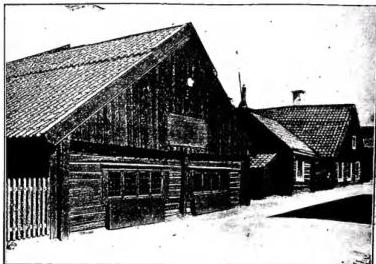
SVEZIA - Old wooden houses, built in 1654 at Eskilstuna.
and economic capacity of the country, with the consequence of Sweden’s decline in the Baltic and in European politics and the ascendancy of Russia. Charles’s death ushered in what historians call the Age of Liberty (Frihetstid), in which political affairs became the prerogative of the four estates (Nobility, Clergy, Bourgeoisie, Peasants), at the mercy of the two parties of the Hats (Hattar) and the Caps (Mösser), which, for their particular domestic political aims, did not hesitate to seek the benevolent support of France, England, Russia, and Prussia, all of which willingly granted it with the intention of diminishing Swedish power. But in 1772 the new sovereign Gustav III, through a coup d’état, restored royal authority. A son of the Enlightenment, Gustav III abandoned the policy of his predecessors in religious matters and issued an Edict of Tolerance in 1781, which also granted Catholics the freedom to practise their religion openly. As a result, Pius VI established an apostolic vicariate for Swedish Catholics in 1783. In the autumn of that same year the king of Sweden came to Rome, where he was cordially received by the Pontiff, and remained there until Easter 1784. During that same Holy Week, Swedish Catholics were once again able, after almost two centuries of persecution, to attend a public celebration of divine worship in Stockholm. The events of the revolutionary and Napoleonic age subsequently had serious political repercussions in Sweden. Gustav IV Adolf’s attempts to maintain neutrality between Russia and Great Britain in an anti-Napoleonic policy proved futile following the Franco-Russian alliance: in 1808 Tsar Alexander I invaded Finland, which, by the Peace of Fredrikshamn (1809), became part of the Russian Empire as an autonomous grand duchy. Gustav IV was forced to abdicate, giving way to a regime based on the separation of powers, established by the Constitution of 1809, which, subsequently revised, is still in force. The election of the French marshal Bernadotte as heir to the throne in 1810 (he later became King Charles XIV John, from 1819 to 1844) brought a new dynasty to the throne, which still endures. When the new prince saw Napoleon’s star setting, he promoted an alliance with Russia and with the anti-French coalition, and had war declared on Denmark, which, after being defeated, was forced to renounce its sovereignty over Norway; Norway then remained united with Sweden until 1905. The spread of the ideas of nationality gave rise to a pan-Scandinavian movement, with a single Nordic monarchy, a design not unwelcome to King Oscar I (1844-59), who hoped thereby also to reunite Denmark under his sceptre. The advent of liberalism instead led in 1865 to a reform of the Diet of the Four Estates and to the adoption of a representative system
with a bicameral parliament. Sweden, which at the Congress of Vienna had renounced all the territories south of the Baltic, shaped its policy according to purely defensive criteria and, especially after 1864, intensified its disengagement from European affairs. This neutralism spared it from being involved in the two world wars of the first half of the twentieth century and fostered its orderly economic and social development, with the progressive integration of the working class (represented by the Social Democratic Party) into the country’s political life.
III. PRESENT SITUATION OF THE CATHOLIC CHURCH IN S
On 24 January 1781, King Gustavo granted the Catholics of S. (which, since 4 May 1688, had been dependent on the apostolic vicariate of the Nordic missions) certain freedoms, and by a rescript of 15 September 1783 permitted the apostolic vicar Nicola Oster, sent by the Pope, to exercise governance and supervision over the Catholics. The first apostolic vicars achieved very little success. Only under Msgr. Lorenzo Studach (1833) did the situation improve, and churches were established in Stockholm (1837), Göteborg (1865), and Malmö (1872). In 1860, the law prohibiting native Swedes from embracing the Catholic religion under penalty of confiscation of property and exile was repealed. The decrees of 1870 and 1873 brought further concessions. On 19 May 1951, the Chamber accepted the law on religious freedom for the first time in the entire history of the country. Thus, the prohibition against building convents was also abolished. The new law, which came into force on 1 January 1952, permits such construction, subject, however, to the consent of the king or of the government of the State. Even after the new law, Catholics are obliged to contribute toward the Protestant State Church, since the Protestant pastors are entrusted with the civil registration of the population. The Catholic Church, by contrast, receives no contribution from the government.The apostolic vicariate of S. currently has 46 priests and 2 seminarians. The number of nuns is 149, and that of Catholics approximately 18,700, of whom 6,000 are Swedish; 27 of the priests and 140 of the nuns are foreigners: this clearly demonstrates that the Church in S. still needs the assistance of the universal Church.
IV. LITERATURE
A written literature arose in S. only after Christianity introduced the Latin alphabet into the country. Of the oldest epic poetry, which flourished in the age of the Vikings and was transmitted orally, no direct testimony remains; but echoes of it are found not only in the Edda and in the Icelandic and Norwegian sagas, but also in the Gesta Danorum of Saxo Grammaticus, in the Kalevala, and even in certain Russian folk songs. From the pagan age there remain only numerous runic inscriptions; but because of their brevity and their not always easy interpretation, they cannot be considered genuine literary testimonies. To(from Svedes, Stockholm 1913, p. 28)
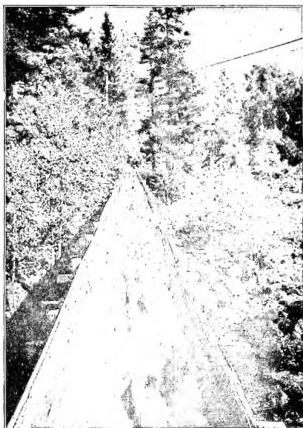
SWEDEN – Transport of timber by means of a watercourse.
The various provincial laws, fixed in brief mnemonic verses, date in their formulation from the pagan period, even though they were written down in the thirteenth and fourteenth centuries.
Numerous lives of saints, legends, chronicles, and poems on religious subjects, generally composed in Latin, testify to the Christian culture that developed after the year 1000 around churches and convents. Worth recalling are the four Offices and the sequence De spinea corona of Brynolphus, bishop of Scara (d. 1317), the song Rosa rorans bonitatem by Nicolaus Hermanni in honour of St. Brigida, and the Offices of Birgerus Gregorii. Among works of prose, notable is the biography of the mystic Kristina of Stommeln, written by the Dominican Petrus de Dacia (d. 1298). The only great poetic work of the Swedish Middle Ages, however, is the Revelationes of St. Brigida (1303–73), a collection in eight books of the Saint’s visions. The effective and imaginative style of these Revelationes, rooted in reality and at the same time open to the boldest mystical flights, still makes them interesting reading today, even apart from their historical and religious value. St. Brigida also rendered an important service to Swedish culture by having Latin religious works translated and founding the convent of Vadstena, where monks and nuns of the Order she had created continued, until the advent of the Reformation, to transcribe Latin texts and translate them into Swedish. While the works of Petrus de Dacia and St. Brigida belong to the line of the Neoplatonic currents that were then running throughout Europe, the author of the Konungastyrelse (“The Governance of a King”), a reworking of Egidius Romanus’s De regimine principum, drew instead upon Thomistic doctrines, dominant in medieval Europe.
Throughout the Middle Ages, every cultural initiative in Sweden was the work of the Church or arose in its shadow: the first Swedish university, that of Uppsala, was founded by papal bull in 1477, and the first book was printed in 1483 in a Franciscan convent in Stockholm. A Franciscan was also responsible for the first, admittedly not very successful, attempt at a history of Sweden, the Prosaiska krōnikas (“Prose Chronicle”), while the religious Orders also included Enricus Olai, author of the Chronica Gothorum, the first important Swedish historical work. Around the middle of the thirteenth century, chivalry also spread in Sweden, with its religious-secular ideals and its common heritage of tales and legends. The only direct testimony to the spread of chivalric tales, however, is provided by the three so-called Songs of Eufemia (Eufemia visorna). At the beginning of the fifteenth century, the legends of Alexander the Great, Charlemagne, and Theodoric would then be translated. Characteristic of the Nordic world, even though they originated under other skies and were often inspired by non-native legendary motifs, are the anonymous dance songs. Circulating throughout Scandinavia with only minimal variations and transcribed in the following centuries according to anything but scientific criteria, they now offer no evidence by which to judge whether there was, in this field, any specifically Swedish contribution.
While throughout the Middle Ages Sweden participated in the common European culture, with the advent of the Protestant Reformation it became detached not only from Rome but also from the culture of the Latin countries, even before the humanistic currents, calling for greater freedom and independence of thought, had reached II. Conrad Rugge was a modest humanist: he took a law degree at Perugia in the second half of the fifteenth century and later became bishop of Strängnia. Undoubtedly greater were the figures of Olaus Magnus (d. 1544), the last Catholic archbishop of Sweden, and of his brother Johannes. Both exiled in Rome, they sought an outlet for their nostalgia for their homeland and for their humanistic dreams of a greater past in the composition of fanciful historical works. Both Olaus’s Historia de omnibus Gothorum Suenumque regibus, published posthumously in Rome in 1560, and Johannes’s Historia de gentibus apdentrionalibus, published in Rome in 1554, became known throughout Europe (Tasso also drew inspiration from the former for his Torrismondo). A greater critical sense, but no greater scientific objectivity, is found in Olaus Petri’s Svenska Krönika (“Swedish Chronicle”) (d. 1552). Already a disciple of Luther at Wittenberg, he was among the first to spread Protestantism in Sweden and, together with his brother Laurentius Petri, worked on the Swedish translation of the Bible commissioned by Gustav Vasa. Again following Luther’s example, he also translated and composed numerous psalms, and the Tobiae comedia, the first Swedish dramatic attempt of any note, has likewise been attributed to him. Although the Protestant Reformation indirectly helped consolidate a national language (the problems addressed and resolved by Olaus Petri in his biblical translation lie at the basis of modern Swedish) and promoted the spread of culture among the laity, on the whole it also marked a setback in the cultural and scientific fields, occupying minds exclusively—for decades—with religious polemics and theological disputes. Besides the already mentioned archbishop Laurentius Petri, it will suffice to cite the names of Abraham Angermannus, Petrus Ioannis Gothus, and Laurentius Paolinus Gothus. The biography of Gustav Vasa written in 1533 by Petrus Swart and the poems in his honour composed in Latin by the court poet Henricus Mollerus indicate the tastes of the period, while the uncertainties left in people’s minds by the religious and political upheavals are clearly apparent in Johannes Messenius’s Scandia illustrata (1579–1639). During the reign of Gustavus Adolphus (1611–32), greater interest was shown in the sciences and literature, by then freed from theology: the State Archives, new universities, and libraries were established. Sweden, having by then risen to the rank of a great European power, no longer wished to be second to anyone, not even in the scientific and literary fields. A typical representative of the era’s multiplicity of interests, passion for research, and nationalistic enthusiasms was Olaus Rudbeck (1630–1702), professor of anatomy, scholar of botany and philology, and author of the imaginative Atland (1679), in which, surpassing
the fantasies of Johannes Magnus, he goes so far as to identify S. with Plato’s legendary Atlantis. Of greater scholarly value is the first history of Swedish law (De jure Sæanum et Gothorum vetusto) by Johan Stiernhöök. Beginning the first dictionary of the Swedish language (Gambla Sæa och Gotha males fästebur) and publishing Ulfila’s Codex argentus, Georg Stiernhjelm (1598–1672) pursues a nationalistic aim; it is love of country that drives him to “make the Muses sing in Swedish for the first time” in his epic poem in hexameters, Hercules (1658), a work lacking lyrical inspiration but fundamental to the subsequent development of literature. The works of Stiernhjelm’s numerous imitators, such as the now-forgotten Samuel Columbus (1642–79), have themselves been forgotten, but the poems of Lars Wivallius (1605–69) and Lars Johansson (1638–74), known by the name Lucidor l’infelice, are still alive. A kind of Nordic Villon, rebellious and vagabond, Lars Wivallius composed his finest songs in prison. Like Wivallius, Lucidor also made his living by singing at weddings and funerals; he experiences the joy of intoxication with a heavy Nordic sensualism, which would later recur in many Swedish poets. Toward the end of the century, the classicizing spirit of Trissino and Opitz, admired and imitated by Stiernhjelm and his followers, is stifled by the influence of Italian Marinism and the Second Silesian School. Rather than Johan Lillienstedt (1655–1732), translator of Guarini, and Christofer Levoncrona (1662–1710), it is Gunnion Eurelius Dahlstierna, an imitator of Marino, who deserves mention. Israel Holmström, an imitator of Scarron, and Johan Runius (1679–1713), on the other hand, look to France. But the defeat at Poltava (1709) suppresses every nationalistic dream, turning the poets back toward reality or toward a more complex religious attitude. If the religious ferment of the period finds an outlet in the hallucinated mysticism of Swedenborg (1707–78), author of many scientific and philosophical works, no less representative of eighteenth-century Sweden is the limpid simplicity of Linnaeus’s prose (1707–78), especially compelling in his descriptions of his journeys in Lapland and Holland. More than under the sign of religious speculation, the century, also in S., is marked by science and the court; in honor of the former and under the latter’s protection, numerous scientific and literary academies and societies arise in Stockholm: last in chronological order, but not in importance, the Swedish Academy, founded in 1786 by Gustavus III and still alive and active in the country’s cultural life. In the same year as Linnaeus’s journey to Lapland (1732), the first important Swedish weekly, Then swänska Argus (“The Swedish Argus”), modeled on Addison’s Spectator, is published in Stockholm under the direction of Olof Dalin. Court poet, official historian of the nation, and tutor to the crown prince, Olof Dalin (1708–63) is the most notable figure of the Gustavian period. More than an inspired poet or an original thinker, he was an animator and popularizer; his History of S. (Sæa rikes Historia), History of the Horse (Saga om hästen), and several songs in honor of nature deserve mention. His comedy Den afwundsjuke (“The Jealous Man”) and his tragedy Brynilde are now forgotten. The ideas of Voltairian rationalism, which Dalin had helped to disseminate, began, after the middle of the century, to encounter opposition from a Rousseauian-style sentimentalism, and the changing taste favored the success of the poets of the “order of the builders of thought” (Tankebyggareorden), open both to the demands of feeling and to those of reason. At the center of the group stands the poet H. C. Nordenflycht (1718–63), author of the sentimental collection Den sorgande Turturduftens (“The Sorrowing Turtle Dove”), which remains valuable for the author’s sincere search for truth, eternally engaged in a struggle with herself in an attempt to reconcile rationalism and sentimentalism, traditional religion and Enlightenment philosophy. Greater as poets were G. F. Gyllenborg (1731–1808) and G. P. Creutz, author of the elegant pastoral poem Atis och Camilla (“Atis and Camilla”). With the deaths of Dalin and Nordenflycht, Creutz’s departure abroad, and Gyllenborg’s withdrawal from the field of militant literature, a void is created in the