
UGRO-FINNIC. - A special linguistic family divided into two branches: the eastern or Ugric and the western or Finnic.
The first includes Hungarian, Vogul and Ostyak; the second includes Zyryan, Votyak, Cheremiss, Mordvin, the proper Finnic languages (Livonian, Veps, Votic, Estonian, Karelian, Finnish) and Lapp. Their original homeland was in north-eastern Europe, specifically the forested territories between the Volga and the Urals, along the Kama and Bjelaja rivers. It was here that their first contacts with Indo-European peoples occurred, as attested by common vocabulary in all Ugro-Finnic languages dating back to Proto-Indo-European (e.g.: Hung. *név* = name, Vog. *nam*, Ost. *nem*, Zyr. *him*, Finn. *nimi*, Lapp. *namma* compared to Skt. *nāman-*, Avestan *nāma*, Greek *ὄνομα*, Lat. *nomen*, Goth. *namō*, etc.). There are even more numerous testimonies of relations between U. and the Aryan branch of Indo-Europeans (e.g.: Hung. *száz* = hundred, Vog. *sat*, Ost. *söt*, Zyr. *sö*, Votyak *sü*, Cher. *šūdō*, Mord. *šada*, Finn. *sata* and Skt. *śatam*, Avestan *satəm*, Lithuanian *šimtas*, Old Church Slavonic *sto*, etc.). Their primitive but relative unity broke apart around the middle of the 11th millennium B.C. with the distinct development of the Ugric group from the Finnic. The ancestors of the present-day Hungarians detached themselves and, finding themselves near the much more numerous and powerful Bulgar-Turkic people living in western Siberia, moved with them between 460-70 A.D. towards the Caucasus, remaining for centuries in a Turkic environment that greatly contributed to transforming their civilisation. The Hungarians became autonomous when, no longer able to find protection within the Bulgar-Turkic Empire against repeated Pecheneg attacks, they had to turn westwards. The command of the seven Hungarian tribes was then already in the hands of the central tribe called *Magyar*, which later gave its name to the people, and the first stop was Lebedia, between the Don and the Dnieper, the second Etelköz (land enclosed by rivers), between the Dnieper and the Lower Danube. Here
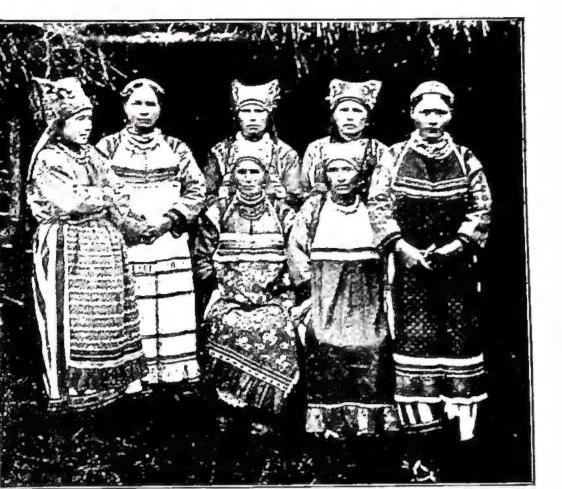
UGRO-FINNIC. - Group of Mordvin women from the Volga, with Baltic and Uralic features.
the definitive union of the tribes took place under the leadership of Árpád, who led the Magyar people to their new homeland between the Carpathians and the Danube, the Drava and the Austrian Prealps; this occurred in the last decade of the 9th century (v. HUNGARY).
The other two components of the Ugric group, namely the Voguls and the Ostyaks, who remained in the Urals territory, continued to live together and their migration from their ancient European seats to their present-day ones near the Ob River occurred not long ago. Voguls and Ostyaks are now reduced to mere remnants: in 1926 their numbers were 5,200 and 18,000 respectively.
The term Ugric, *ugro*, a scholarly technical term, however, derives from denominations recurring in historical sources for more than a millennium. The words *ugri*, *ungar*, *hongrois*, *Ungarn*, *Hungaria* all go back to the ancient name of the Bulgar-Turks: *Onogur*, which in the forms *ongur*, *ongr* passed, through Slavic languages (*ugre*, *ugry*, *ugré*, *úgrin*, etc.), into medieval Latin (plur. *ungri*), German (*ungar*) and, re-Latinised as *ungarus*, became French *Hungri*, *Hungaria*, etc. In Byzantine Greek it is found as early as the 10th century: *Οὖγγροι*. On the other hand, the names *Ugra*, *Jugra*, *Jugria*, used by ancient Russian sources, Arab geographers and European writers of the 15th-16th centuries to denote the territory inhabited by the Voguls and Ostyaks, are also derivations of *Onogur-ongur*.
Once the ancient Ugro-Finnic unity was broken, the western complex still followed the same evolutionary path for a long time and maintained more frequent contacts with Indo-European peoples than the Ugric group did. Its further division into two branches occurred around 1000 B.C. The Finnic branch (Cheremiss, Mordvins, Finns and Lapps) moved westwards, while the Zyryans and Votyaks (known as the Perm peoples) remained in their eastern seats between the Vjatka and Kama rivers.
The Zyryans, tributary to the Russians since the 13th century, converted to Christianity at the end of the 14th century through the work of St Stephen of Perm, creator of the Zyryan alphabet, who translated many religious texts into his language. These, together with the Hungarian ones from the 11th-13th centuries, constitute the oldest Ugro-Finnic monuments. According to a Soviet census of 1926, the number of Zyryans amounted to 364,000, most of whom are engaged in agriculture and trade.
The Votyaks, slightly more numerous, live south of the Zyryans in a territory that until 1236 was part of the Bulgar-Turkic Empire destroyed that year by the Tartars. After a long and peaceful coexistence with the Bulgar-Turks, the Votyaks fell under the dominion of Tartar khans, which lasted until 1552, when the Russians made them tributary to Moscow as well. In 1920 the territory they inhabited received an autonomous aspect. The very young Votyak literature is partly nourished by rich folk poetry, and partly, like the Zyryan, reflects Soviet literature.
The ancestors of today’s Cheremiss and Mordvins separated from the proper Finns no earlier than the 2nd century B.C. and continued to form a single people until the division, which took place slowly, became complex in the 7th century A.D. In the history of the Cheremiss and Mordvins three main periods can be distinguished: 1) Bulgar-Turkic influence (700-1236); 2) Tartar domination (1236-1552); 3) Russian domination (from 1552).
The language of the Cheremiss is more imbued with Turkish elements than any other Ugro-Finnic language. Today the Cheremiss number about 425,000 and live in two groups to the north-west and north-east of the Volga bend. The Mordvins, south of the Cheremiss and Votyaks, are scattered along both banks of the Volga and mingled with Russians and Turkic-Tartars. Despite their relatively high number (in 1926: 1,267,000), they resist Russian cultural and linguistic influence very weakly.
The Lapps have lived from very ancient times in the northern regions of Norway, Sweden, Finland and Russia. Their total number amounts to only 35,000. They speak different dialects, which undoubtedly belong to the Ugro-Finnic family, while anthropologically the Lapps, according to recent studies, represent the remnant of a very ancient Nordic Mongoloid type. Their present language is certainly not their original idiom, but the speech of the Finns adopted in the last centuries B.C., at the time, that is, of the division of the western Ugro-Finnic branch into the Finnic and Mordvin-Cheremiss groups. Even their name derives from Finnish, where *lappi*, *lappi* means ‘remote place’, and *lappalainen* ‘inhabitant of out-of-the-way places’, which in a transferred sense means ‘backward, primitive, uncivilised’. The Norwegians, who had contacts with the Lapps from ancient times, always called them ‘Finnic’ and this word (*fennici*), first handed down by Tacitus (*Germania*, ch. 46), in the Middle Ages served to denote now the Lapps, now the proper Finns (*suomalainen*).
The ethnic units of the Finns, Estonians, Karelians, Veps, Votians and Livonians formed after the detachment of that Ugro-Finnic group which, leaving the ancient seats of the Volga, moved westwards to settle finally in the territory south of the Gulf of Finland and Lake Ladoga. Linguistically, its components are still very close today. In the last centuries B.C., this group came into contact with Baltic peoples (Lithuanians, Latvians, ancient Prussians), from whom it learned agriculture, animal husbandry and house construction. In the first centuries of the Christian era, Germanic influence began, which was decisive for the further cultural development of this group, and only towards the 8th century A.D. did its members begin to take on more or less distinct features of new ethnic identities.
The Finns took possession of their present homeland (Suomi) between the 3rd and 7th centuries AD (v. FINLANDIA).
The Karelians, once the most advanced of the inhabitants around Lakes Ladoga and Onega, succumbed to the Russians by the middle of the 17th century, converted to Orthodoxy, and lost all cultural contact with the Finns. The sense of brotherhood was later rekindled by the discovery in Karelia of a shared ancient poetic treasure. Today the Karelians (no more than 300,000) live in Russian Karelia and farther south, in the regions of Tver and Novgorod. The Veps (barely 30,000 souls) are scattered across the territory south of Lake Onega and east of Lake Ladoga. Their backward civilization and instinctive reserve have so far resisted Russification, though this has lately been making steady progress. The smallest group among the Finnic peoples is represented by the Votes, who in a few remote spots of Ingria are struggling through their final days. Almost extinct too is the language of the Livonians, who gave their name to Livonia, which they inhabited from the 12th century onward.
The Estonian people, freed from Russian servitude without losing their identity or language, organized themselves in 1918 into an independent state, Estonia, which in 1934 had 1,125,000 inhabitants. The two main Estonian dialects, those of Tallinn and Tartu, are very dissimilar, and each has developed its own literary language; their unification is of recent date. At present Estonia is incorporated into the Soviet state.