
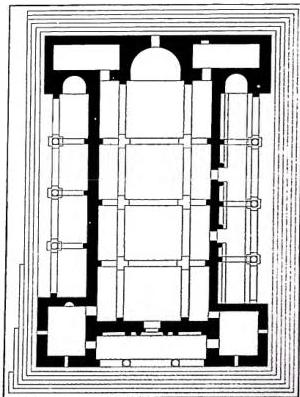
ARMENIA - Basilica of Odzum (ca. 8th century).
of Catholicism. He was wrongly accused of having granted, in the Regolamento of the patriarchate, to the laity in the election of patriarchs a role condemned by the Reversurus. However, this regulation served for the election of his successors Paul Peter XI Emmanuelian (1899-1904) and Paul Peter XII Sabaghian (1904-1909), without Rome protesting. The controversy flared up again during the first three years of the patriarchate of Paul Peter XIII Terzian (1910). In Turkey, the new Ottoman constitution had been proclaimed. Terzian refused to sign a new Regolamento that the laity had already presented to his predecessor Sabaghian, in which they sought to introduce popular suffrage even in the election of diocesan bishops. Having come to Rome, he convened the episcopate in a national synod (1911); Pius X reserved for himself, on that occasion, the appointment of vacant sees. The agitators, this time exclusively laymen, rebelled; and with the support of the Sublime Porte, they declared Terzian deposed from his civil attributes as patriarch (1912). The scandal did not end, unfortunately, until the sword of the Turkish massacres of 1915-18, in which five bishops were martyred, three others died in exile; of the 16 dioceses, only three remained; of 250 priests, about 126 were massacred along with a multitude of nuns.
The Armenian episcopal conference held in Rome in 1928, through the munificence of Pius XI, transferred the patriarchal see of Cilicia from Constantinople to Beirut (Lebanon), where today Cardinal Gregory Peter XV Agagianian resides, toward whom all hopes are directed for a spiritual resurrection of the Armenian nation.
#### IV. - THE ARMENIAN RITE.
1. Origin. - The origin of the Armenian rite is connected with the spread of the Gospel in Armenia, which occurred around the year 300, through the work of St. Gregory the Illuminator (q.v.), who had been educated in Caesarea in Cappadocia, and other followers. These brought to Armenia the rite of Caesarea, which in turn derived from that of Antioch, from which the first missionaries of the same Church had set out. There was then a great affinity between the Antiochene and the Jerusalem rites, both of which were held in high esteem by the Armenians.
2. Language. - With the Cappadocian rite, the Greek language was also adopted for divine worship, due to the lack of an Armenian alphabet. Persia, the rival of Byzantium, during its brief period of invasion in Armenia (368-369), attempted to replace Greek with the language of the Syrians, its faithful subjects, and maintained its preservation even after the division of Armenia in 387. The inefficacy of that incomprehensible tongue for the spiritual benefit of the people prompted St. Mesrop (St. Mašthoc), the doctor, to create the Armenian script, which he accomplished in 404, basing it on the Greek alphabet. With the help of the patriarch Isaac and his disciples, versed in Greek and Syriac letters, he immediately translated the Holy Scriptures and the liturgical books. After the Council of Chalcedon (q.v.), the official Armenian Church (591) separated itself, aligning with the Syrians who had instigated the Monophysite schism, and began to be influenced by them also in its rite. Indeed, it was in the 6th century that the following changes occurred: the suppression of water in the chalice at Mass, the restoration of the ancient union of Christmas with Epiphany, and the addition of the words “qui crucifixus es pro nobis” in the Trisagion, which was accepted and preserved even among the Jacobites and dissident Armenians.
3. Office. - In the 5th century, when the Armenian rite properly so-called began, public prayer (in Armenian Pašton, office) was composed of six hours: three, recorded by historians of the time, recited by the Leontine priests in prison among the Persians: the Nocturn, which took place at midnight; the Matins, which began at cockcrow; and the Vespers, said in the evening; there were also the prayers of the Terce, Sext, and Nones, which the Mandacuni enriched with his Admonitions and Lenten Prayers. Stephen, bishop of Iunius, in the 8th century, added two other offices to the aforementioned ones: one at Sunrise (Prime), and another at Rest (Compline), which followed Vespers. But these two, originally proper to that diocese, had become common by the 10th century, so that they could be commented upon by Khosrov, bishop of the Anzevesi.
In the breviary manuscripts of the 14th century, we find another hour, which followed that of Rest and was called the Hour of Peace. It was recited privately, before retiring, and only later became public. In certain circles, all nine offices were recited every weekday, as in Sunia, while other testimonies from the 7th to the 14th centuries speak of only seven being recited. The Nocturn was reserved for feast days, and the Sunrise office for weekdays, alternating in turn with the Hour of Peace. This was the system followed throughout the nation. In certain circles and periods, two of these offices were entirely suppressed, as affirmed by Moses of Erzinca in the 13th century and others.
The obligatory offices were first recited privately, then publicly in church, according to testimonies from the 8th century onward.
In the 5th century, the breviary (Alotanoc or Alotamatoic) was composed of the 150 psalms and the prophetic blessings, for which reason it is defined in the canons of St. Isaac as: “Office of Psalmody.” This patriarch divided the psalms into eight “canons” or groups, each followed by a blessing, an “admonition,” and a double “prayer.” The office was then completed with biblical readings and doctrinal explanations. The Mandacuni added his admonitions, as we have said above; and gradually it was enriched, also with hymns subsequently composed, which formed a separate volume, called the Sorocan (Hymnal); while the year-round office, with the ceremonies and readings of the Mass, formed the Conocoic (Calendar).
4. Ritual (Maithoc). - The ritual was composed, after the abandonment of the Syrian one, in the 5th century, as evidenced by its affinity with the Greek ritual, due to the bonds of sympathy that then linked the Armenians to Hellenism. The original structure of this book is not known to us; but we do know for certain that it soon began to develop. In the oldest surviving manuscript from the 11th century, preserved at San Lazzaro in Venice, the first chapter is on the Order of the Foundation (and Consecration) of the Church, by John Mandacuni, Katholikos of the Armenians (years 478-90).
The ritual underwent another reform in the 9th century, or rather, all the previously separate blessings were gathered into a single volume to facilitate its use. Later authors attribute this work to Maithoc, superior of the Sevan monastery, whose name would have been appended to the books, while his disciple Stephen, in the memoir that has come down to us, states that he himself carried out this work: “I made,” he says, “this little book in 893” (Ms. no. 1571 of S. Lazzaro). Since this memoir is found only in the ritual books, it concerns the same work, which he does not think at all of attributing to his master in the biography inserted in the same document. It is far from being a “little book,” however, since it contains 45 chapters: it is the sole and precious representative of the ancient, though not primitive, state of the ritual, and was published in English by Conybeare (Oxford 1905).
With the approach of the Western Church to the Armenian East and Cilicia at the time of the third crusade, the Armenian rite came under the influence of the Roman rite. Catholicos Gregory IV, in 1185, requested from Pope Lucius III the Roman ritual, which he had translated into Armenian. In Vatican codex Bb 100 (13th century) there are two orders of Baptism: the Armenian and the Latin, and the order of Confirmation, which is administered by the bishop; both were practiced at will, as confirmed by the Council of Sis in 1342. The Latin element is more abundant in the exemplar written at Sis in the 14th century. The council also refers to other Latinizing innovations. This confusion of rites could not persist even in Cilicia, because the Greater Armenia never accepted it and it was suppressed in subsequent ritual books. Instead, the minor orders, unknown in the Armenian Church, were spontaneously accepted and preserved by the entire nation; they were first mentioned by Zacharias Dzoraporetsi in the first quarter of the 14th century and by the Council of 1342, and were inserted in the aforementioned codex of 1345, along with the unction of bishops and priests and the handing over of vessels, also recalled by the same council and still practiced; likewise, the order of the coronation of kings, used in Cilicia. The Catholics, then, at Rome’s suggestion, accepted the infusion of water into the wine of the chalice, the separation of Christmas and its related feasts, and Extreme Unction, abandoned since the 10th century, which had already been attempted to be restored in Cilicia; as well as the modification of the Trisagion and the blessing of the oil of the sick, performed by the bishop instead of the priest. Besides these, many other points of the Latin rite were adopted by the Catholic clergy in its ritual, published by Hassunian (1880), which diverges from that approved by the Sacred Congregation of Propaganda Fide in 1840 and edited by the Mechitarists of Venice on the basis of ancient texts (1831).
What is of interest here is the fact that this Mass was immediately received also by the Armenian Church, as is evident from a passage attributed to a famous Armenian by Faustus, who wrote toward the end of the 4th century, and highlighted by P. Gathircian (SS. Liturgie degli Armeni, pp. 97-132). The Armenian translation of this liturgy, executed in the 5th century, is still preserved in manuscripts along with another medieval version. It was followed by the current one, which since the 10th century has been known in Armenia by the name of Athanasius. Gathircian found traces of this Mass in Armenian literature between the 5th and 8th centuries. A passage common to this and a “warning” by Mandacuni is enough for him to conclude that the same patriarch had a hand in this liturgy (op. cit., pp. 323-28). He may have been a reviser of it, which in its essential parts corresponds to that still in use today in the Greek-Byzantine rite under the name of Chrysostom. Its origin is therefore clear; and reasonably F. Cabrol linked it with the Byzantine (in DThC, IX, col. 817). It is still the same liturgy, first shorter and later developed in the Greek text and in Armenian, which was commented on by Khosrov around 950 (Comment. Missae, Venice 1869) and by Nerses Lambronatsi, archbishop of Tarsus, in 1177 (Comment. Missae, Venice 1846), the latter of whom also “embellished” the missal. After him,
ARMENIA - Basilica of Ereruk (10th cent.).
Additions were made: the beginning of the breviary and the Armenian version of the Roman Missal, probably translated together with the ritual, the vesting prayers, the Confiteor in its three parts, which first appear in manuscripts of the 13th century, and the last Gospel (cf. Hatzuni, Messale armena, pp. 14, 15, 25). Alongside this, other liturgies existed in Armenia, and Khosrov saw them without being able to explain all of them; this means that they were also used on certain days. This is also indicated by Ukhtanes, toward the end of the same 10th century, recalling his meeting with Anania on the banks of the Akhurian River, where “they said the Mass of Domine potentiae (thus begins the Mass), which they say is of Athanasius” (p. 12). It is precisely this distinction that proves that other Masses were in use, of which ten are counted in later manuscripts, in addition to the usual one. Three of these, namely the two translations of the Basil and the Chrysostomian, contain passages from the ordinary missal, and are then cited by the Councils of 1397 and 1316 (Gathircian, op. cit., p. 352); and an indicator, of which the oldest copy dates to 1287 (Ms. 1411 of S. Lazzaro), also marks the days of celebration of those of Athanasius (the common one), of Chrysostom, and of Basil (2nd translation), although the Lambronese declares that at his time they did not have the Chrysostomian reform. It may be that this was translated and admitted after him.
One of the characteristics of the Armenian liturgy is, besides the absence of water from the chalice, the use of unleavened bread, whose use is very ancient and confirmed by all Armenian writers, beginning with Moses II, who, in the letter to Emperor Maurice (591), declared that he did not wish to go to him “so as not to eat bread baked in an oven, or drink hot water,” which were the elements of the Greek Mass. In the ancient Armenian liturgical collections we also find that of the Presanctified, in accordance with the Greek text, while the Cilician Ms. 1411 of S. Lazzaro has modified it with various omissions and the addition of some passages from the ordinary Armenian missal, intercalating it then into the vespers office. It was to be celebrated “on Wednesdays and Fridays of Lent.” It seems that it was practiced arbitrarily in Cilicia, while Greater Armenia did not want to know anything of this “semi-Mass” or “Presanctified Liturgy,” according to Gregory of Tavel (1397).
The Sung Mass—indeed the only one at first—was reserved, as well as for feast days, for Saturday and Sunday, as the Council of Duin decreed in 645 (can. 6). But later the Low Mass also appears in Armenia, deriving from the application to private individuals of the divine Sacrifice in “quarantines,” which is cited in the canons of the Council of Partaw in 768 (can. 18), and which made necessary the daily private celebration. This manner was widespread in the Middle Ages throughout the country, as confirmed by countless inscriptions remaining in ancient churches and by the Lambronese, who also describes the very simple form of it, with only the celebrant (Comment. Missae, p. 438), or with the assistance of a minister. This system continued until the 17th century and was therefore preserved only among Catholics. During Lent, in which the liturgy was suspended except on Saturday and Sunday, there was instead used throughout Armenia an “Order of the Prayer of Refection at the ninth hour of Lent,” which was the so-called Dry Mass, i.e., without oblation. At that time it did not yet have its own schema, but one of the Masses in use was read, e.g., that of St. Athanasius. Later it had its own formulary, which is described in the “Instructions” taken in the 12th century from the Theleni monastery (Ms. 1372 of S. Lazzaro). It was a summary of the ordinary Mass, as it appears in the breviary of Princess Mariun (14th cent.) at S. Lazzaro (Ms. 521), and in Vatican Ms. V 3 (13th cent.), the latter ending thus: the priest “blesses the bread and distributes it, and they depart,” as in the common liturgy. The missal currently in use among Catholics is in fact twofold: the one printed in Rome in 1677, with some arbitrary doctrinal corrections by the Armenian priest Barsech; and that published by Patriarch Hassunian in 1879 for the Low Mass, and somewhat Latinized. All the others are no longer in use.
V. – CANON LAW.
Up to the 5th century the canonical repertory of the Armenian Church, like that of the other Eastern Churches, consisted of the decisions of ecumenical councils, of pseudo-apostolic collections, and of some national synods.
The canons of Nicaea (325) were introduced through St. Aristakes, who had taken part in them. For the canons of local councils we lack contemporary allusions in historical sources; however, it is not improbable that the canons of one or another local council, in which the Armenians had participated through the see of Caesarea, were introduced.
Worthy of mention is the canonical letter, consisting of the answers to the 9 questions of the Armenians, presumably written around the year 333 by Macarius I of Jerusalem to St. Verthanes the catholicos (or, according to some, around 564 by Macarius II to Verthanes, bishop of Sunia).
There were also the canonical decisions of the First National Legislative Synod of Aštisat (354-55), where the so-called First Apostolic Canons were adopted, i.e., the Doctrina Apostolorum composed of 34-35 articles; then the canons of Ephesus (dogmatic) officially introduced into Armenia through the Translators under Catholicos St. Sahak at the national synod of Aštisat around 435; the disciplinary canons of the National Council of Sahapivan (447), and presumably also the so-called Canons of St. Sahak the Great, Soperk Haykakanlı, Venezia 1853, 2ª serie, pp. 71-134 (Armenian), as well as the so-called Second Apostolic Canons, which would be the Canones Apostolorum composed of 85 articles, published by Funk, and finally the Canons of St. Thaddeus the Apostle.
At the beginning of the 8th century it appears that the first work of systematization or coordination was carried out in the form of an official canonical collection, the Kanonaghirkh, by John of Odzun, catholicos called the Philosopher (717–28), who gathered the canons then introduced or in use in the Armenian Church and preserved in the patriarchal curia. The merit of the work seems to have been that of having collected these norms in chronological order, reconstructing for each series the preface indicating the motivation, the date, and the index to facilitate their use. Since the original of Oznetzi’s Collection or a coeval manuscript is lacking, it is not easy to determine precisely which canonical groups it comprised. We can only conjecture, on the basis of historical testimonies and citations made by contemporary writers, that the said Collection should have contained, in addition to the series of canons cited above, other new groups introduced into the Armenian Church after the 5th century up to his own time. It certainly included the series of canons of the Councils of Ancyra (314), Neocaesarea (314–25), Antioch (341), and Laodicea (343–81); perhaps also the so-called canons of St Athanasius and the national synods convoked in the city of the patriarchal residence at Dvin, namely the 39 canons of Nerses II of Aštarak, the 12 canons of Dvin of 645 under Nerses III, and those of 719 under John of Odzun; and perhaps other series of canons of the Holy Fathers that it is not possible to identify.
This Collection of Oznetzi was further enriched up to the 10th or even 11th century by the addition of other canonical groups from Armenian synods, and perhaps also from Holy Fathers.
Judging from the oldest codex of the said canonical collection that has come down to us (the Giulfa codex, Persia, written in 1098, now preserved in the monastery of the Most Holy Saviour), by the end of the 11th century the Armenian canonical collection, the Kanonaghirkh, contained, in addition to the aforementioned groups of canons, also the 114 canons called the Second Nicaean (actually an eclectic juxtaposition of Nicene and topical canons); the 50 canons of St Basil of the first series, called the “first,” and of the second series, called the “second”; the 21 canons of Sardica (343–44), the 23 canons of Gangra, the 24 canons of the National Synod of Partaw (771), the canons attributed to St Gregory the Illuminator, and many other canons transmitted under the name of John Mandakuni, of Abraham bishop of the Mamikoneans, and of the National Synod of Karin (Erzerum); and under the names of the Holy Fathers and ecclesiastical writers, such as the 27 canons transmitted under the title of the “Fathers Successors of the Apostles,” in addition to those under the name of the Apostle Philip, Clement of Rome, and St Nectarius, St Hippolytus, St Epiphanius, St Ephrem, St Gregory the Theologian, St Cyril, St Dionysius of Alexandria, St John of Jerusalem, Dionysius the Areopagite, etc., containing one or two canons of lesser importance.
From the 11th century onward this official collection underwent no further development, so that the decisions of the subsequent national synods of the 12th–17th centuries remained outside the collection. Almost all the manuscripts of the Kanonaghirkh from the 11th–17th centuries preserve the same contents.
All this canonical series was collected in the form of a Nomocanon by the glossator Mechitar Gosh (d. 1213) in the Datastanaghirkh (Book of Judgments or of Judicial Sentences), where the author, following his own systematic order, cites the text of the canon or of a vóμος and provides a commentary. The work was written between 1184 and 1213. This Nomocanon Collection dominated throughout the Middle Ages as a manual of ecclesiastical-civil law, both in Greater Armenia and in Cilicia, where it prevailed rather in the form of the redaction of the Code of Sampat Connetable, and also in the Armenian colonies of Poland, where a Latin version was ratified by Sigismund I in 1519, and of Tartary, where a Tartar version was made for the Armenian colonies of Astrakhan and the Crimea. Indeed, it had notable influence on the Georgian Code in the redaction of Vahtang VI (18th century), in whose third part it is incorporated, and indirectly also on the general Code of Tsar Nicholas I in 1835, when it was decided that the Russian Senate would make use of the aforementioned Code of Vahtang VI.
The Canonical Collection of the Kanonaghirkh, like that of the Nomocanon Datastanaghirkh of Mechitar Gosh, having been closed at the end of the 12th century, the disciplinary acts of the subsequent Armenian synods or the patriarchal encyclicals of the 13th–16th centuries remained outside the aforementioned collections. Among these acts worthy of mention are the Patriarchal Encyclical of St Nerses Glajese (1166–73), of Constantine I catholicos (1220–67), the Acts of the Armenian Synods of Sis of the years 1204, 1246, 1307 (the last under Gregory VII of Anazarba), the Synod of Adana of the year 1316, which confirmed the Acts of the previous synod (1307), the Synod of Sis of 1342; as well as the Constitutions of the monastery of Zak of 1270, and the Synod of Jerusalem of 1651. The Synods of Sis of the year 1307 and of Adana of the year 1316, as synods of Latinizing tendency, were not accepted by the eastern vartapet. It was the period in which the influence of Latin discipline had begun through the frequent correspondence and embassies between the Roman Pontiffs and the patriarchs, kings, and princes of Armenian Cilicia during the centuries of the Crusades. This influence, although contested, grew in direct proportion to the penetration of Western missionaries—Franciscans and Dominicans first, and later, after the 16th century, of other orders (Jesuits, Theatines, Carmelites, Capuchins, etc.)—and finally of the Armenian students of the Urban College and the Armenian College of Lviv.
At the beginning of the 18th century, as a consequence of the official and definitive Armenian schism, Armenian canonical discipline bifurcated: Catholic Armenian discipline and non-Catholic and dissident discipline. The latter is constituted predominantly by the ancient traditional Collection of Kanonaghirkh, by the canons of Armenian synods extra-collections, by the book Datastanaghirkh of Mechitar Gosh, and by the synodal or extra-synodal decisions of the patriarchs of Echmiadzin. The encyclical and private letters of the catholicoi of Echmiadzin—of Simeon of Erivan (1763–80), Lukas Karnetsi (1780–99), Hovsep Arluthian (1800–1801), and Daniel I (1801–1808)—are collected in Alaneantz sac. Kiut, Archivio della Storia Armena (in Armenian), vols. III, IV, IX, Tiflis 1893–99.
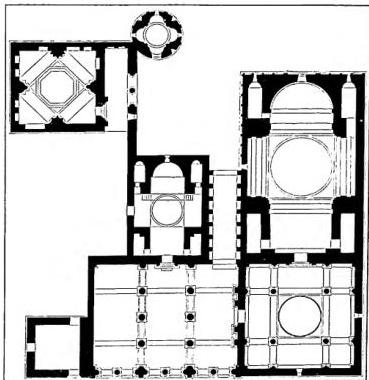
ARMENIA - Monastery of Sanahin (c. 11th cent.).
Europeans, or Armenian pupils of the Urban College. The new hierarchy, moreover, being chiefly preoccupied with orthodoxy and dogmatic integrity and with the sustenance of Catholic missions amid persecutions, and also owing to a lack of knowledge of ancient traditions, generally entertained a certain distrust toward those same traditions. On Mount Lebanon synods were convened that were exclusively elective; for discipline, recourse was had to custom, albeit very vaguely known, and more to Western canon law. Under Abp. Nurigian and Abp. Marusci, the first two Armenian Catholic primates of Constantinople, measures of a rather liturgical character were taken.
In 1848, during the apostolic visitation of Abp. Innocenzo Ferrieri, certain resolutions were adopted (Propaganda Archives, Acts of 1849–50, text of the 37 Dubia, ff. 92–93; Rescripts, ff. 81–91); and in 1851 the episcopal conference of Primate Hassun was held (ibid., Acts of 1853, part III, Ponenza Stato della Nazione Armena). In the same year (16–18 Oct.) the Armenian Synod of Bzommar was convoked on Mount Lebanon under the presidency of Michael-Peter VIII Katholikos (Mansi, XL, cols. 890 ff.), whose acts, however, examined in Rome were not approved, whether because they were incomplete or perhaps rather because of the failure of the synodal Fathers themselves to achieve union. In 1867 there was the Roman Episcopal Conference (Mansi, XL, 953–1018). The Armenian Synod of Constantinople of July–October 1869, convoked by the decree of 4 Apr. of Patriarch Hassun, following suggestions conveyed by Pius IX in the letters Commissum humilitati and Libentissime certe of 1869, to restore Armenian Catholic discipline, was prepared with serious study by a commission composed of competent theologians and canonists, such as Azarian Vartapet, Malachia Ormanian, etc., and by eminent figures of the Armenian-Catholic clergy, both secular and regular, who, alongside knowledge of Latin discipline, were also acquainted with the ancient sources and canonical traditions of the Armenians. When the synod was on the verge of concluding, its sessions were abruptly suspended, the fathers having to depart for the Vatican Council. It must be acknowledged: this was the first Armenian-Catholic synod conducted with broad vision, on a grand scale, by persons truly competent, such as those who constituted the three Preparatory Commissions (theological, canonical, liturgical). The acts could not be promulgated; they survive only in the few lithographed copies that served the synodal Fathers themselves. It is a precious document for penetrating the mind and outlook of the prelates of an era in which disciplinary controversies and problems of reconciling Eastern disciplinary institutions and privileges with Western ones were very heated, in order to impart to the former the dynamism and vitality of the latter.
The Synod of Calcedonia (1890), convoked by Patriarch Azarian, is nothing other than the perfection of the acts of the 1869 Constantinople Synod. Azarian Vartapet, who had been the guiding spirit of the Constantinople Synod and one of its principal promoters, at Calcedonia did no more than promulgate, after certain revisions and additions, under his own patriarchal authority, the very acts of the 1869 Synod, pending papal approval, which, unfortunately, was not obtained. The acts, comprising in all 928 canons, were published in 1910 under the editorship of Alessio Sirounian Vartapet. It is to be noted that this was the most organic, best elaborated, and best representative synod of Armenian disciplinary institutions, adapted to the exigencies of modern times. To anyone who studies, even cursorily, the acts of these last two Catholic synods (of Constantinople and Calcedonia), the great service rendered by the learned historical, theological, liturgical, and canonical publications produced from the late 18th century through the 19th by the two Mechitarist monasteries of Venice and Vienna at once leaps to the eye—works such as those of Ciamcian, G. B. Aucher, Ave-Dichian, Gathircian, etc., which created the first current of trust and respect toward the ancient sources of Armenian tradition.
The National Synod of Rome of 1911, convoked by Patriarch Terzian with the assistance of a body of illustrious Latin theologians and canonists who, in the Preparatory Commission, represented the preponderant part in comparison with the Armenian consultants, is the synod currently in force and use in the Armenian Patriarchate of Cilicia, having been approved in forma communi by the S. Congr. de Propaganda Fide. From the standpoint of the expression of Armenian canon law, it has very limited value, both because of the extensive adoption of Western principles and institutions and because of the predominance of the dogmatic and hortatory part, in which the disposititive part is almost lost.
It must be noted, moreover, that, given the almost rudimentary knowledge of Armenian canonical tradition, none of these Catholic synods of the 19th–20th centuries represents the ancient disciplinary tradition in its entirety, not even the Synod of Calcedonia, although it was the one that best realized the effort to restore traditional Armenian canonical discipline. This is confessed by the Synod itself in cann. 117, 118, 216 (ed. arm.).
For the modern Canon Law of the dissident churches of Egmazin, cf. Aivarat (arm. rev. of Egmazin), 1882, p. 83; for the resolutions of the Synod under George IV regarding the duties of rural deans, see the same journal 1887, pp. 47, 93, 140, 288, etc.; and in subsequent years see the titles Archiv. del Beat. Patriarca, and the Cronaca del Sinodo. This journal is rich in information regarding dissident canon law.
Studies: F. Bischoff, Das alte Recht der Armenier in Lemberg, Vienna 1862; A. Balay, Historia Dogmatis Catholici apud Armenus, Vienna 1878; A. Pipas, L'Autorità legislativa degli armeni della città di Elisabetopoli di Transilvania, in Pazmaveb 1891, pp. 104, 172, 373; 1893, pp. 335, etc.; A. Meghavorian, Etude ethnoge. juridique sur la famille et le mariage arménien, Geneva 1895; G. Daëan, Doctrina Apostolorum (in arm.), Vienna 1896; V. Hatzuni, Cod. can. or., Fonti, fasc. VIII, Vatican City 1932, pp. 141–66; G. Amaduni, Cod. can. or., Fonti, 2ª serie, fasc. XII, Monachismo, Venice 1940; V. Hatzuni, L'autore della lettera a Verthanes à Macario I e non II, in Pazmaveb (arm. rev.), 89 (1931), fasc. I–II.
Infine si trovano molte notizie utili riguardanti il diritto canonico armeno, negli studi circa il diritto armeno civile, come: M. Brosset, Notice sur le Code Glorien, manuscrit de la biblia Royale, in Nouveau journal Asiatique, 3 (1829), pp. 177-201; id., Détails sur le droit public arménien, extraits du code glorien du roi Wakhhang, in Nous, journ. Asiatique, 9 (1832), pp. 21-30; A. von Haxthausen, Transilvania, 2 tomi in 1 vol., Lipsia 1856 (contiene molte interessanti notizie circa il diritto armeno comparato con quello dei Georgiani, ecc.); M. Brosset, Rapport sur un manuscrit arménien de Mechitar Gos, in Bull. de l'Acad. impér. des sciences de Saint-Pétersb., cl. hist. phil., 6 (1849), pp. 380-382; J. Kohler, Das Recht der Armenier, in Zeitschrift f. Vergl. Rechtswissenschaft, 7 (1887), pp. 385-436; M. Ghazarian, Armenien unter der Arabischen Herrschaft bis zur Entstehung des Bagratidenreiches, Marburgo 1903, p. 87; H. Thopdschian, Politische und Kirchengeschichte Armeniens unter Alet I und Sinopad I, Berlino 1905, pp. 96-215; V. Aptowitzer, Beiträge zur mosaf-