
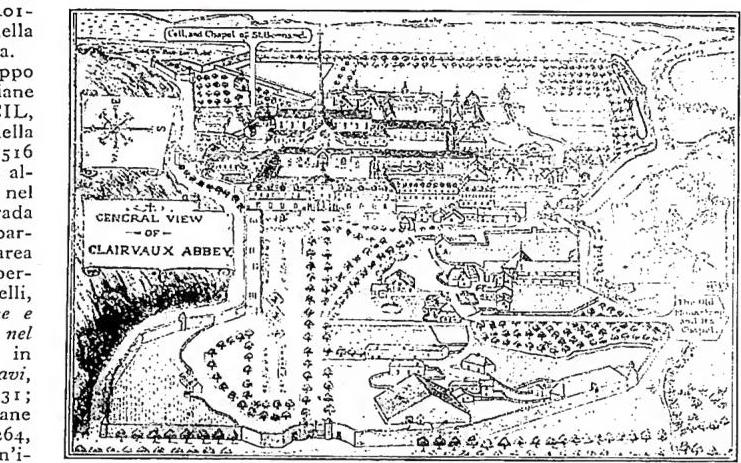
**CLAIRAUX (Clara Vallis).** – A toponym subsequently very common (v. CHIARAVALLE), a nursery of saints and scholars, of bishops and cardinals, among whom Pope Eugenius III (1145–53); the Grammaticus calls it “the noble monastery of France,” and Bernard himself “the heavenly Jerusalem.” Much contributed to the endowment of C. was Hugh I, Count of Troyes; kings, nobles, and bishops proved munificent, especially Count Theobald of Champagne, who, in 1135, given the enormous growth of the community, had almost the entire structure enlarged at his own expense. The King of Portugal, Alfonso I, in a letter of 27 April 1142, offered his kingdom for the needs of C.
Between 10 October 1118 and 11 February 1154, C. alone founded no fewer than 67 monasteries, which in turn multiplied prodigiously. At the death of St Bernard, 20 August 1153, the monastery housed more than 700 monks, devoted to contemplation and fieldwork, to study and the arts (v. CISTERCIANS).
Up to 1718, 49 abbots are counted, under whom the monastery’s fortunes varied (cf. list in Gallia Christiana, IV, Paris 1728, cols. 796–814). The abbey was sold at auction in 1792, its rich library dispersed; later turned into a glassworks, it is today a state penitentiary. The ancient enclosing walls measured about 2 km in length.
Among the abbots are remembered: Robert of Bruges, Geoffrey, Pons of Polignac, Gerard I, Henry (later cardinal bishop of Albano), Peter Monoculus, Conrad of Urach, Stephen Lexington.
---
ART. – The small original monastery founded in 1115 by St Bernard was enlarged in 1135.
The buildings were grouped into two complexes: the monks’ dwellings, beside which stood the church, the library, and rooms for study, and the structures intended for craft activities.
The church had a Latin-cross plan divided into three naves covered with ribbed vaulting, and a shallow apsidal choir flanked by two chapels on each side. At a later date the choir was demolished and replaced by nine trapezoidal radiating chapels, while the choir itself was transferred to part of the nave in front of the presbytery; the enlarged church was consecrated in 1174. Its features set the pattern for all Cistercian architecture (v.). The 1667 plan reproduced by Viollet-le-Duc shows that the abbey retained its original arrangement until that time, though notable remodellings were carried out in the following century. – Vedi Tav. CXI.
CLAMYS (κ λ π μ ζ̇ ς). — The Romans called by this name a cloak shorter than the pallium, the two extreme points of its long side being gathered on the right shoulder and fastened with a clasp. It was essentially a military garment.
In early Christian art, it is given to Orpheus, sometimes to the Magi, to the soldiers accompanying the centurion Cornelius at the miracle of the fountain; only once is it worn by the Saviour as King of Judea in the scene of the conversation with the Samaritan woman in the cemetery of Pretestato. The evangelists Matthew (27:27 ff.), Mark (15:16 ff.) and John (19:2) recall that the Lord was clothed in a purple cloak (clamys coccinea) when mocked by the soldiers. The long clamys is called the paludamentum.
CLAREMBALDUS of Abras. — Chartres (v.), of whom there is known to date a lengthy commentary on Boethius’s *De Trinitate*, written around 1153 (cf. ed. W. Jansen, Breslau 1926). In it, Clarembaldus remains faithful to his master’s exaggerated realism, admitting for all men a single and identical humanity, and expressly opposing certain “famous doctors” (namely Gilbert of Poitiers and his school), who attributed to individual men distinct humanities. Yet noteworthy in the commentary is the recourse to Aristotle, especially for physical theories; Clarembaldus, like Thierry, accepts the composition of matter and form, thus avoiding extreme pantheism.
CLARENUS, Angelus. — Franciscan (more correctly Angelus of Chiarino, also called of Cingoli), leader of the Zelanti or Spirituals (v.), born at Chiarino (Recanati; or at Fossombrone), died at Santa Maria d’Aspro (Lucania) on 15 June 1337. He entered the Order about 1270 and was soon involved in the repression of the Spirituals, with whom he was condemned to perpetual imprisonment; however, he was released (c. 1289) and sent to Lesser Armenia (Cilicia). Returning to Italy in 1294, he fled with his followers to Greece (c. 1296).
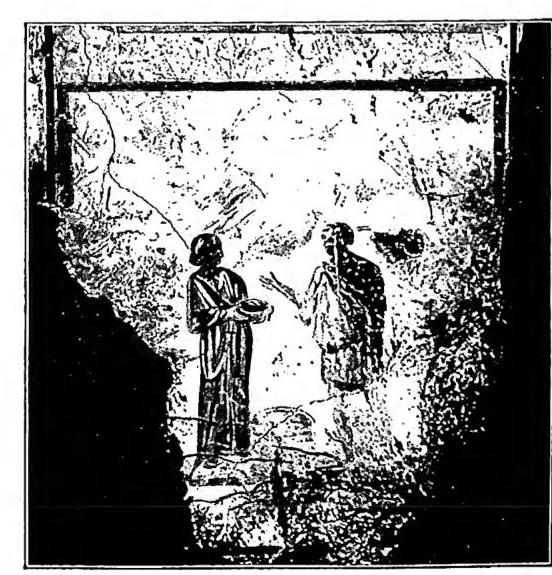
Clamys — Christ clothed in the clamys and the Samaritan woman (late 2nd century) — Rome, cemetery of Pretestato.
He returned to Italy in 1305, remaining near Rome, then went to Avignon (1311–18), where in 1317 he was tried and acquitted. After the Spirituals, of whom Clareanus had been leader since 1307, were condemned and excommunicated by the bull *Sancta Romana* (30 Dec. 1317), and after the death of his protector Cardinal Giacomo Colonna (12 Aug. 1318), he returned to Italy and, without submitting, continued to govern his followers from refuge at Subiaco. Feeling insecure under the Inquisition’s action, in 1334 he took refuge in Lucania, where he died.
Venerated by his followers as a saint and a friend of the blessed Simon of Cascia, Clareanus appears as a man of integrity and high ideals, yet unable to subordinate his ideas to superior commands, and not lacking in culture, as his writings show. These are: 1) *Historia septem tribulationum Ord. Min.*, i.e. the history of the persecutions of the Spirituals from the time of St Francis until about 1318: a reliable source for the period in which the author lived. No complete edition exists. An early Italian translation was published by L. Malagoli: *Cronaca delle tribulazioni di A. C.*, Turin 1931. 2) *Expositio regulae fratrum Minorum*, ed. L. Oliger, Quaracchi 1912. 3) *Epistola excusatoria ad papam* (John XXII), published by Fl. Annibali da Latera in *Ad Bullarium franciscanum supplementum*, Rome 1780; *Animadversiones*, pp. 153–164. 4) *Epistolario* (1311–36), partly edited by F. Ehrle in *Archiv für Literatur und Kirchengeschichte*, I (Berlin 1885), pp. 543–69. 5) *Praeparantia Christi Iesu habitationem... in nobis...*, ed. N. Mattioli in *Il b. Simone Fidati da Cascia (Autologia apostoliana, II)*, Rome 1898, pp. 467–71. 6) *Breviloquium super doctrina salutis ad parvulae Christi*, ibid., pp. 471–87. In addition, he translated into Latin from Greek the Rule of St Basil, the *Scala* of John Climacus, and a *Dialogue* attributed to St Macarius; on these translations cf. *Expositio Regulae*, ed. L. Oliger, pp. xxxiv–lv.
CLARET, Anthony Mary, Blessed. — Founder of the Congregation of Missionaries, Sons of the Immaculate Heart of Mary (v.), born at Sallent (Barcelona) on 24 Dec. 1807. After studying at Vich and being ordained priest at Solsona, he came to Rome in 1840 to devote himself to missionary work under the auspices of the Sacred Congregation of Propaganda Fide. Returning to Spain after a brief stay in the Society of Jesus, he dedicated himself with apostolic zeal to preaching and the reform of morals. In 1849, together with five other priests, he founded in the seminary of Vich the said Congregation of Missionaries, obtaining its apostolic approval in 1860 and, six years later, that of its constitutions.
In the same year (1849) he was named Archbishop of Cuba, a see he governed until 1857, when he was called to Madrid as confessor to Queen Isabella II. This important and delicate position did not prevent him from exercising a remarkable apostolate through word and pen, founding the famous “Religious Bookshop” and assisting other founders of religious institutes and pious societies. After Queen Isabella was driven from the throne in 1868, he followed her into exile. The following year he took an active part in the Vatican Council in Rome. He died shortly afterwards in the Cistercian monastery of Fontfroide (France). He was beatified by Pius XI in 1934. His cause of canonization is now under way. His body is venerated in the mother-house at Vich.