
EUCARIST - Last Supper, Sculpture of the 14th century, detail of the portal of the Cathedral - Altamura.
They then hold that this conception verifies, if not in the proper sense, at least in equivalent terms, the total conversion required by Catholic dogma.
These propositions certainly remain within the bounds of orthodoxy, but when compared with the principles established by the ecclesiastical magisterium, they do not seem perfectly to exhaust them. The Church speaks a) of a conversion of the substance of the bread; b) of the impossibility of Jesus’ glorified Body; c) of an intrinsic connection existing between the two extremes.
While the Thomistic explanation is in perfect harmony with these data, the theories of the 16th and 17th centuries seem in some way to conflict with each of them and to become entangled in a tangle of difficulties that spontaneously present themselves to thought. In fact, once the annihilation of the bread and the adducing or reproduction of Jesus’ Body are posited, it is not possible to speak of a true conversion, which formally entails the passage of one thing into another, and not the total destruction of one thing in order to make room for another that is adduced or reproduced. Moreover, the bond between the destruction of the bread and the adducing or reproduction of the Lord’s Body can only be logical—that is, extrinsic—and not arising from the real nexus of the ontological succession of two substances. Nor is it possible to understand how Jesus’ glorified and impossible Body could be adduced under the Eucharistic species without leaving its original place and without traversing the intervening spaces. Nor can one see how the very same Body of Jesus could be reproduced as many times as there are consecrations and yet remain the same, one and identical Body that was born of the Virgin.
BIBLI: C. van Crombruggles, La présence réelle et la transsubstantiation, Ghent 1906; J. Leberton, Le dogme de la transsubstantiation et la théologie autochemie du Ve siècle, in Études, 117 (1908, IV), pp. 477–87; J. Piccirolli, Disquisition de catholico intellectu dogmatic transsubstantiationis, Naples 1912 (in the Suárezian sense); A. Bassani, De transsubstantiatione ad mentem s. Thomae, Florence 1913; J. M. Lagrange, Mélanges d'histoire religieuse, Paris 1915, pp. 204–205; A. von Splawa-Neyman, Das Problem der weenotoren Gestalten im hl. Altersabrumm nach der Lehre des hl. Thomas von Aquin, Breslau 1920; J. Bitterneux, De transubstantiatione quid scenerit s. Bonaventura, in Collectanea Franciscana, 5 (1923), pp. 26–30; A. Zychlinski, Sinvera doctrina de conceptu transubstantiationis iuxta principia s. Thomas, in La ciencia tomista, 16 (1924), pp. 28–65, 222–44; J. Puig de la Bellecasse, De transubstantiatione secundum s. Thomam, Barcelona 1925; V. M. Cachia, De natura transubstantiationis iuxta s. Thomam et Scatum, Rome 1930; A. M. Vellico, De transubstantiatione iuxta Duns Scatum, in Antonium, 6 (1930), pp. 301–32, to which V. M. Cachia replied, Animodustriones in transubstantiationis doctrinam, in Angelicum, 9 (1931), pp. 246–62; H. Weisweiler, Die Impanationlehre des Soannes Quidori, in Scholastik, 3 (1931), pp. 101–95; M. T. L. Penido, La rda de l'analogie en théologie dogmatique, Paris 1931, pp. 427–41; ■. Baur, Non potest aliter Corpus Christi incipere esse de novo in hoc Sacramento nisi per conversione substantiae panis in panus, in Divia Thomas, 38 (Piacenza 1934), pp. 120–43; A. Verhamme, Exponitur notis transubstantiationis, in Colletiones Brugenses, 20 (1935), pp. 92–99; id., Genesis canonis transubstantiationis in Concilio Tridentino ibid., pp. 140–49; id., Relatantur sententiae reproductionis et adductionis, ibid., pp. 180–89; H. J. Storf, De natura transubstantiationis iuxta J. Duns Scatum, Quaracchi 1938; P. Glorieux, Fieri est factum esse, in Divia Thomas, 42 (Piacenza 1938), pp. 254–378; T. Horan, Doctrina transubstantiationis secundum F. Suárez, Rome 1938 (thesis of the Gregorian University); A. Michel, Les décrets du Concile de Trente, Paris 1938, pp. 239–87; H.-H. Maltha, Cosmologia circa transubstantiationum, in Angelicum, 16 (1939), pp. 305–34; F. Simons, Indagatio critica in opinionem s. Thomas de natura intima transubstantiationis, Indore 1939; R. Maglione, Il concetto di conversione eucaristica in Egidio Romano, Benevento 1941; L. Drembrogie, La S.ma E. in A. Román, Rome 1941 (thesis of the Gregorian University); C. Glorzo, La dottrina della conversione eucaristica in Pascolo Radierio e Rotramme, Palermo 1945; A. Michel, Transubstantiation, in DThC, XV, cols. 1396–1406, Paris 1946.
IV. MODE OF THE EUCHARISTIC PRESENCE.
The mode of the real presence of the Body and Blood of Christ, considered in itself (absolute) and in its relation to the sensible species (relative), is connected with the Eucharistic conversion, because, since this takes place between two substances, with the absolute exclusion of accidents, it necessarily has as its term the substance of the Body and Blood of the Lord.
Therefore, directly and in itself—that is, by the words of the Consecration (vi verborum)—under the species of bread there is present only the substance of the Body, and under the appearances of wine there is present only the Blood of the Lord. But since, after the Resurrection, the Body, Blood, Soul, and Divinity are really and inseparably united in Christ, as a natural consequence and almost indirectly (vi naturalis concomitantiae), under the species of bread there are also present the Blood, Soul, and Divinity, and under the species of wine there are also present the Body, Soul, and Divinity; that is, under both species there is present «totus et integer Christus», as the Council of Trent defines, following the data of Revelation (Denz-U, 885). By this expression it is meant that the Body of Jesus is present with all its organized quantity, as that of a perfect body enjoying the fullness of sensory life.
Since, however, the substance of the Body and Blood of the Lord is directly and in itself present, the quantity that is present consequently and by virtue of the accidents is brought to exist in the manner of substance, per modum substantiae, that is, acquiring the mode of being proper to substance. For if quantity were present in its connatural mode, it would have to possess weight, extend beyond the limits of the Host, and fill the place occupied by another quantity—that of the accidents of the bread and wine—which is impossible, and indeed contradicted by experience and by the data of Revelation, which assures us of the glorified and impossible state of Jesus’ Body.
Although this mode of presence is mysterious (a corollary of transubstantiation), human intelligence nevertheless cannot demonstrate its repugnance, because it is ignorant of the intimate nature of the two extremes on which it depends: divine omnipotence, which is inexhaustible, and the nature of corporeal substance, which eludes both the acuity of the philosopher and the eye of the scientist, as is clear from the many conjectures formulated concerning bodies, both in the field of philosophy and in that of experience (v. the up-to-date study by F. Selvaggi, Il concetto di sostanza nel dogma eucaristico in relazione alla fisica moderna, in Gregorianum, 30 [1949], pp. 7–45). «Ignoranza dal lato della sostanza materiale, ignoranza dal lato dell'omnipotenza di Dio, ecco come siamo armati per giudicare i miracoli eucaristici» (G. M. Monsabré, Esposizione del dogma, Italian version by G. Bononelli, Turin 1949, conf. 68).
Revelation presents analogies that help the human mind to glimpse the possibility of this mystery. The Gospel relates that Jesus’ glorified Body appeared exempt from gravity and impenetrability when he walked on the waves and entered the Upper Room through closed doors. On the basis of these facts, distinguished theologians, such as Franzelin, conceived of a «meccanica sopennaturale» with higher laws that elude every kind of experience.
Since the Body of Jesus is present with its quantity in the manner of substance, which, like the soul, is wholly in the whole body and wholly in each of its parts, it follows that the same Body of Christ is present wholly in the entire Host and wholly in each fragment, both after (as the Council of Trent defines [Denz-U, 885]) and before the breaking of the Host. It does not follow from this, however, that before the breaking the Body of Jesus is present infinitely many times in the Host, because, as St. Thomas observes, “number follows division. Therefore, as long as quantity remains undivided, the substance of a thing is present only once under its dimensions” (Smm. Theol., 37, q. 76, a. 3 ad 1).
The substance of Christ’s Body, in turn, is present in a singular manner, because it excludes all the modes of presence found in nature. It is not present through quantitative contact, because, although it possesses all its dimensions, it does not, through them, stand in relation to the species of bread; nor through informative and virtual contact, as the soul and the angel are present in a body, because the Body of Jesus does not affect the species either as formal cause or as efficient cause; nor through ubiquity, which belongs to God, because the intrinsic power of Christ’s Body is limited and therefore cannot embrace all beings, containing them within its power without being contained by them. Rather, it is present through the simple and mysterious relation of containment which, by transubstantiation, the species acquire with regard to the Lord’s Body; hence, as these relations multiply, the presence of the same body is multiplied (v. ACCIDENTI EUCARISTICI).
This mysterious and glorious mode of presence, reserved for the Body of Jesus, is designated by the technical term sanctioned by the Council of Trent (Denz-U, 874), “sacramental.”
Brac.: F. X. Wild, Explanatio mirabilium quae divina potentia in angustissimo Eucharistiae sacramento operatur, Bonn 1868; A. Lépicier, Le meraviglie eucaristiche alla luce della filosofia cristiana, Rome 1913; J. Vásquez de Mella, Filosofia de la Eucharistia, 2nd ed., Barcelona 1928; F. de Lanverain, La priaure eucharistique, in Recherche de science religieuse, 23 (1935), pp. 196-198; A. Verhamme, De modo praesentiae Christi in Sacramento, in Colletiones Brugenses, 20 (1935), pp. 384-50; id., De doctior praesentiae Christi in Eucharistia, ibid., pp. 435-50; L. Baudinot, Notre Seigneur n'est-il présent qu'une fois dont l'Hostie?, in Revue apologetique, 63 (1937), pp. 546-61; B. Ayala, De oclusi ecrezione Christi in Eucharistia in sententia Doctoris Ecclesiam, Rome 1930 (thesis of the Gregorian University); J. Vas der Meersch, De praesentiae Christi in Eucharistia, in Colletiones Brugenses, 24 (1939), pp. 465-66; R. Masi, La teoria suarecena della teoria eucaristica, Rome 1942; A. Vonier, La clef de la doctrine eucharistique, Lyon 1942 (on the extreme modes of presence); F. Orozco, La explicacion de santo Tomas sobre la presencia del cuerpo de Cristo en la Eucharistia «per modum substantiae», Rome 1943 (thesis of the Gregorian University); V. de Montcheuil, La raison de la permanence du Christ sous les espèces eucharistiques d'après si Bonaventure et si Thomas, in Méloures théologiques, Paris 1945, pp. 71-82; G. Loreti, La dottrina della presenza eucaristica in Durando di
S. Porziano, Rome 1949; E. C. Nuñez Goerjaga, El valor y funciones de la presencia real integral de Temacristo en el Sacramento, según la doctrina eucaristológica de S. Tymos, Tolosa 1949.
V. CONCLUSION: THE E. IN THE DIVINE PLAN.
At the moment of transubstantiation, a series of wonders takes place: the conversion of the substance of the bread and wine into the Body and Blood of Christ, the attraction of quantity to exist per modum substantiae, the sacramental multipresence of that same Body of Jesus, and the permanence of the accidents without a subject of inherence: the life of the universe is suspended at that instant. For four centuries Protestantism seems to have been saying: « ad quid perditio haec? ». Why trouble the Divinity and demand so many wonders when faith alone unites us to Christ? The E. is useless.
Let us return to the Gospel: in the discourse at Capharnaum, Jesus indicated the close bond uniting the E. to the Incarnation. Whoever considers the E. superfluous must reject every mediation of the Incarnate Word. Along this fatal slope liberal Protestantism slid.
The divinity of Jesus, humbly accepted, illuminates the shadows of the mystery and dispels the difficulties. Faith in the real presence, a prolongation of the Incarnation, unites us to Christ, just as the Incarnation brings us close to God. If the Incarnation is God becoming man, the E. is God becoming every man: « Per hoc sacramentum omnes nos sibi univit Deus, cum in Incarnatione non univerit sibi nisi unius solius naturam » (Albert the Great, In Mt. 26, 27; ed. Borgnet, XXI, col. 165). Thus God enters not only within the limits of our nature, but also within those of our person. The transubstantiation of the bread into the Body of Jesus is the emblem of the supernatural transformation of our being, which the Greek Fathers call divinization (Quincoloc). In the Eucharistic banquet the most intimate union between God and man is achieved: all humanity is the « sodalizio eletto alla gran cena ». Just as at Cana the Mother of Jesus intervened in the working of the miracle, a figure of the E., which consoled the hearts of the bridegroom and bride and elicited the faith of the disciples, so in this perpetual feast, where all the faithful « sicut novellae olivarum » surround the table of the Church, Mary is present as the generous dispenser of favors to the guests, mediatrix between Christ and the Church, Mother of the Head and of the members: Mater unitatis. Jesus, who entered the world the first time through his Mother, returns to it with Mary and through the E.; he inscribes himself in the fabric of individual life, permeating it with his divine outpourings; he grafts himself onto the course of social life, cementing its structure
with the cohesive force of love; he rises as the crown of creation in a cosmic repercussion touching the mysterious roots of substance and clasping heaven and earth in an eternal embrace.
BIBLI: L. Thomassio, Dogmata theologica de Incarnatione Verbi Dei. Venice 1730, pp. 608-727; V. Contenson, Theologia mentis et cardis. IV. Turin 1770, pp. 136-44; F. Hettinger, Apologia del cristianesimo, Italian trans., II. Pistoia 1896, pp. 61-69; Ph. Gerbert, Considérations sur le dogma de l'Eucharistie, 19th ed., Paris 1801; L. Lessio, De perfectionibus marihuncus divinis, 3rd ed., Paris 1912, pp. 268-79; F. G. Faber, Il Santo Sacramento, Italian trans., Turin 1931, pp. 357-469; H. Benson, L'amicizia di Cristo, Italian trans., Brescia 1936, pp. 67-78; A. Schütz, Christus mit uns. Munich 1939; A. Piolanti, L'E. e la Vergine, in Tabor, 2 (1948, t), pp. 317-21; M. I. Scheeben, I misteri del cristianesimo, edited by I. Gorlami, Brescia 1949, pp. 344-94; J. Knox, De necessitudine Deiporum inter et Eucharistiam, Rome 1949; Ch. De Keyser, La Vierge Marie et l'Eucharistie. Essai théologique et excétique, Montreal 1949; A. Piolanti, L'E. e il Papa, in Tabor, 3 (1949, t), pp. 528-35. Above all, the encyclical of Leo XIII, Mirae caritatis, of 18 May 1902.
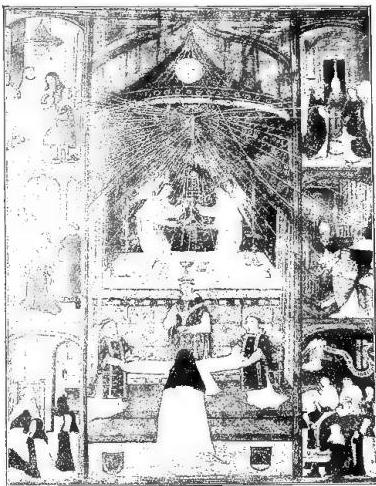
(Ist. E. Thill, Brussels)
EUCARISTIA – The E. among the other Sacraments. Miniature from a Missal dating from the end of the 1400s. – Bruges, church of Notre-Dame de la Poterie.