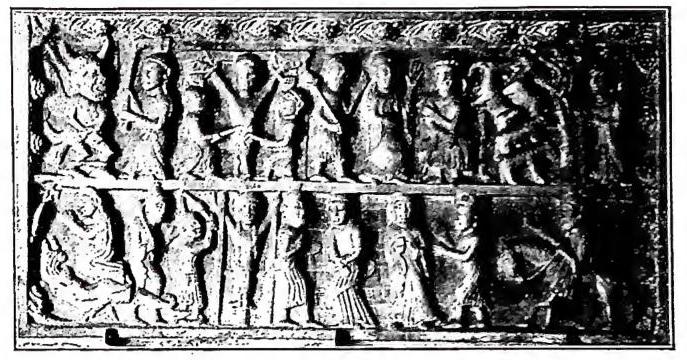
After losing her parents, she consecrated herself to God with a vow of perpetual virginity (1524) and devoted herself entirely to serving the poor and the plague-stricken, aided by the Madonna and St. Roch, to whom she was also greatly devoted. By the command of the Madonna and with the support of the faithful, convinced by extraordinary miracles, she built a church dedicated to the Annunciation in Cabera in 1535, and near the church a monastery, where she enclosed herself with other virgins.
In 1599, the "Margheritine" were transferred to Compiano and placed under the Rule of St. Augustine. The monastery flourished until the Napoleonic storm. The memory of the Devout remains ever alive among her people. The process for her beatification was initiated in the 16th century.
*Costagminiana*: *Life of the Devout Woman of Cantiga, drawn from the chronicles, reviewed in*.
*Margaritae Antoniazzi a Cantiga*, 1618-20 (ms. in the parish archive of Costagminiana): *Life of the Devout Woman of*.
*Costagminiana*: *Life of the Devout Woman of Cantiga, drawn from the chronicles, reviewed in*.
*Margaritae Antoniazzi a Cantiga*, 1618-20 (ms. in the parish archive of Costagminiana): *Life of the Devout Woman of*.
*Costagminiana*: *Life of the Devout Woman of Cantiga, drawn from the chronicles, reviewed in*.
*Margaritae Antoniazzi a Cantiga*, 1618-20 (ms. in the parish archive of Costagminiana): *Life of the Devout Woman of*.
*Costagminiana*: *Life of the Devout Woman of Cantiga, drawn from the chronicles, reviewed in*.
*Margaritae Antoniazzi a Cantiga*, 1618-20 (ms. in the parish archive of Costagminiana): *Life of the Devout Woman of*.
*Costagminiana*: *Life of the Devout Woman of Cantiga, drawn from the chronicles, reviewed in*.
*Margaritae Antoniazzi a Cantiga*, 1618-20 (ms. in the parish archive of Costagminiana): *Life of the Devout Woman of*.in the parish archives of Costagminiana): *Life of the Devout Woman of*.
*Costagminiana*: *Life of the Devout Woman of Cantiga, drawn from the chronicles, reviewed in*.
*Margaritae Antoniazzi a Cantiga*, 1618–20 (ms. in the parish archives of Costagminiana): *Life of the Devout Woman of*.
*Costagminiana*: *Life of the Devout Woman of Cantiga, drawn from the chronicles, reviewed in*.
*Margaritae Antoniazzi a Cantiga*, 1618–20 (ms. in the parish archives of Costagminiana): *Life of the Devout Woman of*.
*Costagminiana*: *Life of the Devout Woman of Cantiga, drawn from the chronicles, reviewed in*.
*Margaritae Antoniazzi a Cantiga*, 1618–20 (ms. in the parish archives of Costagminiana): *Life of the Devout Woman of*.
*Costagminiana*: *Life of the Devout Woman of Cantiga, drawn from the chronicles, reviewed in*.
*Margaritae Antoniazzi a Cantiga*, 1618–20 (ms. in the parish archives of Costagminiana): *Life of the Devout Woman of*.in the parish archives of Costagminiana): *Life of the Devout Woman of*.
*Costagminiana*: *Life of the Devout Woman of Cantiga, drawn from the chronicles, reviewed in*.
*Margaritae Antoniazzi a Cantiga*, 1618-20 (ms. in the parish archives of Costagminiana): *Life of the Devout Woman of*.
*Costagminiana*: *Life of the Devout Woman of Cantiga, drawn from the chronicles, reviewed in*.
*Margaritae Antoniazzi a Cantiga*, 1618-20 (ms. in the parish archives of Costagminiana): *Life of the Devout Woman of*.
*Costagminiana*: *Life of the Devout Woman of Cantiga, drawn from the chronicles, reviewed in*.
*Margaritae Antoniazzi a Cantiga*, 1618-20 (ms. in the parish archives of Costagminiana): *Life of the Devout Woman of*.
*Costagminiana*: *Life of the Devout Woman of Cantiga, drawn from the chronicles, reviewed in*.
*Margaritae Antoniazzi a Cantiga*, 1618-20 (ms. in the parish archives of Costagminiana): *Life of the Devout Woman of*.
*Costagminiana*: *Life of the Devout Woman of Cantiga, drawn from the chronicles, reviewed in*.
*Margaritae Antoniazzi a Cantiga*, 1618-20 (ms. in the parish archives of Costagminiana): *Life of the Devout Woman of*.
*Costagminiana*: *Life of the Devout Woman of Cantiga, drawn from the chronicles, reviewed in*.
*Margaritae Antoniazzi a Cantiga*, 1618-20 (ms. in the parish archives of Costagminiana): *Life of the Devout Woman of*.
*Costagminiana*: *Life of the Devout Woman of Cantiga, drawn from the chronicles, reviewed in*.
*Margaritae Antoniazzi a Cantiga*, 1618-20 (ms. in the parish archives of Costagminiana): *Life of the Devout Woman of*.in the parish archives of Costagminiana): *Life of the Devout Woman of*.
*Costagminiana*: *Life of the Devout Woman of Cantiga, drawn from the chronicles, reviewed in*.
*Margaritae Antoniazzi a Cantiga*, 1618-20 (ms. in the parish archives of Costagminiana): *Life of the Devout Woman of*.
*Costagminiana*: *Life of the Devout Woman of Cantiga, drawn from the chronicles, reviewed in*.
*Margaritae Antoniazzi a Cantiga*, 1618-20 (ms. in the parish archives of Costagminiana): *Life of the Devout Woman of*.
*Costagminiana*: *Life of the Devout Woman of Cantiga, drawn from the chronicles, reviewed in*.
*Margaritae Antoniazzi a Cantiga*, 1618-20 (ms. in the parish archives of Costagminiana): *Life of the Devout Woman of*.
*Costagminiana*: *Life of the Devout Woman of Cantiga, drawn from the chronicles, reviewed in*.
*Margaritae Antoniazzi a Cantiga*, 1618-20 (ms. in the parish archives of Costagminiana): *Life of the Devout Woman of*.in the parish archive of Costagminiana): *Life of the Devout Woman of*.
*Costagminiana*: *Life of the Devout Woman of Cantiga, drawn from the chronicles, reviewed in*.
*Margaritae Antoniazzi a Cantiga*, 1618-20 (ms. in the parish archive of Costagminiana): *Life of the Devout Woman of*.
*Costagminiana*: *Life of the Devout Woman of Cantiga, drawn from the chronicles, reviewed in*.
*Margaritae Antoniazzi a Cantiga*, 1618-20 (ms. in the parish archive of Costagminiana): *Life of the Devout Woman of*.
*Costagminiana*: *Life of the Devout Woman of Cantiga, drawn from the chronicles, reviewed in*.
*Margaritae Antoniazzi a Cantiga*, 1618-20 (ms. in the parish archive of Costagminiana): *Life of the Devout Woman of*.
*Costagminiana*: *Life of the Devout Woman of Cantiga, drawn from the chronicles, reviewed in*.
*Margaritae Antoniazzi a Cantiga*, 1618-20 (ms. in the parish archive of Costagminiana): *Life of the Devout Woman of*.
In 1310 she succeeded St. Humility in the leadership of the community. Endowed with exceptional charisms, in her visions she shared in the sufferings of the Lord’s Passion, which, it is said, He sealed upon her finger with His ring. Her memory is celebrated on August 26.
MARGHERITA d'Angoulême, queen of NAVARRE. – Duchess of Alençon, then queen of Navarre, b. at Angoulême on April 11, 1492, d. at Odos-en-Bigorre on December 21, 1549. Daughter of Charles of Orléans and Louise of Savoy, and thus elder sister of Francis I, she was one of the most learned and intelligent women of the French Renaissance, admired and praised for the liveliness of her mind and the refinement of her sensibility. She received a careful education in a humanistic milieu: alongside her knowledge of Italian, Spanish, and Latin, she later added a smattering of Greek and Hebrew. From her natural dispositions and the influence of French Humanism sprang her desire for a refined religious life and her disgust for religious worldliness.
Two figures of French religious Humanism exercised a particular influence upon M.: the celebrated Lefèvre d'Étaples (q.v.), and Guillaume Briçonnet (q.v.), bishop of Meaux, her spiritual director, known for an attempted reform begun in his diocese (1518) and inspired by the religious-humanistic ideals of the time.
In an environment where the ideal remained one of energetic reform, yet far removed from any schism, moral symbolism came to permeate and almost transform traditional beliefs. For example, the Virgin appeared in the *Miroir de l'âme pécheresse* (Alençon 1531), which provoked violent criticism and was condemned by the Sorbonne in the 1533 edition (the condemnation was later withdrawn through the intervention of Francis I), almost as a symbol of the purified soul; indeed, faith itself, far removed from Luther’s moral predestination, seemed almost to be identified with the illumination that concludes the Platonic dialectic of love (Renaudet).
The events of a life that, in so many respects, ran counter to her innermost dispositions and her very temperament contributed to immerse M. ever more deeply in this atmosphere. Married twice, always for political reasons and without any genuine affection on her part—first to Charles III of Alençon (1509) and then, after becoming a widow in 1525, to Henry d'Albret, king of Navarre (1527)—she placed all her interests in study and in the life of a small court dominated by her culture, and all her affection in her brother Francis I, whom she tenderly loved.
1525, to Henry d'Albret, king of Navarre (1527), she placed all her interests in study and in the life of a small court dominated by her culture, and all her affection in her brother Francis I, whom she tenderly loved.
To understand M.’s attitude toward Protestantism, one must take into account this complex of circumstances. Like many other learned contemporaries, she saw in the Protestant Reformation, up to a certain point, a movement of moral revision inspired by evangelical ideals, while the violent repercussions disturbed her sensibility as a woman. More than in favor of the Protestant cause, she worked on behalf of many persecuted persons, both Protestant and non-Protestant. In 1543, in fact, she went so far as to welcome at her court in Nérac some libertines persecuted by Calvin, thereby incurring the severe condemnation and hostility of the Genevan reformer. In short, M., like many others, failed to grasp the overall character of the Protestant movement, and thus there can be no doubt of her desire to remain inwardly faithful to the ideal and concrete unity of the Christian world.
Her literary output—poetic works, dialogic compositions recited at her court, novellas, and writings of piety—is of signal importance: literature, in short, rather than artistic creation. A special mention must be made of the *Heptaméron*, in which, following the example of Boccaccio’s *Decameron*, a company of ladies and gentlemen gather to tell stories, offering a lively description of the customs of the time and a precious testimony to the taste and art of her age.