
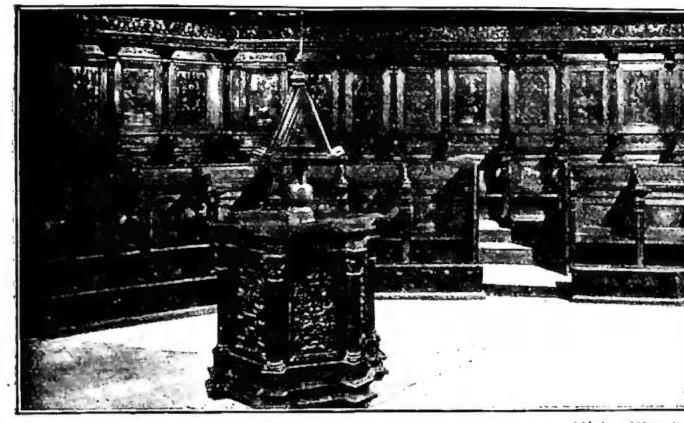
UMBRIA – Wooden choir with carvings and inlays by Baccio d’Agnolo, perhaps to a design by Perugino (1502–32) – Perugia, church of S. Agostino.
The artistic culture of Umbria, though influenced by Tuscan and Sienese currents, developed along lines that were distinctly its own. Sienese influence is evident in Orvieto, where Ugolino di Prete Ilario, Pietro di Duccio, and Cola Petruccioli appear to have been shaped not only by the Lorenzetti but also by the presence of the Sienese Luca di Tommè. It is likewise felt in Gubbio, where miniature painting flourished, and in Perugia. In the latter city are preserved paintings by Duccio da Buoninsegna and his pupil Meo da Siena; and the markedly Duccesque style is revealed in Marino da Perugia, who was followed by other local artists throughout the fourteenth century. To strengthen these ties, toward the end of the century Perugia—already on its way to becoming the most important artistic center in Umbria—attracted two more Sienese painters, Bartolo di Fredi and Taddeo di Bartolo, while in the years that followed, up to the mid-fifteenth century, the region continued to receive artists and works from Siena. Yet already in the first decades of the fifteenth century, Umbria began to welcome artists of Florentine birth or training, who would leave an increasingly significant mark. From Masolino (Todi) to Domenico Veneziano, from Fra Angelico (Perugia and Orvieto) to Benozzo Gozzoli (Orvieto, Foligno, Montefalco), from Filippo Lippi and Domenico Ghirlandaio (Narni) to Piero della Francesca (Perugia), a succession of artists introduced the latest Florentine novelties and tastes to Umbria. Siena, moreover, had itself drawn closer to Florence and transmitted its artistic forms to Umbria; and at the turn of the two centuries, hints of the new forms of International Gothic had already appeared, to which the Eugubine Ottaviano Nelli adhered (v.), while Gentile da Fabriano, one of its leading exponents, left a painting in Perugia and a fresco in Orvieto.
Renewal is already evident in the finest artists of the first half of the fifteenth century, among whom Niccolò Alunno stands out in Foligno alongside Mezzastris. Alunno had come into contact with the Florentine world both indirectly through Siena and directly through Benozzo Gozzoli. What matters most is that with him one can speak for the first time of an Umbrian school: Umbrian artists had always sought to interpret ideas and motifs from outside, but only in the fifteenth century did an Umbrian school of painting emerge with its own autonomy within the complex of external influences. At the same time in Perugia, where besides the Florentines Giovanni Francesco of Rimini and above all Giovanni Boccati of Camerino (paintings in the Pinacoteca) had worked, BUON, FAMIGLIA (v.), the Caporali (v.), Fiorenzo di Lorenzo (v.) began to make their mark. These three also drew from Benozzo, at times approaching other great masters, yet always expressing themselves in an individual and coherent manner. By the second half of the century, their efforts culminated in the emergence of Pietro Perugino (v.) Pinturicchio (v.), marking the apogee of Umbrian painting. From his earliest works, Perugino distilled the characteristics of Umbrian art to such formal perfection that he in turn influenced the very Florentine milieu from which Umbria had previously drawn. Beside him, Pinturicchio distinguished himself by rendering the world around him in a manner at once analytical and poetic, entirely his own, even in collaborative works—first and foremost the *Nicchia di S. Bernardino*, a complex of paintings of the highest importance for understanding Umbrian art in the second half of the fifteenth century.
To these two masters were joined the painters of the new generation. Among Perugino’s pupils, besides Raphael (v.) Ingegno (v.), were Sinibaldo Ibi, Eusebio da S. Giorgio, Domenico Alfani, G. Battista Caporali, and others; Tiberio d’Assisi and Antonio da Viterbo, called il Pastura, at a certain point drew closer to Pinturicchio, while both Giannicola di Paolo and Lo Spagna—Perugino’s most accomplished follower—reflect the manner of the young Raphael in their mature works. The same is true of Francesco Melanzio, Bernardino di Mariotto, Dono Doni (later drawn into Michelangelo’s orbit), and Orazio Alfani. By contrast, SIGNORELLI, LUCA (v.) on Umbrian painters was limited, despite his intense activity in Umbria at the same time as Perugino (so much so that many scholars consider him Umbrian) and his having left works in Città di Castello, Perugia, Orvieto, Umbertide, and Morra. Fiorentino (v.), active in Perugia, Giovanni Antonio Pordenone, and later L’Aliense, who had imported a reflection of the flourishing Venetian school. Meanwhile, Mannerism—specifically a Michelangelesque strain—had taken hold through Vasari (in Perugia and Città di Castello), Raffaellino del Colle, Cristoforo Gherardi, Cola dell’Amatrice, and others, and Umbria could even boast a notable Mannerist in Michelangelo Carducci. Yet this was soon countered by another artistic movement led by Federico Barocci, who brought to Perugia (with his *Deposizione* in the Duomo) the formal elements of the purest Emilian Mannerism. His followers included Felice and Vincenzo Pellegrino, Silla Pecennini, and two Sienese artists active in Umbria, Francesco Vanni and Ventura Salimbeni.
The autonomy of Umbrian painting nonetheless came to an end in the second half of the sixteenth century. The seventeenth and eighteenth centuries saw only feeble personalities working in the wake of the more celebrated painters whose works were present in Umbria—from Baglione and Pietro da Cortona to Calvaert and Sebastiano Conca, from Domenichino and Sacchi onward.
Architectural and pictorial achievements were not matched by an equal richness in sculpture. The few surviving early examples are tied to architectural decoration, such as the façade of the Oratory of S. Giovenale in the cathedral of Narni (6th century) or certain ornamental parts of the abbey of S. Pietro in Valle (8th century), where there is also an antependium signed “Ursus,” datable to 739–40. Contemporary with these are the ciboria of S. Prospero in Perugia and of S. Giuliano delle Pignatte near Umbertide.
In the Middle Ages, local sculptors worked chiefly in wood. There is evidence of a very rich production (not always clearly distinguishable from that of neighboring regions such as the Marches and Abruzzo), though relatively few examples survive today. The earliest of these is the *Madonna and Child* (first half of the 12th century), now in the Museum of the Parish Church of Spello, and a prototype for those that followed. Alongside a few groups of high artistic quality, one frequently encounters works that are the fruit of a very active and traditional craftsmanship, so that pieces still in a Romanesque style were executed as late as the fifteenth or sixteenth century. Such is the case of the *Virgin and Child* in the church of S. Maria in Camucia at Todi. Naturally, alongside these woodcarvers there were also marble workers who, in the twelfth and thirteenth centuries, left traces of their activity—sometimes of excellent quality—in the decoration of church interiors and façades: among these may be recalled S. Maria Assunta at Lugnano Teverina, S. Pietro at Spoleto, and the basilica at Assisi (v. also, ibid).
The façade of S. Rufino and the Loggia del Monte Frumentario, S. Felice and S. Anatolia of Narco, and numerous others. These are, for the most part, geometric decorations, of Oriental taste, or floral motifs, deriving from classical tradition, with rare symbolic figurations. In 1270, Fra' Bevignate, by summoning Giovanni and Nicola Pisani to execute the Fontana Maggiore of Perugia, fostered the Tuscan orientation of sculptural taste. He was followed by Arnolfo di Cambio, present in Perugia with some statues in the Museum (a follower of his or of Lorenzo Maitani is attributed the monument to Benedetto XI in S. Domenico) and author of the monument to Cardinal de Braye in the S. Domenico of Orvieto. There, L. Maitani, with Pisan-Sienese craftsmen, had splendidly decorated the four pillars of the façade of the Duomo in bas-relief and had left three masterpieces in the crucifixes of S. Francesco and the Duomo. Despite the example of these and other masters who came to Umbria in the 1300s, a local current did not succeed in forming, neither in this century nor in the following one, when the influx of sculptors and sculptures from other regions continued.
Agostino di Duccio adorned the exterior of his S. Bernardino with elegant figures; Mino da Fiesole, Francesco di Simone, and Francesco di Giorgio Martini are well represented in Perugia; the Della Robbia in Città di Castello; and in S. Gregorio of Spoleto there is a fine tabernacle by Benedetto da Rovezzano. In the 1500s, alongside the usual foreign artists, the Perugian V. DANTE, also active in Florence, and in Orvieto the aforementioned Ippolito Scalza, gained prominence. In the 1600s and 1700s, non-local artists continued to work in Umbrian territory even for sculpture.
The minor arts were cultivated at all times: Gubbio has already been noted as an important center for miniature painting, to which even great artists such as Perugino and Pinturicchio devoted themselves. In Orvieto (reliquary of the Corporale by Ugolino di Vieri), Città di Castello (pallotto of Celestino II), Perugia, and above all Assisi (Treasury of the basilica of S. Francesco), excellent pieces of silverwork are preserved, often showing a marked adherence to Sienese taste.
Notable examples of ecclesiastical furnishings adorn many churches: among the best known in Perugia are the choirs of S. Pietro, begun by Bernardino Antonini of Perugia, and of S. Agostino, executed by Baccio d'Agnolo from designs attributed to Perugino; less well known is the fine twelfth-century *falsidorio* preserved in the Cathedral of Perugia. Yet truly original characteristics can be seen in the ceramics produced in the two centers of Gubbio and Deruta and in the typical Perugian embroidery.
which will vie in height with the others. An interesting vestige, moreover, of the tradition of improper incubation is found in the practice, noted in Gubbio, of placing the husband’s trousers on the belly of the woman in childbirth; while, according to another version, the husband is sent to the church bell tower to grasp the bell rope with his teeth and ring it three times.