
P. Miscattelli (Florence 1923) and Fantozzi (Lanciano 1925). For the life, v.: G. Pardi, On the Life and Writings of G. C. da Siena, in Bull. sen. di st. patria, 2 (1895), pp. 1–50 and 202–30, and by the same author: The Blessed G. C. da Siena, in Nuova viv. star., 11 (1927), pp. 286–336. For the life and the art, v.: N. Sapegno, The Fourteenth Century, Milan 1934, pp. 510–55 and 564; A. Levasti, in Mystics of the Thirteenth and Fourteenth Centuries, there 1935, pp. 65–67, 1008–1010 (and the Letters, pp. 749–81); G. Petrocchi, The Letters of Blessed C., in Convictum, 2nd series, 3 (19–30, 1).
COLOMBO, CRISTOFORO. — The great navigator was born in Genoa, as is unanimously attested by archival documents, by statements of C. himself or of members of his family, and by highly authoritative contemporaries such as A. Giustiniani, in 1451, between August and October, into a modest family of the Ligurian artisan class. His father was engaged in commerce, especially in woollen goods, and Cristoforo initially assisted him; later he entered the service of important Genoese trading firms, above all the Centurione and Dinegro families, which conducted extensive business in many Mediterranean countries. In this capacity, which might be defined as that of a commercial agent, he probably made a voyage to Chios; in the same capacity he is found in Lisbon in 1476, where those firms had a commercial house, and in Madeira in 1478. From 1479 he was permanently settled in Lisbon, and there, or in Madeira, he married Filipa Moniz Perestrello, daughter of a Bartolomeo Perestrello of Italian origin, governor of the island of Porto Santo. It seems that this marriage gave him connections in Portuguese court circles and brought him into contact with Portugal’s movement of commercial and maritime expansion. At that time, by privileges sanctioned by papal bulls, this country held a monopoly on maritime expeditions in the Atlantic; aboard a Portuguese ship C. made at least one voyage to Guinea, after 1482. At that time he conceived his great project, which consisted in reaching eastern Asia, or the Indies as they were then called, by sailing westward across the open Ocean, rather than by the long route around Africa. On the basis of ideas certainly very erroneous, but widely disseminated in his time, C. considered this route much shorter than the circumnavigation of Africa.
C., who had not pursued regular studies, acquired during these years a cosmographic education by reading works that were very widely circulated in his time (among them the Imago mundi of Cardinal Pietro D'Ailly), in which he found numerous statements confirming his conviction. C. probably learned only later of a similar project for sailing across the Atlantic, submitted as early as 1474 to the Portuguese government by a learned Florentine, Paolo dal Pozzo Toscanelli, and made use of it to perfect and substantiate his own. C. also proposed his project to Portugal, which rejected it; C. then, around 1485, left Portugal with a son, Diego, and moved to southern Spain, where his wife’s relatives, by then deceased, and other agents of Genoese trading firms resided. With the help of his fellow countrymen and of influential acquaintances, he soon gained access to the circles of the Spanish court and presented his project, which some, especially Queen Isabella, supported, while others opposed it; but many long years of hardship and deprivation passed before he could obtain serious consideration. The final difficulties were overcome through the intervention of the prior of the convent of La Rábida, P. Pérez, and of other figures from that monastery, where C. and his son Diego had found hospitality at difficult moments. A special agreement concluded at S. Fe near Granada on 17 April 1492 crowned C.’s perseverance: he was granted three small ships with which to attempt to reach Asia by crossing the Atlantic, and was assured very generous rewards and privileges in the event of success.
The three ships (the Niña, the Pinta, and the S. Maria, the flagship) were fitted out in the port of Palos with the con-
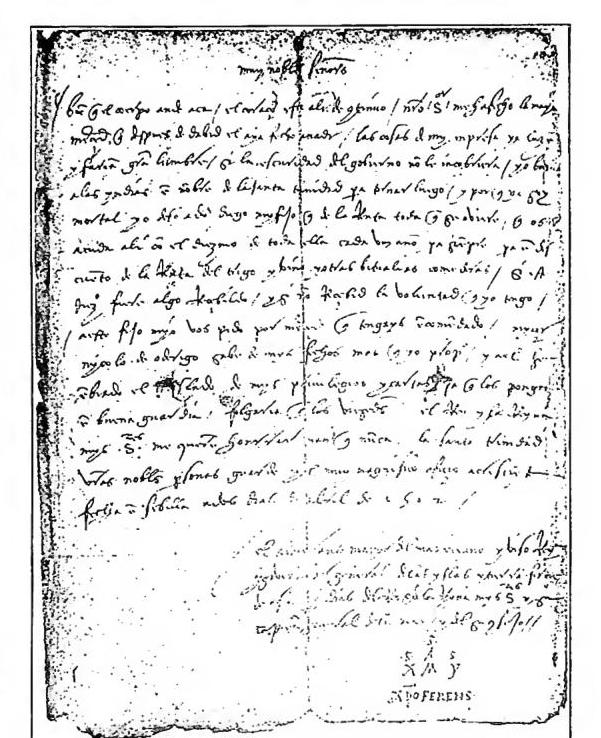
COLOMBO, CRISTOFORO. – Original autograph letter of C. C. to the protectors of the Bank of S. Giorgio in Genoa (Seville, 2 April 1502) – Genoa, Palazzo del Comune, Podestà’s Hall.
with the collaboration of a family of local shipowners, the Pinzóns. The names of almost all the members of the crew are known, and in essence they always performed their duty very well. There was no ecclesiastic on board. The departure took place on 3 August; after four weeks spent in the Canaries, on 6 September the three caravels began their crossing of the unknown Ocean, which, aided by the northeast trade wind, proceeded essentially without mishap until 12 October, the day on which an island was sighted, named San Salvador by C. and usually identified with Watling in the Bahama group. In the course of the subsequent voyage, Cuba was discovered, which C. believed to be a portion of the Asian mainland, and Haiti, identified with Marco Polo’s Cipango, that is, Japan. On the coast of the latter C. left a small colony, Navidad; then, on 16 January 1493, he resumed the return journey with two ships, since the S. Maria had been wrecked. On the return voyage, undertaken along a much more northerly route, in the zone of the westerly winds, the ships escaped a cyclone that put the commander’s nautical skill to the test, and, having reached the Iberian shores unharmed, they landed at Palos on 15 March 1493. C. received triumphant welcomes; the twofold crossing was celebrated as an unprecedented maritime undertaking, and to the commander himself it seemed beyond human possibilities, so that he came to believe that he had been guided by Divine Providence. Hence arose his faith in his divine mission, which would accompany C. for the rest of his life.
The diplomatic disputes that immediately arose with Portugal having been provisionally settled by means of three bulls of Pope Alexander VI (3–4 May 1493), highly favorable to Spain, a second expedition of seventeen ships was fitted out, with a colonial character. A mission of priests took part in it, led—on the basis of instructions issued by the Pontiff himself in a bull of 25 June—by Fr. Bernardo Boyl of the Minims. This second expedition, which departed on 23 September 1493, resulted in the discovery of several of the Pic-
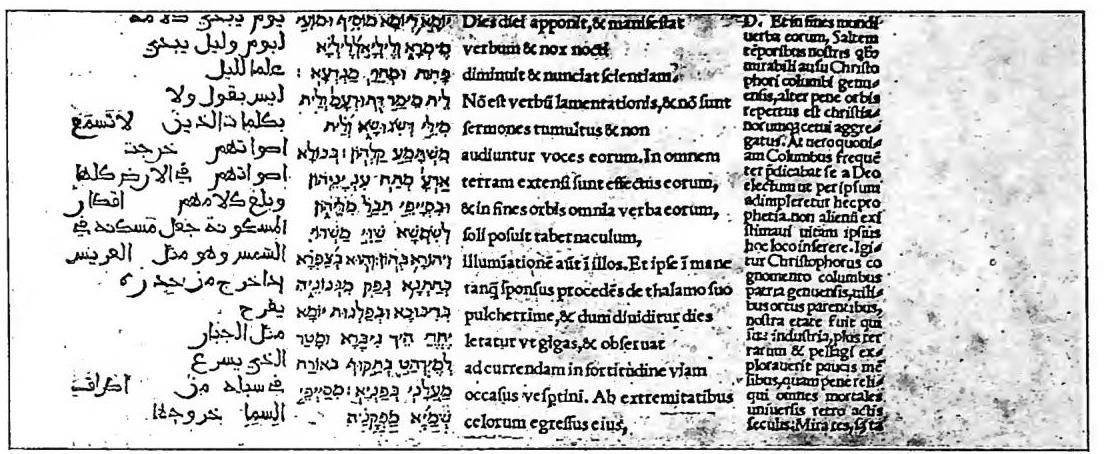
COLOMBO, CRISTOFORO — Psalterium Octaplum by Agostino Giustiniani, Genoa 1516. Beginning of the biographical notes on C. C. (“patria Genuensis”), added as a marginal gloss to Ps. 18:5. Copy of the Pontifical Biblical Institute — Rome.
the Lesser Antilles and a better knowledge of Cuba and Haiti, where the city of Isabella was founded; but the hoped-for riches in gold, gems, and precious products, of which the Asian shores were reputed to be abundantly endowed, yielded little or nothing, since C. still believed that he had reached them. From these disappointments there arose discontent among the colonists and also among certain influential figures at court, who were jealous of the foreigner’s rapid rise.
On a third voyage (30 May 1498–November 1500), C. touched the mainland of present-day South America near the mouth of the Orinoco, which he believed to be the Asian mainland; but upon returning to Haiti he had to confront revolts which, in his absence, had degenerated into open anarchy.
Confident in his evangelical mission beyond the Ocean (he was the bearer of Christ, Christophorus or Christoforens, as he more often signed himself), C. nevertheless proved unequal to the grave problems involved in organizing the colonial territories over which he was viceroy and governor under the agreements of S. Fe; the party opposed to him in Spain took advantage of this to obtain from the sovereigns the dispatch of an inspector, Francesco Bobadilla, who, abusing the mandate he had received, had C. arrested together with his brother Bartolomeo and sent him back to Spain in chains.
The humiliation he suffered, and which was not adequately redressed, together with his manifold disappointments and the bitterness arising from failures, incomprehension, and hostility, had the effect of strengthening C.’s religious feeling. Now conscious of being persecuted, he was led toward a mysticism that would dominate the remainder of his life. Yet, immovable in his blind confidence that he had found the direct maritime route to
Asia and had reached that continent, C. requested and obtained command of a fourth expedition (May 1502–November 1504), during which, having reached the isthmic region of present-day Central America, he sailed as far as the coast of Veragua, not far from present-day Panama, in search of a passage toward India and the mouths of the Ganges. If fortune had favored him, he perhaps intended to return by way of the Indian Ocean and the Red Sea, even attempting the reconquest of the Holy Land! The voyage, an interminable succession of misfortunes, ended with the sheltering of the now damaged and worn-out ships in a port on the lonely island of Jamaica. There C., by then tormented in body and broken in his final, indomitable energies, seemed destined to end his days “so far from the Holy Sacraments of Holy Church that she will forget this soul if it departs from the body here,” as he himself wrote in a celebrated letter, appealing to the compassion of “whoever possesses charity, truth, and justice!” Salvation came unexpectedly through the desperate but successful attempt of two trusted men, who, after a very long period resembling a slow agony, managed to send him a rescue ship. Returning to Spain on 7 November 1504, C. died forgotten at Valladolid on 20 May 1506, the eve of the Ascension, attended by his sons and a very few members of his household. His final words were: “In manus tuas Domine commendo animam meam”.
(courtesy of Fr. Alberto Vaccari)
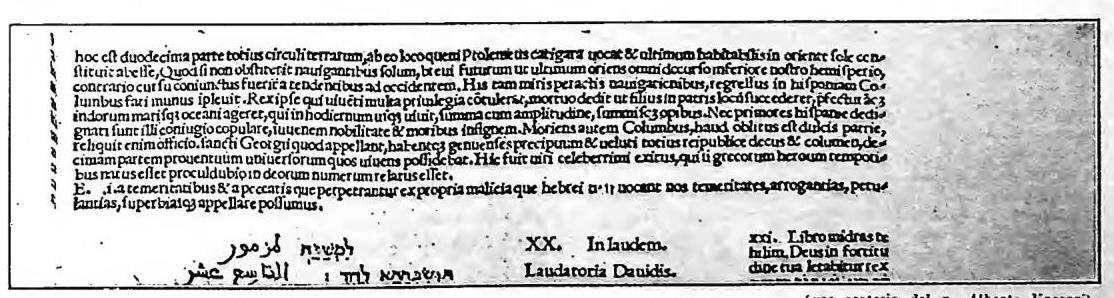
COLOMBO, CRISTOFORO – Psalterium Octaplum by Agostino Giustiniani, Genoa 1516. End of the biographical notes on C. C., added as a marginal gloss to Ps. 18:5. Copy of the Pontifical Biblical Institute – Rome.