
DANIELE DA VOLTERRA - The Assumption. Fresco in the Della Rovere Chapel in the Church of Trinità dei Monti. The last figure on the right, in the act of pointing to the Assumption, is Michelangelo - Rome.
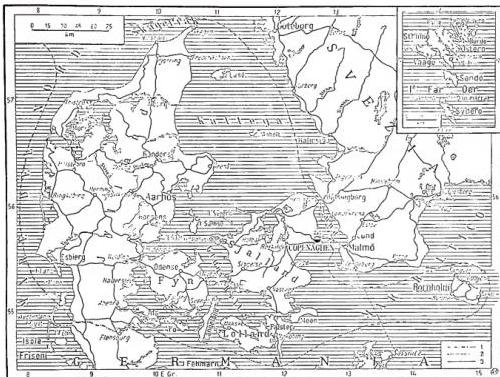
Denmark's economy is based on specialized agriculture (barley, oats, wheat, potatoes, fodder), and livestock farming (cattle, pigs, poultry) destined for the export of products (butter, cheese, meat, lard, cured meats, and eggs) demanded by neighboring markets (England, Germany, Sweden, Norway, etc.). With these, Denmark maintains very active trade, which guarantees it the raw materials it lacks and which are necessary for its industries.
The population, much denser in the islands, numbers 4.2 million inhabitants, who are ethnically very homogeneous (96.5% Danes) and almost entirely (98.8%) Protestant. Only three cities exceed 100,000 inhabitants. The capital, Copenhagen, on the island of Själland (over 1 million inhabitants), is one of the most active ports in Northern Europe; Aarhus (110,000 inhabitants) is the most important city and the main port of Jutland. Frederiksberg (115,000 inhabitants) is part of the Copenhagen urban agglomeration.
Denmark is a hereditary constitutional monarchy with bicameral representation, elected by universal suffrage extended also to women. A Danish possession is Greenland. The Fär Öer, an archipelago of 22 islands with 29,000 inhabitants, was once governed by a Danish prefect. Since March 30, 1948, they have been self-governing.
II. CIVIL AND ECCLESIASTICAL HISTORY
Christianity penetrated relatively late into D. The Catholic Church reached its zenith there in the early Middle Ages. The Lutheran Reformation, through an act of political violence, brought it to a rapid end in 1536.The law on freedom of worship of 1849 created the conditions for a silent and slow recovery.
1. The Church in the Middle Ages (826-1536)
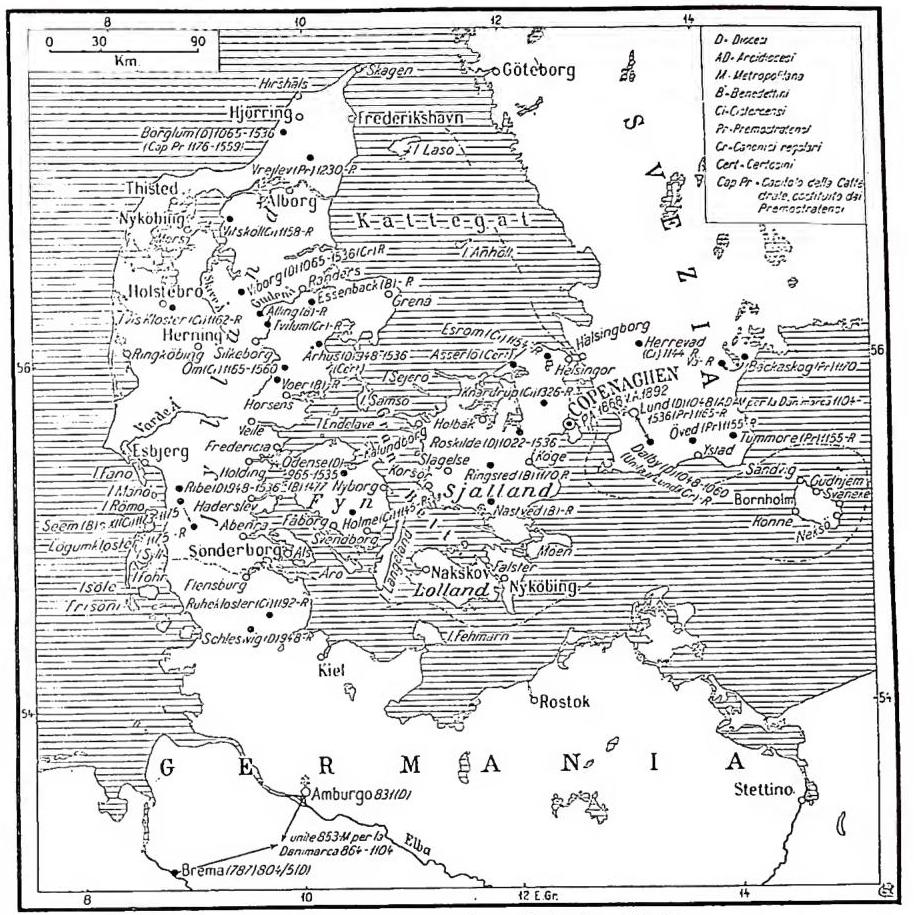
The first attempts to evangelize D. were made by St. Willibrord of Utrecht (710) and Ebbo, Archbishop of Reims (822), but the credit for laying the foundations of the missionary work that was to conquer the country belongs to St. Ansgar, who, having arrived there in 826, founded the first two churches in Hedeby in Schleswig and in Ribe. His work was continued, albeit with little success, by the archbishops of Hamburg-Bremen, and it was only after the conversion of King HaraldBluetooth (960) that the mission was able to progress. In the meantime, in 948, the three bishoprics of Schleswig, Ribe, and Aarhus in Jutland had been established; in 965 this was followed by the establishment of that of Odense on the island of Funen. Under Cnut the Great (1018-35), whose rule also extended to England and Norway, religious life underwent a powerful development, aided by the missionary work of Anglo-Saxon monks. Thus in 1022 the bishopric of Roskilde in Zealand was established. Under Sweyn Estridson (1047-74) and Archbishop Adalbert, the organization of the Church could be said to be complete. In 1048 the bishoprics of Lund and Dalby (united to Lund in 1060) arose in Scania (Sweden), and in 1065 those of Viborg and Vestervig (later transferred to Børglum). In 1104 the eight bishoprics were detached from the metropolitan dependence of Hamburg-Bremen and constituted as an autonomous province under the archbishopric of Lund. Under King Valdemar II, the Conqueror (1202-41), D., through the close collaboration of Church and State, reached the highest degree of its political and cultural development.
Archbishop Anders Sunnesen (1221-23) excelled in literature, Saxo Grammaticus in history, Gunners of Viborg (1222-51) in law (see below). Danish students attended the Universities of Paris, Bologna, and Padua in large numbers; and the logical writings of a Simon, a Martin, a Boethius, and a John of Dacia gained fame in the field of Scholasticism. In the 12th century alone, approximately 2,000 masonry churches were built, and all the Romanesque and Gothic cathedrals of the country date back to that century and the next. During this period, cultural relations with France were broad and deep. This upward movement stopped in the following era and declined. The years from 1241 to 1340 were marked by the internal dissolution of the forces of Church and State, agitated by violent discord and the struggle between the two powers. This reached its climax during the
bishopric of the courageous defender of the rights of the Church, Archbishop Jakob Erlandson (1254-74), and under his successor Jens Grand. It was only with the advent of King Valdemar Atterdag (1340-75) that the situation could be said to have been overcome. His daughter, the wise and pious Queen Margaret (1375-1412), united the three northern kingdoms through the Union of Kalmar (1397) and created the conditions for the flourishing of the Church. In 1523 Sweden, under the leadership of Gustavus Vasa, became independent, while Norway remained united with D. until 1814. In 1479 Christian I founded the University of Copenhagen with the approval of the Pope. During this period, despite not a few external difficulties, religious life enjoyed a new, albeit brief, flowering in literature and art. In the Middle Ages, D. had approximately 24 Benedictine monasteries, 15 Cistercian, 7 Premonstratensian, 26 Dominican, 30 Franciscan, 11 Carmelite, 9 Augustinian, and 2 Brigittine convents. Among the saints
of Denmark, special mention deserve: King Cnut (d. 1086), Duke Cnut (d. 1131), Kjeld of Viborg (d. 1150), and Abbot William (d. 1203).
2. From the Reformation of 1536 to the Law of 1849
Under the reign of Frederick I (1523-33), the German Reformation began to spread also in D., acquiring increasingly wide influence there. In 1527 the Lutherans obtained parity with the Catholics. The Catholic reform movement led by the Carmelite provincial, Poul Helgesen, did not have the strength to contain the political-religious revolution. In 1536 King Christian III, by a coup d'état, proclaimed Lutheranism the national religion: the bishops were arrested, Church property confiscated, and the monasteries abolished. The German reformer J. Bugenhagen consecrated the first Protestant bishops, and the apostolic succession was interrupted.In the following era, Catholicism was entirely eradicated with a series of violent measures. The "Danish Law" of 1683 prohibited Catholic priests from residing in the country under pain of death; exile and confiscation of property were threatened against conversion to the Catholic religion. Only foreign ambassadors and their personnel, as well as foreign Catholics and their personnel, were granted the private exercise of their worship. Foreign Catholics obtained limited freedom of worship in the free city of Fredericia. Thus missionary stations arose in Copenhagen and Fredericia, and their care was held by the Jesuits.
3. The Modern Era
The law of 1849 gave Catholics complete freedom of worship. On Aug. 7, 1868, an apostolic prefecture was established in D. under H. Gruder. Under his successor, Bishop Giovanni von Euch, and precisely on March 15, 1892, the prefecture was transformed into an apostolic vicariate, and from then on the young mission developed.Upon the death of von Euch in 1922, D. counted 29 Catholic communities, with 19,750 the faithful. In 1849 there were no more than 500. Von Euch was succeeded by Bishop Giuseppe Brems, a Premonstratensian, and between 1922 and 1938 approximately 30 churches and chapels were built. In 1931 the mission in the Faroe Islands was resumed, while an apostolic prefecture was established in Iceland in 1923. Since 1938 the vicariate of D. has been held by Bishop G. Teodoro Suhr, a Danish Benedictine, who, despite the difficulties of the war, managed to maintain the position reached by the Church unchanged. In 1942 the vicariate had under its jurisdiction: 37 parishes, of which 9 in Copenhagen, 30 Catholic schools, and 19 hospitals. Of the parishes, 14 were held by secular clergy and 23 by religious orders. The Church numbered 22,000 souls, of which 7,000 in the capital. It is estimated that conversions proceed at an average of 150-200 per year. The communities are therefore largely made up of converts. A. Otto
III. LITERATURE - Mentions of a Danish people, clearly differentiated from the other Germanic and Scandinavian populations, are found as early as the 4th century, but no work from this period survives in its original form. Runic inscriptions contain echoes of oral songs in honor of gods and heroes, and some specimens of the latter remain in the Latin translation of Saxo Grammaticus.
The first literary documents, mostly in Latin, show the influences of Christianity, which was introduced into D. around the year 1000. For several centuries, the Church would be the custodian of culture, introducing D. into European culture.
Literary and historical interest is offered by the collections of laws composed in the 13th century: the science of law reaches its peak in the code of Jutland (Jyske Low) compiled by Bishop Gunners of Vibory. Latin-Danish dictionaries and popularizing works are largely the work of priests. Historiography, originally cloister chronicle (except for the Chronicle of Roskilde, which runs from 826 to 940), boasts at the beginning of the 13th century a fundamental work for the knowledge of the most ancient Danish history (from the mythical King Dan to c. 1185) in the Gesta Danorum by the ecclesiastic Saxo Grammaticus.
With the affirmation of Christianity, the Danish nobility, having entered the international orbit of the chivalric world, participated in the Crusades, became acquainted—at least in poetry—with courtly love, and took pleasure in chivalric tales and romances of French origin (Eufemia Viserne).
More original in tone and content are the numerous dance songs (Folkeviserne), which likewise arose in the aristocratic milieu and were transmitted orally for centuries across every stratum of the population; collected and published for the first time by Anders Sørensen Vedel in 1591, they would form a source of inspiration for Danish romantic poets. It is interesting to note that in their melody they are linked to the rhythm of Gregorian chant.
The influence of the Church on culture weakened with Humanism and the Renaissance, when biblical studies undertaken by laymen and a new indifference toward ecclesiastical authority prepared a favorable ground for the Reformation in D. as well, which by 1536 was an accomplished fact: Catholic texts were replaced by a new religious literature of a Protestant tone of German origin, soon translated and assimilated. The final voice of Danish Catholicism is that of the Carmelite Poul Helgesen, a staunch defender of the Church of Rome, even amidst criticisms of the corruption of some of its members.
On the Protestant side, aside from the theological writings of Niels Hemmingsen, one recalls the two collections of psalms by Hans Tausen and Claus Mortensen, and the so-called Bible of Christian III, the work for the most part of the humanist Christian Pedersen, which is fundamental for the
history of the Danish language. Indeed, as in Germany, so too in D. the proliferation of translations and religious writings in the early years of the Reformation contributed greatly to the development of the language. A valid ally of the new religious order was the theater, then in its infancy: suffice it to mention the biblical dramas of Hieronymus Justesen Ranch (d. 1603).
Among historiographers, less bound to the rigid chronological criteria of their predecessors, Anders Sørensen Vedel and Arild Huitfeldt, author of a chronicle of the kingdom of D. (Danmarks Riges Kronike), stand out.
Following the invention of printing, adventurous histories (mostly translations of German Volksbücher) concerning Charlemagne, Ogier the Dane, and other popular heroes enjoyed widespread circulation among the people.
The 17th century represents for D. the century of erudition: poetry is almost entirely silent; dominant are Protestant orthodoxy, the most rigid religious formalism, and scientific studies, by then emancipated from theology and superstition.
(courtesy of Fr. P. Langsted, Redemptorist)
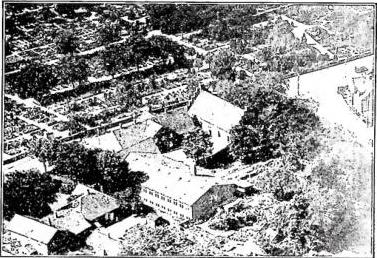
DANIMARCA - Aerial view of the current missionary station of the Redemptorist Fathers with church and school - Naestved.
Both in scientific and historical writings, the Latin language continued to dominate: the first grammar of the Danish language was published in Latin by Erik Pontoppidan (1658). The only true poet was Bishop Thomas Kingo (1634–1703), whose psalms, full of vigor despite their exuberant Baroque form, are still sung in Danish Protestant churches. Forgotten, on the other hand, are the century's other poetic works, which possessed a cold classicizing taste or a false French-style pastoral tone. The first Danish newspaper (Den danske Mercurius, 1666–77) was written in Alexandrine verse. Outside the world of science and literature are the lively prison memoirs (Jammers Minde) of Leonora Christina Ulfeldt, the unfortunate daughter of Christian IV.
In the 18th century, the influence of the French grand siècle became stronger in D. The most remarkable figure of the century was L. Holberg (1684–1754), Norwegian by birth, Danish by education, and cosmopolitan both through his Enlightenment and 18th-century spiritual formation and through his direct knowledge of contemporary Europe. With him, D. finally had a writer of European significance. While his historical, philosophical, and satirical writings in prose and verse are known today only to scholars, his comedies (Den politiske Kandestøfer ["The Political Tinker"], Jean de France, Jeppe paa Bjerget, and Erasmus Montanus) are still successfully performed in Scandinavia; they combine a crude and rapid popular comic style with a cold and refined aristocratic rationalism. Holberg's 18th-century Enlightenment is entirely contained in his Latin satirical novel Nicolai Klimii iter subterraneum, inspired by C. L. de Montesquieu's Persian Letters and J. Swift's Gulliver's Travels.
Like the 17th century, the 18th century was not a favorable era for poetry: notable are the Pietist-toned psalms of H. A. Brorson (1694–1764), largely adapted from German, and the fresh poetic compositions of Ambrosius Stub (1705–58).
The period of peace and prosperity lasting from 1720 to 1801 fostered the consolidation of an educated bourgeoisie, who were attentive readers of newspapers and magazines (the widely circulated Den danske Spectator), interested in works of popular science and social reform rather than poetry and speculative thought, and vaguely deist in religion. In a country that was peacefully seeking its social equilibrium, the ideologies of the French Revolution could find little echo; the sole favorable voice was that of the liberal P. A. Heiberg (1758–1841), who was also the author of well-known convivial songs.
Nevertheless, quite a few young people, dissatisfied with Enlightenment optimism, suffocated by the rigid orthodoxy of the State Church, and enthusiastic about reading Klopstock, Young, and Ossian, embraced the reaction against French literature and theater that had begun in Germany. The rules of classical drama were undermined above all by the parody Kærlighed uden strømper ("Love Without Stockings") by J. Wessel (1742–85), a Norwegian by birth who died young after a restless and disorderly life. Together with J. Ewald (1743–81), a sentimental poet and playwright of "Nordic" inspiration, Wessel anticipated Danish romanticism, which would prevail in the following century despite the opposition of K. L. Rahbek.
A transitional figure between classicism and romanticism was J. E. Baggesen (1764–1826), who reconciled 18th-century taste with the new trend toward sentiment and enthusiasm. Among his extensive production, in both Danish and German, which includes lyric and epic poems, verse epistles, travel descriptions, and literary polemics, Labyrinthen (1792–93) is especially worthy of mention. At once attracted to and repelled by romanticism, he opposed it in a fierce and unfortunate six-year polemic against A. Oehlenschläger (1779–1850), the initiator and main representative of Danish romanticism. An avid reader of Goethe, Schiller, Klopstock, and J. Ewald, Oehlenschläger was converted to romantic ideas in 1802 after a conversation with the Norwegian H. Steffens. His work displays the primary tendency of Danish romanticism to escape from reality, either in time (toward Nordic antiquities: Guldhornene; dramas and tales inspired by the Edda, or the Middle Ages: ballads, romances, dramas) or in space (toward the Orient: Aladdin; or Italy: Correggio). With Jesu Christi gientagne Liv i den aarlige Natur, he restored Christianity from the world of rationalism to that of poetry, while in Sct. Hans-aften Spil he magistrally portrayed a romantic idyll set against the background of contemporary Copenhagen.
This was the golden age for Danish literature, featuring writers such as A. W. Schack Staffeldt (1769–1826), German by origin but Danish by choice; B. S. Ingemann (1789–1862), author of melancholy elegies, long historical novels, and delicate psalms imbued with a love of nature; and Carsten Hauch (1790–1872), scientist and poet.
Perhaps the most significant figure of the century, however, was N. F. S. Grundtvig (1783–1872), the awakener of the Danish popular conscience in the national and religious fields, the soul of Scandinavianism, the herald of a "joyful Christianity," and the author of inspired psalms and powerful historical works. To the folk high schools, conceived by him and rapidly spread also to Sweden and Norway, is largely due the high level of political and social education of the Scandinavian peoples.
Around 1824, Danish literature reached a new turning point: the stabilization of the political situation and
The last of the romantics is H. C. Andersen (1805-75), known throughout the world for his fairy tales, which are only seemingly naive and childish. Far removed from the world of fairy tales, S. Kierkegaard (1813-55) was meanwhile living his religious experience aimed at the search for a Christianity that was not merely doctrine, but the very essence of life; yet his fierce and acute polemic against Heiberg's Hegelianism and Grundtvig's cheerful religion remained without an echo. According to Kierkegaard, there are three stages of human life on the path to God: the aesthetic, the ethical, and the religious; for Paludan-Müller (1809-76) instead, the author of Adam Homo, a powerful and ambitious Faustian-type novel, the moment that matters is the ethical one. Far from any philosophical speculation, but adhering to daily reality, is the work of