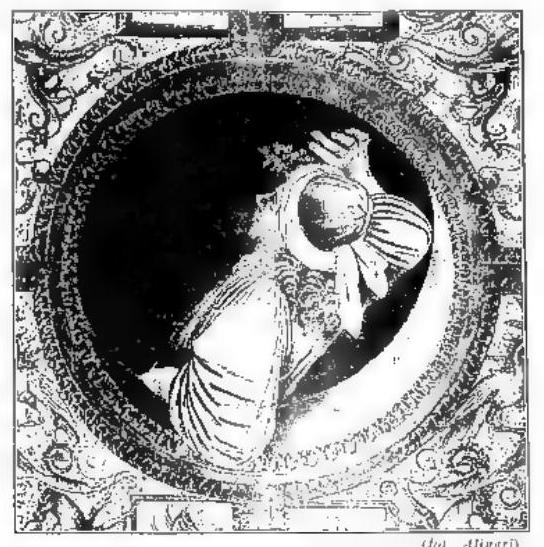
EMPEDOCLE of AGRICENTO (Ἐμπεδοκλῆς, Empedocles). - A complex figure as physician, naturalist, philosopher, and statesman, in whose regard legend and history cannot easily be separated, he lived approximately between 490 and 430 B.C. He caused the democratic party to prevail in his native city, but seems to have died in exile, in the Peloponnese. Entirely legendary is the tradition accepted by Orazio: « deus immortalis haberi dum cupit Empedocles, ardentem frigidus Actnam insiliuit » (Ep., II, 3, 464), although in a well-known fragment he says that he walks about like a God among mortals, honored by all.
He wrote two works: Περὶ φύσεως and Καθαρισμοί (some others are attributed to him, on scant grounds, by Diogene Laersio). In the first, it may be said schematically that, like Anassagora and Democrito, he occupies an intermediate position between the Eleatic doctrine of being, which excludes becoming, and the Heraclitean doctrine of becoming, which excludes being: according to E. there are both being and becoming, the former represented by the four elements—fire, air, water, earth—the latter by union (μεῖξις) and separation (διέλ-λαξις), effected respectively by love (Φιλία, Ἀρμενία, Ἀρροδίνη, Σταργή, Γηθοσύνη, Κύκας) and hate (Νεῖκας, Κόπας, Δήρις, Ἄρης). The nature of these causes, which alternate in their dominion over reality, is uncertain