
GOVERNING AUTHORITY. — This may be defined as the right of an imperfect society and of the superiors established within it to command its individual members and to make use of their work within the constitutive laws of that society.
This right does not belong to the public authority, since it is not necessary for its purpose and has ends clearly distinct from those of public society. It arises fundamentally from the free will of the members of the society, who, upon entering it, accept its laws and undertake to observe them by a formal or at least tacit promise.
Governing authority entails the right to command, and therefore to impose obligations to the extent and in the manner required by the matter commanded, by the nature of the society, and by the basis that binds the members to the society. The obligation may be not only juridical but properly moral, binding in conscience. Free entry entails a surrender of oneself, placing oneself at the disposal of the society by a genuine, albeit tacit, contract. Authors recognize a true obligation of justice, so that a dependent who refuses to obey is guilty of a violation of justice. By virtue of this power, the master may invalidate the vows of his dependents insofar as they are incompatible with what has been agreed (can. 1312). In religious persons, in addition to this title, essential in every human society, there is another, by obedience (v.), namely, the obligation of religion,
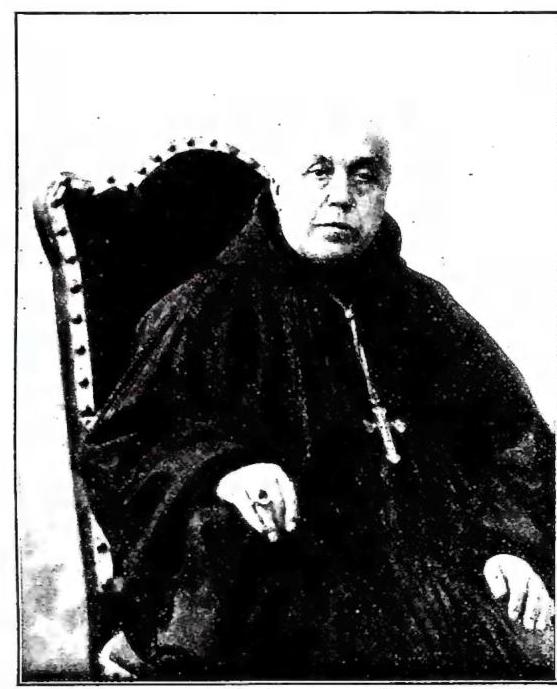
(courtesy of the Most Reverend Abbot of St-Wandrille)
POTHIER JOSEPH — Portrait.
in itself grave, provided that the matter is sufficient and the other conditions are present. The vow made to God binds precisely when the Superior commands in the name of God.
I. ACTIVE SUBJECT
The active subject (the superior) is determined concretely in the various societies by the constitutive law and by agreements entered into among the members. In the Church, lay persons and women, who are incapable of jurisdiction (abbesses, etc.), also exercise effective p. d. over the members of the community (can. 501 § 1).II. NATURE OF P. D. — Theologians generally address the question almost exclusively with regard to the family structure and religious institutes; at most, they content themselves with setting out rights and duties, without a comparative study of the nature of authority in the various imperfect civil and ecclesiastical societies, whether recognized or not (cf. cann. 684–87). To liken the family, in which authority is founded on natural law with indissoluble bonds, even if the law completes natural law, to a society which anyone may join by a rescindable contract appears unnatural; to equate a society bound by religious ties (in which rebellion against authority bears the character of sacrilege) with a society of economic interests, in which the member is bound solely by a title of justice or fidelity, does not seem logical.
III. OBJECT AND SCOPE
The object and scope of dominative power are determined by the nature and purpose of the society, by its constitutional laws, and by the lawful agreements entered into when the individual members join it; in general, whatever exceeds these limits cannot be its object (there is debate, in the case of the Rule of s. Francesco and of the Society of Jesus, as to whether dominative power extends to every honest matter, including matters beyond the Rule). There are three principal acts that may be performed by dominative power: to command, to direct, and to punish (although with penalties that are only disciplinary and paternal; cf. cann. 2306, 2312), even by one who is merely a layperson.Among other things, one invested solely with dominative power has no right to dispense from any ecclesiastical law (and consequently, in itself, from any law approved by the public authority, e.g., constitutions). Since this principle is odious, it must be understood strictly; but it presents practical difficulties. It is generally taught that by dominative power one may: a) declare the existence of excusing or exempting causes under an ecclesiastical law; b) dispense from merely internal disciplinary norms of constitutions, if these grant such power. Although constitutions are often approved by the supreme authority, since they do not bind in conscience (as is usually provided by the constitutions themselves), they lack an essential element for constituting a formal law and must therefore be regarded solely as directive norms (silence in the refectory, exemption of an individual from some common act, etc.); c) dispense ministerialiter from some ecclesiastical law (the Office, fasting, etc.); that is, so to speak, verify the presence of certain conditions on the basis of which the Ordinary dispenses by making use of the Superior; d) apply or declare operative a law, including a penal law; e.g., the case contemplated by can. 646, though without the particular juridical consequences of a judicial declaration; thus to declare, if the constitutions authorize it, that the conditions exist whereby someone is deprived of a voice in the Chapter, loses internal precedence, ceases to hold office, etc. Finally, dominative power entails the right to issue juridical (not jurisdictional) precepts in accordance with can. 24 (e.g., to prohibit certain things in accordance with can. 661 §§ 1, 2, coll. canon. 649), and also to issue precepts to all the members in a stable manner.