
PRESBITERIO — P. of the basilica of S. Clemente with the cathedra commissioned by Cardinal Anastasio, titular of the Basilica (1108). Rome.
A general conference held in Edinburgh (Scotland) gave rise to the Pan-Presbyterian Alliance, which brought together all the Presbyterian Churches of Scotland, England, Ireland, Spain, France, Holland; the missionary Churches of Belgium; the Free Churches of Switzerland; the Reformed Churches of Bohemia, Moravia, Hungary, and Russia; and the missionary Churches of Africa, India, New Zealand, Australia, and Formosa.
This Alliance published the Quarterly Review in London from 1885 onward. It was agreed that the union should be based solely on the principle proper to the Presbyterian system, which makes room for the laity and is founded on election. No account was to be taken of doctrinal differences. General Synods were held at Philadelphia (1880), Belfast (1884), London (1888), Toronto (1892), Glasgow (1896), Washington (1899), etc. Because of its very diversity, the Alliance began to claim the title of “ecumenical”; it would, however, be more accurate to say that it is international and interconfessional, since it has no unity of doctrine.
A second step toward linking the groups was taken recently. A special issue of the Christian Century, dated 13 Dec. 1950, announced the creation of the National Council of the Church of Christ in the United States. The following joined it: the Presbyterians of the United States of America (approx. 3,400,000 adults), the Baptists (approx. 8,000,000 adults), the Lutherans (approx. 1,700,000 adults), the Methodists (approx. 10,000,000 adults), the Episcopalians (1,671,000 adults), and several Congregationalist denominations: Disciples of Christ, Quakers, etc. (6,000,000 adults altogether). This federation as a whole adheres to the ecumenical movement of the Churches, which has continued to develop from 1919 onward (v. PROTESTANTESIMO).
IV. CONCLUSION
From the doctrinal point of view, three tendencies may currently be discerned in Presbyterianism: a) those who have remained faithful to the Westminster Confession of Faith (of 1643–46), which is strictly Calvinist and Congregationalist, but with a certain flexibility in its formulations and considerable individual freedom with regard to Predestination; b) those who refuse to subscribe to the Westminster Confession (nonsubscribing Presbyterians), especially in England and Ireland; c) those who are still more liberal, with doctrines imbued with modern rationalism, concerning the dogmas of the Most Holy Trinity and the Incarnation.From the liturgical point of view, all Presbyterian denominations preserve a strong affinity: worship is austere in character, indifferent to art, hostile to every form of mysticism, without altars, baptisteries, candles, images, etc., except for some in the stained-glass windows. The organ is almost always absent, and the pastor limits himself to wearing a black robe; the sermon, which has absorbed everything, is often read. Rhymed psalms are sung; prayers are left to the pastor’s initiative, and the faithful listen to them, each maintaining whatever posture he pleases (some kneeling, some standing, some sitting). What is called “the long prayer” lasts on average from 10 to 15 minutes, wherever it is still practiced.
One of the most noteworthy elements of Presbyterianism, especially in Scotland and England, is the strict observance of Sunday rest, also called the “Lord’s Sabbath.” Its opponents accuse Presbyterianism of attaching excessive importance to this observance: it almost seems that there is no other sin than violation of the Sabbath. Assiduous readers of the Bible and austere Puritans in their conduct, Presbyterians appear throughout history as people who ostentatiously practice the finest family virtues and display great religious zeal. The Protestant historian A. de Mestral observes that they love their Church not as a mother, but as a daughter—that is, not for what they receive from it, but for what they give II.
BIBLIOGRAPHY: G. V. Lechler, Gesch. der Presbyt. und Synodalverfassung. Leiden 1854; A. Gee and W. J. Hardy, Documents illustrative of English Church history, London 1866; J. V. DIOTREPHES, The Presbyterian Churches, Divisions and unions in Scotland, Ireland, Canada and America, Philadelphia 1910; J. N. Ogilvie, The Presbyterian Churches of Christendom, London 1925; G. M. Trevelyan, England under the Stuarts, London 1928; L. Cristiani, s. V. in DThC, XIII, cols. 111–16; I. Islan, The history of the Presbyterian or Protestant Dissenting Chapel, in Transact. of the Unitarian Histor. Soc., 7 (1940), pp. 139–62; C. Algermissen, La Chiesa e le Chiese, Italian trans., 2nd ed., Brescia 1944, passim; C. M. Hilton, Whitehaven Presbyterian Church, in Journ. of the Presbyterian Histor. Society, 8 (1943), pp. 42–56. Leone Cristiani
PRESBYTERY (sacrarium, sanctuary). - The space designated for the bishop and priests during sacred functions.
It was located opposite the entrance, slightly elevated with one or more steps, corresponding thus to the part called the "praetorium" of the ancient pagan basilica, and typically ended in a semicircular, rectangular, or polygonal apse. At the back of the apse was placed the bishop’s cathedra, with simple stone benches to the right and left for the priests (deacons never sat but assisted standing). The altar stood before the cathedra beneath the so-called "triumphal" arch of the basilica. From the Middle Ages, when the high altar moved closer to the wall, thus taking the place of the cathedra, the area immediately before the altar—the space where sacred services unfolded—was called the presbytery. To the left, known as in cornu Evangelii,
In cathedrals, the bishop’s cathedra or throne is placed; opposite, on the Epistle side, are the benches or seats for the sacred ministers in attendance. Toward the people, a low dividing barrier, called a pergola, lectern, or iconostasis (today, the communion rail), served to separate the presbyterium from the nave, reserved for the faithful, thereby ensuring a sufficient zone of reverence around the altar, within which no layperson was to enter, especially during the celebration of sacred functions; women were forbidden access to the sanctuary.
---
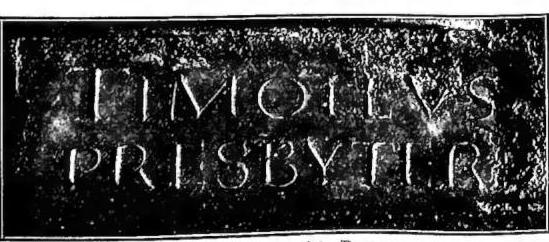
PRESbyter, PRESBYTERATE - Damasan inscription in memory of the presbyter Timothy (4th century) - Rome, cemetery of S. Ippolito.