
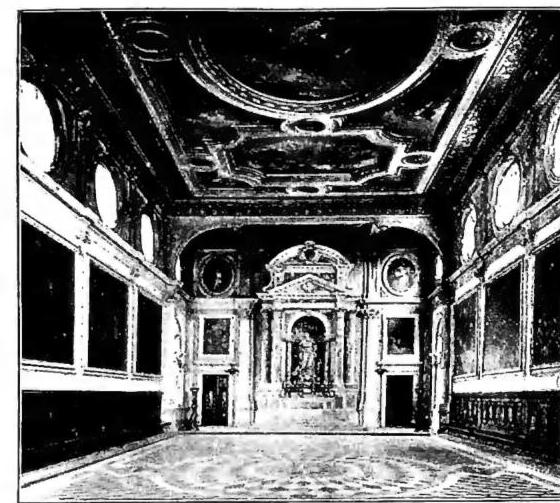
VENICE — Great Hall of the Scuola Grande di S. Giovanni Evangelista. Walls and ceiling adorned with canvases and frescoes from the 16th–17th centuries; on the altar, a statue of S. Giovanni by G. M. Morlatter (18th century).
The Chronicle of the deacon Giovanni from the late 10th century (cf. G. Monticolo, *La Cronaca del diac. Giovanni*, Perugia 1890). Earlier chronicles are little more than dry lists, more or less reliable (G. Monticolo, *Cronache veneziane antichissime*, Rome 1890); the so-called *Chronicon Altinate* (ed. MGH, *Script.*, XIV, pp. 1–69) is merely a patchwork of material from different periods and of limited authority. On these uncertain foundations, Andrea Dandolo—later Doge—compiled his history, whose authority begins with his own time (14th century; ed. RIS, XII, 1). Marin Sanudo (v. 1), with his *Vite dei Dogi* (ibid., XXII, 1), extends to the end of the 15th century, when his famous *Diarii* begin, reaching up to 1533. Contemporaneous with Sanudo’s *Diarii* are the *Diarii veneziani* of G. Priuli (RIS, XXIV, II, III, 1). Toward the end of the 15th century, the humanist M. Antonio Sabellico compiled a humanist-style Latin history of Venice, followed by works of Pietro Bembo, Paolo Paruta, and others in an official vein, until the 18th century, when erudite studies began with Filiasi, Galliccioli, and others, culminating in the still valuable comprehensive work: S. Romanin, *Storia documentata di Venezia*, 10 vols., Venice 1842–78, later reprinted. Critical investigations into the early period followed: A. Gröber, *Gesch. Venedig bis 1084*, Graz 1872, Italian trans. by P. Pinton, 1876–78; H. Kretschmayr, *Gesch. von Venedig*, 2 vols., Gotha 1905–20; W. Lenel, *Venetianische-histor. Studien*, Strasbourg 1911; R. Cessi, *Venezia ducale*, 2 vols., Padua 1928–31; id., *Le repubblica di Venezia e il problema adriatico*, Naples 1953. In the same work, histories of major families and studies on specific episcopal periods of Venetian history by Barozzi, Fulmin, Della Santa, Giorno, Cessi, and many others. Useful compendia include: R. Fulin, *Breve sommario di storia veneta*, Venice 1914; Ch. Diehl, *Une république patricienne, Venise*, Paris 1915; E. Musatti, *Storia di Venezia*, 2 vols., Milan 1919; A. Battistella, *La repubblica di Venezia nei suoi undici secoli di storia*, Venice 1921. For literary history, comprehensive works include: G. Degli Agostini, *Notizie istorico-critiche intorno agli scrittori veneziani*, 2 vols., Venice 1752–54; A. Cicogna, *Iscrizioni veneziane*, 5 vols., ibid. 1824–43 (unfinished); M. Foscari, *Della letteratura veneziana*, 2 vols., ibid. 1854; P. S. Molmenti, *La storia di Venezia nella vita privata*, 5 vols., Bergamo n.d.; Pio Paschini.
II. THE PATRIARCHATE OF GRADO
The ecclesiastical origins of Venice are closely tied to the formation AQUILA (v.) Grado (v.), particularly the latter, established following the Venetian schism of the Three Chapters (v.). The resolution of that schism (late 7th century) did not restore unity, and the patriarchate of Grado continued to exist despite repeated legal and even violent attempts by Aquileia. Grado oversaw communities along the coast and islands of the lagoon before Venice itself existed; once the settlement at Rialto grew in strength and political importance, the patriarch—constantly chosen from among the leading Venetian families—preferred to reside there, partly due to Grado’s gradual decline and the expansionist ambitions of the prince-patriarch of Aquileia. Thus, Patriarch Vitale IV Candiano (d. 1018) resided in Venice, near the church of S. Silvestro, which had been placed under the jurisdiction of the patriarch of Grado since 989, though without formally transferring the see. Patriarch Enrico Dandolo (1131–86), forced to flee to Venice due to the invasion by Ulrich II, patriarch of Aquileia, built the Patriarchal Palace behind the church of S. Silvestro; this palace was later made independent of the jurisdiction of the bishop of Castello by Pope Boniface VIII (1294–1303). Doge Vitale Michiel II (1156–72) soon recovered Grado, but Patriarch Dandolo obtained from Alexander III in 1177 permission to transfer his residence to Venice, along with his Curia, courts, and ordinary diocesan jurisdiction—extending not only to the parish of S. Silvestro but also to those of S. Giacomo dell’Orio, S. Martino, S. Cassiano, S. Matteo di Rialto, S. Bartolomeo, and the monasteries of S. Maria dei Crociferi and S. Clemente in Isola. Conflicts and jurisdictional disputes were inevitable between the metropolitan and suffragan authorities within the same city, whether over poorly defined rights, the patriarch’s ambitions to expand diocesan jurisdiction within Venice, or the indiscipline of clergy who declared allegiance alternately to one or the other authority to avoid subordination. It is true that Alexander III himself wrote on 21 January 1178 to Doge Sebastiano Ziani, urging him to facilitate the transfer of the patriarchal see of Grado to Venice; but the doge died on 31 April, and the matter was dropped.Upon the death of Patriarch Domenico VI Micheli of Grado in 1451, Nicholas V issued the bull *Regis Aeterni* on 8 October 1451, suppressing the diocese of Castello (Venice) and the patriarchate of Grado, uniting their revenues, rights, privileges, obligations, and jurisdictions to establish the patriarchate of Venice, appointing Lorenzo Giustiniani (v.), the former bishop of Castello. The ecclesiastical province of Grado, with its suffragan bishops, was erected as the patriarchal province of the Church of Venice. On 23 December, the bull was executed in the cathedral of S. Pietro di Castello, resulting in the patriarchate of Venice, whose diocesan jurisdiction extended over all parishes of the city (except S. Marco, which remained an *abbazia nullius*), the parishes of Grado and Latisana, the forania of the Campardo (Conegliano), later composed of six parishes (S. Giovanni Battista di Fior di sopra; S. Lorenzo di Pianzano; S. Vendemiano; S. Martino di Bibano; S. Pietro di Zoppé; S. Giustina di Fior di sotto), the curacy of S. Martino di Torre di Mosto—the sole survivor of the suppressed diocese of Eraclea or Cittanova, united to the patriarchate of Grado in 1440—and later the parish of S. Giovanni Battista di Jesolo, resurrected from the ruins of the ancient diocese of Equilio, suppressed and united to the patriarchate of Venice in 1466, and the parish of S. Giovanni Battista di Gambarare, an ancient territory of the abbey of S. Ilario. The metropolitan jurisdiction extended over the dioceses of the Venetian martyrs (Caorle, Torcello, Chioggia). The patriarchate of Venice also inherited the primatial jurisdiction over the metropolitan church of Zara, with its suffragans of Veglia, Ossero, and Arbe, which Adrian IV had subjected to the patriarch of Grado by brief of 22 February 1155; a jurisdiction repeatedly confirmed by the popes but constantly contested by the Zadarese, until Patriarch Gianfranco Morosini (1644) deemed it advisable to retain only the title of this supremacy.
III. THE DIOCESE OF OLIVOLO OR CASTELLO
It is held that the first houses and church at Rialto arose in 421, spiritually subject to the bishop of Padua, who occasionally took refuge in the maritime island of Malamocco. By the 8th century, however, there existed a community of twenty-five islands with their respective churches. With the establishment of the ducal seat at Rialto, near the church of S. Teodoro—then the principal patron of the nascent community, brought from Alexandria in 828 along with the relics of S. Mark—the decision was made to erect a sumptuous basilica in honor of the Evangelist, who became the principal patron and, with his lion, the living symbol of Venice. The true origins of the diocese of Olivolo, however, remain obscure; it had jurisdiction over the islands and
Venice – Grand Hall of the Scuola Grande di S. Giovanni Evangelista. Walls and ceiling adorned with canvases and frescoes from the 16th–17th centuries; on the altar, a statue of St. John by G. M. Morlauer (18th century).
Its center shifted seaward with the cathedral dedicated to St. Peter and the baptistery to St. John the Baptist; by 1091 it had taken the name of the bishopric of Castello. Despite uprisings and rebellions of various kinds, over the centuries new churches, convents, monasteries, hospitals, and charitable institutions arose. By 1450, there were already 140 churches (six of which no longer exist); not counting reconstructions, which amounted to fifty in the 12th century alone.
The islands, now all regulated and connected by bridges, formed the city of Venice, divided into seventy contrade (parishes) with their respective churches, almost all collegiate, grouped into five clusters under the title of filiali, each headed by a collegiate (parish or baptismal) church. The monastic movement, begun with the Benedictines in 800, and perhaps earlier, and with the Benedictine nuns in 727, accelerated after the year 1000; by 1450, there were twenty-seven religious orders with forty-nine houses (nineteen female and thirty male) and their respective churches: Benedictine nuns (9), Benedictine monks (3), Camaldolese (1), Canons Regular of St. Anthony of Vienna (1), Canons Regular of the Holy Spirit (1), Canons Regular of the Lateran of the Holy Molavatore of Lucca (1); Secular Canons of St. George in Alga (1), Carmelites of the Primitive Observance (1), Knights of St. John (1), Teutonic Knights (1), Carthusians (1), Cistercians (1), Crosiers (1), Dominican nuns (1), Dominicans (2), Augustinian Hermitesses (7), Augustinian Hermits (1), Hermits of St. Jerome of Fiesole (1), Augustinian Hermits of Monte Orto (1), Hermits of St. Jerome (1), Poor Clares (1), Friars Minor (3), Jesuits (1), Olivetans (1), Servites (2), Humiliati (1). Twelve hospitals, seven of which had their own churches, along with other non-parochial churches, completed the crown of 134 churches that adorned Venice by the mid-14th century; all rich in art and precious relics, most brought from the East. The Basilica of St. Mark, rebuilt in 1063 in its definitive form, stood preeminent. It soon became the ducal chapel with its primicerius and clergy. In 1071, works of art and precious marbles were brought from the East to adorn it, and it was solemnly consecrated on 8 October 1094, the year in which the body of St. Mark was miraculously rediscovered (25 June) after all trace of it had been lost. In 1053, Pope Leo IX passed through Venice on his return from Germany; after his death, a parish church was dedicated to his name. In 1177, Alexander III met with Barbarossa in Venice. There were occasional conflicts between the Republic and the Papacy, but these never touched on matters of religion (e.g., the interdict of 1309–13 during the war for Ferrara). The series of its bishops, with few negligible exceptions, is a series of saintly shepherds. One, Angelo Correr, took the name Gregory XII (1406–16) upon his election; the last, Lorenzo Giustiniani (q.v.), was raised to the altars. Venice also has its saints among the laity: St. Peter Orseolo I (q.v.), Doge of Venice who in 978 left his office to lead a solitary and penitent life and died on 10 January 997; St. Gerard Sagredo (q.V. GERARDO DI CSANÀD, SANTO); Bl. Peter Acotanto, father of the poor, a beggar for the love of God, who died on 26 August 1187; Bl. James Salomonio (q.v.), Dominican, who died on 31 May 1314. Another Venetian, Gabriele Condulmer, became pope as Eugene IV (1431–47) at the same time that Lorenzo Giustiniani ascended to the bishopric of Castello (1433) and, in the fullness of the Renaissance, impressed upon Venice a strong seal of spirituality, enabling it to resist Protestant propaganda despite many pitfalls. The Council of Trent was fully accepted in the same year of its conclusion (1564).
IV. THE PATRIARCHATE IN VENICE
From the mid-15th to the mid-18th century, the rhythm of new church foundations continued (no fewer than forty-five), which, added to those already existing, became peerless models of all styles: from Byzantine to Romanesque, Gothic, Renaissance, Baroque, and finally Neoclassical. The religious orders already established in Venice flourished, and new ones, such as the Capuchins and Capuchin nuns, the Discalced Carmelites, the Carmelites of the Mantuan congregation, the Fatebenefratelli, the Filippini, the Minims, the Reformed Franciscans, the Jesuits, the Minims, the Theatines, etc., found a warm welcome and contributed nobly to the spiritual life of the city. With the canonical suppression of seven orders (the Humiliati in 1462; the Venetian priory of the Teutonic Knights in 1592; the Canons Regular of the Holy Spirit and the Crosiers in 1656; the Secular Canons of St. George in Alga; the Hermits of St. Jerome of Fiesole and the Jesuits in 1668)—whose property was devolved to the Republic for wars against the Turks—by the mid-18th century Venice counted forty religious orders in eighty-one houses. In the first half of the 16th century, Gian Pietro Carafa (Paul IV) and St. Cajetan of Thiene provided a shining example of charity and faith in the city; and Venetian nobility gave to the altars Jerome Emiliani (q.v.), who died on 8 February 1537, and his faithful companion and imitator, John Marinoni (q.v.), who died on 13 December 1562. In this period, two clamorous ecclesiastical interdicts, arising from political disputes, interrupted peaceful relations with the Holy See: the one under Sixtus IV in 1483 during the war for Ferrara, and that of 1509 under Julius II during the League of Cambrai, which Venice ended by submitting when it realized its political error. The interdict of Paul V in 1605 had greater resonance in public life at the time. Provoked by reasons more strictly of ecclesiastical discipline, it struck the city along with all the territory subject to it on the mainland, provoking true crises of conscience. The Jesuits, Capuchins, and Theatines obeyed the Pope and were expelled from Venetian territory. The Senate particularly targeted the Jesuits with a decree of perpetual banishment, though they managed to return in 1657. The conflict, dangerous in every respect, was resolved through the mediation of the King of France. During the plague of 1630, which claimed 46,536 victims in the city alone, the Republic vowed the magnificent temple of Santa Maria della Salute. This century also produced its saints: Lawrence of Brindisi (q.v.), born of a Venetian family (d. 22 July 1619), and the Venerable Gregory Barbarigo, bishop of Bergamo and later of Padua (d. 18 June 1697). Venetian nobility continued in the luminous wake of the Giustiniani, producing a series of twenty-nine patriarchs (the last, Lodovico Flangini, d. 29 February 1804), several of whom died in a reputation for holiness, along with many bishops and cardinals and three other popes: Paul II (1464–71; Pietro Barbo), Alexander VIII (1689–91; Pietro Ottoboni), and Clement XIII (1758–69; Carlo Rezzonico).
However, the seed sown by SARPI (v.) MICANZIO (v.) on the occasion of the interdict of 1606 and the accompanying controversy continued in the legal consultants who assisted the Signoria in ecclesiastical disputes, favouring its jurisdictional tendencies. The Apostolic See encouraged this by financing the long War of Candia and that of the Morea, granting dispensations over ecclesiastical property, particularly that of religious orders; but the Republic, following the fashion sweeping across Europe, claimed to proceed on its own authority, invoking politico-religious theories that granted it a right in this matter. It thus introduced the prohibition of churches receiving testamentary inheritances, restrictions on offerings for Holy Masses, and so forth. Not content with this, from 1768 onwards it issued a series of laws all contrary to the freedom of the Church. Clement XIII protested in vain; Venice claimed to regulate ecclesiastical discipline on the pretext that Rome was not doing so. In reality, the Republic was in its death throes and needed money. It began with the union and suppression of various convents: seven in the city (Carmelites of the Congregation of Mantua at S. Angelo della Giudecca, 1768; Lateran Canons Regular of S. Maria della Carità, 1768; Benedictines of S. Niccolò del Lido, Castello, 1771; Camaldolese of S. Giovanni Battista della Giudecca, 1771; the commendatory abbacy in the Benedictine monastery of S. Gregorio, 1776; Cistercians of S. Cristoforo, 1787), but well over three hundred in the State. This was the end of the Republic. Venice, which for eleven centuries had not seen a foreign foot, had to witness the parade of French republican armies right in its heart, in the magnificent Piazza di S. Marco (16 May 1797). The provisional government was the first storm against religious institutions. The advent of Austria in the same year, after the Treaty of Campoformio, brought a relative calm, and the election of Pius VII took place on the island of S. Giorgio Maggiore on 14 May 1800, four months after the death of its most pious patriarch, Federico Maria Giovanni (10 Jan. 1800). The Napoleonic tempest was at its height. In 1806–08 all schools, confraternities, and brotherhoods of every kind and purpose (over 700 in Venice) were suppressed; in 1807 eleven convents and eighteen monasteries were consolidated and suppressed; in 1808 the seventy parishes were reduced to forty and then to thirty; in 1810 the remaining nineteen convents and twenty-two monasteries were also suppressed. With the exception of some churches, which for various reasons were later reopened for worship, of the sixty that were suppressed, nearly all have now been demolished! Exempt from suppression were: the Melkite Armenian Monks of S. Lazzaro on the island, the Hospitallers of S. Servolo on the island, the Basilian Nuns (Greek); the Salesian Nuns (French) of S. Giuseppe di Castello, S. Giorgio dei Greci, S. Giorgio degli Schiavoni, S. Croce degli Armeni, and the School of S. Rocco. In 1807 the transfer of the cathedral see from S. Pietro di Castello to S. Marco was ordered, with the merging of the two chapters: the patriarchal chapter of S. Pietro and the ducal chapter of S. Marco, with twenty beneficed canons, who were to be reduced to fourteen over time. The patriarch, with all his offices, also had to move to S. Marco into a temporary residence until 1851, when he obtained a permanent one in the present palace. In 1815 Austria returned, and it was necessary to consider rebuilding. The bull of 10 May 1818 of Pius VII suppressed the dioceses of Torcello and Caorle and united them to Venice (12 parishes), from which Grado, Latisana, and the forania of Campoardo (6 parishes) were removed. Thus the patriarchate counted 32 parishes in the city (including: Giudecca, Lido, Gambarare) and 12 in the foranie of Caorle, Murano, and Torcello. The same bull assigned as suffragans the dioceses of Adria, Belluno and Feltre, Ceneda, Chioggia, Concordia, Padua, Treviso, Verona, Vicenza, and temporarily Udine, an arrangement that still holds today. From 1819 to 1859, thirteen male and fifteen female religious houses were reopened, some newly founded. Congregations, especially female ones, began to flourish; it was a time of intense charitable activity that gave rise to particular institutions for the benefit of childhood and youth.
With the events of 1866, Venice became part of the Kingdom of Italy, and in 1867 the law of 7 July 1866 was applied. By a fortunate turn of events, despite being confined to a few small premises, some religious were able to remain under the aegis of the so-called “religious associations” recognised by the law itself; nuns remained in their monasteries, albeit indemnified, up to the number of six, and churches remained open for the convenience of the faithful. The last three decades of the 1800s saw a wave of sectarian anticlericalism; yet the clergy, accused of being pro-Austrian and anti-Italian, worked instead for the good of Venice and of Italy. The Institute for Juvenile Delinquents arose from the great heart of the young priest Carlo Coletti; the Institute for Young Women was erected by the parish priest Giuseppe Solsien; the Work of Evening and Sunday Patronages was founded by the priests Giovanni B. Piemonte and Angelo Bortoluzzi; and the Opera dei Congressi, which prepared and anticipated the political activity of Italian Catholics. Thus the threshold of 1900 was reached with the great Eucharistic Congress (1897), desired and guided by Cardinal Patriarch B. Giuseppe Sarto (v. PIO X). The last fifty years, marked by the two world wars, recall Cardinal Pietro La Fontaine and Cardinal Adeodato Giovanni Piazza, who saved Venice from German threats. In 1919 the parish of S. Maria Assunta of Malamocco with the island of Poveglia, detached from the diocese of Chioggia, was united to the patriarchate; and in 1927 eleven parishes (including Mestre), detached from Treviso.
V. Institutes
Among the most illustrious Venetian institutes, the Biblioteca Marciana (now national) certainly stands first: it contains an initial fund from the Republic, augmented by the bequest of Cardinal Bessarion of 900 manuscripts, mostly Greek; later various private collections were added, including in the 19th century that of the Dominicans at the Zattere, which made it rich in numerous rare editions, such as the collection of Aldines and in particular the celebrated miniature Breviary left by Cardinal Domenico Grimani. Initially housed near the church of S. Marco, it was transferred to the famous “Libreria” built by the Senate in 1559 by Jacopo Sansovino. In 1812 it was moved to the Doge’s Palace when the building was annexed to the Royal Palace (Procuratie Nuove). In 1904 it passed to the premises of the old Mint, suitably adapted, and in 1929 it also acquired the old Libreria building when the Procuratie were put to another use. The State Archive, founded in 1815, was housed in the former large convent of the Conventuals at the Frari and comprises the Archive of the Venetian Republic, unfortunately damaged by fires such as the disastrous one of 1571, the records of numerous monasteries, confraternities of the Dominante and its dominion; a source of the highest order not only for the history of Venice and Italy, but also for that of other states of the Near East and the Orient. In 1869 Giovanni Querini-Stampalia bequeathed to his city his library rich in manuscripts, to which were added an art gallery and a museum, gathered by him to preserve the memories of the past and thus save them from dispersal.A rich collection of Venetian manuscripts (including those of C. E. Cicogna) and coins forms part of the Civic Museo Correr, begun in 1836 and now housed in the Procuratie Nuove on St Mark’s Square. Nearby stands the Archaeological Museum, established from an initial bequest to the Republic by Cardinal Domenico Grimani (d. 1523) and his nephew Giovanni, Patriarch of Venice. In the 19th century, the rich Manfredini Gallery and Museum were installed in the Patriarchal Seminary and the sacristy of the church of the Salute. The grand Palazzo Rezzonico now contains a Museum of 18th‑century Venetian art, while the Palazzo Pesaro has housed since 1928 both the Museum of Oriental Art and the Gallery of Modern Art. Another prized collection is that assembled by Baron Franchetti in the restored Ca’ d’Oro, which was added to Venice’s marvelous holdings.
Elsewhere, the suppressed church of the Carità and its adjoining convent became home to the Academy of Fine Arts, founded in 1750. With its annexed galleries, it constitutes a premier artistic institution with an excellent tradition.
In 1840 the Istituto Veneto di Scienze, Lettere ed Arti held its first meeting and thereafter pursued unbroken activity, publishing in its Memoirs and Proceedings major scientific contributions, historical studies and literary research. A specialized journal is also issued by the Ateneo Veneto. In 1871 Riccardo Fulin founded a Society for Historical Studies, which began publication of the Archivio Veneto (1871–90); this became the Nuovo Archivio Veneto (1891–1921), then the Archivio Veneto Tridentino (1922–26), and finally resumed as Archivio Veneto (1927–39). In 1873 the Society became the Deputazione di Storia Patria per la Venezia, with the aim of publishing major studies, chronicles and documents concerning V. and the Venetian region (though Trento and Trieste continued their own publications). Notable among its works are the eight volumes of regests of the Libri Commemorationum of the Republic of Venice by R. Predelli (1876–1913) and the Diplomatarium Veneto‑Levantinum by G. M. Thomas and R. Predelli (2 vols., 1880–99).
VI. ART
The city of Venice rises amid the waters of the Venetian Lagoon, equidistant from the mainland (now joined by two long bridges) and the open sea (accessed through ports that break the narrow coastal strip).When populations from the mainland sought refuge from barbarian raids—especially the Lombard invasion—certain lagoon islands, previously humble fishing hamlets, offered safe haven and soon flourished (Torcello). The political authority of these settlers, deriving from that of the Byzantine exarchate of Ravenna, first resided at Eraclea, then at Malamocco on the sea; the latter proved too exposed to Frankish naval incursions. The capital was therefore transferred in 812 to Rivo Alto (Rialto) in the heart of a maze of canals, on the banks of a broad waterway (the Grand Canal) that, with its sinuous course, divides a dense archipelago of islets. From this moment Venice’s singular destiny began.

Venice, measuring 3,800 meters in length and 2,300 in width, today comprises within its 11‑kilometer perimeter 108 islets (to which are added those of San Giorgio Maggiore and the Giudecca), separated by 150 canals and ri (the term for smaller, shallow channels four to ten meters wide). The largest is the Grand Canal, whose width ranges from thirty to seventy meters and which traverses the city, opening into the basin of Saint Mark.
About 400 bridges in stone, iron, and—now rare—wood connect the opposite banks of the canals; three are especially imposing spans over the Grand Canal: the Rialto, the Scalzi (in stone), and the Accademia (in wood). In earlier times there were fewer bridges (until 1854 the Rialto Bridge alone spanned the Grand Canal) and many more ri, several of which have been filled in (hence the name Rio Terra), necessitating the use of ferries even in the city’s interior. In the 18th century about a hundred were counted. The service of ferry transport, now limited to the opposite banks of the Grand Canal, is still provided by the gondola, Venice’s characteristic boat.
Buildings crowd the restricted space, creating narrow lanes (calli) without any urban plan; the city’s layout shows some affinity with Byzantine emporia. Many calli are dead‑ends that suddenly close or open onto the water. Along the canals, a narrow strip of land (fondamenta) was often left between buildings and the water. Paving of the streets began only in 1676; the term salizada (silicata) recalls the singularity of the first paved streets. A ramo is a short branch of a calle. Calli sometimes widen into small squares called campi or campielli, where one still frequently finds the marble vere da pozzo of every age and style—parapets shaped like rings encircling the rims of artesian wells. A corte is a small enclosed space between buildings; a sottoportico is a calle formed within a building’s structure. Ruga (from Late Latin) denotes a street of medium width. The term piscina recalls water basins reserved for fish farming, now all filled in. The word piazza is reserved solely for Saint Mark’s Square, while piazze are the two adjacent spaces: that of the Leoncini and that between the Doge’s Palace and the Marciana Library.
The city’s appearance has continued to change over the centuries. Every style has left its mark. Once enchanting vistas delighted Venice before modern buildings rose along the Grand Canal; when the dim, narrow calli hemmed in by houses—each leaning against the next—were interspersed with gardens and unexpected luminous openings. The excess of construction often stifled buildings that are beautiful only when they can breathe in space and live in atmospheric reflection.
A city of the most delicate colors, Venice has transmitted from generation to generation a chromatic sensibility that seems innate to the Venetian soul and to the city itself, so that it is easy to believe the city itself shaped the artistic sense constantly drawn to color among its greatest artists.
Every artistic current has contributed to giving Venice its uniquely distinctive physiognomy, perhaps losing the purity of each style yet bending to collaborate in its fantastic scenography. From Venetian‑Byzantine to Gothic, from Renaissance to Baroque and Rococo, every style has been subsumed into a constant chromatic interpretation, almost never plastic. The masonry does not convey weight or thickness; windows and loggias crowd the façades of buildings greedy for light, while the subtlest decorative devices help to dissolve even the severest architecture beneath the slow, gentle play of light. Exceptional, therefore, is this architecture that seems to elude every conventional definition. The Venetian red of plasters, bricks and inlays, the bas‑reliefs, the lace‑like biforas, the façades revetted with rarer marbles, the imperceptible projection of refined moldings, and the chiaroscural force of Baroque elevations all contribute to create the spell of a chromatic narrative, bathed in atmospheric felicity.
The history of sculpture and painting is equally singular, for Venetian art may be called, by definition, pictorial art.
Every pronounced stylistic preference that appears conceptual in nature, such as for linear or tactile values, finds no welcome here. Generally considered, the arts at Venice could all seem to move and harmoniously articulate themselves in respect of a single principle: that of color.
The city is divided into six districts, called *sestieri*, three on this side of the Grand Canal (S. Marco, Castello, Cannaregio), and three on the other side (S. Polo, S. Croce, Dorsoduro, to which is added the island of Giudecca, separated from the rest of the city by a wide and deep channel that connects the industrial port of Marghera with the sea). For each *sestiere*, the civil registry numbering is unique and progressive, with the exception of the modern district of S. Elena. A series of recently constructed streets, partly obtained by filling in canals, leads from the railway station to S. Salvador, where the Mercerie begin. The main artery of the city, which opens into Piazza S. Marco. This is the historic and monumental center of the city. Here stand the Doge’s Palace and the church of S. Marco, which, with the Procuratie Vecchie, those Nuove, and the Napoleonic Wing, encloses the famous square. The church of S. Marco dates back in its original construction to the year 828, in which the relics of St. Mark the Evangelist were furtively transferred from Alexandria in Egypt; he replaced the old protector St. Theodore in primacy, as the Venetians aimed to elevate their own prestige in relation to the patriarchate of Aquileia, placed under the protection of St. Hermagoras, a disciple of Mark.
After a first rebuilding in the 10th century, which presumably did not alter the characteristics of the original structure, work began in 1063 on a more extensive construction for which a central plan in the form of a Greek cross surmounted by five domes and smaller cupolas was adopted, with the base surrounded by exo-narthexes: a scheme believed to have been devised by Antemius of Tralles, the Justinianic architect who had erected in Constantinople the church of the Holy Apostles, likewise, like S. Marco, a palatine chapel and not a cathedral church. Immediately the new basilica began to be decorated with marble mirrors, mosaic floors, sculptures ranging from bas-reliefs with Byzantine infusions to the Roman arch of the central portal, up to the “flaming” Gothic crown of the early 15th century.
The domes were covered with lead sheathing, of Moorish profile. But S. Marco owes its fame above all to the mosaics that, on a continuous gold background, completely cover its interior. From 1071, various craftsmen succeeded one another in this patient work, so that each century left its mark. Even among the oldest mosaics (11th–12th centuries), stylistic differences can be discerned, due in part to the periods and in part to the differing artistic tendencies of the craftsmen, perhaps coming from Ravenna, Rome, Constantinople, before a proper Venetian school had formed. The work of mosaic decoration continued in the following centuries, both to complete gaps and to replace deteriorated parts; though with results of lesser charm. Cartoons were supplied by Venetian and foreign painters from the 14th to the 19th centuries (M. Giambono, A. del Castagno, T. Vecellio, L. Lotto, P. Veronese, L. Bassano, P. Vecchia, G. B. Piazzetta). The iconographic program remained unchanged, illustrating in the domes the Church Militant, the Church Triumphant, and the Church Expectant; along the walls and beneath the arches, the life of Jesus, of St. Mark, of St. Clement, of the Baptist, while in the atrium are the mosaics narrating the Old Testament.
The Doge’s Palace was the seat of the highest magistracies and the residence of the doge. Its first construction in the form of a fortified castle dated to the 9th century. After various vicissitudes, at the beginning of the 14th century, once the reasons for particular defensive works had ceased, construction began on the palace in its current appearance, in Gothic style. Antonio Rizzo and his school (late 15th century) are responsible for the Renaissance façades on the courtyard and the Rio di Palazzo, and the Giants’ Staircase. A covered gallery over the waters (the Bridge of Sighs) connects the Doge’s Palace to the Prisons. Inside, the various halls have been decorated by the most famous painters of the Venetian school: the masters of the 16th century stand out. Among all the halls, those of the Anti-College, the College, and the Council of Ten shine, decorated by Paolo Veronese and Jacopo Tintoretto. An entire wall of the Hall of the Great Council is covered by one of the largest paintings in the world, a work by Tintoretto: *Paradise*. To the left, the square is closed by the Procuratie Nuove (16th century); the Procuratie Vecchie, belonging to the previous century, rise opposite. They take their name from the procurators of the fabric of S. Marco and the legal procurators of the Minorites, who resided in these palaces. The Marciana Library, which stands opposite the Doge’s Palace, is another Renaissance work (by Jacopo Sansovino).
The bell tower of S. Marco, which stands at the corner of the square, has very ancient origins; it was completed in various periods and completely rebuilt after the collapse of 1902, “as it was and where it was.”
Very few original elements remain in the oldest churches of the city, which were of the Ravenna-type basilican plan. Among the 90 churches of the city, those of SS. Giovanni e Paolo (early 15th century) are particularly celebrated, a true “pantheon” of the glories of the Second Venice (built in Venetian Gothic style, adorned with paintings by Giambellino and sculptures by Antonio Rizzo), and the coeval church of the Frari, which preserves works by Giambellino, Antonio Rizzo, and Titian (the Assumption altarpiece and the Pesaro altarpiece).
Numerous are the minor Gothic churches, with their characteristic mixtilinear gables (S. Stefano, S. Giovanni in Bragora, Carità). At the end of the 15th century, Mauro Codussi gave the façade to the church of S. Zaccaria and built the churches of S. Michele in Isola, S. Giovanni Crisostomo, and S. Maria Formosa, pictorial inventions based on the teachings of L. B. Alberti. In the 16th century, Jacopo Sansovino provided models for many churches; set apart, those by Palladio shine with particular light: S. Giorgio Maggiore on the island of the same name opposite the Piazzetta, and the Redentore on the Giudecca. Also from the 16th century is that of S. Sebastiano, entirely decorated with paintings by Paolo Veronese.
As a singularly fanciful “machine,” the Baroque church of S. Maria della Salute rises on the Grand Canal, a work by Baldassare Longhena.
To the 17th century also belong the façades of S. Moisè and S. Maria del Giglio. In the 18th century, the Baroque softened and cooled in the churches of the Jesuits (paintings by Piazzetta and Tiepolo) and of S. Stae (S. Eustachio), a true picture gallery of 18th-century Venice.
Among the religious architectures, those of the surviving *scuole* of devotion should also be remembered: S. Rocco, a work of Scarpagnino, entirely decorated with paintings by Jacopo Tintoretto; and the Carmini, with ceilings by G. B. Tiepolo. Along the banks of the Grand Canal stand palaces that allow one to follow the styles of Venetian architecture in every era, from the Venetian-Byzantine of the 12th century (Ca’ da Mosto, Ca’ Loredan, Ca’ Farsetti, Fondaco dei Turchi), with their characteristic arches raised on impost blocks, to the Gothic, among which, besides the Doge’s Palace, the Ca’ d’Oro shines.
In the 15th century, Pietro Lombardo constructed buildings with façades inlaid with polychrome marbles (Palazzo Dario), while Mauro Codussi revealed true architectural genius in the Palazzo Vendramin-Calergi. In the following century, Sannichelli erected the Palazzo Grimani with a monumental sense, while Jacopo Sansovino adapted his classical manner to the specific demands of the Venetian tradition (Palazzo Corner). In the 17th century, Baldassare Longhena exalted the pictorialism of Sannichelli and Sansovino, imbuing his architecture with a more vibrant rhythm and a heightened chiaroscuro (Ca’ Pesaro, Ca’ Rezzonico). In the 18th century, Giorgio Massari gave the cold façade of Palazzo Grassi. The feeble L. Santi proved unable to elevate Neoclassical style to the level of the preceding tradition.
The layout of the Venetian patrician house remained constant over the centuries: a portico opening onto the water; a courtyard at whose center stands a well; on the upper floors, corresponding to the portico, the *portego*, a kind of atrium that connects the various rooms. This type also includes the *fondaci*, emporia reserved for foreign nations, such as the Fondaco dei Tedeschi, likely the work of Scarpagnino.
At the Galleria dell’Accademia, one can trace the development of Venetian painting from its origins (Maestro Paolo) through the artists of the Quattrocento (Vittore Carpaccio, Giovanni Bellini), who laid the foundations of the school, to Giorgione (*La Tempesta*), Titian, Lorenzo Lotto, Tintoretto, Paolo Veronese, Jacopo Bassano, and finally to Tiepolo, Guardi, and Canaletto, who brought that glorious tradition to a close. The Pinacoteca Querini-Stampalia also houses works mostly by Venetian masters (Palma il Vecchio, P. Longhi). At Ca’ d’Oro, a rich collection of Venetian sculpture and paintings by Andrea Mantegna, Cima da Conegliano, and Francesco Guardi is displayed. Ca’ Rezzonico houses a permanent exhibition of 18th-century Venetian art (paintings by Giovanni Battista and Giovanni Domenico Tiepolo, Pietro Longhi, Rosalba Carriera; sculptures by Giovanni Maria Morlaiert).
Ca’ Pesaro hosts the Galleria internazionale d’Arte moderna. Also notable are the Museo archeologico (with originals of Greek and Roman sculpture), the Museo storico-navale at the Arsenale, which preserves the memory of the colossal shipyard where the Republic’s warships were built; and the Museo di Storia Naturale, dedicated to Adriatic flora and fauna. *Vedi tavv. CXXVI–CXXIX.*
Michelangelo Muraro

8790
8800
8810
8820
8830
8840
8850
8860
8870
8880
8890
8900
8910
8920
8930
8940
8950
8960
8970
8980
8990
9000
9010
9020
9030
9040
9050
9060
9070
9080
9090
9100
9110
9120
9130
9140
9150
9160
9170
9180
9190
9200
9210
9220
9230
9240
9250
9260
9270
9280
9290
9300
9310
9320
9330
9340
9350
9360
9370
9380
9390
9400
9410
9420
9430
9440
9450
9460
9470
9480
9490
9500
9510
9520
9530
9540
9550
9560
9570
9580
9590
9600
9610
9620
9630
9640
9650
9660
9670
9680
9690
9700
9710
9720
9730
9740
9750
9760
9770
9780
9790
9800
9810
9820
9830
9840
9850
9860
9870
9880
9890
9900
9910
9920
9930
9940
9950
9960
9970
9980
9990
10000
10010
10020
10030
10040
10050
10060
10070
10080
10090
10100
10110
10120
10130
10140
10150
10160
10170
10180
10190
10200
10210
10220
10230
10240
10250
10260
10270
10280
10290
10300
10310
10320
10330
10340
10350
10360
10370
10380
10390
10400
10410
10420
10430
10440
10450
10460
10470
10480
10490
10500
10510
10520
10530
10540
10550
10560
10570
10580
10590
10600
10610
10620
10630
10640
10650
10660
10670
10680
10690
10700
10710
10720
10730
10740
10750
10760
10770
10780
10790
10800
10810
10820
10830
10840
10850
10860
10870
10880
10890
10900
10910
10920
10930
10940
10950
10960
10970
10980
10990
11000
11010
11020
11030
11040
11050
11060
11070
11080
11090
11100
11110
11120
11130
11140
11150
11160
11170
11180
11190
11200
11210
11220
11230
11240
11250
11260
11270
11280
11290
11300
11310
11320
11330
11340
11350
11360
11370
11380
11390
11400
11410
11420
11430
11440
11450
11460
11470
11480
11490
11500
11510
11520
11530
11540
11550
11560
11570
11580
11590
11600
11610
11620
11630
11640
11650
11660
11670
11680
11690
11700
11710
11720
11730
11740
11750
11760
11770
11780
11790
11800
11810
11820
11830
11840
11850
11860
11870
11880
11890
11900
11910
11920
11930
11940
11950
11960
11970
11980
11990
12000
12010
12020
12030
12040
12050
12060
12070
12080
12090
12100
12110
12120
12130
12140
12150
12160
12170
12180
12190
12200
12210
12220
12230
12240
12250
12260
12270
12280
12290
12300
12310
12320
12330
12340
12350
12360
12370
12380
12390
12400
12410
12420
12430
12440
12450
12460
12470
12480
12490
12500
12510
12520
12530
12540
12550
12560
12570
12580
12590
12600
12610
12620
12630
12640
12650
12660
12670
12680
12690
12700
12710
12720
12730
12740
12750
12760
12770
12780
12790
12800
12810
12820
12830
12840
12850
12860
12870
12880
12890
12900
12910
12920
12930
12940
12950
12960
12970
12980
12990
13000
13010
13020
13030
13040
13050
13060
13070
13080
13090
13100
13110
13120
13130
13140
13150
13160
13170
13180
13190
13200
13210
13220
13230
13240
13250
13260
13270
13280
13290
13300
13310
13320
13330
13340
13350
13360
13370
13380
13390
13400
13410
13420
13430
13440
13450
13460
13470
13480
13490
13500
13510
13520
13530
13540
13550
13560
13570
13580
13590
13600
13610
13620
13630
13640
13650
13660
13670
13680
13690
13700
13710
13720
13730
13740
13750
13760
13770
13780
13790
13800
13810
13820
13830
13840
13850
13860
13870
13880
13890
13900
13910
13920
13930
13940
13950
13960
13970
13980
13990
14000
14010
14020
14030
14040
14050
14060
14070
14080
14090
14100
14110
14120
14130
14140
14150
14160
14170
14180
14190
14200
14210
14220
14230
14240
14250
14260
14270
14280
14290
14300
14310
14320
14330
14340
14350
14360
14370
14380
14390
14400
14410
14420
14430
14440
14450
14460
14470
14480
14490
14500
14510
14520
14530
14540
14550
14560
14570
14580
14590
14600
14610
14620
14630
14640
14650
14660
14670
14680
14690
14700
14710
14720
14730
14740
14750
14760
14770
14780
14790
14800
14810
14820
14830
14840
14850
14860
14870
14880
14890
14900
14910
14920
14930
14940
14950
14960
14970
14980
14990
15000
15010
15020
15030
15040
15050
15060
15070
15080
15090
15100
15110
15120
15130
15140
15150
15160
15170
15180
15190
15200
15210
15220
15230
15240
15250
15260
15270
15280
15290
15300
15310
15320
15330
15340
15350
15360
15370
15380
15390
15400
15410
15420
15430
15440
15450
15460
15470
15480
15490
15500
15510
15520
15530
15540
15550
15560
15570
15580
15590
15600
15610
15620
15630
15640
15650
15660
15670
15680
15690
15700
15710
15720
15730
15740
15750
15760
15770
15780
15790
15800
15810
15820
15830
15840
15850
15860
15870
15880
15890
15900
15910
15920
15930
15940
15950
15960
15970
15980
15990
16000
16010
16020
16030
16040
16050
16060
16070
16080
16090
16100
16110
16120
16130
16140
16150
16160
16170
16180
16190
16200
16210
16220
16230
16240
16250
16260
16270
16280
16290
16300
16310
16320
16330
16340
16350
16360
16370
16380
16390
16400
16410
16420
16430
16440
16450
16460
16470
16480
16490
16500
16510
16520
16530
16540
16550
16560
16570
16580
16590
16600
16610
16620
16630
16640
16650
16660
16670
16680
16690
16700
16710
16720
16730
16740
16750
16760
16770
16780
16790
16800
16810
16820
16830
16840
16850
16860
16870
16880
16890
16900
16910
16920
16930
16940
16950
16960
16970
16980
16990
17000
17010
17020
17030
17040
17050
17060
17070
17080
17090
17100
17110
17120
17130
17140
17150
17160
17170
17180
17190
17200
17210
17220
17230
17240
17250
17260
17270
17280
17290
17300
17310
17320
17330
17340
17350
17360
17370
17380
17390
17400
17410
17420
17430
17440
17450
17460
17470
17480
17490
17500
17510
17520
17530
17540
17550
17560
17570
17580
17590
17600
17610
17620
17630
17640
17650
17660
17670
17680
17690
17700
17710
17720
17730
17740
17750
17760
17770
17780
17790
17800
17810
17820
17830
17840
17850
17860
17870
17880
17890
17900
17910
17920
17930
17940
17950
17960
17970
17980
17990
18000
18010
18020
18030
18040
18050
18060
18070
18080
18090
18100
18110
18120
18130
18140
18150
18160
18170
18180
18190
18200
18210
18220
18230
18240
18250
18260
18270
18280
18290
18300
18310
18320
18330
18340
18350
18360
18370
18380
18390
18400
18410
18420
18430
18440
18450
18460
18470
18480
18490
18500
18510
18520
18530
18540
18550
18560
18570
18580
18590
18600
18610
18620
18630
18640
18650
18660
18670
18680
18690
18700
18710
18720
18730
18740
18750
18760
18770
18780
18790
18800
18810
18820
18830
18840
18850
18860
18870
18880
18890
18900
18910
18920
18930
18940
18950
18960
18970
18980
18990
19000
19010
19020
19030
19040
19050
19060
19070
19080
19090
19100
19110
19120
19130
19140
19150
19160
19170
19180
19190
19200
19210
19220
19230
19240
19250
19260
19270
19280
19290
19300
19310
19320
19330
19340
19350
19360
19370
19380
19390
19400
19410
19420
19430
19440
19450
19460
19470
19480
19490
19500
19510
19520
19530
19540
19550
19560
19570
19580
19590
19600
19610
19620
19630
19640
19650
19660
19670
19680
19690
19700
19710
19720
19730
19740
19750
19760
19770
19780
19790
19800
19810
19820
19830
19840
19850
19860
19870
19880
19890
19900
19910
19920
19930
19940
19950
19960
19970
19980
19990
20000
20010
20020
20030
20040
20050
20060
20070
20080
20090
20100
20110
20120
20130
20140
20150
20160
20170
20180
20190
20200
20210
20220
20230
20240
20250
20260
20270
20280
20290
20300
20310
20320
20330
20340
20350
20360
20370
20380
Smuggling and the commercial movement of Spanish galleons to and from Europe (Maracaibo, Puerto Cabello) continued throughout the entire 17th century. Around 1728, this situation was brought to an end by entrusting the exclusive rights of trade to a Guipuzcoan company, on the condition that it combat smuggling and piracy carried out by the Dutch (Curaçao) and the English (Margarita, Trinidad, Windward Islands). Following these measures, the colony developed significantly, two insurrectional movements provoked by landowners and government employees were suppressed (1749, 1752), a university was opened, and Caracas became the seat of the archbishop (1803). Despite having a population of approximately 412,000 (of which 12,000 were Spaniards; 100,000 were Spanish Americans; and 300,000 were indigenous people, blacks, and mulattos) spread over an area of one and a half million square kilometers, Venezuela would rise to the forefront due to its revolutionary activity against the antiquated Iberian colonial regime. In the struggle for the country’s independence, notable figures included Francisco de Miranda, the precursor of South American revolution (1750–1816), and Simón Bolívar (1783–1830), who brought it to fruition.
The entire history of Venezuela from 6 May 1830—when General Páez and Bermúdez proclaimed to the Congress convened in Valencia the separation of the region from Gran Colombia and the birth of the Venezuelan state—can be said to be encapsulated in the politics of the two parties—the conservatives and the liberals—and in the activity of four statesmen who, each in their own way, imposed their will upon the Republic. In chronological order, they were: José Antonio Páez, hero of the wars for independence; José Tadeo Monagas; Guzmán Blanco; and Juan Vicente Gómez. Through the multifaceted capabilities of these men, the political life of Venezuela unfolded in its entirety up to the present day, in which power rests in the hands of a military junta presided over by Colonel C. Delgado Chalbaud, who, having dissolved Parliament, has governed since December 1948. The peculiarity of these men—military leaders and politicians as circumstances dictated—was not confined to the years in which they held the presidency directly but extended through the subsequent presidents they had elected, imposing their will upon the country even through third parties. Among the latter, other personalities emerged who steered the country toward the normalization of internal life, recognition by other powers, decisive steps toward social reforms, the restoration of public finances, and later, the thorough exploitation of oil—primarily and continuously the region’s wealth—through foreign capital.
In more recent years, particular mention must be made of Gómez’s work: at the helm of Venezuela from 1908, “almost a self-taught man, but gifted with natural intelligence, shrewdness, and remarkable business sense,” he succeeded in maintaining good foreign relations, favorably resolving disputes with the Netherlands, Belgium, and the United States, remaining neutral during the First World War, adhering to the League of Nations in 1920, settling border issues with Colombia (1922) and Brazil (1929), and absorbing the complex foreign public debt between 1930 and 1935. His successor, General López Contreras, who served from 1936 to 1941, made significant contributions to the constitutional reform, restored political, press, and assembly freedoms to the people, and spearheaded a three-year plan for economic, agricultural, and social improvement. Following him, the presidency passed to his minister of war, General Medina Angarita, who severed relations with the Axis powers after the Japanese attack on Pearl Harbor, supplied substantial raw materials to the United States—which in turn strongly aided Venezuela in its industrialization and exploitation of natural resources—intensified the fight against illiteracy, and expanded social security provisions.

Venezuela – View of Caracas.
Socially, he outlawed communists, dissolving their leagues (though in 1945 he was compelled to recognize the legality of that party).
At the end of 1945, Medina was forced into exile in the United States along with López Contreras by a popular uprising; following a brief interim of a popular junta, the economist Rómulo Betancourt became president. Though he accomplished commendable acts during his years in office, he did not meet the country’s expectations, leading to insurrectionary movements and a coup d’état at the end of 1948. Since that year, as mentioned, Colonel Chalbaud has led the Republic.
III. EVANGELIZATION
The first missionary attempt in Venezuela was made in 1513 by the Dominican Francisco de Córdoba, who, together with a lay brother, set out from Haiti toward the Pearl Coast, west of the Island of Trinidad. Due to the pearl traders who enslaved the indigenous people, the attempt ended in the massacre of the two missionaries. A second attempt, undertaken from 1516 to 1519 by Dominicans and Franciscans, likewise failed after initial successes because of Spanish slave hunting and ended with the killing of the missionaries. The same fate befell the colonization of the Pearl Coast, conceived by Bartolomé de las Casas.In the 16th century, Spanish colonization and the Dominican and Franciscan missions were confined to the northwestern part, where flourishing cities such as Coro arose, and Caracas became the seat of government in 1578. In 1531, Coro was established as a diocese, later transferred to Caracas in 1637. Eastern Venezuela, as well as the lowland regions of the interior, remained unexplored. After various failed attempts, the Franciscans succeeded in founding a convent on the Island of Trinidad at the end of the 16th century. From there, they advanced toward the Orinoco Delta, initially without success. Only after 1656 did they establish a thriving mission among the Indian tribes in Piritú, and throughout the 18th century, they penetrated regions south of the Orinoco River. From around 1760, the missions were under the jurisdiction of the Apostolic College of the Franciscans in Piritú.

The Franciscans were assisted, from 1650 in Cumaná and from 1678 in Guayana, by the Capuchins, who established fine reductions. At the beginning of the 18th century, the Jesuits founded several missions in the Upper Orinoco region. With the so-called “Concordia” of 1734, the spheres of activity of the Franciscans, Capuchins, and Jesuits were clearly demarcated. After the expulsion of the Jesuits in 1767, the Franciscans took over their missions in the Upper Orinoco. In 1787, the Franciscans administered 68 missions with approximately 35,000 Christian Indians, while the Capuchins, in 1789, had 30 missions with about 25,000 Christian Indians.
Until the end of the 18th century, Caracas remained the only diocese; in 1777 the hierarchy was expanded with the erection of the diocese of Mérida, followed in 1790 by that of Guyana. In 1803 Caracas was elevated to a metropolitan see. During the struggles for independence in the first decades of the 19th century, the flourishing Franciscan and Capuchin missions were radically destroyed. The ongoing struggles against the Church in the 19th century prevented the restoration of the missions. It is true that in 1862 a Concordat was stipulated with the Holy See and that the new dioceses of Calabozo (1863), Zulia (1897), and Barquisimeto (1907) were erected, and furthermore in 1922 the dioceses of Coro, Cumaná, Valencia, and San Cristóbal followed; Mérida was also elevated to a metropolitan see. However, it was only in 1918 that the Capuchins were able to return to their former mission, where in 1922 the Apostolic Vicariate of Caroní (q.v.) was erected. In 1943 they were also entrusted with the new Apostolic Vicariate of Machiques (q.v.) in western Venezuela, where the Motilones, fierce Indians, live. The Salesians began their mission in the Upper Orinoco region in 1933, which in 1932 had been erected into an Apostolic Prefecture. In the territory there are numerous Indian tribes still pagan.