
AESTHETIC SURGERY. — In the broad sense, this means that branch of surgery concerned with improving patients’ appearance by correcting anatomical imperfection or the external form of the body disfigured or destroyed by trauma or disease.
Understood in this way, a. s. includes numerous procedures that belong to other specialties, already well defined and now completely detached from their common parent, general surgery, in which the aesthetic aim is intimately combined with that of functional restoration. This applies to “orthopedics,” which deals with deformities of the locomotor system, as well as to “orthognathodontics” (dento-maxillofacial orthopedics), which deals with dental malpositions and deformities of the maxillofacial complex. While treating excessive or deficient development of the maxillary skeleton, the latter also corrects certain important functions (breathing, mastication, phonation) and establishes a better harmony of lines in the face. Likewise, reconstructive plastic surgery of the facial mask destroyed or disfigured by trauma and congenital or acquired diseases is a specialty in its own right, and it too has an aesthetic and functional aim at the same time. Plastic surgery does not limit its activity to the face, but extends it to other regions where, for example, it may be necessary to remedy the aesthetic and functional consequences of a scar contraction caused by burns.
It is now generally accepted that surgery relating to these specialties is not contrary to the laws of natural morality.
On the other hand, some raise objections to procedures whose indication lies not in the consequences of disease or congenital malformation, but in the desire to improve the harmony of lines in the human person, altered by conditions lying on the borderline between the normal and the pathological.
This surgery might be called “cosmetic” (from κοσμέω = I adorn, beautify) if one wished to consider it solely in its aesthetic function. But there is no doubt that the boundaries between plastic surgery and purely cosmetic surgery are highly indeterminate, and that the latter, like the former, is at the same time aesthetic and functional. It deals, for example, with correction of the shape of the nose (saddle-shaped, hooked, etc.) and of the ear (protruding ear), plastic surgery of the breasts and abdomen, removal of wrinkles, etc. Many of these conditions may be troublesome, give rise to disorders or to genuine pathological states (e.g., hypertrophy of the breasts, hyperadiposity of the abdomen), and therefore fall within plastic surgery; others, which seem not to impair any function, nevertheless disturb the harmonious fusion of the various features of that design which tends more or less toward the ideal of normotype (v.).
God, who created man without sin and in his own image and likeness, cannot have fashioned him except as beautiful, and beauty should therefore be the normal condition; every deviation is to be regarded as the result of the transmission and perhaps the accentuation of degenerative traits. “Beauty,” says H. Bohn, “is it not a characteristic of divinity?” (op. cit., p. 500). It should be added that every deviation from the norm may cause an obstacle in social life and be a source of dangerous psychological complexes. This also applies to the removal of wrinkles, the product of the loss of elasticity of the skin, a consequence and symptom of old age, but sometimes a disease that appears prematurely, at an age still youthful, and which men often regard as a condition of inferiority; therefore, at least in many cases, the attempt to erase their signs is justified.
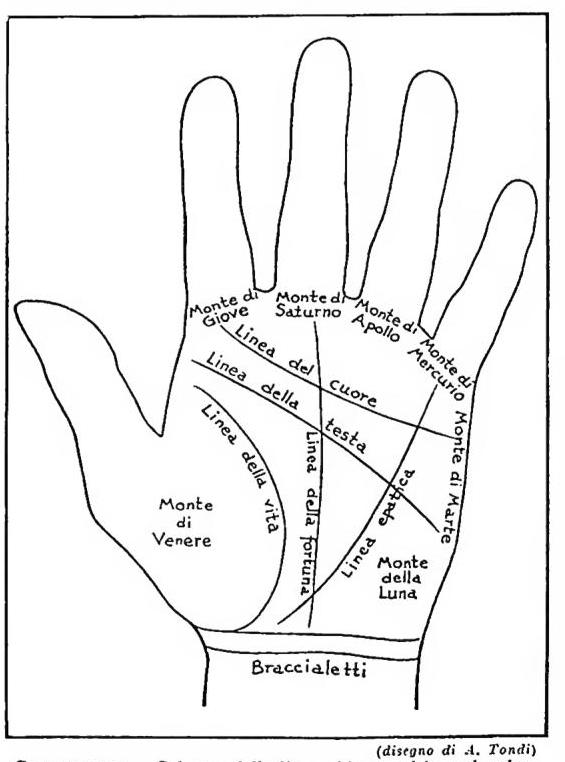
(drawing by A. Tondi)