
CHIROMANCY (from the Greek χείρ = hand and μαντεία = divination [Fr. chiromancie, Sp. quiromancia, Engl. palmistry, Ger. Chiromantie]). — C. is the doctrine and art that seeks to investigate and discover, through examination of the form and signs (lines, protuberances, etc.) of the hand, everything concerning an individual in the past, present, and future. The etymological definition is more restricted, and considers only the prediction of the future: for, properly and historically, divination is the power of knowing future things, communicated by God to human beings.
The doctrinal foundation of c. is to be sought in the idea that the ancients had of man. The earth is the centre of the universe. On earth, the centre and culmination of physical, psychic, and natural powers is man. Man is therefore the centre and, in a certain way, the synthesis of the world, so that universal harmony is summed up and brought to completion in human affairs. These are the harmonies that inspired astrology, according to which the movements and vicissitudes of the universe would have a counterpart and repercussions in man and in the course of his life. Thus, from the study of the movement and vicissitudes of the stars, people believe and hope to be able to pre-
dict the course of future human vicissitudes. But in man the hand is the wondrous and principal instrument of his activity: therefore the hand is like the synthesis of activity, that is, of human life, because to live precisely means to act, to work. Thus, in the hand—that is, in its form and its accidental features (lines, protuberances or mounts, etc.)—the sum of human life must already be depicted. This is why many chiromantic signs (e.g., the palmar protuberances) are still designated today by astrological names (Mount of Jupiter, of Saturn, etc.).
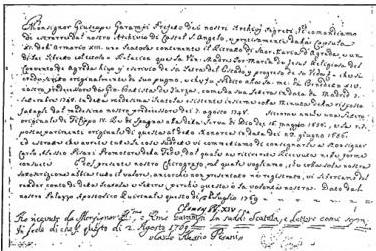
(from G. Battelli, Acta Pontificum, II, Vatican City 1933, tur. 26)
CHIROGRAFO — Chirograph of Clement XIV, 28 July 1769 — Vatican Archives.
These signs and forms having been assigned their corresponding meanings, everything initially comes down to verifying which of the elements in the lexicon are found in the hand of the subject under examination. Generally, the left hand is examined, because it is less deteriorated by use. This, however, is not enough, since the forms and signs must also be interpreted according to their greater or lesser development and according to their mutual relations. The interpretation is simple and based on commonplace criteria: for example, if the line of life is long and uninterrupted, longevity is assured;
if the line of the mind is short, there is intellectual impoverishment.
ASSESSMENT. — Modern c., although its practitioners have freed it from astrological superstitions and presented it in language bearing a scientific coloration, nevertheless remains a doctrine without foundation. Indeed, it is without foundation a priori, because the meanings of the chiromantic signs and forms are established a priori. But these meanings are also false a posteriori, because no statistics exist to justify them through a sufficient number of scientifically controlled observations; on the contrary, the few statistics that have been compiled demonstrate the opposite. At this point, however, c. must be distinguished from chirology, which, apart from certain very doubtful inferences concerning the relations between the forms of the hand and the subject’s psychology, is used to identify criminals, principally through the study of fingerprints (dactyloscopy) and palm prints, and in the investigation of paternity.
C., therefore, seeking to obtain knowledge disproportionate, indeed entirely unconnected with the elements that ought to provide it, superstition (v.), and must be included among the so-called occult sciences. It assumes an absurd determinism, contrary to science and Revelation, claiming to specify what depends on the freedom of God (the line of life) or of man (career, marriage, etc.). For these reasons c. is included in the list of divinatory arts enumerated and condemned by Sixtus V in the bull Coeli et terra of 5 January 1585. The reading of publications dealing with c. is regulated according to the norms established in the CIC, can. 1399, n. 7. Chirology, however, as discussed above, is permitted in the sense explained by Vermeersch: « per se patet nullam illicitam exerceri divinationem ab iis qui ex vultu, membrorum dispositionem, lineis et partibus manus, scripturae notis, temperiem corporis, immo etiam animi propensiones et affectus probabiliter coniciunt » (Theologia moralis, II, Roma 1928, n. 244).