GRAFOLOGIA. — From γραφή (writing) and λόγος (discourse), it has as its object of study the investigation of any relationships that exist between an individual’s handwriting and his nervous, psychic, and moral characteristics; according to certain authors (the old attempts of J. Chr. Grohmann and the modern studies of G. Moretti), even the physical features of bodily constitution; hence the possibility of knowing the entire personality through graphological expertise.
In the evolution of the theories and practical application of g., differing explanatory concepts followed one another, both with regard to the evidentiary value to be preferentially assigned to this or that element of the graphic complex, and with regard to their corresponding expert value, as well as to the power of revealing only innate characteristics or also those acquired by the individual nature (v. CARATTERE E
CARATTERIOLOGIA; INDOLE).
Graphological examination takes into consideration the numerous elements of handwriting, from the elementary graphic signs in their characteristics of form, inclination, and intensity of stroke, and the greater or lesser union or spacing between letters and words, to the particularities of alignment and direction of the line, and of simplicity, harmony, or superfluity in the design. Thus graphologists came to assign a corresponding somatic and psychological value to individual signs, or rather, in more recent times, to the graphic complexes constituted by their association or combination—complexes indicative of affective-active dispositions, intellectual aptitudes, and even the morphological habitus of the subject under examination. One of the most authoritative modern scholars of g., the scholar from Recanati, Fr. Girolamo Maria Moretti, of the Order of Friars Minor Conventual, in his treatise lists, describes, and critically studies the diagnostic value of seventy graphic signs, distinguished as substantial, modified, and accidental, each classified with regard to its quantitative value according to a personal decimal system of classification. The individual tendencies and their different decimal values, when combined, would lead to the determination of the resulting psychology, or personal psychographic profile.
For a more detailed exposition of the history, rules, and practical application of g., one is referred to the works cited in the bibliography, particularly the more recent ones, composed in the form of treatises with a scientific orientation.
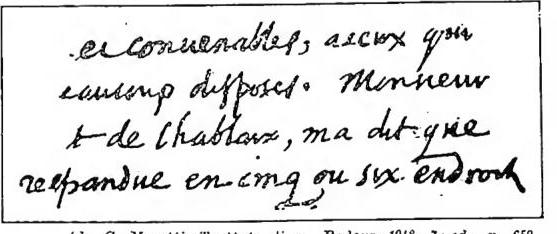
fig. 211)
GRAFOLOGIA - Handwriting of mahatma Gandhi. The following should be noted principally: the width of the individual letters (depth of intelligence), that between the letters (generosity), and that between the words (reasoning, criticism); the intonation of the first mode, that is, the fact that it is written with strong and continuous pressure (command, imperiousness), the angularity (resentment, touchiness), the sinuosity, that is, the varying inclination of the axis of the individual letters (profound sensitivity); moreover, maintaining the line (firmness of purpose), being profuse, that is, with flourishes of letters and curls (expansiveness), and being fluid and flowing (spontaneity).
As regards the scientific character of g. and the consequent moral judgment concerning it, it should be noted that it is undoubtedly possible, on the basis of scientific physiopsychological arguments, to maintain the existence of well-defined relationships between the characteristics of personality, understood in the broadest and most comprehensive sense, in the manner of the modern constitutionalist schools, and language (v.) (mimic, phonic, graphic). Everyday observation and, in particular, the study of the individual under different conditions of physical or psychic health or illness, reveal corresponding modifications of gesture, speech, and writing; anatomo-physiological investigation of the nervous system highlights the presence of clearly defined centres of language, writing, and mimic-phasic expression, connected with one another through structural relationships of correlation and collaboration (v. NERVOSO, SISTEMA (DELL'UOMO)). Just as there can be no doubt that, provided they occur spontaneously, gesture and speech are personal to the individual and manifestations of his psychophysical self, so the same must be held equally certain of writing. The practical point at issue remains the problem of the evidentiary value of individual signs and of the extent and quality of what can be diagnosed from graphic signs. Therefore, while professing faith in the scientific value of g., it is held that, as already in the course of its historical development, the future will have to make short shrift of much material currently considered sound and bring within more modest but firmer limits certain practical conclusions which, upon truly critical examination, appear to be preconceived artificial constructions and which, even if in the hands of particularly skilful practitioners they succeed in coinciding with reality, seem to derive more clairvoyance (v.) than from the application of canons deduced by scientific method.
Scientists of distinction were attracted by the serious characteristics and by the possibility of organizing the study of g. according to a scientific method, and they contributed their work to it; it will suffice here to recall A. Binet, Ch. Richet, C. Lombroso, E. Morselli.
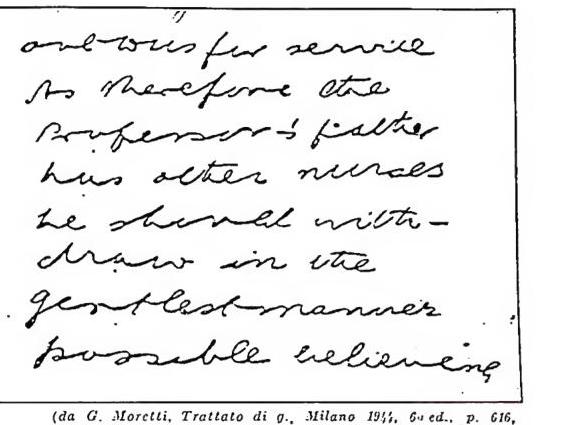
(from G. Moretti, Trattato di g., Padova 1918, 7a ed., p. 639, fig. 117)
GRAFOLOGIA – Handwriting of s. Francesco di Sales. Thickened in the first manner (command, imperiousness), angular (resentment, touchiness), ascending (tendency to perfect one’s own personality), upright, with an almost vertical direction of the strokes (self-control in the manifestations of the senses and affectivity), broad in the letters and between the letters (depth of intelligence and generosity); moreover, clear, that is, such that each sign represents itself well (clarity of ideas and communicative ability). Handwriting in harmony with the Saint’s innate tendencies, naturally inclined to mastery over anger and resentment, he became a model of self-control and gentleness through a continuous heroic effort, sustained and strengthened by the work of Grace.