
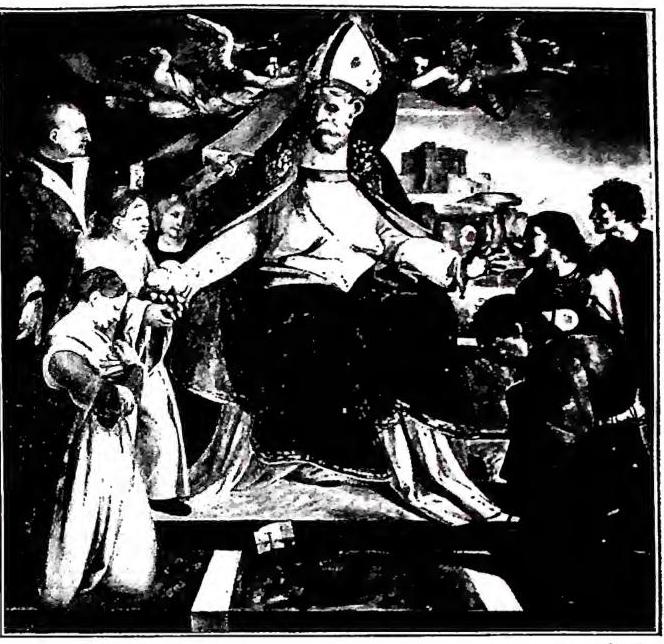
NICOLA di MIRA, saint — S. N. with boys and girls. Painting by Andrea Sabatini, known as Andrea da Salerno (16th century) — Naples, Pinacoteca.
unpublished Byzantine work, in Monuments Piot, VII, 1900). Russian art has often represented s. N. also with episodes from his life: in the Vatican Pinacoteca there are several examples from the 16th–17th centuries. In Germany, Switzerland, and Holland, popular imagination has made N. into the white-bearded, munificent old man who, on his feast day (6 December), brings his gifts to children. In North America he has been identified with the popular Santa Claus (from s. Nicolaus), who brings his gifts on Christmas Eve.
The Roman Martyrology, in addition to the feast of 6 December, commemorates his translation on 9 May. Even today, a liquid resembling oil, called the “manna of s. N.,” is collected at the Saint’s tomb; it is said to issue from his bones and is attributed with miraculous power.
Art. — In Byzantine art, the figure of the Saint appears on talismans and in the iconostases of churches; there is also, in a chapel dating from 1560 on Mount Athos, a complete cycle devoted to his legend, in accordance with the precepts of the Book of Painting.
Among the principal pictorial representations of the Saint are the altarpiece by Bernardo Daddi in the Uffizi, a sculpture in the style of Jacopo della Quercia in Siena Cathedral, and another in the Saint’s chapel at Siest. There are also very numerous German wooden sculptures representing the Saint with the attribute of golden balls on the book.
(photograph by Michele Ficarelli)
NICOLA di MIRA, saint — The façade of the basilica of S. N. — Bari
in a Flemish altarpiece in the Dublin Museum. At S. Paolo in Carinthia, a Romanesque pulpit with 29 carved scenes is preserved; in the great cathedrals, entire stained-glass windows are devoted to the Saint’s story, at Bourges, Civray, Chartres, Tours, Le Mans in France, and Freiburg. The Saint’s story is also extensively represented in contemporary fresco cycles. Five scenes are represented in Cologne, in S. Maria del Giglio, others in the Chapel of the Sacrament in S. Croce in Florence and in the Lower Basilica at Assisi. Also to be recalled are the 14th-century frescoes in the main cloister at Zurich, those in a chapel near Bonaduz, and, above all, the lengthy narrative that an anonymous master represented in 12 scenes in the chapel formerly dedicated to the Saint in the cloister at Constance. There are also very numerous altarpieces reproducing the image, while individual episodes appear in predellas or in the lateral compartments. Italian art possesses outstanding masterpieces in this field, such as the four panels by Ambrogio Lorenzetti, in the Accademia of Florence, dated 1332, and three panels in the Galleria Buonarroti, from the beginning of the 15th century; in addition, various predellas, such as the one attributed to pupils of Masaccio in the Berlin Museum. S. Nicola frees three knights in a panel by Mariotto di Nardo (15th century) in the Vatican Pinacoteca, where he also appears together with s. Paolo in a panel by Niccolò Buonaccorsi, and with other saints in another by the Sienese Paolo di Giovanni Fei. Gentile da Fabriano painted a politico for the Quaratesi chapel in S. Niccolò in Florence, part of which is in the Uffizi in the same city, while the central panel is in Buckingham Palace in London; and four paintings from the predella, depicting the scenes of the Saint’s birth and three of his miracles, are in the Vatican Pinacoteca. Angelico repeated the theme several times, and among his works a particularly notable one is an altarpiece for the chapel of S. N. in S. Domenico in Perugia, now in that city’s Pinacoteca; its predella, with episodes from the Saint’s life, is preserved in the Vatican Pinacoteca. Other examples can also be found in German-speaking countries, for example, in S. Niccolò at Rostock and in S. Maria at Gdańsk. Less numerous are representations in relief, in marble or wood, of the various events in the Saint’s life: from the Romanesque period there are two baptismal fonts at Zedelghem (in Holland) and Winchester (in England), an archiepiscopal chair at Troyes, and tympana and portals at Kolmar, Chartres, etc. — Vedi tav. CXVII.