
St. PETER, Apostle – The niche of the Pallia; above, the gate of Innocent III; in the background, the mosaic of the Savior (9th century); on the sides, Sts. Peter and Paul, mosaics commissioned by Urban VIII; below, the coffer of Benedict XIV for the Sacred Pallia and the slab with the cross of Innocent X, located above the tomb.
A Bohemian one from the 14th century; a Livonian one from the 15th century; a Slavonian one from the 13th century; 5 from Spain of the 11th and 12th centuries; one from Portugal of the 12th century; in total, 812 Roman coins, 102 pontifical, 526 Italian, and 460 foreign coins have been identified, for a sum of 1,900 coins.
Enrico Josi
V. LETTERS OF ST. PETER – Two epistolary writings belonging to the group of the 7 “Catholic Epistles” (v.) of the New Testament. The first was always recognized as canonical (protocanonical), while the second was the subject of doubts in some Churches (deuterocanonical).
1. The First Epistle of Peter – a) Subject Matter
The author, who presents himself as “Peter, apostle of Jesus Christ,” wishes an abundance of grace and peace “to the elect exiles (that is, to Christians striving for their heavenly homeland) living in the diaspora (dispersed among the pagans) of Pontus, Galatia, Cappadocia, Asia, and Bithynia” (1:1-2).In the body of the letter, he exhorts to a holy life for three main reasons: 1) for the great benefits bestowed by God (1:3-2:10); 2) to edify and convert the pagans (2:11-4:4); 3) for the divine judgment that looms over all (4:5-5:11).
b) Authenticity and Canonicity. – These were always accepted among Catholics. In the prologue, the author presents himself as Peter the apostle. From the context, it appears that the writer was an immediate disciple of Christ, a witness to the sufferings of the Savior (5:1; 2:21-24). He distinguishes himself from those who believe in Christ without having seen Him (1:8), and calls “my son” that Mark (v.) who, from the Acts of the Apostles (12:13) and tradition, is presented as Peter’s spiritual son and “interpreter.” The author of the epistle displays the characteristics that the Gospels attribute to Peter: simplicity, combined with a certain roughness, enthusiasm, fervent love, humility (5:5-6), sorrow for sins, and great trust in divine mercy (1:3; 2:22-25; 5:10, 15).
The testimonies of the first three centuries are summarized by Eusebius of Caesarea, who lists this letter among the ὁμολογοῦμενος (Hist. eccl., 3, 25: PG 20, 268).
Even before the Council of Nicaea (325), the First Epistle of Peter was explicitly accepted by Irenaeus, Tertullian, Clement of Alexandria, Origen, and Cyprian. Implicit citations are noted in the Letter of the Churches of Lyons and Vienne, in the Acts of the Scillitan Martyrs, and in the writings of Clement of Rome, Polycarp, Justin, Hermas, as well as the Basilidian and Valentinian heretics. It is debated whether the Muratorian Canon, which cites an Apocalypse of Peter, alludes (lines 71-73) to the First Epistle of Peter or to an apocryphon. Only the Syriac Churches were somewhat slow to accept the Catholic Epistles. However, St. Ephrem cites the First Epistle of Peter, and in the Peshitta version (ca. 400) the Epistles of James, First Peter, and First John are found. Opposition to the Petrine origin of the letter arose only in the 18th century with the doubts of J. S. Semler and the denials of modern rationalists such as H. von Soden, H. Gunkel, R. Knopf, A. Loisy, H. Windisch, and F. Hauck. Nevertheless, even in non-Catholic circles, there are scholars who defend its authenticity. Among these are B. Weiss, F. Sieffert, C. H. van Rhijn, K. Burger, J. C. K. von Hofmann, E. Kühl, J. Monnier, Ch. Bigg, and G. Wohlemberg (for details, cf. U. Holzmeister, cited in bibl., p. 148 ff.). The objections based on stylistic similarities with the Epistles of Paul are explained by considering the intervention of the secretary-redactor Silvanus, a former disciple of Paul. Moreover, there are no explicit references to the persecutions of Domitian or Trajan. The allusions to the trials endured by the readers are sufficiently explained by considering the time of Nero. The circumstances of the epistle’s composition provide sufficient arguments to respond to the difficulties raised by opponents.
The author states that he wrote through Silvanus (5:12), or Silas (Acts 15:22, 32): this refers not to a mere scribe but to a secretary-redactor who clothed Peter’s thoughts in his own style. Thus, certain Pauline resonances and some differences between this letter and the Second Epistle of Peter, due to another secretary-redactor, are explained.
c) Purpose. – From the cited epilogue (5:12), it appears that Peter wrote to exhort Christians and to confirm them in the faith. The doctrinal teaching is also in service of exhortation, which explains the lack of strict logical order in the parts. The faithful were undergoing trials of every kind (1:6-7), slander (2:12-15), threats, interrogations (3:9-17), insults (4:4); they were as if in a fiery trial (4:12-16). For this reason, they needed to be exhorted and comforted. However, it does not seem that Nero’s persecution (v.), which began after the fire of July 64, had already started, though its threat loomed on the horizon. From this and other indications, it can be concluded that the letter was written in the spring of 64. In the epilogue (5:13), the author sends greetings from the Church that is “chosen together with you in Babylon” (v.). With this symbolic name, Peter indicates Rome, not the city on the Euphrates destroyed long ago, nor the homonymous small Roman military outpost in Egypt. Historians of Peter’s life now agree on this point. In the years 63-64, Paul, released from prison, must have been absent from Rome; thus, the absence of Paul’s greetings to those Churches of Asia Minor partly evangelized by him is explained.
d) The Recipients. – They are the Christians of Pontus, Galatia, Cappadocia, Asia (proconsular), and Bithynia (1:1). They must have been converted from paganism: Peter considers that their women “were not daughters of Abraham” (3:6). To all, he says: “It is enough to have satisfied the desires of the pagans” (4:3). Since there are some warnings for slaves without corresponding ones for masters, it can be supposed that Peter addresses especially the lower social classes. Writing to those populations of Asia Minor evangelized by Paul and others, Peter exercises his primatial authority.
e) Doctrine. – The First Epistle of Peter contains the principal truths of the Apostles’ Creed. It expressly recognizes the divinity of Christ, calling Him Lord (1:3; 2:13; 3:15), preexistent (1:20), and the illuminator of the prophets (1:11). It particularly insists on the salvific work of God and the Messiah, who redeemed men with His precious blood (1:18-19). On this subject, V. P. De Ambroggi, Epistole cattoliche, 2nd ed., Turin 1949, pp. 93-98.
2. The Second Epistle of Peter – a) Subject Matter
The author, who presents himself as “Simeon Peter, servant and apostle of Jesus Christ,” wishes the readers (not specified) an abundance of grace and peace (1:1-2).There follow paternal exhortations, which can be summarized into three groups corresponding to the number of chapters: a) to persevere in the faith: God’s divine power has filled men with gifts, through participation in the divine nature. Let them practice virtues, and they will secure their salvation. Peter is about to die: let them gather his supreme warnings; the teaching on the Parousia is confirmed by the divine voice and the inspired prophetic word (1:3-21). b) To beware of false teachers. These deny the Master who redeemed men. They will be punished like the rebellious angels, like the unbelievers in the time of Noah, like Sodom and Gomorrah. They are impious and shameless (2:1-22). c) To remember the teaching of the prophets and the Apostles on the Parousia. It is not true that everything remains as it was in the beginning. A thousand years for the Lord are like a day. Let them prepare themselves appropriately, as the beloved brother Paul has written (3:1-16). A final warning and a doxology follow (3:17-18).
b) Authenticity and Canonicity. – The prologue and internal criteria present the Second Epistle of Peter as the work of “Simeon Peter, servant and apostle of Jesus Christ.” The author shows himself animated by sincere and ardent zeal for the purity of faith and morals. Had the adversaries suspected in this letter a fiction, even if only literary (pseudepigraphy), they would have seized the opportunity to discredit II. The writer attests that he was with Jesus on the “Holy Mount” of the Transfiguration (1:16-18). A hypothetical forger would have tried to better harmonize this account with the analogous one in the Gospels. Only an Apostle could call Paul “our beloved brother” (3:15).
BIBL.:
For the First Epistle of Peter: U. Holzmeister, Commentarius in Epistolas S. Petri, Rome 1937; P. De Ambroggi, Le Epistole Cattoliche, Turin 1949; J. Chaine, Les Épîtres Catholiques, Paris 1939; F. W. Beare, The First Epistle of Peter, Oxford 1947; E. G. Selwyn, The First Epistle of St. Peter, London 1946; J. Moffatt, The General Epistles: James, Peter, and Judas, New York 1928; A. Charue, Les Épîtres Catholiques, Paris 1939.
For the Second Epistle of Peter: M.-J. Lagrange, Saint Pierre: Épître, Paris 1931; J. Chaine, op. cit.; P. De Ambroggi, op. cit.; J. B. Mayor, The Epistle of St. Jude and the Second Epistle of St. Peter, London 1907; E. M. Sidebottom, James, Jude, and 2 Peter, London 1967; R. E. Picirilli, 2 Peter and Jude, Nashville 1988.
Giuseppe Ricciotti
The author explicitly states: "This is now the second letter that I am writing to you" (3:1). There is no reason to suppose that he is alluding to a letter other than 1 Peter. The sentiments expressed in this second letter correspond well to the character of Peter, as it emerges from the Gospels and 1 Peter. Moreover, there are notable agreements in thoughts and words with the latter.
Both letters give the number of those saved with Noah (1 Pt 3:20; 2 Pt 2:5), speak of the flood as a type (1 Pt 3:20; 2 Pt 2:5), draw a parallel between the prophets and the heralds of the Gospel (1 Pt 1:12; 2 Pt 1:16, 21; 3:2), and consider Christianity as the fulfillment of ancient prophecies (1 Pt 1:10-12; 2 Pt 1:19-21). Many verbal concordances between the two epistles are indicated by the Anglican scholar J. B. Mayor (v. BIBLICA), p. LIX. On this subject, see also U. Holzmeister, Vocabularium secundae epistulae s. Petri, erroresque quidam de eo divulgati, in Biblica, 30 (1949), pp. 339-55.
The objections raised by rationalists and some Catholics (among them J. Chaine) against the genuineness of 2 Peter can be resolved either by citing and valuing the response already given by St. Jerome (a different redactor) or by observing that the alleged indications of a late date are not decisive. Among these indications, they cite the expression "your apostles" (3:2), concluding: therefore, the author was not an apostle. One may respond: the author, who in the prologue declares himself an apostle, with the expression "your apostles" alludes to those who directly brought the Gospel to the recipients. There are no decisive reasons to suppose pseudepigraphy in this letter, which bears clear marks of sincerity. It is true that from 3:4 it appears that "the fathers" had been dead for some time, but it is not necessary to descend to the decade following Peter's death (70-80), as J. Chaine thinks, to explain that expression. The persecution of Nero, which erupted between 1 and 2 Peter, with the consequent psychological reactions among the faithful who awaited the imminent punishment of the tyrant, sufficiently explain that and other disappointed expressions of those who denied the Parousia, who had multiplied in the meantime. From the fact that 1 Peter speaks of "all the epistles" of Paul (3:16), it does not follow that the writer knew the complete canon and that he belongs to the 2nd century. The author does not clearly indicate the recipients of this letter, but from the fact that he himself calls it "second," one may suppose that they are the same as those in Asia Minor to whom the first was addressed. They were converts from paganism (2:18-20); they were in danger of losing their faith due to the intervention of false teachers devoted to vices (described especially in chapter 2). Peter, who had received from Christ the revelation of the nearness of his death (it is therefore around 67), instructs a collaborator to write this testament of his to warn the faithful, to instruct them, and to exhort them to resist the heretics courageously. Probably 2 Peter was also written in Rome.
Many similarities are noted between 2 Peter and the Epistle of Jude (v.), not only in subject matter but in the order of the sections. It can be said that the brief letter of Jude (setting aside the disputed citations from the apocryphal books of Enoch and the Assumption of Moses, proper to Jude) is entirely contained in this writing of Peter, especially in chapters 2 and 3. The majority of scholars hold that Peter, seeing the false teachers penetrating the Gentile-Christian communities of Asia Minor—already combated by Jude in the Judeo-Christian Churches—drew from that letter the strongest arguments and expressions to refute them. The author of 2 Peter implies that he has used the writings of others (he praises the epistles of Paul). Taking into account the dependence on the Epistle of Jude and the collaboration of another secretary-redactor, certain dissonances with 1 Peter are easily explained.
1940. Doctrine
Against the false teachers, St. Peter intends to demonstrate that the Parousia is certain, as are the sanctions that will accompany II. This is the central point of the teaching of 2 Peter. The other truths are taught or assumed as the framework for this. The coming of the Judge is certain: the Apostles affirm it, witnesses of the Transfiguration (1:16-18); it is foretold by the prophets (1:19-21); it is willed by the justice of God, who punishes sinners and saves the just. The examples adduced in chapter 2 prove this assertion. The Lord does not delay the fulfillment of his promise: he exercises patience because he does not want anyone to perish; his day will come like a thief (3:9-10).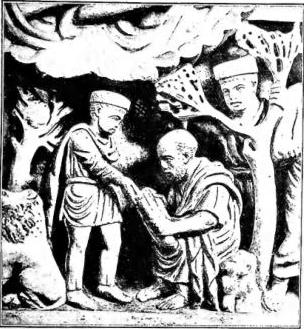
VI. LITURGY
1941. Veneration
John Chrysostom points to "he who, clad in purple, approaches as a pilgrim the tombs of P. and Paul and kisses them devoutly. Having laid aside the splendor of his garments, he clothes himself in humility and fervently prays to the holy Apostles that they may intercede for him before the Lord. The Emperor prays at the tombs of a tentmaker and a fisherman" (PG 61, 582). The same concept is repeated twice by St. Augustine, who notes that the Emperor, upon arriving in Rome, does not ascend immediately to the Palatine palace but hastens to the tomb of the Fisherman (PL 33, 1028, 1830). Around 393, Rufinus, prefect of the praetorium, erected near Chalcedon a basilica in honor of the holy apostles P. and Paul, placing therein "brandea" brought from Rome (Callinicus, Vita Hypatii, Leipzig 1895, p. 18). From the farthest reaches of the Roman world, Theodoret, bishop of Cyrrhus in Syria near the Euphrates, wrote thus to Pope Leo the Great in 449: "Rome possesses the bodies of P. and Paul, our common fathers, our lords in the faith; their tombs illuminate the souls of the faithful. This blessed pair, inspired by God, arose from the East and spread its rays everywhere: but in the West they found death, and from the West they illuminate the world. They have given your see an incomparable glory, they constitute its most precious treasure" (PG 83, 1314). Veneration for the apostles P. and Paul spread throughout the Christian world, and "brandea" were collected and carried to the most distant regions to honor the Princes of the Apostles in the sacred buildings erected in their honor. Bishop Achilleus (v.), in the first two decades of the 5th century, built in Spoleto, on the Via Flaminia, a basilica in honor of the Prince of the Apostles, for in P. the Church is founded for all peoples. P. stands as arbiter on earth, "ianitor in superis" (G. B. De Rossi, in Bull. arch. crist., 1871, p. 117). In the basilica of St. Stephen in Ravenna, Bishop Maximian placed in 550 merita (brandea) of the apostles Peter and Paul. On the hill sacred to pagan deities, Clovis, at the urging of Genevieve, had the great Basilica of precious marble columns from Oloron erected in Paris, dedicated to the apostles P. and Paul, where St. Genevieve would later be laid to rest. Gregory of Tours, in his Historia Francorum, recalls a basilica of St. P. in Clermont and one of the two Apostles in Tours. In Spain, in the ancient Hilipula Halos, today's Loja, the remains of a Christian basilica and a cippus with an inscription dedicating the building to SS. P. and Paul were discovered (E. Hübner, Inscriptiones latinae Hispaniae christianae, suppl., Berlin 1900, pp. 59-60, no. 374). The Benedictine B. Biscop, from 653 onward, made five pilgrimages from England to the apostolic tombs; in 674 he founded a monastery in Northumbria at Wearmouth in honor of the Prince of the Apostles, and another at Jarrow in 682 dedicated to St. Paul. In the atrium of the Vatican Basilica was buried Cædwalla, king of Wessex, baptized by Pope Sergius I on Holy Saturday in 689 and died the following Sunday in Albis (G. B. De Rossi, Inscr. Chr., II, 1, p. 288). King Cenred of Mercia and Prince Offa of Essex, arriving in Rome during the pontificate of Pope Constantine (708-15; Lib. pont., I, p. 391), exchanged their royal purple for the Benedictine habit to remain in one of the four monasteries that ensured the laus perennis in the Vatican Basilica. His successor, King Ine, died in 730 in Rome "ad limina apostolorum." In Africa, at El Kef (the Roman Sicca Veneria), in the keystone of the apse of the Byzantine basilica of Dar-el-Kouss, is inscribed DMNS for "dominus," and below is a crown enclosing a Greek cross with a letter in each of the four arms forming P(e)TR(u)S, that is, DOMNUS PETRUS (P. Monceaux, Enquête sur l'épigraphie chrétienne de l'Afrique, in Mémoires de l'Académie des Inscr. et belles lettres, 12, 1 [1907], p. 42 ff., no. 247); a second keystone belonging to the narthex has inscribed in a disk an equilateral cross with SCS (Sanctus) P(e)TR(u)S (ibid., p. 45 ff.). At Enchir-Chigarnia, the ancient Uppenna, in a large floor mosaic of a Byzantine basilica, with a jeweled cross between two sheep, is a long inscription beginning: "Hec sunt nomina martirum Petrus Paulus" (ibid., pp. 26-29, no. 238). Southwest of Tebessa, at Henchir-Magroun, in an arched block of a tabernacle, above two large monograms is the inscription: "Memoria domni Petri et Pauli" (CIL, VIII, 10693). At Henchir-Taghfaght, not far from Khenchela, a stone was found with the inscription: "Hic est domus Dei, hic memoriae Apostolorum..." evidently referring to the apostles P. and Paul (CIL, VIII, 17714). On a marble slab discovered near Guelma (the ancient Calama), now in the Louvre Museum, is written: "Hic reliquiae beati Petri Apost(o)l(i)..."; this slab sealed a marble reliquary (ibid., pp. 64-65, no. 262). Among the ruins of a church at Ain Zirara, between Constantine and Tebessa, from which the noted silver capsella was extracted (G. B. De Rossi, La capsella argentea africana, Rome 1889), fragments of a limestone slab were collected with a long inscription: "Hic exaudito sanctorum Petri Pauli apostolorum," etc. (CIL, VIII, 17746). Fifteen kilometers north of Ain Beida, on a stone possibly from a pulvinus, is engraved the epitaph "Hic memori(e)e sancto(rum) Pauli Petri" (ibid., 18656). At Kherbet Oum-el-Ahdam, southwest of Sétif, in the ruins of a church, a stone altar was found with an inscription dated to the year 320 of the Mauretanian era, i.e., 359 A.D., containing a series of relics, among which those of the apostles P. and Paul (CIL, VIII, 20600). A limestone slab, once part of a tabernacle in a chapel at Oppidum Novum, today's Duperré, contained a "memoria sanctorum Petri et Pauli" (CIL, VIII, 21496), now at St-Cyprien des Attafs. At Castellum Tingitanum, the present-day Orléansville, on a marble slab dated to the year 367 of the Mauretanian era, i.e., 406 A.D., is the funerary inscription of the son of a military tribune buried in an oratory near the altar containing relics of the apostles P. and Paul (CIL, VIII, 9715). Still in Orléansville, in a chapel, two fragments of brick were found with an inscription mentioning a "memoria apostolorum Petri et Pauli" (CIL, VIII, 9714); another broken tile also recalls a memoria of the martyrs P. and Paul (CIL, VIII, 9716). All these fragments are now in the Algiers Museum. At Bir Hadad, near Ain Melloul, south of Sétif, a limestone reliquary was sealed with a lid on which was engraved an inscription indicating the relics deposited, among which those of Paul and P. (CIL, VIII, 20490). At Tipasa in Mauretania, a basilica dedicated to the apostles P. and Paul has recently come to light.(de Wilpert, Sarcofagi, tav. 153, 1)
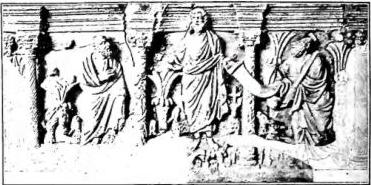
PIETRO, APOSTOLO, santo - The capture of St. P. Detail from the sarcophagus known as the "Two Brothers" (4th century) - Rome, Lateran Museum.
1942. Dates of Veneration
June 29. In the Catalogus Liberianus, it is recorded that Peter "suffered with Paul on the third day before the Kalends of July (June 29), under the consuls ss. (Nero and Vetus, 55), during the reign of Nero" (MGH, Anct. antiquiss., IX, 1, p. 73); the same date appears in the Depositio martyrum, followed by the note "Petri in catacumbas, Pauli Ostense, Tusco et Basso consulibus" (258 A.D.). Thus, there is a single date of commemoration in the 4th century for both Apostles. All manuscripts of the Martyrologium Hieronymianum, both complete and abridged, record on June 29 the feast of the Apostles Peter and Paul, which in the hymn attributed to St. Ambrose is said to be celebrated in Rome "trinis viis," that is, on the Appian, Aurelian, and Ostian Ways. Paulinus of Nola calls his annual pilgrimage to Rome for the feast of the Apostles Peter and Paul on June 29 a "solemnis consuetudo" (PL 61, 235, 247, 382, 392). In the Liber Pontificalis, the date "III Kal. iulias" appears as the day of burial in the Apostle’s biography (Lib. pont., I, p. 118) and as the date of the reposition of his relics on the Appian Way by Pope Cornelius (ibid., p. 150). The Bern Codex of the Martyrologium Hieronymianum states: "Romae Via Aurelia, natale sanctorum Apostolorum Petri et Pauli: Petri in Vaticano, Pauli vero in Via Ostienai, utrumque in catacumbas, passi sub Nerone, Basso et Tusco consulibus"; the names of the two consuls of 258, added at the end, are evidently taken from the Depositio martyrum. H. Quentin attempted to prove that the consular date did not refer to the Apostles (Tusco et Basso cons., in Rendiconti della Pont. accad. rom. di archeol., 5 [1929], pp. 145-47); he was refuted by H. Delehaye (Tusco et Basso cons., in Mélanges Paul Thomas, Bruges 1930, pp. 201-207). But why such a liturgical station "in catacumbas"? The excavations carried out there in 1892 and from 1915 onward demonstrated that Christians gathered in that place from the mid-3rd century to perform the refrigerium rite, as attested by hundreds of Greek and Latin graffiti invoking the two Apostles. Archaeologists have divided into three groups: the first recognizes "in catacumbas" as a place where the two Apostles would have resided for some time during their lives (R. Gamurrini, G. Wilpert, R. Lanciani); a second group believes it refers to a temporary resting place of their bodies either immediately after martyrdom or in 258 (L. Duchesne, H. Lietzmann, A. Profumo); the third, however, holds that the date of June 29, 258, "in catacumbas" is merely that of the liturgical institution of a feast in honor of the two Apostles (H. Delehaye, P. Franchi de' Cavalieri). It may be noted that the site "in catacumbas" is that of a Roman public cemetery in use even before Vespasian, one of whose servants was buried there in one of the columbaria; that the lower part of this burial site was covered with earth after the mausoleum of Clodius Hermes passed into Christian ownership, where the graffito ΙΧΘΥΣ (v. Enc. Catt., IX, col. 1270) was inscribed in the adjacent mausoleum, and nearby were buried faithful whom H. Lietzmann called "cryptochristians"; that on the raised ground a triclia was built where, from 258 to the beginning of the 4th century, the refrigerium rite was celebrated in honor of the two Apostles, a rite eminently sepulchral.Recently, E. Griffe sought to see in the "in catacumbas" memorial a "sepulchrum honorarium" in honor of the two Apostles, which would have preceded the sumptuous basilicas of the 4th century on the Vatican and Ostian Ways (La légende du transfert des corps de saint Pierre et de saint Paul ad catacumbas, in Bulletin de littér. ecclés. publié par l'Institut catholique de Toulouse, 1951, pp. 193-200), but the Basilica of St. Paul became sumptuous later than the Vatican, since "Theodosius coepit, perfecit Honorius aulam." N.-M. Denis-Boulet attempted to see a connection between the two dates of the Chronographer of December 25 and June 29 and imagined that the Vatican Basilica was consecrated on December 25, 335 and 336 (A propos des fouilles de St-Pierre. Questions historiques et liturgiques, in Recherches de sciences religieuses, 34 [1947], pp. 385-406). This hypothesis is untenable because the excavations ordered by Pope Pius XII revealed the magnitude of the works carried out by Constantinian architects to construct the grand five-naved basilica, a complex of works requiring a certain period of time for completion, as emphasized, for example, by W. Seston (Les récentes fouilles de St-Pierre de Rome et la date de la construction de la Basilique constantinienne, in Revue de l'hist. des relig., 130 [1945], pp. 186-88, and Hypothèse sur la date de la Basilique constantinienne de St-Pierre de Rome, in Cahiers archéolog., 2 [1947], pp. 153-59). E. Kirschbaum better related the commemoration of Peter alone "in catacumbas" in the Chronographer of the years 336-54 to the construction of St. Peter’s Basilica in the Vatican, certainly not yet completed (Petri in catacumbas, in Miscellanea liturgica in honorem L. Cuniberti Mohlberg, Roma 1948, pp. 221-29). That the date "III Kalendas iulias" was considered in the 4th century as a date of deposition is demonstrated by the following inscription discovered in the cemetery "inter duas lauros": "III Kalendas iulias deposo Donni Petri" (R. Kanzler, Relazione ufficiale degli scavi eseguiti dalla Commissione di Archeologia sacra nelle catacombe romane [1911-1912]. Scavi nel cimitero di SS. Marcellino e Pietro sulla via Labicena, in N. Bull. arch. crist., 20 [1914], p. 76, n. 46). Thus, June 29 has been celebrated by the Christian community of Rome since 258 as the date of deposition of the two Apostles. In the East, both the Consularia Constantinopolitana and the Consularia Ravennatia, as well as Pseudo-Chrysostom (in SS. Petrum et Paulum: PG 59, 496), mark June 29 as the date of the martyrdom of the two Apostles. Only the Syriac Martyrology, dated between 411-12, indicates "on the 20th day in the first Kanun, that is, December 28, in the city of Rome, Paul the Apostle and Simon Cephas, head of the Apostles of our Lord" (H. Lietzmann, Die Drei älteste Martyrologien, Bonn 1912, p. 9).
For the feast of February 18 and 22, V. S. P. For the feast of January 25, V. S. PAOLO.
VII. ICONOGRAPHY
1943. Archaeology
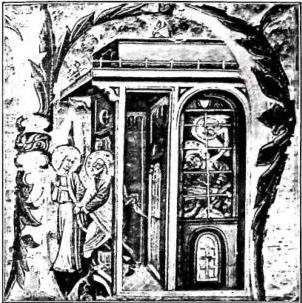
Just as in the Gospels Peter is mentioned 195 times, John 29 times, and the other Apostles collectively 130 times, so in icono-(from Catalogue d'une collection de manuscrits à miniatures des IX-XIᵉ siècles, Amsterdam DD, pl. 68) PIETRO, APOSTOLO, santo - St. Peter in prison and his liberation. Miniature from the Bolognese school (14th century) - Amsterdam, Private Collection.
In early Christian iconography, Peter is the most frequently represented Apostle, surpassing all others in the number of scenes depicted. G. Wilpert noted that the baptism of Cornelius alone appears in over 120 representations, while sixty depict his arrest and around seventy his denial. The miracle of the spring, with Peter indicated, is found not Podgoritza (v.) but also on gilded glasses bearing the inscription PETRUS (R. Garrucci, Storia dell'arte crist., III, Prato 1876, pl. 179,9), signifying, as St. Augustine states, that Moses "was a figure of Peter" (Serm., 251, 4). Peter is portrayed with a thick, curly beard and hair, the beard short, as seen in the cemetery inter duas lauros (Wilpert, Pitture, pls. 93-94) or in Domitilla (id., ibid., pl. 193, 2). The Apostle appears beardless in only one painting of the denial (Wilpert, Pitture, pl. 242, 1). However, the most characteristic type—a sailor-like figure with a high forehead, expressive eyes, and a beard framing his face—appears in the fresco in the hypogeum of the Aurelii (v.) on Via Manzoni (Wilpert, Le pitture dell'ipogeo di Aurelio Felicesimo presso il Viale Manzoni in Roma, in Memorie della Pont. accad. rom. di archeol., 3rd ser., 1 [1924], pl. 6, 1). Peter is the Apostle to whom the Lord entrusts His law as the Moses of the New Testament. Though this scene appears only once in catacomb painting (Wilpert, Mosaiken, p. 269 and pl. 132), it is frequent on sarcophagi, where Peter receives the law while also holding the cross, the instrument of martyrdom that will liken him to the Lord (Wilpert, Sarcofagi, p. 113 ff.). This scene is preferred in baptisteries for initiation into the lex Christi. To Peter, the Lord entrusts the keys of the heavenly kingdom (Mt. 16:19), and through Peter, to His Church, as Tertullian states (Scorpiace, 10). Peter is the "eternal doorkeeper" (ianitor aeterus; Dracontius, Carmen de Deo, V. 222: PL 60, 857). On sarcophagi, this scene is depicted sixteen times in Rome and Gaul; in painting, it appears in the cemetery of Commodilla (Wilpert, Mosaiken, pls. 148-49). To Peter, the Lord washes the feet (v. LAVANDA). The scene of Peter saved from the waves is first represented on the walls Dura Europos (v.); in Rome, it appears in a fragment found in the eastern tricora of San Callisto (G. Wilpert, La cripta dei Papi e la cappella di S. Cecilia nel cimitero di Callisto, Rome 1910, p. 96 and pl. 6, 1). The scene is engraved on a gem published by Girolamo Aleandro (R. Garrucci, Storia dell'arte cristiana, VI, Prato 1881, p. 118 and pl. 418, 13). The scene was part of the basilical cycle in a Spanish church, as attested by Prudentius in his Dittochaeon (PL 60, 105), and in the Basilica of St. Martin of Tours (E. Le Blant, Inscriptions chrétiennes de la Gaule, I, Paris 1886, p. 235). In Ravenna, it appears in a mutilated inscription in the Baptistery of Neon (R. Garrucci, Storia dell'arte cristiana, IV, Prato 1876, pl. 37); in Naples, in the mosaic of the baptistery (Wilpert, Mosaiken, pl. 30 ff.). In Gaza, a painting of the scene is recorded by Choricius (ca. 550) in the Church of St. Sergius. The same episode was painted at the beginning of the 9th century in San Saba (G. Wilpert, Le pitture dell'oratorio di S. Silvia, in Mélanges d'archéologie et d'histoire, 26 [1906], pp. 224 ff.). The resurrection of Tabitha appears on a complete sarcophagus from St. Maximin (Provence) and on a fragmentary one. G. Wilpert identified the episode of the punishment of Ananias and Sapphira in a fragment from the museum of Avignon (Sarcofagi, pl. 145, 3) and another from San Callisto (ibid., 145, 2), based on the scene carved Brescia (v.). This scene was later painted in the Lateran. In a Spanish basilica (perhaps Zaragoza, where the biblical sky was illustrated by verses of Prudentius), the episode of Peter freeing the possessed was also represented (Dittochaeon, 36), as it was depicted in the Church of SS. John and Paul in Rome (G. B. De Rossi, Inscriptions Christianae, II, 1, Rome 1888, p. 150). Eusebius attests that images of Paul and Peter were preserved on painted panels (Hist. eccl., VII, 18, 4). Numerous monuments depict them together: Peter with his usual iconographic type, Paul bald with a long, pointed brown beard. Though St. Augustine questions the existence of a portrait of Paul (De Trinitate, 8, 5: PL 42, 912), the two Apostles appear together with their individual traits in Roman catacomb frescoes (Wilpert, Pitture, pls. 153 ff.; 117, 1; 179; 182; 248; 251 ff. and 254). The episode of Peter and Paul led to martyrdom is a subject found on Roman sarcophagi, such as the well-known one of Junius Bassus (v.), discovered in the confession of St. Peter, and in the Lateran sarcophagus 164. They appear together on sarcophagi, in the only catacomb fresco (ad decimum), and in mosaics in all representations of the traditio legis; they also appear together in all scenes of the traditio clavium. Together, they acclaim the divine throne in the triumphal arch of Santa Maria Maggiore. In Naples, they appear multiple times in San Gennaro dei Poveri, where they retain the same individual characteristics as in Rome. Peter also appears alone in San Gaudioso, in the tomb of Pascentius (H. Achelis, Die Katakombe von Neapel, Leipzig 1936, pl. 39). Together, they are found in a fresco in the cemetery of Albano (O. Marucchi, Le catacombe di Albano, in N. Bull. di arch. crist., 8 [1902], p. 89 ff., pl. 5). Together, they acclaim the Signum Christi in Pannonia at Pécs (G. B. De Rossi, Bull. arch. crist., 1874, pls. 7-8). They appear on funerary slabs, such as that of "Asellus" in the Lateran Museum, where their busts are engraved according to the known iconographic type, marked by their names PETRVS PAVLVS. They are also found together in a precious series of catacomb glasses (R. Garrucci, Vetri cimiteriali in oro, Rome 1854, passim); on terracotta lamps, such as one from Akhmim, where they are nimbed and distinguished—Peter with the keys, Paul with the sword (R. Förrer, Die altchristliche Alterthümer aus dem Gräberfelde von Akhmin Panopolis, Strasbourg 1893, p. 6, pl. 5, no. 2); on diptychs, such as that of the Sancta Sanctorum, now in the Sacred Museum of the Vatican Library (H. Grisar, Die römische Kapelle der Sancta Sanctorum und ihre Schatz, Freiburg im Br. 1908, pp. 118-20 and pls. 4-5, nos. 5-6); and on icons, such as the Vatican one (W. F. Volbach, Die Ikone der Apostelfürsten in St. Peter zu Rom, in Orientalia Christiana Periodica, 7 [1951], pp. 480-97).
A glass cup, perhaps from the 4th century and found in Carthage, depicts two fishermen identified by the inscription as the "Apostles Petrus et Johannes," though Peter does not bear his usual iconographic type (G. Picard, Vase gravé de Carthage, in Fasti archaeologici, 4 [1949], p. 530, no. 5031). Two statues of the Apostle once stood in the ancient Basilica. The first is the famous bronze statue. H. Wickhoff dated it to the 13th century (Zeitschrift für bild. Kunst, 1890, p. 108 ff.). H. Grisar proposed dating the statue
BIBL.:
G. Wilpert, I sarcofagi cristiani antichi, Roma 1929-36; id., Le pitture delle catacombe romane, Roma 1903; id., Die römischen Mosaiken und Malereien der kirchlichen Bauten vom IV. bis XIII. Jahrhundert, Freiburg im Br. 1916; R. Garrucci, Storia dell'arte cristiana nei primi otto secoli della Chiesa, Prato 1872-81; H. Leclercq, in Dictionnaire d'archéologie chrétienne et de liturgie, XIV, Paris 1939, coll. 1467-1550; O. Marucchi, Manuale di archeologia cristiana, Roma 1933; G. B. De Rossi, La Roma sotterranea cristiana, Roma 1864-77; E. Le Blant, Les sarcophages chrétiens de la Gaule, Paris 1886; H. Grisar, Analecta Romana, Roma 1899; H. Achelis, Die Katakomben von Neapel, Leipzig 1936; W. F. Volbach, Frühchristliche Kunst, München 1958.
A. Ferrua
The niche of the Pallia; above, the gate of Innocent III.
Two statues of the Apostle were present in the ancient Basilica; the first is the celebrated bronze one. H. Wickhoff dated the statue to the 13th century (Zeitschrift für bild. Kunst, 1890, p. 108 ff.). H. Grisar proposed dating the statue to the late 5th century (Della statua di bronzo di s. P. apostolo nella Basilica Vatic., in Civ. Catt., 1898, II, pp. 459 ff.; id., in Analecta romana, Rome 1899, pp. 627-57). A. Venturi initially dated it to the 4th-5th century (Venturi, I, p. 414) and later attributed it to Arnolfo di Cambio (ibid., IV, p. 113 ff.). For P. Toesca, it belongs to the 13th century (Storia dell'Arte it., I, Turin 1927, pp. 287 and 1110). C. Cecchelli followed Grisar’s dating, but for G. B. De Jerphanion, the question of the date remains open (Bulletin d'arch. chrét. et byzant., in Orientalia Christiana periodica, 4 [1938], p. 538). In the atrium of the ancient Basilica, there was a seated marble statue of the Apostle, which is nothing more than an adaptation of a Roman orator’s statue, whose head was replaced around the 13th century and whose right forearm and left hand—holding the keys—were altered in the 16th century. It is now in the Holy Grottoes.
2. Art. - In the Romanesque period, representations of scenes from the life and martyrdom of the Apostle also developed extensively. Unfortunately, the most important of these have not survived: such as the frescoes by Cavallini in the ancient Vatican Basilica; or they are heavily damaged, like those in the choir of the upper church of Assisi, by Cimabue. A repetition of the lost cycle of S. P. in the Vatican can be found in the organic decoration of S. Piero a Grado, near Pisa, attributed to the painter Deodato Orlandi, who died in Lucca in 1337. Isolated events from the Saint’s life were also depicted in panels, such as in the Stefaneschi Polyptych of the Vatican Museums, by Giotto and his pupils, and in a Byzantine-influenced panel in the Pinacoteca of Siena, showing the Apostle’s imprisonment and crucifixion. Stained glass windows, especially French ones, should also be mentioned: in Bourges (13th century), Chartres, Lyon, Sens, Poitiers, Troyes, and Tours. The Renaissance masterpiece depicting the fate of S. P. is in the Brancacci Chapel at the Carmine in Florence, where Masolino, Masaccio, and Filippino Lippi meticulously followed the miraculous story of the Saint, also drawing on the apocryphal Gospels.
Countless devotional images dedicated solely to S. P. or to sacred conversations in which he participates have followed one another throughout the Renaissance, the Baroque period, and the modern era, up to the present day. Many altars depict him in individual panels, such as the works by Francesco del Cossa in Brera. It is worth noting that while in Italy the character of the Saint as portrayed in paintings—even very recent ones—remains quite similar to that of the original images, in Germany and generally in Northern Europe, the Saint is preferred to be represented in his pontifical vestments rather than in the guise of an Apostle, as seen in many paintings depicting the Death of Mary, where he also appears.
The vastness of the iconographic theme, developed especially in Rome in the basilicas dedicated to the Saint, in sculptures, altars, and sacred furnishings—sometimes of high artistic value—allows only a brief mention of some particularly fortunate iconographic themes. S. P. in the navicella, symbolically guiding the Church, already appears in a bronze from the Archaeological Museum of Florence (ca. 4th century) and reaches its greatest apotheosis in the famous, though unfortunately disfigured, mosaic by Giotto for the Jubilee of 1300. The delivery of the keys to S. P. was depicted by Perugino in a fresco in the Sistine Chapel and in a tapestry by Raphael, who also illustrated his liberation from prison in the Stanze. S. P. as the guardian of Paradise appears as early as an 11th-century historiated capital in the Civic Museum of Turin, where the Apostle leads a devotee and his companion into the Kingdom of Heaven, symbolically indicated by the key. Similarly, in a Gothic reliquary from S. Galgano, now in the Museo dell'Opera del Duomo in Siena, from the late 13th century.
On the other hand, throughout the Middle Ages and beyond, the rooster—recalling his denial—and the keys, symbol of his power, are the characteristic iconographic attributes of the Apostle, whose image recurs continuously in all representations of the events narrated in the Gospel.
VIII. APOCRYPHA
1. Apocalypse of Peter. - An apocryphon cited as authoritative by St. Clement of Alexandria (in Eusebius, Hist. eccl., 6, 14: PG 20, 549), St. Methodius (Symposion, 9, 1: PG 18, 180), and perhaps by the Muratorian Fragment (line 71 ff.), where, however, some, following Th. Zahn, see a reference to I Peter. From Sozomen we learn that the Apocalypse of Peter was still read in the churches of Palestine on Good Friday in the fifth century (Sozomen, Hist. eccl., VII, 19: PG 67, 1477), but it had already been excluded from the canon by Eusebius (Hist. eccl., III, 2: XXV, 4: PG 20, 217, 269) and by St. Jerome (De viris inlustr., 1: PL 23, 609).According to E. Amann, the Apocalypse of Peter was written in Egypt in the first half of the second century A.D. It alludes to the persecution of Bar Kōkhöbbä against Christians. The text, believed lost, was partially rediscovered in Greek in 1886 at Akhmim by U. Bouriant (published in Mémoires publiées par les membres de la Mission archéologique franç. du Caire, 9 [1892], pp. 91-147) and supplemented by another papyrus fragment from the Bodleian (published by F. Nau, Rev. de l'Orient chrét., 15 [1910], p. 441 ff.). There is also a complete Ethiopic reworking published by S. Grébaut (Littérature éthiopienne pseudo-clémentine, in Rev. de l'Orient chrét., 12 [1907], pp. 139-51, 285-93, 280-92; 13 [1908], pp. 166-80, 314-20). In response to the Apostles' question preceding the eschatological discourse (Mt. 24:3), Jesus shows the glory of the righteous and the terrible torments of the damned. The eschatological ideas seem to derive from Jewish sources. The author also had in mind the texts of II Peter 1:16-18; 3:6-17. Among the Gnostic writings recently discovered in Egypt, an Apocalypse of Peter is also noted. Cf. Biblica, 31 [1950], p. 71.
2. Acts of Peter. - A legendary apocryphon preserved in several recensions.
(photo: Vatican Museums)
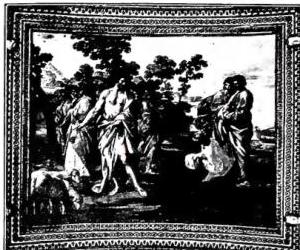
PIETRO, APOSTOLO, santo - Passe oves meas. Fresco in the vault of the Gallery of Maps, decorated under the direction of G. Muziano (late 16th century) - Apostolic Palace, Vatican.
3. Acts of Peter and Paul. - An apocryphon born from the revised fusion of the Acts of Peter (v. above) and the Acts of Paul (v.).
These writings, of Asian origin, spoke of the two Apostles independently, without regard for the Roman tradition, also Decree of Gelasius (v.), according to which Peter and Paul suffered on the same day, whatever the heretics may say. The compiler of the Acts of Peter and Paul eliminated certain theologically less acceptable expressions (not properly Gnostic, as H. Höpfl and B. Gut think [V. BIBLICA.], no. 308) from the Acts of Peter and sought to show that perfect harmony reigned between the two Apostles, who together would have confronted Simon Magus, together would have been condemned by Nero, and on the same day would have suffered martyrdom: Peter crucified, Paul beheaded. The final chapters speak of Peter's burial "under the terebinth, near the Naumachia, on the Vatican," and of a vain attempt by the Easterners to remove the relics of the two Apostles from Rome. These relics, once recovered, were temporarily placed in the catacombs, awaiting their final deposition in their respective monuments: Peter on the Vatican, Paul on the Via Ostiense. The various layers of reworking can be dated from the third to the sixth century.
4. Preaching of Peter. - An apocryphon originally written in Greek (Κηρυγιὰ Πέτρου). It was used by Clement of Alexandria and Heracleon the Valentinian (cf. Origen, In Io., XIII, 17: PG 14, 424). It is relegated to the apocrypha by Eusebius (Hist. eccl., III, 3, 2: PG 20, 217) and by St. Jerome (De viris inlustr., 1: PL 23, 609).
From the fragments preserved by Clement of Alexandria, it appears that the work must have contained a kind of programmatic discourse by Peter, summarizing his entire preaching. It seems the author took his cue from II Peter 1:15, where the Apostle writes: "I will make every effort to ensure that after my departure you may be able to recall these things." Among the exhortations reported in the Preaching of Peter was this: there is one God, who must be honored, not as the pagans do, nor as the Jews. Christians constitute a tertium genus. They must remain faithful to the new covenant already foretold by the prophets. The work was written in the first decades of the second century, according to E. von Dobschütz in Egypt, according to A. Hilgenfeld in Greece. It is debated whether the work can be identified with the Didascalia of Peter mentioned by St. John Damascene (PG 95, 1157 B., 1461 D), and to which (Doctrina Petri) Origen seems to allude (De principiis: PG 2, 119 O). Among the recently discovered Gnostic Coptic papyri in Egypt, there is also an Oration of Peter the Apostle; cf. Biblica, 31 (1959), p. 71 (Elenchus bibl.*).
5. Gospel of P. — An apocryphon, first mentioned in a letter by Serapion, bishop of Antioch, at the end of the 2nd century, addressed to the faithful of Rhossos in Cilicia (Eusebius, Hist. eccl., VI, 12, 2 ff.; PG 20, 545). He condemns its reading.
The Gospel of P. is also recalled by Origen (In Mt., 10, 17; PG 13, 876); reproved by Eusebius himself (op. cit., 3, 3 and 25; PG 20, 217 and 269); listed among the apocrypha by St. Jerome (De vir. ill., I; PL 23, 639) and by Theodoret (Haer. fabul. comp., II, 2; PG 83, 389). Beyond its name, nothing was known of it until the winter of 1886-87, when the French Archaeological Mission discovered, in the tomb of a Christian monk in Akhmim, alongside other texts, an old parchment attributed to the 8th-9th century and containing a portion of the Gospel of P. It is a writing with traces of Docetism (vv. 10, 19, 39-44), mutilated at the beginning and end, containing the narrative of Christ’s Passion, Death, and Resurrection. It is a free reworking of the Gospel account, with a markedly anti-Jewish tone; all responsibility for the condemnation and crucifixion of the Savior falls upon Herod and the Jews, while Pilate appears as a spectator favorable to the condemned. The composition, in popular Greek, most likely dates to around the middle of the 2nd century (130-160).
IX. LEGENDS
Even regarding the founders of the Roman Church, legends did not fail to arise, which are recounted in apocryphal Acts and in topographical localizations throughout various parts of the city, all pertaining to different episodes of their Roman lives.1. The legend of the Mamertine Prison. — In an itinerary of Rome from the late 8th century A.D., immediately after the Porta Aurelia (the present-day Porta S. Pancrazio), a "Fountain of St. Peter" is indicated, where his prison was said to have been. Since there is no ancient record of a prison of St. Peter on the Janiculum (v. below), Marucchi and Duchesne believed this indication was misplaced and referred instead to the prison near the Roman Forum at the foot of the Capitoline Hill, mentioned by Titus Livius, who attributes its foundation to King Ancus Marcius. King Servius Tullius would have added the lower chamber, where there was a spring of water, tullus, from which its name Tullianum actually derives. Externally, the prison was restored during the time of Tiberius (14-37 A.D.), as demonstrated by the names of the two suffect consuls inscribed on the travertine blocks: Caius Vibius Rufinus and M. Cocceius Nerva. After the 5th century A.D., this prison was erroneously given the name "Mamertinum" or "Privata Mamertini," as found in the legendary acts of many Roman martyrs, such as the popes Stephen (154-56) and Sixtus II (258), Caledopius, Abbundius and Abbundantius, Chrysanthus and Daria, and especially Processus and Martinianus. The legend made these latter two the jailers of Peter and Paul in this very prison near the Roman Forum; it is said that, witnessing the miracles performed by Peter and Paul in the Mamertine Prison, the two jailers Processus and Martinianus asked to be baptized together with all the prisoners. Peter then would have made the Sign of the Cross on the Tarpeian Rock, causing water to spring forth, and Processus and Martinianus, having been baptized, would have begged Peter and Paul to leave the prison freely. Yet the spring in that place was very ancient; near it, in the Middle Ages, an altar was built. Some have even sought to identify the column to which Peter and Paul were bound and an imprint left in the wall by St. Peter’s head. In reality, although the legend of the martyrs Processus and Martinianus dates to the mid-6th century, it was still unknown to Pope Gregory the Great, who lived at the end of that century (590-604) and presents the two martyrs as foreigners, without any allusion to their role as jailers of the Apostles.
2. The title "de Fasciola." — In the acts of Processus and Martinianus (Acta SS. Iulii, II, p. 304), it is recounted that St. Peter, fleeing from prison, lost on the "Via Nova" a bandage he had wrapped around his foot to cover the wounds caused by chains; this bandage was picked up and preserved by a matron who lived nearby; her house, transformed into a titulus, would have taken the name "de Fasciola," later of SS. Nereus and Achilleus. Apart from the fact that the document is much later than the Apostle, the "Via Nova" was built by Caracalla at the time of the Antonine Baths. The oratory that stood on the Via Ostiense, called the "separation," was erected in the Middle Ages based on a legend that on the Via Ostiense the two apostles Peter and Paul would have parted before being led to martyrdom. The origin of the legend may derive from the episode, contained in the apocrypha, of St. Paul’s farewell to the matron Plautilla (F. Martinelli, Roma ex etonica sacra, Roma 1653, pp. 101, 301; G. B. De Rossi, in Bull. arch. crist., 1877, p. 137). The oratory, later renovated, was eventually removed to widen the road.
3. The oratory of the "Quo vadis." — The acts of Processus and Martinianus also contain the legend of St. Peter’s flight from Rome and the apparition to him, on the Via Appia, of the Redeemer, who, in response to the Apostle’s question, "Domine, quo vadis?" would have answered, "Romam redeo ut iterum crucifigar." Origen, citing a passage from the Acta Pauli, adds that the Redeemer would have asserted that He would be crucified again; this was believed to refer to Peter (In Iohannem, 20, 12; PG 14, 600; also in St. Ambrose, Contra Auxentium, 13; PL 16, 1053). In the aforementioned legendary acts of Processus and Martinianus, there is still no indication of the existence of an oratory on the site of the apparition. At the end of the 8th century, the itinerary known as the Einsiedeln Itinerary places on the Via Appia, beyond the gate and beyond the stream of the Almo, an oratory of St. Mary, which only in the 11th century bears the addition "where the Lord appeared." The author of the Mirabilia, in the 12th century, directly indicates the oratory where the Lord appeared to Peter: "Domine, quo vadis?" In other documents, however, the original name of St. Mary remains, with the addition "of the plants." Indeed, in the church is preserved a stone with the imprints of two feet, which is a copy of an original that existed there until 1620 and was then transferred to San Sebastiano. The legend saw in these imprints the miraculous appearance of Jesus to Peter; in reality, they were brought there, while originally they were nothing more than a votive monument in some pagan sanctuary, signifying the path taken by a pilgrim and his desire to eternalize his presence in the sanctuary itself. In the 16th century, Cardinal Reginald Pole, seeing that the oratory was falling into ruin, built another round one a little further along the Via Appia, at the intersection with the alley of the Caffarella. At the end of the same century, a learned Roman, Pompeo Ugonio, described the ancient paintings that existed there, among which was the scene of Pentecost.
The church was rebuilt in 1620, and in 1637 Cardinal Francesco Barberini added the current façade. Perhaps the localization of the "Quo vadis?" legend on the Via Appia is due to the fact that this queen of Roman roads, which led from Rome to Brindisi, was traveled by those coming from or going to the East.
4. The alleged residence of St. Peter in the house of Pudens. — This legend, too, depends solely on apocryphal documents, according to which Peter would have resided in the house of a senator named "Pudens."