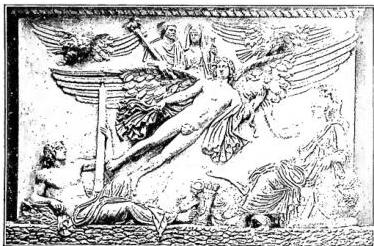
APOTEOSI (Gr. Ἀποθέωσις, Lat. consecratio). — In Rome, the deification of the emperor after death. The origin of the rite is to be sought in the Syrian East, where it is frequent to find the soul of the deceased depicted as an eagle on funerary monuments; and it is a consequence of the astrological belief, widespread during the Hellenistic period, that the soul, an emanation of the divine substance of the sun, returns after death to its fiery origin on the wings of the eagle, the quintessential solar bird. In Rome, Augustus was the first of the rulers to benefit from this ceremony, which became customary in the practice of his successors. His body was placed upon a great pyramidal pyre in the Campus Martius. Once the pyre had been set alight, an eagle detached itself from it and flew upward, as if to signify that the emperor’s soul was ascending to heaven (Suetonius, Aug. 100).
The fullest description of this rite is given to us by Herodian, on the occasion of the funeral of Septimius Severus. He describes the pyre, formed of several wooden cubes placed one upon another and adorned with draperies: in the second, the corpse was laid with offerings of perfumes, fruit, and aromatic herbs. Horsemen and chariots bearing images of emperors and victorious generals made a circuit around the pyre, which the new emperor then set alight. “Then from the top of the pyre an eagle is released, which, rising through the air amid the flames and smoke, carries, as the people believe, the emperor’s soul to heaven”
(Herodian, IV, 2). After the a., the image of the ruler who had become divus was no longer carried in the funeral ceremonies of his family together with those of the other deceased, but was placed upon a special chariot (tena) beside those of the gods in public ceremonies, for example in the circus procession.
Individual temples were also built for the deified emperors, until the emperor Tacitus created a common temple for all deified emperors; a particular priesthood was also established, taking its name either from the ruler (e.g. flamen Augustalis, Claudialis) or from his family (e.g. sodales Flaviales). Imperial a. ceased in the Constantinian period.