
ERZERUM. - A city formerly called Karin and Theodosiopolis, after Theodosius II, who fortified it in defence of the eastern frontiers of the Empire. E. is divided into three parts: citadel, city, and outskirts. History mentions the bishop Astmazatur (Adeodatus) of E. at the Synod of Hronkia (1179); then Sarkis (Sergius), in the thirteenth century; Simeon in the fourteenth century, etc. In 1850 an episcopal see for Catholics was established at E., under the jurisdiction of the primate of Constantinople, together with five other cities. From the sixth to the eighteenth century E. was repeatedly subject to invasions, destruction, and pillaging by Persians, Arabs, and Turks. E. is today one of the principal cities of eastern Turkey. It has been destroyed several times by violent earthquakes.
(for information from Fr. P. Thomas)
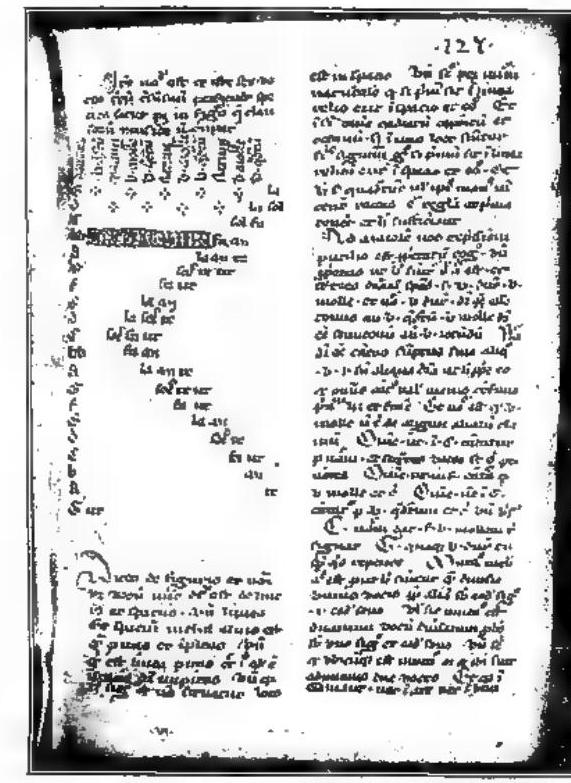
ESACORDO - The natural, soft, and hard hexachords are indicated on the upper line. In the margin, the alphabetical letters corresponding to the musical diagram are marked vertically. Horizontally are marked the three monosyllables (e.g., G. sol, fa, ut) that each note receives in solmization — Paris, Bibliothèque Nationale, ms. Lat. 13128, f. 124r (14th cent.).