
MATRIMONIO
Marriage — Betrothal of the Virgin. Painting by Raphael (1504). Milan, Pinacoteca di Brera.
Shared by all Protestants, particularly by Calvin (cf. Institutio christianae religionis, 4, 19), who in his commentary on the Letter to the Ephesians stigmatized the Catholic teaching as a crassa ignoratiae hallucinatio (Opera Calvini, in Corpus reformatorum, LXXIX, 227).
5. Council of Trent
Against this distortion of the truth, the Catholic theologians of the 16th century fought with zeal and learning (cf. V. Zollini, De Matrimonii Sacramento novatorum errores, catholicorum explanationes, Rome 1943; unpublished thesis of the Ateneo of Propaganda Fide) and the Council of Trent issued its solemn definitions in its 24th session (11 Nov. 1563), which vigorously affirmed the sacramental nature of marriage, also treating its properties (Denz-U, 969-82). The clear and precise formulas of Trent, a happy culmination of Christian tradition which caused much vexation to regalists and febronians, ardent “secularizers” of marriage, were taken up and illustrated, according to the needs of the times, by Pius VI against Scipione Ricci (Denz-U, 1556-60), by Pius IX in the Syllabus (ibid., 1765-76), by Leo XIII in the encyclical Arcanum divinae sapientiae, 10 Feb. 1880 (ed. F. Hurt, Rome 1942), whose concise style and robust formulas are celebrated, by Pius X in the decree Lamentabili, against the modernists (Denz-U, 2251), and by Pius XI in the classic encyclical Casti connubii, 31 Dec. 1930 (ed. F. Hurt, Rome 1942).Ehe in den ersten drei Jahrhunderts, Berlino 1927; L. Godefroy, Mariage dans les Pères, in D'THC, IX, coll. 2077-2123; P. R. Pivano, De essentia Matrim. ad mentem Patrum, in Rass. di morale e diritto, 4 (1938), pp. 216-36; 5 (1936), pp. 132-53; A. Reuter, S. Augustini doctrina de bonis Matrim., Roma 1942; N. Lado, mèstaki, St Augustin docteur du Mariage chrétien, 11 (1942, 3) Scollastici: F. Falk, Die Ehe am Ausgang des Mittelalters, Magonza 1908; I. de Guibert, Le texte de Guillaume de Paris sur l'essence du Sacrement du Mariage, in Recherches de science religieuse, 5 (1941), pp. 422-27; G. Le Bras, La doctrine du Mariage chez les théologiens et les canonistes depuis l'an mille, in D'THC, IX, coll. 2123-2131 (conspicuo per la vastità e la profondità dell'indagine); L. Misery, Le Mariage, in st Thomas d'Aquin, Somme théologique (ed. Revue des jeunes), 2 voll., Parigi 1930, nell'appendice di ambedue i volumi; P. Abellan, El fin y la significación sacramental del Matrimonio desde s. Anselmo asta Guillermo de Auxerre, Granada 1939; V. Fagiolo, Il Sacramento del M. in s. Bonaventura, Roma 1946 (tesi inedita dell'Ateneo Lateranense), 4) Protestanti: E. Safeld, Luthers Lehre von der Ehe, Lipsia 1882; S. Baranowski, Luthers Lehre von der Ehe, Posen 1913; J. Fourey, Le protestantisme français et le Mariage, Parigi 1925; F. Wendel, Le Mariage à Strasbourg à l'époque de la Réforme (1560-1622), Strasbourg 1928; id., Calvin. Vie et doctrine, Parigi 1950; J. Paquier, Luther, in D'THC, IX, coll. 1276-83; 5) Trattati classici: P. Ledesma, De magno Matrim. Sacramento, Venezia 1595; R. Bellarmino, De Matrim., 11 (1590); Th. Sanchez, De s. Matrim. Sacramento, Anversa 1617; B. Pontius, De Sacramento Matrim., Salamanca 1624; I. Perrone, De Matrim. christiano, 3 voll., Roma 1858; M. P. Rosset, De Sacramento Matrim., 6 voll., Parigi 1896-96; 6) Studi recenti: I. Bilz, Die Ehe im Lichte der katholischen Glaubenslehre, 2 ed., Friburgo in Br. 1920; A. De Smet, De sponsalibus et Matrim., 4 ed., Bruges 1927; I. Dormine, La doctrine du Mariage chrétien, 2 ed., Lovanio 1928; G. Kiselstein, De Matrim. sacramentalitate, in Rev. ecclésiat., de Liège, 24 (1932-33), pp. 246-49; A. Koch, Symbolismus Ehe, in Stimmen der Zeit, 124 (1932-33), pp. 336-38; P. Doncour, La sainteté du Mariage chrétien, in Etudes, 236 (1938), pp. 385-55; P. Carré, Compagnon d'éternité, Parigi 1939; A. Chri-stian, Le Sacrement est grand, 11 (1939; C. Boyer, Synopsis praelectionum de Matrim., Roma 1942; B. Lavaud, Mariage. Nature humaine et Grâce divine, Friburgo 1942; A. Piolanti, De Sacramentis, 2 ed., Roma 1947, pp. 432-51; E. Boissard, Questions théologiques sur le Mariage, Parigi 1948; F. Taymans d'Épernon, La Ste Trinité et les Sacrements, Bruxelles-Parigi 1949, pp. 93-107; A. Piolanti, Dignità del M. cristiano, in Tabor, 4 (1949), pp. 202-206; P. Colli, La pericope paolina ad Eph. 5, 32, nella interpret. dei SS. Padri e del Conc. di Trento, Parma 1951.
Antonio Piolanti
II. NATURE OF THE SACRAMENT OF MATRIMONY
I. Contract and Sacrament
As regards the nature of this Sacrament, the fundamental question, from which all others logically depend, concerns the relationship between the contract and the Sacrament: whether, that is, Christian marriage, before being a Sacrament, must be considered as a contract, so that one can distinguish in it two successive elements, the first of which must be considered as the necessary foundation of the second; or whether the contract remains totally permeated by the Sacrament.The conception that separates the contract from the Sacrament came late into doctrine, and had advocates up to the 19th century, for reasons not always of a theological nature. It was contributed to by some well-intentioned theologians, who certainly did not foresee the baleful fruits that would result from II.
The first was Melchior Cano (Opera theologica, II, Rome 1900, ch. 8), according to whom the marital contract is nothing but the matter of the Sacrament, to which is added the blessing of the ministering priest as the sacramental form. This led directly to the view that a marital bond not a Sacrament was conceivable: and he himself affirmed this without ambiguity. The Spanish theologian had many followers up to the threshold of the 19th century (e.g., Silvio, Estius, Tournely, even Benedict XIV before he became pope).
The same conclusion was reached by the theory of Vázquez and the Salmanticenses, according to which the two elements are certainly linked together, but the contract retains its natural validity, in the case that the betrothed intended to conclude only a contract: the contract would therefore remain in their power to separate it from the Sacrament.
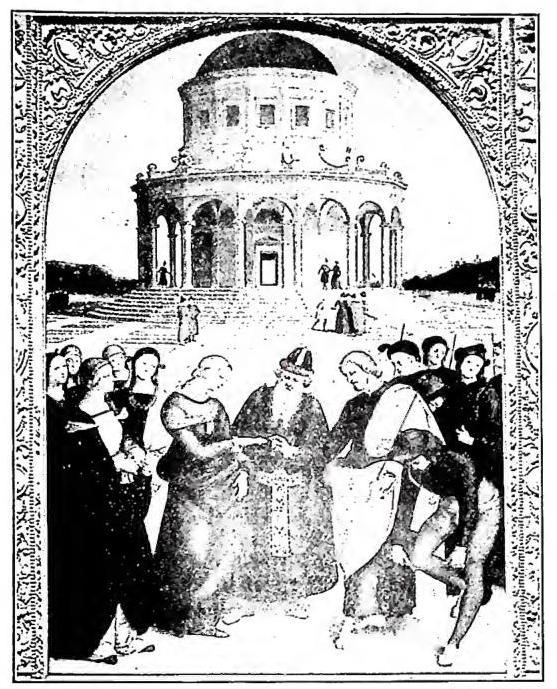
Marriage — Espousal of the Virgin. Painting by Raphael (1504). Milan, Pinacoteca di Brera.
Some modern theologians and canonists, Gallicans and Josephists (e.g., M. A. de Dominis, Launoy, Nuyte), separated the contract from the Sacrament even more. They held that between these two elements there existed only extrinsic relationships, inasmuch as the priest’s blessing would be added externally to the contract. Through the work of these theologians the distinction descended from the theological to the political sphere, lending valid support to the claims of the State in matters of marriage. In this way modern civil marriage was fostered.
According to Catholic teaching, in Christian marriage the contract and the Sacrament, while logically distinct, are in reality identical, since “Christ the Lord elevated the very marriage contract between the baptized to the dignity of a Sacrament” (CIC, can. 102 § 1). The contract, therefore, is raised from the plane of an officium naturae to the order of grace, so that this sublimation of value permeates the contract entirely. It is inconceivable to make a division such that the contract remains in the sphere of nature and the Sacrament is added to it, as it were, to perfect II. Hence the CIC declares that “between the baptized there cannot exist a valid contract that is not at the same time a Sacrament” (can. 102 § 2).
This doctrine, although not proposed in the Church’s official teaching as divinely revealed, is nevertheless certain; indeed, it has been judged by the Sacred Roman Rota to be de fide (AAS, 11 [1919], p. 933). Moreover, the Fathers were unaware of this distinction, as were theologians before the 16th century. Furthermore, Eugenius IV in the Decretum pro Armenis implicitly affirmed that the marriage contract and the Sacrament in the faithful are not two distinct things (Denz-U, 702). The same concept is presupposed by the Council of Trent, which attributed sacramental value to clandestine marriages celebrated before the decree Tametsi (Denz-U, 990); and it is validly defended by Pius IX in a brief to the King of Sardinia (1852) and also in the allocution Acerbissimum vobiscum of 27 Sept. 1852 (Denz-U, 1640) and in the condemnation of contrary errors contained in propositions 66 and 73 of the Syllabus (Denz-U, 1766, 1773); and by Leo XIII in the encyclical Arcanum (10 Feb. 1880: Denz-U, no. 1854) and by Pius XI in the encyclical Casti connubii (31 Dec. 1930: ibid., no. 2237).
6. Matter and form
Since the Sacrament is nothing other than the natural contract elevated to the order of grace, it follows that the constitutive elements of the Sacrament must be identical with the constitutive elements of the contract itself. The sensible sign of the Sacrament of Matrimony is therefore constituted by the mutual consent of the two spouses. The words that express this consent are regarded as matter, inasmuch as they contain the giving of one party to the other, and as form, inasmuch as they imply the acceptance of this giving.No formal wording is required, because Christ did not demand as the sensible sign of this Sacrament anything beyond what is necessary to constitute a human contract; it is sufficient, therefore, to have any sign by which internal consent is expressed.
Such doctrine, formulated by Bellarmine, Suárez, and Sánchez, is commonly held by almost all modern theologians and is echoed even in the same constitution *Paucis* of 17 March 1758 by Benedict XIV. The words of the Council of Florence, which establishes a threefold element for the constitution of the sacrament—“res tamquam materia, verbis tamquam forma et persona ministri”—cannot be opposed to this doctrine, on the basis of which some theologians argued that the bodies are the matter and the words by which the contracting parties mutually transfer the right over their bodies are the form. In Matrimony, as in the Sacrament of Penance, there is in fact no true matter. The bodies of the contracting parties do not constitute the contract but are rather its object (materia remota circa quam). The contract is formally concluded by the fact that the parties outwardly express their consent. In this consists the sensible sign of the Sacrament of Matrimony (cf. St. Thomas, *In IV Sent.*, d. 26, q. 1, a. 1, ad 2). At a later stage, by analogy with the other sacraments, a determinable and a determining element are distinguished, namely a mutual giving and a mutual acceptance of the right over the body, respectively called matter and form.
Theologians who consider the priest as the minister of the Sacrament of Matrimony hold that the contract is the matter and the words of the blessing are the form that seals and confirms the contract. It has already been noted how such an opinion rests on an unsustainable principle. Its supporters adduce as evidence the words of the Ritual: “Ego coniungo vos,” but it must be observed that these words do not exist in the more ancient Rituals, and that the Council of Trent left their use optional and permitted other quite different formulas (Denz.-U., 990). This would not have been established if the Church had seen in these words the sacramental form of Matrimony.
7. Ministers
The ministers of the Sacrament of Matrimony are the contracting parties themselves: given the inseparability of the sacrament from the contract, whoever makes the contract also makes the sacrament. The priest celebrates the rite, not the sacrament; his assistance is merely that of a qualified witness who receives the consent of the spouses in the name of the Church.The Fathers emphasized the blessing of the Church and required it, but nothing suggests that they saw in the blessing the necessary form: they never in fact denied the validity of clandestine marriages. Scholastic theology held the same view. St. Thomas considered the priest’s blessing as a sacrament. Matrimony is effected by mutual consent (*Summa Theologica*, Supplement, q. 45, a. 5), and this conception among the scholastics is all the more noteworthy in that they placed great emphasis on the priest’s role in the sacrament.
THE SUBJECT OF MATRIMONY
Validly to receive matrimony (M.) only a baptized person who is free from diriment impediments is capable.
To receive matrimony licitly and fruitfully, the absence of prohibiting impediments and the state of grace are required. Matrimony contracted with prohibiting impediments is valid, but grace is not conferred because the obstacle of grave sin at the moment of contracting the marriage prevents II. As for the state of grace, it is required because matrimony is a sacrament of the living; this state can be obtained either by perfect contrition or by confession. Although the state of grace obtained through the sacrament of penance is prescribed only for the Eucharist, the Code of Canon Law nevertheless orders the parish priest to exhort the betrothed to confess their sins and to receive Holy Communion piously before the celebration of matrimony (can. 1033).
There cannot be a valid matrimony between baptized persons which is not at the same time a sacrament: this holds even when the contracting parties are not aware of this, or intend to contract a valid matrimony while excluding the sacrament, or mistakenly believe that matrimony is not a sacrament. Therefore, not only Catholics but also heretics, schismatics, and apostates receive the sacrament. There is no controversy on this point. The question, however, is debated
When two infidel spouses convert and receive baptism, does the marriage become a sacrament? Some hold that an expressed or tacit renewal of consent is required; others maintain that such a marriage can never attain the dignity of a sacrament. Today the prevailing opinion, already defended by Bellarmine (De Matrim. Sacrament., cap. 5), is that the marriage becomes a sacrament at the very moment the two spouses receive baptism. Bellarmine was followed by Sánchez, Perrone, Pesch, Billot, Cappello, De Smet, and Wernz-Vidal. This opinion has a biblical foundation, since the words of St Paul to the Ephesians (Eph. 5:32) were addressed to Christians, many of whom had certainly married while still infidels; it is also theologically sound, if one considers that the efficient cause of the sacramental bond in the marriage of the baptised is the natural consent of the faithful, and that the only obstacle to the sacramental character of an infidel marriage is the lack of baptism. Once this is received, the enduring bond is elevated to signify the union of Christ with the Church, and nothing further is lacking for the general principle to apply: “Matrimony between Christians is a sacrament.” A new consent, necessary for the sacrament, is to be excluded, because baptism does not dissolve but leaves intact the previous marriage; there is therefore a single, ever-enduring marriage in which the original consent always retains its validity.
A different conclusion prevails in the case of a marriage contracted between a baptised and an unbaptised person. Some hold that such a marriage is a sacrament for the faithful party (Sasse, Rosset, Pesch). Others affirm this only when a dispensation from the impediment has been granted. But the more common opinion does not admit this division: if there is no sacrament, as is certain, for the infidel spouse, then, given the inseparability of the contract and the sacrament, there can be no sacrament for the faithful spouse either (Wernz-Vidal, Cappello, Noldin, Gasparri).
8. Effects
The effects of this sacrament consist in the formation of the sacramental bond, the increase of sanctifying grace, and the right to all actual graces necessary for living the married state in a Christian manner.The marital bond constitutes the res et sacramentum; it serves as the dispositive cause for the infusion of grace, and it endures until it is lawfully dissolved. The conferral of sanctifying grace is a truth of defined faith declared by the Council of Trent in sess. VII, can. 6, 8 (Denz-U, 849, 851) and sess. XXIV, can. 1 (Denz-U, 791). This is a second grace, since marriage, by symbolizing the union of Christ with the Church, is a sacrament of the living. When received knowingly in a state of mortal sin, it is valid if all other conditions are present, but illicit. In such a case, grace revives subsequently when the obstacle is removed. If, however, it is received unknowingly in a state of sin, it produces “per accidens” the first justification through attrition.
The right to special actual graces is one of the aspects of the sacramental grace proper to this sacrament, by means of which spouses are enabled to attain the lofty purposes of married life. Already St. Paul alludes to the negative effect of the moderation of concupiscence: “To avoid fornication, let every man have his own wife, and let every woman have her own husband” (1 Cor 7:2; cf. 1 Thess 4:4–5). The Council of Trent also recalls, among the effects produced by the sacrament, the perfecting of natural love and the strengthening of indissoluble unity, by which the spouses are sanctified, just as the bond uniting Christ with the Church is a bond of charity and holiness (Denz-U, 969). *Casti connubii* speaks of living marriage “whose efficacy, though it does not imprint a character, is nevertheless permanent.” In this regard the encyclical comments on a text of St. Robert Bellarmine: “The sacrament of marriage is like the Eucharist, which is a sacrament not only when it is conferred but also while it endures; for as long as the spouses live, their union is always the sacrament of Christ and the Church” (*De Matr.*, II, 6). Therefore all acts that translate into practice, that continue to ratify in detail the mutual gift—namely, everything among spouses that manifests sanctified love—is a source of grace. In this way the state of marriage can be eminently sanctifying.
9. Powers of the Church
The marriage of the faithful is always a sacrament, and the power to administer the sacraments was conferred exclusively by Jesus Christ upon His Church; to it therefore belongs the proper, exclusive, and independent right to determine what is necessary for the valid and lawful celebration of Christian marriage (can. 1038). In particular, the specific powers of the Church include: a) to interpret and declare in an authentic and exclusive manner (without derogating from or dispensing without express mandate from God) divine law, by virtue of its teaching authority (can. 1322); b) to determine the diriment impediments and prohibitive impediments, and to prescribe the conditions required for the lawful and valid celebration of marriage; c) to proceed and adjudicate in all matrimonial causes concerning the existence, validity, effects, and dissolution of the marriage itself, as well as the separation of the spouses; d) to compel delinquent spouses, even by penalties, to observe its laws and sentences. These powers of the Church indirectly extend even to the unbaptized, should they wish to contract marriage with a baptized person; hence the law that directly binds one of the contracting parties also indirectly binds the other. In such a case, the baptism of one party suffices to establish the Church’s competence in the matter.From this it follows that the State has no power whatsoever over the lawfulness or validity of the marriage of the faithful, for whom the sacrament is not distinct from the contract. The State can only: a) establish certain conditions, civilly obligatory, for those who wish to contract marriage, provided that this is required by the public good and does not conflict with divine and canon law; b) legislate on temporal effects that are separable from the substance of marriage. In this regard, its competence is proper and exclusive.
The exercise of this power by the Church is already evident in St. Paul (1 Cor 5); from the earliest centuries the Church asserted these rights, independent of civil power, so that during the Middle Ages canon law became prevalent, if not exclusive. There were no lack of resistances on the part of princes, nor errors on the part of regalist canonists and theologians. The Protestants, considering marriage no longer as a sacrament but as a simple contract, made it dependent exclusively on civil jurisdiction. Yet there were theologians (Sánchez, Soto, Billuart) who, while holding the contract and sacrament inseparable for the faithful, granted both authorities proper rights over marriage, unless the Church wished to reserve to itself, as it does, the right to establish exclusivity. Even in this case, however, the State was conceded the right to establish prohibitive impediments, reserving to the Church the diriment ones.
La dottrina cattolica emerge da numerose ed esplicite dichiarazioni dell'insegnamento ufficiale della Chiesa: Concilio Tridentino (sess. XXIV, can. 3, 4, 9, 12); Pio VI, Errores Synodi pistorians, propp. 58-60 (Denz-U, 158-60); Breve ad archiep. Trevirense, 1782; Ep. ad episc. Mutolensem, 1788; Pio IX, Syllabus, propp. 68-70 (Denz-U, 1768-70); Leone XIII, encicl. Arcanum, Pio XI, encicl. Casti connubii, CIC, can. 1016, 1038, 1040, 1960-61.
Ecclesia catholica, II, Augusta-Agria 1887, p. 467 ssgg.; M. Covillard, Le Mariage considéré comme contrat civil dans l'histoire du droit français, Parigi 1889, p. 38 sgg.; E. Glasson, Le mariage de Gaston d'Orléans avec Marguerite de Lorraine, ivi 1896; J. Basdevant, Des rapports de l'Eglise et de l'Etat dans la législation du Concile de Trente au Code civil, ivi 1900, pp. 26-28, 106-122; G. Cavigioli, La precedenza del m. civile durante il Regno Italico, Novara 1914; G. Serviz, De quelques recherches concernant le Mariage contrat-Sacrement et plus particulièrement de la doctrine augustinienne des biens du Mariage, Parigi 1928; P. Gasparri, Trattato canonico de Matrimonio, I, 2a ed., Roma 1932, pp. 31-34; Circa il potere della Chiesa sul M. dei fedeli; J. Perrone, De Matrimonio christiano, II, Roma 1858, pp. 5-132; F. Huszar, De potestate Ecclesiae circa Matrimonium, ivi 1900; E. Grzymala, Ratio sacra in Matrimonio canonico et civil, Roma 1935; G. Stocchiero, Il M. in Italia, 5a ed., Vicenza 1946, p. 42 sgg. Guglielmo Zannoni.
III. ENDS OF MATRIMONY
I. The Data of Revelation
It has already been noted how God Himself establishes the natural foundations of matrimony, promulgating its laws and determining its ends in procreation and mutual aid (Gen. 1:26–31; 2:7–25).These concepts are elsewhere recalled in the books of the Old and New Testaments. The doctrine of St. Paul on this matter holds particular importance, since it indicates another purpose to which God ordained the matrimonial institution after original sin, namely, the remedy of concupiscence. In the First Epistle to the Corinthians, speaking of widows and the unmarried, he says: “It is good for them if they remain even as I. But if they do not contain themselves, let them marry. For it is better to marry than to burn” (7:8–9); moreover: “It is good for a man not to touch a woman. Nevertheless, to avoid fornication, let each man have his own wife, and let each woman have her own husband” (ibid. 7:1–2). And after teaching that it is good to abstain from marital relations in order to devote oneself to prayer, he adds: “But afterwards be ye together again, lest Satan tempt you for your incontinency” (ibid. 7:5). These sober yet profound revealed data were later developed by Catholic tradition into systematic doctrine.
10. Essential Ends of Matrimony in the Doctrine of the Church
Proceeding from the lines traced by Sacred Scripture, Catholic teaching has always been in agreement in assigning to matrimony three essential ends: the generation and education of offspring, mutual aid, and the restraint of concupiscence. The generation and education of offspring is an end which, following the sacred text, is first emphasized by Catholic tradition. The thought of the Fathers is summed up by St. Augustine: “That marriages are contracted for the sake of offspring is testified by the Apostle: I will that the younger women marry” (1 Tim. 5:14). And as if to ask, “And why?” he immediately adds: “To beget children and to be mothers of families” (De bono coniug., chap. 24, no. 32; cf. enc. Casti Connubii, Denz.-U., no. 2228 ff.).In matrimony, man and woman, beyond the perpetuation of the race, seek and find the companion of life. Matrimony, in fact, through the intimate, total, and definitive union of the two spouses, offers to each of them the complement they naturally desire: a precious material and spiritual support, which for the generality of men constitutes the providential means of their personal and social perfection, of their moral progress, and of their sanctification. One also speaks of the “completion” or “perfection” of the spouses. These terms well express the idea of a void filled, of fullness, of equilibrium of the entire being aroused by mutual love. Hence in the spouses there arises joy, dedication to the beloved person and to the hearth, courage in the hour of trial, and the harmonious and complete development of their own personality.
Besides the *mutuum adiutorium* in marriage, the present order also includes the *remedium concupiscentiae*. Indeed, the concupiscence of the flesh is not merely a providential impulse toward satisfying a natural need, but, after original sin, it often becomes a dangerous deviation from the natural impulse, insofar as it arises against the governance of reason and drives man toward the disordered use of sensual pleasure; theology has regarded it as a *vulnus naturae*. A legitimate remedy for the wounded nature is marriage, which, while tempering the ardor of passion, restrains concupiscence by directing it to the noble end of procreation.
3. Relationship among the ends of marriage — There is no opposition among the ends of marriage, but rather harmony. Spouses, in seeking mutual completion, contribute to the well-being of society; moreover, the procreation and education of children benefits not only the State and the Church but also strengthens conjugal love through new bonds.
These ends, however, are not on the same level or of equal importance: there exists a hierarchical relationship, whereby one is higher and more important than the others. “The primary end of marriage is the procreation and education of offspring; the secondary end is mutual aid and the remedy of concupiscence” (CIC, can. 1013 § 1). This statement is a synthesis of the Church’s traditional doctrine. Indeed, drawing on the Fathers, theologians, moralists, and canonists prior to the CIC consistently operated within this established doctrinal framework. In particular, no one held that the primary end of marriage was other than the procreation and education of offspring: the only exception was Hugh of Saint-Victor, who substituted the union of love between man and woman, from which the generative function of the spouses derives as a consequence (cf. M. Abellan, *El fin y la significación sacramental del matrimonio, desde s. Anselmo hasta Guillermo de Auxerre*, Granada 1939). Saint Thomas called it the “most essential end,” without which marriage cannot be understood or defined: “Proles est essentialissimum in Matrimonio; et secundo fides, et tertio Sacramentum” (Sum. Theol., Suppl., q. 49, a. 3). The Church maintained this position even after the CIC. Pius XI’s *Casti connubii* (31 Dec. 1930) reaffirmed “what is also effectively expressed in the Code of Canon Law,” referring to can. 1013 § 1. Moreover, it is nature itself that leads to this hierarchy of ends: only offspring can be considered the natural term to which the very difference of temperaments is ordered, corresponding to the distinct roles of man and woman within the family. The matter is even more evident when considering the remedy of concupiscence. To separate this end from procreation is to invert the order established by God, according to which the pleasure joined to the use of marriage is by its nature a providential means to facilitate spouses in the task of propagating the human race, and almost to counterbalance its grave responsibilities.
It must still be emphasized that the three ends are subordinated but distinct and absolutely irreducible. The secondary end, namely, is not exhausted in merely being a means or instrument—even of the principal end—but retains its character as an end in itself, albeit subordinated to another that is principal. In other words, it is not something accessory or accidental added to the essence of marriage, but belongs to the substance of the institution and of the sacrament, and therefore can be pursued for its own sake. This explains how, in certain periods when the primary end is absolutely and temporarily unachievable, marriage and its use remain reasonable and lawful, since a sufficient end continues to provide them with a rationale. The marital union, however, deprived then “per accidens” of its higher end, toward which it does not cease to be oriented in its intimate constitution, remains imperfect without its ultimate fulfillment.
11. New theories and authoritative reconfirmations of traditional doctrine
Recently, however, an attempt has been made to give primary emphasis to the psychological and affective element of conjugal society, which must be a full communion of souls between two spouses. In Italy, among others, those who aligned with this trend included B. Brugi (L'art. 107 del Codice civile italiano e lo scopo del M., in Rivista intern. di filosofia del diritto, 5 [1925], pp. 113 ff.); L. Cornaggia Medici (Dell'essenza del M., in Il diritto eccels., 39 [1928], p. 398 ff.); G. Viglino (Oggetto e fine primario del M., in Diritto eccels., 40 [1928], p. 142 ff.). In Germany, mention should be made of Von Hildebrand (Die Ehe, Munich 1928), N. Rocholl (Die Ehe als geweihtes Leben, Dulmen 1936), especially H. Doms (Vom Sinn und Zweck der Ehe, Breslau 1935), and B. Krempel (Die Zweckfrage der Ehe in neue Beleuchtung begriffen aus dem Wesen der beiden Geschlechter im Lichte der Beziehungslehre des hl. Thomas, Benzinger 1941).The reasons that led to this abandonment of the traditional position are dominated by psychological motives, namely the sincere desire to introduce a higher note of spirituality into marriage. The canonistic conception does not seem sufficient, for, according to these theorists, it would reduce marriage to a specifically sexual function, diminishing its spirituality and reducing it to something material and almost vulgar. Thus, the current doctrine is considered outdated, as it would be linked to the state of biological sciences in the 13th century, and therefore needs to be updated in light of advances in psychological studies.
These theories threatened to cause doctrinal and practical deviations in a matter that, more than any other, demands clarity of terms and concepts. For these reasons, the Church deemed it opportune to reaffirm the immutable principles of its doctrine. A first intervention occurred on October 3, 1941, with the discourse that Pius XII delivered to the Sacred Roman Rota: “Two tendencies are to be avoided: one that, in examining the constitutive elements of the act of generation, gives weight solely to the primary end of marriage, as if the secondary end did not exist, or at least were not a *finis operis* established by the Ordainer of nature itself; and the other that considers the secondary end as equally principal, detaching it from its essential subordination to the primary end, which, given the necessity of the case, would lead to disastrous consequences” (AAS, 38 [1941], p. 423).
The Holy Office, in a decree dated 1 April 1944 (*AAS*, 36 [1944], p. 103), insisted on the dangerous nature of the new way of thinking, which was expressly designed to foster errors and uncertainties. This was amply demonstrated by the authors who defended the traditional line. According to them, it is already a serious assertion to interpret can. 1013 § 1 as a mere pastoral formula. But the errors are not limited to this. To mention a few: 1) If the principal purpose of marriage is the mutual completion of the spouses, and offspring is merely a means to that end, it follows that offspring could be sacrificed if it threatened the life of the mother. 2) If marriage is then considered an essential perfection of human life, almost a dramatic error that outside of marriage man remains incomplete, it follows that the value of virtuous celibacy or of the priestly and religious state is depreciated, contrary to the traditional doctrine of the Church. 3) Likewise, the intrinsic gravity of onanism, so firmly asserted by the Church inasmuch as it opposes the primary end of marriage, is not sufficiently explained.
According to the latest directives of ecclesiastical teaching, it is necessary to preserve the wording and meaning of the terms: primary end and secondary end, and to affirm that secondary ends are subordinate to the principal end and not independent.
II. IL M. PRESSO I PRIMITIVI.
I. END AND SOCIAL IMPORTANCE
Frazer, having expounded the so-called conceptional theory of the origin of totemism, a theory based on certain explorations by Spencer and Gillen among the primitives of central Australia and by Rivers among those of the Banks Islands in Melanesia, concluded that “the origin of totemism is a barbarous ignorance of the physical process by which men and animals reproduce their species; in particular, it is ignorance of man’s role in the procreation of a child.”It is clear that, if this evolutionist thesis of Frazer’s is accepted, marriage was not instituted and cannot be understood by primitives as being for the procreation of offspring, but rather for selfish ends. But this hypothesis of Frazer’s is unfounded. First, because it attributes to primitives an infantile mentality, whereas today, with the fall of Lévy-Bruhl’s pre-logical and alogical mentality, it is demonstrated that primitive mentality is fundamentally the same as our own. Second, the aforementioned peoples are not ethnologically the most ancient. Third, the facts considered refer only to those peoples and, as Granet has observed, may appear as an ethnological curiosity limited to an isolated and relatively small civilization. As for the fact that even the most recent research (e.g., J. Haeckel) has better clarified that such peoples of Australia, on the contrary, have a true concept of paternity and a high idea of the originality of life. The same has been observed among the most ancient ethnological peoples, known as gatherers. Indeed, their careful powers of observation have even led them to determine the most favorable time for conception. This is the case among the African Pygmies of the Ituri (P. Schebesta) and among the Tungus reindeer herders (Shirokogoroff). Precisely because primitives know the necessity of marriage for obtaining offspring, they consider marriage the foundation and growth of society itself. According to these Pygmies, motherhood is the greatest desire of a woman, offspring is the end of the family; they regard marriage as an act of social importance; their principal idea of it is that of continuity and progressive increase of the population.
II. IMPEDIMENTS
In contracting marriage, all primitive peoples observe a whole complex of rules and rites, which form an important part of their traditional cultural heritage. The impediments to marriage are chiefly consanguinity, affinity, and, where the custom of adoption exists (Andamanese), spiritual kinship. The degree of these impediments and sometimes even the persons to whom they refer vary in every type of civilization, and even among peoples of the same type of civilization (cf. EXOGAMY; INCEST; KINSHIP). Among those primitive peoples where monogamy is the rule, another impediment to marriage is a previous marriage (cf. CUSTOMS OF THE WORLD, ed. W. Huthmann, I, Milan 1915, p. 57).Karyay of Brazil; cf. INDISSOLUBILITY OF MARRIAGE AND DIVORCE). Age, which, where initiation exists, begins after it, constitutes an impediment only to the use of marriage.
III. BETROTHAL
Primitive marriage ordinarily involves two main, clearly distinct acts: betrothal, which marks its beginning, and the wedding, which concludes and consummates II. Marriage should reconcile all the manifold interests, namely those of the spouses, who must cohabit and educate their offspring at least in early childhood—that is, until the children are separated from the family and placed in the common houses of the young, where such a custom exists; and the interests of the two related clans, which are social and economic in nature. Even in this regard, however, the greatest variety is observed among peoples of equal or differing civilizations.Among the Tungus, for example, there are three forms of betrothal: 1) arranged by the parents when the children are still young; 2) likewise arranged by the parents, but with consultation of the adult children; 3) directly by the young man and woman according to their mutual affection and love, while reserving for the parents the necessary formalities, though abduction may eventually occur. Among the Bambuti Pygmies of the Ituri, all interests are harmonized or are brought into harmony. Marriage is normally contracted on the basis of mutual affection between man and woman, but since it is primarily a contract between families (Sippe), it is not officially recognized unless it is economically and socially sound.
Among the Andamanese, who are also gatherers, betrothal is concluded by the parents or by the guardian—that is, the adopter—when the children are still young. After a brief formal cohabitation for the purpose of notification, the betrothed do not marry until physical maturity is reached; yet any infidelity on the part of the betrothed is considered a crime.
Among other peoples, ethnologically more advanced than gatherers, the freedom of man and woman to contract marriage—with due exceptions—is little or not at all respected. One such exception is betrothal directly concluded by the young people during common spring festivals, which have been given great ethnological importance, having been arbitrarily regarded as “mass marriages” and remnants of primitive promiscuity. These festivals persist among many primitive peoples of Asia and once existed among the rural populations of China and Japan. The aforementioned interpretation of them by evolutionary ethnology is refuted by the fact that such festivals, even in their present complex form, are clearly related to individual marriage and derive
From the initiation of youth. It should also be noted that the actual betrothal takes place after the preliminary one arranged by the parents, from the children’s earliest years, with which it is often in conflict. Indeed, the civilization of these peoples is a blend of the agricultural matriarchal culture with that of pastoralists and totemists.
Various forms of betrothal exist in matriarchal societies (v. DIVITTO. IX; MATRIARCATO).
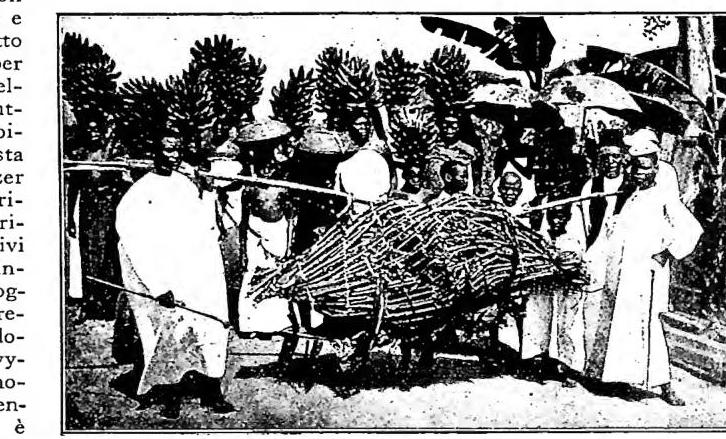
The strangest form of betrothal has been observed among the totemic peoples of Central Australia. According to their highly complex kinship system, every man has a primary right to the daughters of one or more women and secondary rights to the daughters of many others. Initial agreements are sometimes made before the man’s birth and even before the birth of his future mother-in-law. The parties involved sometimes modify the original agreement, which is not done without lengthy discussions. But when a man reaches the age of twenty or twenty-five, the agreement is considered final: he knows with certainty who his future wife will be. She may then be only one or two years old, and so he must wait until she reaches the appropriate age, which is considered to be fourteen.
IV. GIFTS, DOWRY, AND BRIDE-PRICE
Among many primitive peoples, at the time of betrothal and marriage, and when a long interval elapses between the two, as in the case previously considered of Australian totemists, at certain times gifts must be exchanged between the two families according to the traditional customs proper to each civilized people. The significance of these gifts is very varied. It may first of all be symbolic and auspicious. Among the Woodlark Islanders in Melanesia, for example, the gift is a sign of the marriage proposal and, if accepted, of its approval or conclusion. The gifts may also constitute a sharing of the expenses of marriage and the necessities for setting up a new household between the two families. Among the Andamanese, for instance, and according to Man, useful gifts must be offered at the wedding. Among the aforementioned Tungus, the groom’s clan must give the bride’s clan a certain number of reindeer, horses, or other animals, or money and other gifts for the marriage. This is called kalym.The bride, however, receives from her own clan a dowry of equal value, namely animals and personal feminine effects. As a general rule, the dowry is considered the private property of the woman, over which she has almost unrestricted control, with the right to take it away when she leaves her husband’s clan, except in cases of certain crimes. It is then inherited by her daughter. In the so-called marriage of women exchanged between two or three clans, no kalym is given. It varies in value according to different tribes, but also according to the personal, familial, and domestic qualities of the bride. The same is observed among the Manchus and the Buryats. These peoples deny that, by giving the kalym, they intend to buy the bride. Indeed, it cannot properly be called a purchase, since the dowry is equivalent to the kalym. Moreover, with the dowry, the bride brings everything necessary to establish a household.
But among many other primitive peoples, there is a true purchase of the bride, as if she were a beast or any other thing. For example, in Cameroon (French Equatorial Africa), the father promises his daughter three or four times over, that is, each time a buyer appears with a higher price, he accepts a larger advance payment from each, which allows him to compensate for the damages of a rejected betrothal. The custom is highly pernicious, both socially and morally, because, given the wide liberties permitted during betrothal, the girl, moving from one fiancé to another, is often satisfied with the variety of her experiences and moreover considers it a great glory to have pleased so many, accompanied by a long succession of quarrels and disputes.
V. BETROTHAL
It can be very simple and of a private family character, or extremely complicated due to the many religious beliefs and practices and superstitions that permeate it, as well as the social festivities that may last several days, during which dances, songs, music are performed and speeches are made. Among the Andamanese, for instance, as Man expressly notes, betrothal has no religious character, does not invoke the help and blessing of God, but is merely a public social and legal act.Among the islanders of Woodlark, betrothal is a family matter. When the betrothed have reached sexual maturity, the relatives lead the bride to the groom’s house, where a banquet is held. Sometimes, however, it is sufficient for the betrothed to eat together and go into the countryside together. Similarly, among Australian totemists, there is no special betrothal ceremony: the fiancée is brought in the evening to her fiancé, for whom she and her relatives build a hut where they will live together as husband and wife.
Among the Pygmies of the Ituri, no ceremony is performed for a single betrothal. However, some groups have the custom of double betrothal, which essentially amounts to this: the families of the betrothed gather in the forest, where they hold a three-day festival and dance. There is the presentation of the betrothed, who then meet and gaze fixedly into each other’s eyes to signify that they are contracting a kinship that binds them in destiny. The elders address words of exhortation to them: that they be kind to all, especially to the old and the children; that they procure food; that they be gentle and kind; and that from now on they may live in peace and bear children. For many other peoples, however, betrothal has, in addition to its ethical and social character, also a religious one. For example, among the T’u jen (a Turkic-Mongolian people of Kansu in northwestern China), betrothal is a great and solemn social event during which numerous symbolic ceremonies and rites are performed. But the proper nuptial rite is directed by the groom’s grandfather, or in his absence by his maternal uncle. He orders prostrations to the God of Heaven and to the spirits, then to the groom’s parents and to the relatives of both the groom and the bride, and invokes a blessing upon the new couple.
Among the Caccin in Burma the celebrant recites the legend of the first human couple; among the Lolo the legend of the flood, in which the surviving brother and sister unite by God’s will. Thus do these peoples reconnect every month with the first human month. They themselves and many others also require of the spouses a sacrifice to the family ancestors at the wedding. For these peoples, who customarily arrange betrothals during spring festivals (in some groups even at funerals, e.g., among the Karens of Burma), the sacrifice does not have a definitive character for married life. Until the first child is born, the bride either returns to her father’s house and makes fleeting visits to the groom’s house at set times, or remains with the groom but behaves outwardly—
like the animals. Morgan, in his evolutionary scale of human history, calls this phase the “stage of agamy.” The reasons advanced in support of this thesis are ultimately those adduced by Frazer, yet these arguments, as has been seen above, are shown to be unfounded in light of the latest scientific findings.
According to the belief of primitive peoples, especially those ethnologically most ancient, marriage was instituted by God, who created the first human couple, or, according to some, several human couples but always in pairs, and forbade incest (v.). This belief is confirmed by most ethnologists and linguists, who, basing their conclusions on sound scientific grounds, acknowledge the monogamy of the human race.
III. STORIA DEL M.
SOMMARIO:
I. Presso gli antichi Ebrei
II. Nel Diritto romano
III. Nel Diritto canonico.I. AMONG THE ANCIENT HEBREWS
In the opening pages of the Bible (*Gen. 2*, 18-24) marriage is presented as the union between man and woman, willed by God for the reproduction of the species (*ibid. 1*, 27 sq.) and for the mutual benefit of the two individuals (*ibid. 2*, 20).Its monogamous character is also evident from the note of wonder with which the appearance of polygamy is described (*ibid. 4*, 19). However, during the patriarchal (Jacob) and monarchical (David, Solomon) periods, the practice of a man marrying several women (polygyny) was considered legitimate and approved by God. After the exile, this custom gradually disappeared; by New Testament times, even among aristocratic circles, monogamous union prevailed in practice.
Although there are allusions to accessory or ceremonial elements (cf. *Gen. 29*, 22, 27; *Judg. 14*, 10; *Ps. 18*, 6; *Is. 61*, 10; *Jer. 7*, 34; *Is. 9*, 9; *Cant. 3*, 11; *1 Macc. 9*, 37; *Mt. 25*, 1 etc.), in the Bible only in *Tob. 8*, 24 is mention made of a written document drawn up at the time of marriage.
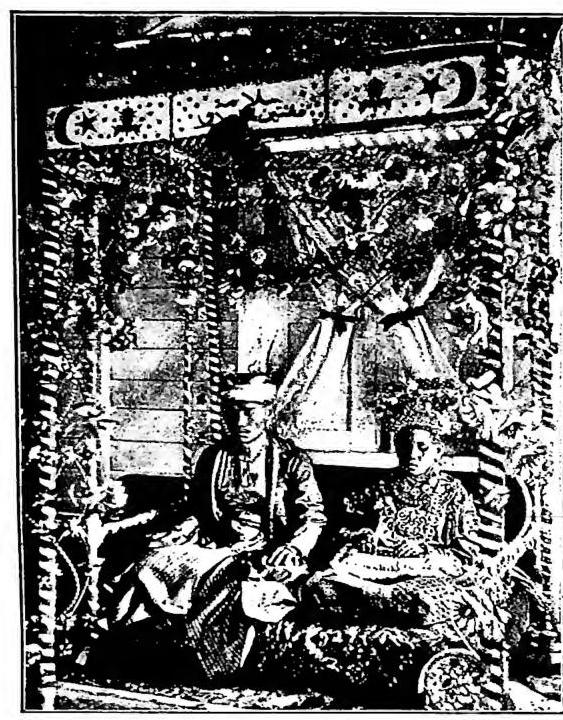
The custom, however, appears to have been widespread in the Diaspora. Some specimens have been discovered in the Elephantine papyri (cf. A. Cowley, *Aramaic papyri of the fifth century b. C.*, Oxford 1923, nos. 15, 18, pp. 44-50, 54-56). Various conjectures are possible regarding the content of such a document. In the Code of Hammurabi (§ 128), on the other hand, the validity of marriage is made dependent upon the drafting of a written contract. Hardly can one speak of a free contract stipulated by the interested parties themselves. Among the Hebrews, as among other Semites, it was the parents who decided the fate of their children (cf. Gen. 24, 2-4; 28, 1 sqq.; Ecclus. 7, 27); occasionally mention is made of the effective resolve of a young man to marry a girl not approved by his parents (Gen. 28, 6-9; Judg. 14, 2 sqq.). Much less freedom was granted to a daughter, though sometimes her consent was sought (cf. Gen. 24, 57).
In Jewish law, mention is made of a sum or equivalent in kind that the groom must deliver to the father of the betrothed (cf. Gen. 34:12; Ex. 22:16; 1 Sam. 18:25; Hos. 3:2). In Deut. 22:28–29, the price that the seducer of a virgin must pay to her father before marrying her is set at fifty shekels. The *Code of Hammurabi* (§§ 138, 139, 164) also mentions a purchase price (*tir-lia-tu*). The difficulty of comparing these customs with those of other related peoples and the uncertainty surrounding the meaning of the Hebrew term *mōhar*, by which this price is designated in Gen. 34:12; Ex. 22:16; 1 Sam. 18:25, have led to differing explanations among various authors. Some scholars see in the *mōhar* the essential element of the marriage contract, considering it as a purchase of the woman, or as a *pretium pudicitiae* (Eberharter, Neubauer, Zolli, Neufeld), or as a mere obligatory gift (Heinisch, Kalt, Burrows, Nötscher, etc.). Without doubt, from the various *mōhar* described, the context of the three passages cited above, and the comparison with the modalities of actual commercial transactions, it does not seem permissible to deduce that marriage represents the effect of a sale. In addition to the *mōhar*, the groom offered other gifts (cf. Gen. 24:53; 34:12). The bride also brought a dowry, of which she retained ownership (ibid., 24:53; cf. *Code of Hammurabi*, §§ 142, 149, 150, 156, 162, 163, 172, 173). If the dowry included a slave as a concubine for the husband (cf. Gen. 16:3; 24:59, 61; 29:24, 29), the mistress retained her rights over her (ibid., 16:6; cf. *Code of Hammurabi*, §§ 144, 146, 147).
While the seducer is obliged to marry the young woman he has violated (Ex. 22:16) with no possibility of divorce (Deut. 22:29), the virginity of the girl is not a condition for the validity of the *mōhar*. Responsibility begins with the betrothal. A young woman who unites with a stranger is already condemned to death as an adulteress (Gen. 38:24). Such severity suggests that the young man who fails to fulfill the promise of *mōhar* was at least subject to a monetary penalty, similar to that prescribed in the *Code of Hammurabi* (§ 159).
Nella S. Scrittura non si precisa un'atta minima degli sposi. Dalla media constatata in Egitto e da affermazioni talmudiche (Aḥbôth, V, 24; ed. Goldschmidt, VII, p. 1171) si può concludere che gli uomini si sposassero verso i 18-20 anni, mentre per le ragazze bastava anche un'età più precoce. Riguardo agli impedimenti matrimoniali, la legge ebraica si preoccupa in genere solo della parentela e della nazionalità. Nel periodo più antico vigeva l'uso di sposarsi anche tra fratellastri (cf. Gen. 20, 12; II Sam. 13, 13) e fra cugini (cf. Gen. 24, 15, 47; 28, 2, 18 sg.). Nel Levitico si proibiscono m. fra consanguinei, ed in particolare con la propria madre o con il padre (Lev. 18, 7), con la matrigna (ibid. 18, 8; 20, 11; cf. Deut. 22, 30; 27, 20), con la sorellastra (Lev. 18, 9; 20, 17; cf. Deut. 27, 22; II Sam. 13, 1 sg.), con la zia paterna e materna (Lev. 18, 12 sg.; 20, 19), con la nuora (ibid. 18, 15), con la cognata (ibid. 18, 16; 20, 21), con la figliastra (ibid. 18, 17), con la figlia del proprio figlio o della moglie (ibid. 18, 17) e con la suocera (ibid. 20, 14). La legge contro il m. fra cognati subiva un'eccezione nel caso che uno morisse senza figli; il fratello del defunto era obbligato a sposare la vedova per perpetuare il nome e il primogenito di tale m. era considerato giuridicamente figlio del defunto stesso (v. LEVIARTO).
Si insiste anche nel riprovare il m. con straniere quale causa di sincretismo religioso e di corruzione morale (cf. Gen. 28, 6-9; Iude. 3, 5 sg.; I Reg. 11, 1 sg.; Mat. 2, 11 sg.; Esd. 9, 1 sg.; Neh. 10, 30; 13, 23-25). In modo particolare la proibizione valeva per le varie popolazioni canane della Palestina o delle regioni limitrofe (cf. Ex. 34, 11, 16; Deut. 7, 1-4). Ma nei tempi più antichi tale legge appare meno rigorosa (cf. Gen. 34, 14; 41, 45; Ex. 2, 21; Iude. 3, 6; 14, 3, 10; Ruth 1, 4). Perfino Mosè aveva per moglie una madianita (Ex. 2, 21; Num. 12, 1). Dopo l'esilio, invece, l'esclusione diventa sempre più rigorosa, come appare dai libri di Esdra e Neemia e dalla tradizione talmudica. Anche nell'uso di sposare due sorelle, come fece Giacobbe, si nota un'evoluzione; in Lev. 18, 18 è proibita l'unione simultanea con tali persone. Una severità particolare era richiesta per la moralità delle future spose dei sacerdoti (ibid. 21, 7). Il sommo sacerdote poteva sposare solo una vergine israelitica (ibid. 21, 13 sg.). Alla donna divorziata e successivamente rispostasi era interdetto un nuovo m. con il primo marito (Deut. 24, 4); ad una giovane erede era lecito unirsi solo con uno della medesima tribù (Num. 36, 6 sg.).
The law against consanguineous marriages explains the horror of incestuous relations (cf. Gen. 19:30–37; 35:22; 49:4; Lev. 20:11 ff.; Deut. 27:20, 22 ff.; Ezek. 22:11). The holiness of marriage, with evident allusion to its primitive monogamous form, stands out in the constant use by the prophets and the Song of Songs of representing the union between God and the chosen people by the metaphor of the bond between man and woman. In the same writings, idolatry is described as a most grievous sin of a spiritual and adulterous nature. In Mosaic law, extremely severe penalties are imposed on adulterers, particularly when the woman is at fault (cf. Gen. 39:7–20; Ex. 20:14–17; Lev. 18:20; 20:10; Deut. 22:22; 2 Sam. 11:2 ff.; Isa. 5:8 ff.; Ezek. 23:20; Hos. 4:2). This severity is also found in other Semitic legislations (cf. Code of Hammurabi, §129; Hittite and Middle Assyrian laws in G. Furlani, Leggi dell’Asia anteriore antica, Rome 1920, pp. 87, 96–99). Even on mere suspicion of adultery, the woman was subjected to a terrible ordeal by God (Num. 5:2 ff.; cf. Code of Hammurabi, §132).
From the account in Gen. 2:24 it appears that the union between man and woman was considered indissoluble. Yet in time the husband was recognized as having the right to divorce (Deut. 24:1–4). The general motive (some indecency) given as the cause of separation lent itself to a flexible interpretation. Indeed, it is known that around New Testament times some rabbis of the school of Hillel were very lenient in this regard (cf. Gittin, IX, 10; ed. L. Goldschmidt, V, Berlin 1930, p. 687). At that time, women were in practice also recognized as having the right to divorce (Mark 10:12; Acts 24:24; cf. Flavius Josephus, Antiquitates Judaicae, XX, 141–43). Jesus Christ, recalling the ancient law, declared that God permitted this contrary practice because of the “hardness of heart” of the Jews (cf. Matt. 19:8).
Finally, noteworthy are the texts that recommend perfect conjugal fidelity (Prov. 5:15–20; 6:24–35; 23:26–28; Sir. 9:1–13; Mal. 2:14 ff., etc.) or describe the ideal wife (Prov. 31:10–31; Sir. 26:1–24) in contrast to the wicked one (Sir. 25:17–36). For the preference of the married state over celibacy cf. Jud. 11:37.
Angelo Penna
II. IN ROMAN LAW
Marriage is the cohabitation of a man and a woman with the intention of being husband and wife (affectio maritalis); this intention must be lasting, in the sense that it is not sufficient for it to exist at the moment when the marriage is contracted, but it must be maintained, so that its cessation entails the dissolution of the marriage itself.The definitions of Roman marriage, one by Modestus (D. 23, 2, 1): «Nuptiae sunt coniunctio maris et feminae et consortium omnis vitae, divini et humani iuris communicatio»; the other contained in Justinian’s Institutes (I, 9, 1): «... viri et mulieris coniunctio individuum consuetudinem vitae continens», show how the will of the spouses tends to constitute a community of life at least intentionally perpetual; in fact, marriage is not conceived by the Romans as a transitory relationship, even though it may cease with the cessation of the affectio maritalis.
Roman marriage has been accurately compared to possession (possessory theory of marriage), since in both institutions there is the coexistence of two elements, one material (respectively cohabitation and availability of the thing possessed), the other spiritual (affectio maritalis and animus possidendi); with this difference, that while in possession the material element acquires greater prominence, in marriage the spiritual element is instead more important.
In the most ancient period, marriage was accompanied by the woman’s exit from her family of origin and her subjection to the authority (manus) of the head of the family into which she entered by reason of the marriage itself, through particular legal means (confarreatio, coemptio) or, in the absence of these, by the woman’s remaining under the authority for a year (usus). From this, however, it must not be inferred—something which is also confirmed by very recent research—that the Romans knew two types of marriage, one cum manu and one sine manu; the subjection of the woman to manus is a distinct and separate fact from marriage to the point that, even when the marriage is dissolved, a specific legal transaction contrary to that used for subjection is necessary to free the woman from the manus.
In relation to and as a consequence of its structure, Roman marriage lacks a legally defined form for its conclusion, even though it is, naturally, accompanied by ceremonies and rites (this is still true in the Justinianic age, even though in this period there was often the priestly eulogia). It would not, in fact, be conceivable to resort obligatorily to specific formalities to give rise to a union that, at any moment, can cease due to the change in the will of even one of the contracting parties. Thus, Roman marriage can be contracted even between absent persons, who manifest their intention to establish the marital society by any suitable means (e.g., by letter), while the woman enters the house of the husband, thereby bringing about the objective element of cohabitation. With regard to proof of the intentional element, this is given by the declarations of the spouses or their friends, but even more so through the honor matrimonii, which is precisely the highly appreciable manifestation of the affectio maritalis, and which consists in the fact that the spouses publicly treat each other as such, with the participation of the woman in the social position of the husband. Equally free from formalities was divorce, even though, from a certain period onward, custom and legislation sought to impose the observance of specific solemnities.
The conception of marriage as an exclusively factual relationship began to change in the Justinianic age, when there emerged a tendency to attribute to the initial consent alone the effect of constituting marriage. This was in relation to the Christian ideas that were exerting an ever-greater influence; and these, even if they did not succeed in imposing themselves completely in Justinian’s legislation (which, while greatly restricting it, still confirmed the licitness of divorce), nevertheless exercised a broad influence on imperial norms.
The requirements for Roman marriage can be summarized as follows: conubium, i.e., reciprocal capacity to contract a legally valid marriage; natural capacity, which requires the attainment of puberty (14 years for the man and 12 for the woman), and in Justinianic law prohibits marriages for those afflicted with certain defects; consent of the spouses and of the paterfamilias (at first essential, later of diminishing importance, both because it was progressively limited to passive assent and because, in Justinianic law, this consent could be replaced by authorization from the magistrate); consent of the father, if he is not a paterfamilias, inasmuch as the children born of the marriage of his descendant may subsequently be subjected to his potestas.
Non può inoltre contrarre m. chi sia legato da altro m., chi sia schiavo e, per il diritto giustiniane, chi abbia fatto voto di castità o abbia ricevuto gli ordini maggiori. Accanto a questi divieti, che hanno valore generale, ve ne sono altri relativi, che impediscono le nozze fra determinate persone (parentela ed affinità, adulterio, ratto, relazione) di tutela e di ufficio pubblico).
Il rito matrimoniale dexterarum iunctio (v.) degli sposi alla presenza di una donna (pronuba) anziana e sposata una sola volta (univira). Nell’arte classica questo personaggio è spesso sostituito dalla figura diademata di Iuno Pronuba, la dea preposta alla tutela delle nozze. Gli antichi cristiani nelle prime scene matrimoniali figure sui sarcofagi non trovarono difficoltà ad inserire questa immagine fra quelle dei coniugi; compare infatti nel primo terzo del sec. IV in un sarcofago ora nella cattedrale di Vescovio, in un altro ora conservato nel Museo del Camposanto teutonico, in un frammento murato nella Villa Doria Pamphili
ed infine in un grandioso sarcofago ora nel Museo del Laterano. La presenza di Giunone su questi sarcofagi cristiani è dovuta evidentemente al fatto che essa aveva perduto del tutto il suo carattere di dea, non aveva più nulla di mitologico e la figura era priva ormai del suo originario significato. Dopo il primo terzo del sec. IV l'immagine di Giunone scompare del tutto, oppure è sostituita, come in un frammento di Villa Albani d'età teodosiana, dalla figura stessa di Cristo, di « Iesus Pronubus » come lo chiama s. Paolino da Nola (Carm., XXV, vv. 151-52).
**
**III. NEL DIRITTO CANONICO.**
*Up to the Council of Trent.* – The historical development of marriage (M.) in Church legislation must be distinguished into two major periods: that before the Council of Trent and that from Trent to *Ne temere* (which came into force on 19 Apr. 1908) and, subsequently, to the current regulations of the Code of Canon Law for the Western Church and the motu proprio *Cebrae Allatae* of 12 Mar. 1949 for the Eastern Church. It has been accurately observed that the first period is by far the most important from a scholarly standpoint, since it encompasses all the various controversies that have so greatly concerned and engaged historians, jurists, and theologians.
Canon doctrine on the subject developed very slowly alongside secular law, and it was only in the 11th–13th centuries that one senses the decisive orientation of writers and legislators toward fully replacing common law with ecclesiastical norms and asserting the exclusive *iurisdictio* of the Church. This has commonly led to the belief that canon law on marriage up to the Council of Trent merely received and adapted principles handed down from Roman law, especially Justinianic law, which in turn had been influenced by early Christian doctrine. A deeper investigation, however, reveals the profound divergence between even post-classical Roman and Christian conceptions of marriage (M.). Whereas in Roman law marriage was a factual relationship based on cohabitation and continuous consent, the Church, from its very beginnings, followed the principle transmitted by the New Testament and could not disregard the importance of initial consent, which gives rise to a status independent of the ongoing will of the parties and the sublime grafting of that status into supernatural life. Thus, while it concealed the profound innovations introduced by respecting ancient formulas, it compelled the institution to modify and evolve in accordance with the fundamental idea, namely that marriage, closely linked to man’s psychological and physiological needs, had been transformed into an act productive of participation in divine life—i.e., into a sacrament that is at once a contract.
It has been precisely emphasized that the first scientific treatment of canonical marriage is to be sought in the patristic period (D’Avack); the Fathers, indeed, while starting from the conviction that the best state and most in conformity with the Christian ideal was that of chastity and continence (*nuptiae terram replent, virginitas paradisum*: St. Jerome, *Adversus Iovinianum*, I: PL 23, 246), ethically justified marriage as a means for the propagation of the human race and for avoiding the dangers of incontinence, and they emphasized the *honestas* and *bonitas* of the institution as a *remedium concupiscentiae*. On these foundations, the doctrine of St. Augustine was formed regarding the three *bona* of marriage, “which ensure that the sexual act constitutes at the same time a *concubitus utilis*, because directed toward the natural end of the procreation of offspring, a *concubitus singularis*, because performed only with one’s own spouse, and finally a *concubitus inseparabilis*, because always performed with the same spouse alone” (D’Avack).
During this long period, therefore, the Church, while decisively proposing to dismantle Roman and Germanic concepts on the matter, limited itself to laying down particular norms, such as those on impediments, degrees of kinship, incest, adultery, divorce, mixed marriages, etc.; holding believers accountable for violations of these apparently uncoordinated precepts. One may therefore observe that until the tenth century the Church’s interference in marriage had a more disciplinary than substantive character. In this same period and in the immediately following one, there was debate regarding the sacramentality of the bond, the separability of the contract from the sacrament, the determination of the minister of the sacrament, and the value of the *copula carnalis*. Ives of Chartres (*Ep.*, XXII: PL 126, 137) concluded that since the sacrament arises only between the baptized, only marriages between the baptized are indissoluble, provided that they are followed by conjugal intercourse.
The theory that the conjugal act was necessary for the perfection of marriage was accepted by Gratian, who, starting from the distinction between *coniugium initiatum* (the mere consent given in any way) and *coniugium ratum*, which according to his terminology would only be achieved after the conjugal act, concluded: “it must be known that marriage is perfected by the conjugal act... hence between betrothed man and woman the marriage is only initiated, but between those who have had intercourse it is ratified marriage” (*Decretum*, c. 34, C. XXVII, q. 2). Consequently, the master of the Bolognese canonical school upheld the precedence of a *census divinopastio* followed by intercourse over one concluded with another person *solis verbis* (c. 1, C. XXVII, q. 2). This conception, taken up by the decretists and in particular by Paucapalea, Stephen of Tournai, and Rufinus, was instead firmly opposed by the school of Paris and especially by Peter Lombard, who defined marriage as a *verborum obligatio* raised to the status of a sacrament and perfected independently of the conjugal act. As is well known, the official doctrine of the Church has denied that consummation pertains to the essence of marriage, basing itself also on a clear statement by St. Thomas Aquinas (*Summa Theologiae*, III, suppl., q. 42, art. 4). Nevertheless, the so-called *copula theory* weighed heavily on the evolution of canonical doctrine in matrimonial matters and probably accentuated the confusion, characteristic of this period, between betrothal (*consensus de futuro*) and marriage (*consensus de praesenti*), gave rise to the singular institution of presumed marriage (v. infra), and indirectly contributed to the affirmation of the dissolution of ratified but unconsummated marriage through solemn profession and, subsequently, by papal dispensation (v. infra).
Another problem hotly debated in medieval practice and doctrine was that concerning the necessity of a form for marriage; indeed, while on the one hand it was affirmed that *matrimonium facit voluntas* and that such *voluntas* could be objectified in any manner (a Romanistic principle), on the other hand there was felt the need to determine the initial moment of the bond’s constitution through the manifestation of the definitive exchange of consent (cf. *Summa Theologiae*, III, suppl., q. 45, art. 5).
It must be noted that the overwhelming majority of modern scholars have firmly denied that a canonical form of marriage could be spoken of prior to the Council of Trent, even though clandestine marriages were severely prohibited; this opinion is based, in addition to the conclusions of Gratian and the decretists, on passages from various authoritative decrees, among which is the *Ostiense*. However, recent research makes it possible to observe that, despite the absence of explicit legislative provisions (with the exception of the obligation established by the Fourth Lateran Council of 1215 to precede the conclusion of marriage with the *banns* to ascertain the possible existence of diriment impediments), the prevailing orientation among many canonists was to prescribe the manner of manifesting marital consent through private autonomy. Indeed, from *Licet praeter* of Alexander III (c. 3, X, 4, 4), from *Tuae fraternitati* of Innocent III (c. 25, X, 4, 1), and from a passage by Innocent IV (“*matrimonii Sacramentum non solum consensum sed verba*”), it may be inferred that, even before the Council of Trent, the prevailing doctrine held that the marriage contract had to be concluded through a direct and unequivocal manifestation of consent by means of the public pronouncement of the *verba de praesenti*, which was considered the ordinary form of celebration, adaptable to any type of marriage, as is confirmed by a practice almost universally observed. On the other hand, since the legislative process was not yet complete, the validity of the following types of marriage was recognized as exceptions: the present marriage (the *consensus de futuro* followed by copula was considered, through a conversion of the act, as *consensus de praesenti*), marriage by proxy, marriage concluded through signs by the mute or the deaf, as well as so-called clandestine marriages (v. infra). With regard to the priestly blessing, the Latin Church, while exhorting the faithful to give their consent in the presence of the Church (*in facie Ecclesiae*) and to attend the sacred rite that concluded with the blessing, did not intend to prescribe, even after the Council of Trent, the observance of this requirement *ad validitatem*, but only *ad solemnitatem*. Some historians, however, have pointed out that “the rite of priestly blessing must have been far more widespread in Italy in the 13th–15th centuries than is commonly believed” (Marongiu).
12. From the Council of Trent to Current Legislation
The greatest elaboration of matrimonial matters was achieved through the decretalists, to whom we owe the formulation and resolution of the principal problems, including that of *potestas in Matrimonium*, around which the Church waged a centuries-long struggle with the States. Even a superficial examination of the discussions held by the Council of Trent suffices to reveal the importance of the conceptions developed by the decretalists. Thus, the Fathers of the Council resolved such grave controversial issues as the complete coincidence of the elements of the contract with those of the Sacrament, the validity of marriages contracted between baptized and unbaptized persons with the consequent proclamation of the unfitness of the unbaptized for the Sacrament and the distinction between disparity of cult and mixed religion (already anticipated by Huguccio, Ostiense, and William Durandus), the determination of certain impediments, including the rite, the non-essentiality of the consent of relatives (a truly revolutionary pronouncement dictated by the *favor matrimonii*), and the obligatory nature of the form of celebration.The Council of Trent, having first proclaimed the divine origin of the institution and its indissolubility and exclusivity, affirmed that monogamy is a principle of divine law, that the Church has the power to establish diriment impediments even for degrees of consanguinity and affinity different from those envisaged by Leviticus, that marriage is indissoluble even in the case of heresy, simulated cohabitation, affected absence, and adultery, and that separation from bed and board is permitted. It was also decreed that the cognizance of matrimonial causes belongs exclusively to ecclesiastical tribunals and that a ratified but unconsummated marriage may be dissolved on account of religious profession.
The *consuetudines super reformatos*, of which the most important from an innovative standpoint was the *Tametsi*, decreed that before the celebration three publications should be made in church on feast days during solemn Mass (only subsequently was it permitted for the publications to be affixed to the door of the church), and that the exchange of consent should take place before the parish priest of the contracting parties (a qualified witness) and at least two other witnesses. The celebration was to be recorded in the appropriate parish register (c. 1).
The impediment arising from spiritual relationship was limited to the bond between the baptized or confirmed and their parents with the sponsor and the baptizer or confirmer (c. 2); the impediment of public honesty arose from valid betrothal only within the first degree of kinship (c. 3); the impediment of affinity arising from fornication was limited to the first two degrees of consanguinity (c. 4); the prohibition of cohabitation applied to spouses who had exchanged consent in prohibited degrees (c. 5); the impediment of right persisted until the abducted woman had regained her freedom, and the abductor, even in the case of marriage, was bound to provide her with a dowry (c. 6); parish priests were forbidden to assist at marriages of vagrants without prior ascertainment of their free status and the bishop’s authorization (c. 7); concubinaries who, after three admonitions by ecclesiastical authority, had not ceased their sinful state were to be excommunicated (c. 8); excommunication *ipso facto* was to be incurred by those who impeded marriages of their subjects or others (c. 9). The ancient prohibition of marriages between Advent and Epiphany, from Ash Wednesday to the octave of Easter, was reaffirmed (c. 10).
As is well known, the provisions of the *Tametsi* came into force only where it was published, and consequently in many regions, especially in northern and eastern Europe, the earlier provisions remained in force. It must also be added that even in places where the Tridentine decrees came into force, various interpretative questions arose, among which the following are particularly noteworthy: 1) whether a marriage (*M.*) celebrated with a defect of form was valid to give rise to betrothal (negative answer); 2) whether the principle enunciated in the decretals *Veniens* of Alexander III and *Is qui fidem* of Gregory IX on presumed marriage (*M.*) was still applicable (negative answer); 3) whether marriages contracted with the omission of the banns were to be considered clandestine (negative answer); 4) whether the so-called "marriages of surprise" were valid, that is, when the parish priest assisted against the will of one of the parties (affirmative answer).
The most important legislative sources after the Council of Trent are: the *Ad compescendum* of Sixtus V (30 Oct. 1586, *Bullarium* of Coquelines, vol. IV, pars IV, p. 267), which imposed severe penalties on spouses who separated without the judicial authorization; the brief *Cum frequenter* of the same Pope to the nuncio in Spain (27 June 1587: *Bullarium cit.*, loc. cit., p. 319), which established principles regarding male sexual capacity; the *Magnum in Christo* of Urban VIII (20 June 1637, *Bullarium cit.*, vol. VI, pars II, p. 103), which imposed severe penalties on bigamous kings; the *Declaratio benedictina* of Benedict XIV (4 Nov. 1741, *Bullarium Benedicti XIV*, I, p. 53), which recognized in Belgium and Holland the validity of marriages contracted in any form by unbaptized non-Catholics among themselves and by a Catholic with an unbaptized non-Catholic, despite their illicit nature. Also noteworthy from this eminent canonist are the *Satis vobis* (17 Nov. 1741, *Bullarium cit.*, I, p. 54), which established general principles on clandestine marriages, after highlighting their serious drawbacks; the *Apostolici Ministerii* (16 Sept. 1747, *Bullarium cit.*, II, p. 199), which concerned the application of the Pauline privilege with particular regard to converted Jews; and the brief *Singularis nobis* (9 Feb. 1749, *Bullarium cit.*, III, p. 2), regarding the validity of a marriage contracted between a baptized non-Catholic and an infidel who later converted.
PIUS VI, with the *Auctorem Fidei* of 28 Aug. 1794 (Bullarium, ed. Spezia, vol. IX, p. 395), confirmed the Church’s exclusive right to determine diriment impediments and to exercise the power of dispensation, and condemned the proposition of the Synod of Pistoia, which demanded that civil authority alter certain impediments, defining the proposal of the aforesaid Synod as “subversive of the liberty and power of the Church, contrary to Trent, and proceeding from a principle already condemned as heretical.”
Regarding the question of mixed marriages, which falls within the broader issue of the legal status of non-Catholics, one should recall the brief *Quantopere* of Clement XIII (16 Nov. 1763, Bullarium, loc. cit., vol. II, p. 425), by which the bishop of Strasbourg was urged to ensure that ecclesiastical laws on mixed marriages remained in force in Alsace; the *Summo iugiter studio* of Gregory XVI (27 May 1832, *Acta Gregorii XVI*, ed. Bernasconi, I, p. 140), which forbade Bavarian parish priests to assist at mixed marriages without a dispensation from the impediment of mixed religion; and the letter *Quas vestro* of the same Pontiff (30 Apr. 1841; *Acta*, III, p. 122), which declared that mixed marriages may be tolerated with due precautions, but the parish priest may intervene only as a witness, without celebrating the sacred rite or giving the blessing.
The fundamental principles of matrimonial law were reaffirmed and confirmed by Pius IX in the section of the *Syllabus* devoted to the *errors de matrimonio christiano*, and by Leo XIII in the encyclical *Arcanum divinae sapientiae* of 10 Feb. 1880 (*Acta Leonis XIII P.M.*, II, Rome 1882, pp. 10 ff.).
Finally, on 2 Aug. 1907 the decree *Ne temere* was published, entering into force for the entire Latin Church on 19 Apr. 1908. The essential changes it introduced were: (a) the transfer of competence from the bishop or parish priest from personal to territorial, and thus restricted to within the limits of their own territories, so that the power of the Ordinary or of the personal parish priest of the spouses to assist wherever the marriage was contracted ceased; (b) the active participation of the bishop or parish priest, who were no longer mere passive witnesses but had to receive the consent of the spouses, and could no longer assist at marriages celebrated through invitation, fear, coercion, or fraud, with the consequent impossibility of so-called “surprise marriages”; (c) the bishop or parish priest could validly assist at the celebration only if they were in legitimate possession of their office or if they were not excommunicated or suspended *a divinis*; (d) the obligation of canonical form even for mixed marriages and for those of baptized non-Catholics, unless for some particular place or region the Holy See had decreed otherwise; (e) in the case that the marriage was celebrated by another priest, that priest had to be expressly delegated by the territorial bishop or parish priest.
The publication of *Ne temere* prompted canon law scholarship to address the juridical qualification of the bishop’s or parish priest’s role in the celebration of marriage. While under the *Tametsi* decree it was undisputed that the officiant acted as a *testis qualificatus*, the subsequent modifications raised the question of whether the powers of the parish priest or bishop in assisting at marriage fall within the scope of *potestas iurisdictionis*. The prevailing and most authoritative opinion denies this (Gasparri), though it has been clarified that “*quam ius assistendi non sit propriae actus iurisdictionis, ei assimilatur, tum quia vi officii obtinetur, tum quia delegari potest*” (Cappello, *De matrimonio*, II, § 932; cf. *S. R. Rotae decisiones*, 1937, dec. 8 coram Winen). A segment of scholarship has remained seriously doubtful about the correctness of this view (cf. Connell, *De intima natura assistentiae matrimonialis*, Rome 1940; and more recently, P. Gismondi, *I poteri del parroco e del vescovo nella celebrazione del M.*, in *Studi Del Giudice*, Milan 1951, p. 315).
As is well known, the norms established by the Council of Trent and the modifications introduced by *Ne temere* were substantially incorporated into the *Codex Iuris Canonici* (v. infra, § 18).
Finally, the Church issued, through the motu proprio *Crebbe allatae* of 12 March 1949 (*AAS*, 41 [1949], pp. 89 ff.), a new discipline governing marriage in the Eastern Church. Like *Ne temere* before it, this document anticipates the forthcoming codification for the Eastern Church. The legislator’s intent was to unify the discipline of the Eastern Church with that of the Latin Church, though certain essential differences remain, among which the most prominent is enshrined in can. 85 § 2, whereby the sacred rite is elevated to a condition for the valid formation of the bond. It follows that the administration of a sacrament (blessing) is integrated into the process by which the natural consent expressed by the spouses produces its juridical effects.
3. M. clandestino. — a) Concept of clandestinity. — The etymology of *clandestino* is commonly traced to the word *clam* or its diminutive *clanculum*, from which derives the verb *clanculare*, meaning to hide. *M. clandestino*, originally, would thus indicate a *M.* contracted in secret, without witnesses, such that legal proof was impossible. Subsequently, those marriages contracted without the customary solemnities and those not preceded by the required notifications, as prescribed by the Fourth Lateran Council, were also termed *M. clandestini*.
The expression “to contract *M.* *in facie ecclesiae*” or “ad valvas, ad fores Ecclesiae” has its origin. Among the nuptial customs of the Middle Ages was the practice of presenting oneself before the Church to express consent in the presence of a priest and receive his blessing; in some cathedrals there was a door reserved for these ceremonies, the *porta matrimonii*, often adorned with symbolic sculptures. Such a custom persisted in France and England until the 16th century. After the Council of Trent, the concept of clandestinity underwent a change, extending to signify a marriage contracted without the form established by the Council, and later by the decree *Ne temere*.
To speak of a *M. clandestino*, it is not sufficient that it be contracted in the form of a mere bilateral consent, lacking solemnity and publicity; it is also implicitly required that laws or customs exist which, in some way, condemn or censure unions thus contracted, without thereby rendering them invalid. The validity of the *M. clandestino* derives from the observance of essential elements; its condemnation, instead, stems from neglecting secondary or accessory elements—those things, that is, which are not *ad esentiam* but, as the Scholastics express it, are *de honeste, de decentia, de convenientia*.
b) Earliest historical foundations of the *M. clandestino*. — The practice of contracting a *M. clandestino* is grounded in the concept of consensual marriage, as recognized even among the Romans.
The Church intervenes already in the 3rd century against imperial laws limiting the natural right to permit *M. clandestino* for Roman matrons, who, given their social position, could marry only a *clarissimus*. The biting criticism directed at Pope Callistus by Hippolytus in this regard is well known (in the *Philosophumena*, IX, 12; PG, 16, 338-38). At the time when the Church, with Christian emperors, was no longer outside the State, through mostly conciliar provisions, efforts were made to establish formalities for the contract to prevent clandestine unions, not free from inconveniences. The *M. clandestini*, considered valid according to the doctrinal premises above, but at the same time illicit, in fact opening the way to polygamy and allowing the parties to disregard impediments which the Church deemed it opportune to establish through the prohibition of *M.* in certain cases, could not fail to concern the Church from remote epochs.
In the centuries of Scholasticism the affirmation of the consensual theory, which, insisting on pure patristic tradition, recognizes that consent has the effect of constituting the sacrament of marriage, merely gives doctrinal expression to the institution of clandestinity. Just as the followers of this theory do not require consummation for the validity of the sacrament, so too they do not require legal formalities.
This is not to say that these legal formalities are not considered to have important value. Hugh of Saint-Victor clearly emphasizes their importance in providing proof of the sacrament having taken place. Like all followers of the consensual theory, he too accepts such dangers as an inevitable consequence (De sacramentis christianae fidei, cap. 6, 488; PL 176, 479-520).
Gratian, although belonging to a different school, recognizes the validity of clandestine marriages, but he reveals the importance of nuptial blessing in relation to proof of the marriage. Indeed, he finds the very reason for prohibiting clandestine marriages in this difficulty of proof (17, C 27, q. 1). Even Peter Lombard holds that blessing and nuptial ceremonies, although not essential elements for constituting the sacrament, give the marriage itself decorum and solemnity (Sent. IV, D. 28, C 2). This becomes common doctrine.
c) Clandestine marriages at the Council of Trent. — A bitter struggle against the validity of clandestine marriages, which the Church had admitted, was waged by the Reformers.
In Luther, clandestinity is understood in the sense of a marriage contracted without the consent of parents and also in the sense of a marriage contracted without publicity. Against these two forms of clandestinity he strenuously fought, claiming for parents the right to intervene with their authority in the marriages of their children and even attributing to them the power to annul marriages. Against possible abuses by parents, however, he allows, as a means of reconciliation, the intervention of authority, the parish priest, and good friends. Conceiving marriage as a public state, Luther wished it to be contracted publicly, before the community and in the presence of witnesses. Nor was it to be the Church alone that would render marriage public or make it exist in itself. Calvin and Monner were also opposed to clandestine marriages, in that, while requiring the consent of the contracting parties, they also required parental consent for the establishment of the bond. Monner (De matrimonio, Jena 1604, pp. 11-14, 44-69, 83) finds justification for this in natural and civil law, as well as in canon law itself and in custom. By all of these the struggle against clandestinity was conducted and imposed at too high a price: renunciation of the entire traditional doctrine, exclusion of ecclesiastical competence, exaggerated interference by parents in the marriages of their children, and publicity of marriage outside the ecclesiastical sphere.
Even from the Catholic side, the drawbacks of clandestine marriages were noted, and it was desired to remedy them, but without in any way touching the traditional doctrine on marriage. As a remedy, greater emphasis was placed on ensuring the publicity and solemnity of the contract, unlike the Protestants who insist rather on the competence of parents over the marriages of their children, after having denied it to the Church. The Council of Trent took an interest in clandestine marriages during the transfer of the same Council to Bologna, specifically in September 1547, and in Trent in 1553. The measure that was to put an end to the institution of clandestinity, although intrinsically of a disciplinary nature, encountered very serious difficulties because the solution to this question was viewed in light of the immutability of the sacramental dogma. This difficulty, which forced the Tridentine Fathers to return to the same decree no less than four times, was championed by a small minority that insisted on the incompetence of the Church to alter the essential constitutive elements of the sacrament. It seemed to this minority that the condemnation of clandestine marriages amounted to denying the validity of consent, considered from various aspects as the matter and form of the sacrament itself. Not inconsiderable difficulty was also encountered in determining the legitimate term, referring to the expression of consent: legitimate consent. The opponents of the Tametsi decree equated it with the spontaneous requirements flowing from natural capacity and freedom to contract, sanctioned by the law of nature, while its supporters concluded from this traditional term the duty of the Church to prescribe legal and social norms for such legitimacy.
The Tametsi decree (sess. XXIV, cap. 1: Denz-U, n. 990), which abolishes clandestine marriages, opens with historical-dogmatic affirmations. It affirms the validity of clandestine marriages contracted in the past, insofar as they are founded on the element of the free expression of consent between the contracting parties. This was in opposition to what had been asserted by the reformers of the 16th century. As for clandestine marriages contracted without the consent of parents, while the validity of the decree is affirmed in principle and in historical-dogmatic evaluation, such a form of contracting is condemned for the grave consequences deriving from such unions. The decree then indicates the reasons that prompted the Council to modify the discipline on clandestinity. These are the ease with which clandestine marriages could be used to break the sacramental bond, the possibility of effecting divorce in a public form, perhaps under the guise of a Church blessing, and the state of grave sin thus engendered in the contracting parties.
The disciplinary provisions studied and issued in the decree are inserted into the tradition. They concern the obligation of publications, already established in the Fourth Lateran Council, and the prescription of the ritual form of blessing for the celebration of Matrimony. It is also ordered that the contracting parties’ own parish priest or a priest duly authorized be present, as well as at least two witnesses for the exchange of consent. To contravene these norms entails the nullity of the act performed, which would remain a mere attempted marriage, since the decree intends to render the contracting parties “omnino inhabiles… et huiusmodi contractus irritus et nullus.”
It is above all to the credit of the aforementioned decree that it transformed Matrimony from a simple contract—one not requiring specific forms for its stipulation—into a solemn contract, and at the same time definitively rendered the perfection of the contract through copulation impossible. The affirmed solemnity of the contract in relation to the Church, which regulates the Matrimonial contract according to contingent circumstances of time and place, places the latter, as is easy to see, in a dynamic position and in a sui generis variability. The original dependence of Matrimony upon the natural law is not denied, nor is its sacred, special, divine character, by which Matrimony becomes a contract more sacred than human. Yet it is possible to overcome this static position, which reflects the invariability of the natural law itself regarding Matrimony, without, however, totally denying II. For the theologian, beyond the juridical fact, what matters is the manner in which the nullity of the act is arrived at, on account of the necessary sacramental and theological reflections. The manner is clearly indicated in the personal inabilitation.
It is the contracting parties themselves who are directly rendered unable to contract; at the same time, every act performed by the same persons with regard to Matrimony is declared and rendered null.
The dogmatic-sacramental question regarding the generic or specific determination of the constitutive elements of the Sacrament by the divine institution remains implied and unresolved. Consequently, the question of the Church’s competence over these same elements remains unresolved. Not without reason does the decree employ the word contractus rather than consensus. The invalidation was directed immediately at the contract rather than at the consent, since the latter was considered the direct matter of the Sacrament.
At the Council the question was also raised whether the invalidity arising from clandestinity operated directly upon personal disability and indirectly upon the invalidity of the contract. It is certain that the two modes were expressed in distinct form and had their respective supporters throughout the conciliar debates. Between the one and the other proposal no particle of causality is to be found (as is found instead in the schema of 7 August) which could determine the pre-eminence of one causal mode over the other and consequently establish which of the two modes has direct or indirect bearing upon the invalidity arising from clandestinity. The invalidity of clandestinity is preventive with regard to contracting marriage. It does not therefore seem possible to speak of direct invalidity of the contract—which cannot come into existence—and of indirect disability of the persons, who in their legal incapacity cannot contract a valid marriage. From this it follows that the invalidity of the contract—the human element—imports the invalidity of the sacrament. It must however be well understood: this sacramental invalidity does not involve the sacrament in its essential inviolability, according to the well-known theses of sacramental theology, nor does it enter into the much-debated question of the relative competence of the Church concerning the matter and form of the sacraments.
The opinion is acceptable that clandestine marriage, as a sacrament, is rendered invalid by the decree. But such invalidity, as has been said, would be only remote and indirect, inasmuch as the contract, the necessary substratum of the sacrament, is destroyed in its juridical value. The variability concerning the sacrament, consequently, as may appear in differing discipline through the ages, does not formally affect II. It is in reality a merely material mutability. The merit of the Council of Trent lies in this solution, to which one arrived after laborious sessions.
d) Clandestinity after the Council of Trent. — The decree *Tametsi* concerning clandestine marriages nevertheless left two difficulties which were felt in the Church for more than a century. In the first place, clandestine marriages, by virtue of the same decree, could still be contracted in those regions where the decree *Tametsi* had not been published. There were not lacking in this regard particular provisions relating to mixed marriages between Catholics and non-Catholics, all of which at times gave rise to doubts and uncertainties regarding the very validity of the marriages contracted (cf. the declaration of Benedict XIV of 4 November 1741 on clandestine marriages in Belgium and Holland, Denz.-U., nn. 1452–57).
For its part, the decree *Tametsi* required that the marriage (M.) be celebrated before the “proper” parish priest. It was not always easy to determine, on the basis of domicile and quasi-domicile of the contracting parties, who was the “proper” parish priest. The difficulties increased in the case of the so-called *vagi*, and there were not lacking those who knew how to exploit such a state of affairs and such uncertainties, so that the very validity of the marriage was threatened. Matrimonial causes of nullity *ex capite clandestinitatis* were frequent. The starting point was taken from the fact that the spouses did not have domicile or quasi-domicile in the parish where they had celebrated the marriage at the time of the marriage (M.). The purpose of avoiding such inconveniences and such causes gave rise to the compilation of the decree *Ne temere*; it was the bishops themselves who requested from the Apostolic See a greater clarification on the matter.
The decree *Ne temere* of 2 Aug. 1907 of Pius X (who had already expressed himself the previous year, 18 Jan. 1906, on the validity of clandestine marriages in Germany: Denz.-U., 1991-94), which came into force at Easter 1908, while on the one hand it extended to all Catholics the law abolishing clandestine marriages, on the other hand it made the competence of the parish priest territorial in the valid assistance to any marriage within the bounds of his own parish.
The *CIC*, in can. 1094, confirms the discipline of the decree *Ne temere*. But it removes the exception, foreseen by the decree itself, in the case of a marriage between a Catholic party and a non-Catholic party (where the Tridentine form is also required in ordinary cases) *nisi pro aliquo particulari loco aut regione aliter a S. Sede sit statutum*. The only exceptions remaining are those foreseen by the same can. 1094 and listed in can. 1098 with regard to cases of necessity and danger of death, and in can. 1099, §3, where the decisions of the Sacred Congregation of the Council — of 1 Feb. and 28 Mar. 1908 — are reiterated, not to apply the above norms to Catholics of the Eastern rite, except when they contract with Latins.
Nevertheless, can. 85 *De disciplina Sacramenti Matrimonii pro Ecclesia Orientali* — promulgated with the *motu proprio* of Pius XII on 22 Feb. 1949 — is perfectly parallel to can. 1094 of the *CIC*, so that the form of a clandestine contract cannot subsist. The competence of the parish priest and of the hierarch, according to can. 86 §1, n. 2, is made territorial, as it was already for the Latins by the decree *Ne temere*.
4. M. presunto. — Figura scomparsa dall'ordinamento canonico attuale, il M. presunto, nel diritto delle Decreti, era quello in cui — secondo una definizione di Giovanni Andrea (ad c. 32, X, IV, 1 n. 6) — anche mancando il vero consenso da parte dei contraenti, questi venivano considerati ugualmente come
coniugi e costretti a coabitare, come se avessero realmente consentito, presumendosi il loro consenso da alcune verosimili congetture. In altri termini, era un M. la cui esistenza si presumeva obiettivamente dalla legge in base a un determinato fatto, che si interpretava come implicitamente contenente il consenso matrimoniale; più in breve, un M. che valeva per presunzione di legge.
a) L'esempio tipico, e più comunemente rammentato, di M. presunto era quello che si aveva quando, dopo valido spostati (v.), aveva luogo fra i fidanzati l'unione sessuale. In tal caso, per il solo fatto della copula carnalis tra i fidanzati gli spostati si trasformavano in vero M., senza necessità di alcuna manifestazione di consenso, e senza che alcuna volontà contraria potesse opporsi a questo risultato.
Ma non mancavano altre ipotesi di M. presunto, e tali erano quelle in cui gli sposti, dopo aver contratto M. sotto condizione de futuro, avessero rapporti carnali prima che la condizione fosse purificata, cioè si avversasse o venisse meno; o quella in cui, celebratosi da impuberi un M. invalido per l'impedimento dell'età, le parti, dopo il raggiungimento della pubertà, lo ratificassero con la copula o con altri segni, quali abbracci, ecc. Ed in generale anche M. nulli per altro impedimento si presumevano convalidati se interveniva la copula dopo la cessazione dell'impedimento, oppure, se nulli per vizio di consenso, si presumevano, in seguito alla copula, convalidati per rinnovazione del consenso stesso.
Such an institution is not naturally comprehensible unless one refers back to the absence, in ancient matrimonial discipline, of the necessity to determine solemn forms for the valid constitution of the bond, for whose existence the mere consent of the parties was necessary and sufficient. Given, therefore, that for the validity of marriage it sufficed to have any form of manifestation of the agreement of the contracting parties—so much so that even clandestine marriages, although reproved and condemned, were considered valid—it is explained how a doctrine could arise that, in order to affirm the existence of a valid marriage, deemed it possible to supply the lack of an express manifestation of consent with a presumption of its existence inferred conjecturally from certain facts, among which the decisive one above all was the concubitus of the parties.
The presumption was iuris et de iure (and, for some doctors, such as the Panormitanus, it was outright a fictio iuris); therefore, no contrary proof was admitted (licet praesumptum matrimonium videatur, contra praesumptionem tamen huiusmodi non est probatio admittenda; c. 30, X, IV, 1). Indeed, not even if the parties, before engaging in intercourse, had declared that they had no intention whatsoever of contracting marriage in that way, could it, according to the prevailing opinion, be prevented from being considered legally contracted. And the reason why it was taught that not even the preventive protestatio could be admitted against the presumption (just as the parties could not subsequently prove that they had engaged in intercourse solely for fornication—that is, with a fornicatory rather than marital intent) was essentially that such proofs would have violated the principle nemo auditur suum turpitudinem allegans, while the presumption itself removed from the intercourse the sinful character it would otherwise necessarily have assumed: ne dicamus, as Covarrubias observed, copulam illam carnalem esse mortale peccatum, quod dubio procul dicendum esset, nisi in sponsum et sponsam animarum affectio coniugalis praesenti consensu daretur: nec praesumendum delictum est (I, 120). It was, however, always difficult to explain how the absoluteness of the presumption and the denial of any value to every proof, even one pre-constituted, of the lack of consent, could be reconciled with the uncontested principle that the essential and irreplaceable element for the formation of marriage is, in every case, true consent, indeed a consensus de praesenti (that is, one that contains the will to give life to the marriage forthwith) and not a mere consensus de futuro (that is, the will to contract marriage in the future).
b) According to some authors (Esmein), the institution—at least in its typical application, whereby betrothal was transformed outright into marriage through the carnal union of the betrothed—could be historically explained as a survival of Gratian’s theory: “Coniugium de sponsione initiatur, commixtione perficitur.” Indeed, the decretalists held that when carnal intercourse preceded future sponsalia, i.e., when the two factors occurred in reverse order to that normally required for the perfection of the presumed marriage, the marriage did not take place. Yet this explanation seems foreign to the motives advanced by traditional doctrine. Be that as it may, among the reasons that practically justified the institution and recommended its retention even after the purely consensual conception of marriage had definitively supplanted Gratian’s copula theory, was the deeply moral one of preventing either of the betrothed from being able to abuse the other with impunity.
c) There remained, however, a fundamental difficulty that from the outset had given rise to very serious inconveniences. The presumption that gave rise to the presumed marriage—especially because of its absolute character, which excluded any contrary proof even when, in reality, the parties had not, in performing the act, entertained any marital intent—applied only to external forum; it could not, obviously, have any force in the internal forum, where fictions or legal presumptions regarding the validity or invalidity of a sacrament, the lawfulness of an act, or the assessment of the subject’s intention in general are inadmissible. Hence, in cases where true marital consent was truly lacking, it was impossible to recognize in the internal forum the legal presumption’s validity and, consequently, to deem the marriage still existent, in the face of the Church’s fundamental teaching that marital consent cannot be supplied by any human power and is therefore indispensable to the valid constitution of the sacramental bond. Thus, one and the same marriage could be considered valid in the external forum and null in the internal forum, with the result that a person who—having performed the act without marital intent—knew in conscience that he was not a true spouse could not live with the other party, even if, given the absolute presumption operative in the external forum, the ecclesiastical judge compelled him to do so under pain of censure. The conflict became even more grave and insoluble when one of the parties bound by a presumed marriage lacking true consent later contracted a true marriage with another person. In such a case, there was a first marriage valid in the external forum but null in the internal forum, and a second marriage valid in the internal forum but null in the external forum.
Some canonists, even from later periods, such as Bartolus, in order to eliminate this anomaly arising from the conflict between the two marriages, argued that from a presumed marriage, even if in reality consent was lacking, a diriment impediment could arise, which would therefore render the second marriage null even in *frío* interno. But this theory was rejected by the official doctrine of the Church, which, until the abolition of the Institute, fully applied the distinction between *frío* interno and esterno (S.C.P.F., 17 Jan. 1821, *Collectanea*, I, 1907, 438). Therefore, a presumed marriage, even if contracted with a fornicatory intent, had to be considered valid in *frío* esterno, and the judge could oblige the parties to treat each other as spouses, forbidding them from contracting other marriages, while in *frío* interno the confessor had to instruct the parties to rather undergo the penalty of communion imposed in *frío* esterno rather than persist in a cohabitation that in conscience was sinful, and to adhere to the second marriage, the true one, contracted *affectu maritai*. A principle already affirmed by Innocent III (1209), in the case of certain knowledge in *frío* interno of an impediment to a marriage deemed valid in *frío* esterno: *Debet potius excommunicatiis sententiam humiliter sustinere quam per carnale commercium peccatum operiri mortale* (c. 44, X, *de sent. excomm.*, V, 39).
d) The presumed marriage, which, as stated above, could juridically subsist—in the typical hypothesis of betrothals followed by copulation—insofar as no solemn form of celebration was prescribed, began to disappear in countries where the decree *Tametsi* of the Council of Trent (sess. XXIV, *de ref. matr.* c. 1) had been published, due to the norms of this decree which sanctioned the nullity of clandestine marriages, imposing a substantial form for the validity of marriage. It therefore persisted in non-Tridentine countries, such as England, Scotland, Denmark, Sweden, parts of Germany and the Upper Rhine region, as well as in all mission territories. Moreover, the other species of presumed marriage, distinct from the typical one mentioned above, remained in force everywhere, namely that of the conditional marriage followed by copulation, and the marriage invalid due to an occult nullity, when copulation followed after the cessation of the impediment.
The total disappearance of the institution from canon law occurred, with regard to betrothals followed by intercourse, with the decree of Leo XIII: *Consensus mutuus* of 15 Feb. 1892 (ASS, 24 [1891-92], p. 441), which declared abolished everywhere, even for causes prior to the promulgation of the decree, the presumption: *copula sponsalitiis sumpta perveniens non amplius ex iuris praesumptione coniugalis contractus censetur, nec pro legitimo matrimonio angoscatur seu declaratur*. The decree made no mention of the other hypotheses of presumed marriage, in which intercourse served to validate the consent or to revoke a previously attached condition, but an authoritative part of doctrine (Gasparri) held that these too should be considered abrogated. In any case, with codification, the figure of presumed marriage has completely disappeared from the Church’s matrimonial law, as indeed every *iuris et de iure* presumption in this matter. Only in the case of the death of one or both spouses before the marriage is impugned does the 1912 provision state that the marriage is presumed valid, with any contrary proof excluded unless an incidental question arises; with this final reservation it is evident that in practice the presumption is emptied of any real character of absoluteness. The other *iuris tantum* presumptions remain effective (cc. 1014, 1070 § 2, 1082 § 2, 1086 § 1, 1093), which, while respecting the consensual doctrine on which the Church’s matrimonial system is founded, at the same time provide the broadest possible guarantee of the firmness of the bond.
e) In civil legislations one sometimes finds norms that may be likened to the ancient canonical discipline of presumed marriage. Such was the case in the Swedish law of 1734, which remained in force until 1920, and according to which the maternity of the fiancée entailed, if the fiancé persisted in refusing to marry her, that the woman be declared his legitimate wife with the attendant patrimonial rights. It has also been noted (Cipriotti) how the norms now common in current civil laws, which establish terms of prescription or forfeiture for the exercise of actions to impugn marriage, often amount to an admission of cases of presumed marriage. And indeed in the Italian Civil Code there are provisions that may confirm this impression (cf. lib. I, tit. VI, sec. 6), at least with reference to hypotheses of conditional marriage or of marriage null for invalid consent subsequently validated by intercourse (it is obvious that no parallel could be drawn with the other, and principal, canonical hypothesis of betrothals followed by concubinage). But these are comparisons of always extremely relative value and hardly reducible to a single conceptual and logical scheme, given the fundamental difference in the principles that inform the civil and the canonical systems respectively in their evaluation of the consensual element as an essential factor in the constitution of the matrimonial bond.
IV. DIRITTO E TEOLOGIA MORALE.
Sommarino:
I. Diritto canonico
II. Diritto concordatario italiano
III. Seconde nozze
IV. M. di coscienza. - V. M.matrimoniale. - VI. M. mutativo. - VII. M. rato e non consumato. - VIII. Uso del M.
I. Diritto canonico
I. Nozione
II. M. può essere considerato giuridicamente, come è stato rilevato nella trattazione dogmatica, sotto due diversi aspetti, come atto transcuneto o come stato permanente. Il primo, chiamato matrimonium in fieri, è l'atto costitutivo della società coniugale, ossia il contratto matrimoniale. Il secondo, chiamato matrimonium in facto esse, è la società coniugale costituita, ossia il rapporto matrimoniale. In altri termini il matrimonium in fieri è il momento iniziale dello stato coniugale o matrimonium in facto esse.La disciplina giuridica matrimoniale potrebbe dunque teoricamente sistemarsi in relazione a tali due momenti; ricollegando al primo tutto quanto concerne i requisiti di capacità e di forma necessari per la costituzione di un valido negozio matrimoniale, cioè del contratto-Sacramento, e al secondo quanto concerne il regime del vincolo, i suoi effetti nei rapporti fra i coniugi e di questi con la prole, la separazione e lo scioglimento. Nel sistema canonico, peraltro, è da notare che l'interesse giuridico è prevalentemente, se non quasi esclusivamente, concentrato sul primo momento, o atto costitutivo. E questo sia per l'efficacia permanente e definitiva attribuita al consenso iniziale dei numeri e conseguente proscrizione del divorzio, sia perché, mentre la Chiesa afferma la propria esclusiva competenza e giurisdizione su ciò che concerne la formazione del vincolo fra i cristiani in quanto questo è inseparabilmente contratto-Sacramento, una volta costituito il vincolo ne considera il regime essenzialmente sotto il profilo teologico-morale, di foro interno; e lascia allo Stato di disciplinare gli effetti civili, consentendo talora, come nel Concordato italiano, che esso ne regoli aspetti anche non puramente civili, come quello della separazione.
13. Fondamenti dogmatici
Per una chiara comprensione dei principi del diritto canonico in materia, occorre tener sempre presenti i fondamenti dogmatici sui quali si basa l'istituto matrimoniale secondo la dottrina cattolica; e cioè che il M. è stato istituito e restaurato da Dio e che il contratto è stato elevato alla dignità di Sacramento.Three great goods are connected with holy Matrimony as so considered, which in the strict sense constitute three obligations: offspring, fidelity, and sacrament. The good of offspring consists in the procreation and Christian upbringing of children; the good of fidelity in the faithfulness that each spouse owes to the other in fulfilling the marriage contract, that is, in the exclusive right and reciprocal duty of each toward the other to perform the conjugal duties; it also requires true love and mutual assistance, as well as a hierarchical order within the family (encycl. Casti connubii, 1); the good of sacrament in the indissolubility of the bond and in the sharing of life; absolute indissolubility pertains to a ratified and consummated marriage, while it may exceptionally cease in the case of ratified but unconsummated marriages. This doctrine of the goods of marriage is of fundamental importance from the juridical standpoint, as will be seen more fully below, especially for determining the validity of consent.
14. Requirements
For the establishment of a valid marital relationship (which may, but need not necessarily, be preceded by a betrothal contract; V. SPONSALI) the following requirements are necessary: capacity; consent or marital will; the lawful form for the manifestation of consent, that is, for the celebration. These requirements, similar in their general formulation to those of any other contract, must nevertheless be understood in relation to the most peculiar nature and juridical discipline of the matrimonial institution. They must therefore not be evaluated according to the standards of other legal transactions, but according to the special principles laid down for this matter.The capacity for marriage and impediments. — This observation applies especially to the requirement of capacity. The general principle is that all can contract marriage when not prohibited by law (can. 1035), that is, when the peculiar obstacles foreseen by the law do not exist in opposition to the valid existence of marriage. Therefore, the capacity for marriage is not to be judged on the basis of ordinary legal capacity, but in relation to the existence or non-existence of such obstacles, called impediments, or conditions relating to the persons of the contracting parties.
In the law prior to the CIC, under the name of impediment were included both the causes that constituted obstacles to marriage depending on the personal condition of the contracting parties (ex parte personae), and those that constituted a reason for the invalidation of marriage depending on defects of consent (ex parte consensus) or of the form of celebration (ex parte formae). Their list was customarily expressed in mnemonic verses, of which here is one of the most used versions after the Council of Trent:
«Erro, conditio, votum, cognatio, crimen,
Cultus disparitas, vis, ordo, ligamen, honestas,
Aetas, affinis, si clandestinus et impos,
Raptare sit mulier loco nec redditato tu».
«Haec facienda vetant connubia, facta retractant».
To these impediments, called diriment, because they cause nullity of marriage, is added the list of merely prohibitive impediments, that is, those that do not render the marriage null but only illicit:
«Ecclesiae vetitum; nec non tempus feriatum
atque catechismus, sponsalia, iungito votum,
Impedunt fieri, permittunt facta teneri»,
later reduced to those contained in the verse:
«Sacratum tempus, vetitum, sponsalia, votum».
In the system of the CIC, however, although the word impediment is still occasionally used in a broad sense, more rationally what pertains to the validity or invalidity of consent or of the form of celebration is considered separately from the circumstances inherent in the person of the contracting parties and that can limit the capacity for marriage. Only the latter are now properly called impediments, and from their examination, by a process of reasoning a contrario, the requirements of capacity demanded for the validity of marriage are deduced.
Impediments are usually classified from various points of view (can. 1036-42), but of these distinctions two are of fundamental importance here. The first and essential one is that already mentioned, between impedient impediments (which impose a grave prohibition against contracting marriage and thus render it illicit, but not invalid if the marriage is nevertheless celebrated) and diriment impediments (which not only forbid contracting marriage but also prevent its valid celebration, and if the marriage is nevertheless contracted, render it invalid: can. 1036). Another distinction is that between impediments of divine law and impediments of human or ecclesiastical law, depending on whether they are established by divine law (natural or positive) or by the laws of the Church. This distinction is also of capital importance because impediments of human or ecclesiastical law can, as a rule, be dispensed, whereas those of divine law cannot. Only to the competent authority of the Church, namely the Pope, does it belong to declare in an authentic manner when divine law either forbids or annuls marriage (can. 1038).
Individual prohibitions must be distinguished from impediments; these can be established by local Ordinaries for a specific marriage, temporarily and for a just cause (can. 1039 § 1). Their effect is merely prohibitive, and thus renders the marriage illicit but not invalid. Only the Holy See can add to such a prohibition an irritating clause, i.e., a sanction of invalidity in case of non-observance of the prohibition itself (can. 1039 § 2).
Impedient impediments, which were more numerous in ancient law and in that prior to the Council of Trent, are reduced in the present system to two: 1) a simple vow of virginity, of perfect chastity, of not marrying, of receiving sacred Orders, and of entering a religious state (v. voto); 2) mixed religion (v.). To these two a third impediment, legal cognation (v. COGNAZIONE), may occasionally be added.
In current law the diriment impediments number twelve of general law, plus a thirteenth of particular law, for those places where it is recognized by civil law. They are: age (v.); impotence (v.); disparity of cult (v.); previous marriage (v. LIGAMEN); sacred Order (v. ORDINE); solemn religious profession and that of simple vows to which, by indult of the Holy See, the force of annulling marriages was added (can. 132 § 2); abduction (v.); crime, i.e., qualified adultery (v. CRIMINALE); consanguinity (v.); affinity (v.); public honesty (v.); legal and spiritual cognation (v. COGNAZIONE, I and II; V. IMPEDIMENTI, II, 1).
For those among the impediments that are dispensable, those competent to grant dispensation are the Supreme Pontiff and those who have been granted the faculty either by common law or by special indult of the Holy See (can. 1040). The Pontiff exercises his power of dispensation either personally (in the case of sovereigns or royal princes) or through organs of the Roman Curia (Congregation for the Discipline of the Sacraments; Sacred Penitentiary; Congregation of the Holy Office; Congregation for the Eastern Church), depending on whether it concerns the internal or external forum, and according to the impediments (cf. cann. 247 § 3; 249 § 1; 251 § 3; 257 § 3; 259 § 1). Bishops can grant dispensations from matrimonial impediments either by ordinary power, that is, power attributed to them by common law (as in the case of danger of death, or an impediment discovered at the very approach of marriage; cf. cann. 1043-45), or by delegated power, that is, power attributed to them by particular indult of the Holy See. Similar powers also belong to the parish priest, the priest who assists at the marriage, and the confessor (but to the latter only for the internal forum in the act of sacramental confession), in cases where recourse cannot be had to the local Ordinary (cf. cann. 1044, 1045 § 3; cf. IMPEDIMENTI, II, 1).
5. **Matrimonial Consent.** — The second of the requirements necessary for the validity of a marriage, namely the consent or matrimonial will on the part of the contracting parties, is defined as the act of the will by which each of the two parties confers and receives the right over the body, perpetual and exclusive, with regard to acts by their nature apt for the generation of offspring (can. 1081 § 2). Upon this consensual element the entire canonical matrimonial institution is constructed with rigorous consistency. With the union of the consents the marriage becomes perfect, without the need for consummation. The consent of the contracting parties, which cannot be supplied by any human power (can. 1081 § 1), must be given by persons who possess the capacity to do so, that is, who, besides not being subject to any of the cases already seen as constituting impediments, possess sufficient capacity to understand and to will, and are therefore not deprived of reason, whether through transitory causes (intoxication, impotence, somnambulism) or through permanent causes (dementia, paranoia, etc.). It is obvious that, for the validity of the consent, the contracting parties must not be ignorant at least that marriage is a permanent society between man and woman for the procreation of children (but such ignorance after puberty is not presumed).
The contract is invalid if one or both parties exclude by a positive act of the will, even if only internal, the sacrament itself, or any right to the conjugal act or some essential property of the sacrament (can. 1086 § 2). However, a precise intention is required, and, as the Code of Canon Law expressly states, a positive act of will excluding an essential property of the sacrament; an accessory or secondary thought in the above sense, nor a simple desire or intention not to fulfill the obligations assumed, is not sufficient to determine invalidity.
The validity of the sacrament can also be affected, in terms of consent, by other causes dependent on defects in the process of formation or determination of the will, or by discrepancies between the will expressed and the internal will. In the description and evaluation of such elements, however, matrimonial law follows peculiar criteria that clearly differentiate it from that relating to other contracts, to whose concepts, therefore, one cannot ordinarily make secure reference in this matter. Thus, with regard to the defect of consent due to error (v.), the Code of Canon Law, besides the typical case of error regarding the identity of the person (where there is rather an absolute lack of consent, due to a discrepancy between the expression of the will and the real will), considers as influential on the validity of the sacrament only error regarding a quality that redounds to error regarding the person (such would be a quality that serves to identify the person), or that whereby a free person contracts marriage with a slave, believing her to be free (can. 1085). Consent is not invalidated by error of law (error iuris) regarding the unity or indissolubility of marriage, or its sacramental dignity, even if it is the cause of the contract (can. 1084), but only that consisting in ignorance of the essence of marriage (v. can. 1052).
Consent may also be vitiated by violence or fear (v.) that has influenced the determination of the matrimonial will, provided certain conditions concur. A marriage contracted through violence or grave fear (vi aut metu gravi) induced from without and unjustly (ab extrinseco et iniuste), from which one is forced to choose marriage in order to escape, is invalid (can. 1087). Thus, fear that lacks gravity is not influential, such as simple reverential fear toward parents (unless it is qualified reverential fear, i.e., threats of grave harm or maltreatment or reproaches, rendering life in the paternal home impossible); likewise, fear that does not come from without, such as fear of supernatural punishments, etc.; finally, fear that, although grave, is induced for a just cause, e.g., to compel a seducer to marry the seduced, provided the threat does not exceed and is therefore unjust *quoad modum*.
The law establishes as a general rule that consent or interior will (internus animi consensus) is always presumed to conform to the words or signs used in the celebration of marriage (can. 1086 § 1). However, this presumption is iuris tantum and can therefore be overturned by contrary proof demonstrating that the real will was discordant from that manifested, rendering the marriage invalid. This is the case with simulation, which occurs when a contracting party outwardly pretends to consent in a serious and ritual manner while internally lacking such consent. This applies both to bilateral simulation, where the parties collude to feign marriage in order to achieve another purpose (e.g., obtaining a change of citizenship, etc.), and to unilateral simulation, or mental reservation, where one party deceives the other unwittingly, rendering the marriage invalid. The same effects as simulation are produced by jest (iccus), although this hypothesis is now highly unlikely to occur.
The function of consent as the central element in Christian marriage means that canon law also considers cases in which it is given with the addition of accessory modalities or determinations by the contracting parties, who intend such elements to affect the validity, existence, or permanence of the bond. While absolutely excluding conditions of the latter kind—i.e., resolutive conditions (because contrary to the principle of indissolubility)—canon law admits within certain limits that consent may be made conditional, either with a suspensive effect on the marriage or with the effect of making its validity or existence dependent on the existence or non-existence of certain circumstances, generically termed conditions. These, however, include both true and proper suspensive conditions (i.e., the determination of a future and uncertain event [V. CONDITION]) and improperly so-called conditions, consisting of the determination of past or present facts whose existence the parties are uncertain about, or the addition to consent—inseparably connected thereto—of agreements regarding the future.
Their effects (always provided that the stipulated condition has not subsequently been revoked) are notably different. The CIC distinguishes conditions as either de futuro or de praeterito vel de praesenti. Proper conditions relating to future licit events suspend the validity of the marriage (can. 1092, n. 3). During the pendency of the condition, conjugal life is not permitted; if the condition is fulfilled, the marriage is valid and all its effects are produced forthwith without the need to renew consent; if the condition is not fulfilled, the marriage is null. If, however, the conditions pertain to future necessary events (e.g., if tomorrow the sun should rise), or impossible events (e.g., if you should touch the sky with your finger), or disgraceful but not contrary to the substance of the marriage (e.g., if you should commit murder), the condition is regarded as not having been stipulated (can. 1092, n. 1). If, on the other hand, the conditions are contrary to the substance of the marriage, they render it invalid (can. 1092, n. 2). Such are those that exclude the ius in corpus, or those that are contrary to or incompatible with the three bona of marriage.
As for improper conditions de praeterito vel de praesenti, the marriage will be valid or not depending on whether the fact posited in the condition exists or not (can. 1092, n. 4). In this way, qualities of the other party may be assumed as conditions, the existence or non-existence of which would otherwise be irrelevant to determining the nullity of the marriage on the grounds of error, if not expressly posited as a condition.
6. The celebration of the marriage — The third requirement for the existence of a valid marriage, namely its celebration, did not receive uniform regulation until comparatively recent times. Up to the Council of Trent there was no general norm prescribing a specific essential form for the validity of marriage. This was established by the celebrated decree Tametsi (sess. XXIV, c. I, de reform. matr.), in which, to eliminate the abuses that had occurred in the past, it was decreed that a marriage (termed clandestine [V. above]) contracted otherwise than before one’s own parish priest or another priest with the latter’s permission and in the presence of at least two witnesses should be not only illicit but also invalid. The non-promulgation of the Tridentine decree in many regions meant that it was not applicable everywhere; hence this aspect of canon law regarding marriage remained regulated differently in various countries according to whether the decree had been published there or not. This inequality ceased only at the beginning of this century with the decree Ne temere of Pius X, dated 2 Aug. 1907, by which the form established by the Council of Trent was extended to all Catholics and also to marriages between Catholics and non-Catholics. The CIC adopted almost entirely the norms of the decree Ne temere.
Before the celebration of a marriage, it must be established that nothing prevents its valid and lawful celebration (can. 1019 § 1). To this end (except in the case of danger of death, can. 1019 § 2), certain preliminary formalities are prescribed: the investigations (q.v.) or premarital process, and the banns (q.v.). Once these formalities have been completed without any impediment being discovered, the marriage may proceed in the ordinary form. This consists in the explicit expression of consent before the parish priest or the local Ordinary or a priest delegated by either of them, and in the presence of two witnesses. As for determining the competence to assist validly and lawfully at the marriage by the parish priest or the Ordinary (whose juridical role is properly that of a qualified witness to the marriage), the spouses themselves are the ministers, as is well known (the CIC lays down various norms in can. 1094-1097). As a general rule, the marriage must be celebrated before the parish priest of the bride unless there is a just cause to the contrary (can. 1097 § 2). No special requirements are demanded of the witnesses; it is sufficient that they possess the use of reason and are able to testify to the giving of consent. The contracting parties must be present either in person or through a proxy (can. 1088 § 1, 1089, 1091); the use of an interpreter is permitted (can. 1090, 1091).
In addition to the ordinary form of celebration, two extraordinary forms are permitted in exceptional cases:
a) marriage before witnesses alone, which may be contracted in danger of death (marriage in extremis), when it is not possible without grave inconvenience to have the presence of the parish priest or bishop or one of their delegates; or also outside of danger of death, when it is likewise not possible to have such a presence and it is foreseen that the absence of one of the aforementioned ecclesiastics will last for a month (can. 1098);
b) the marriage of conscience (q.V. infra), also called secret or occult marriage, which is contracted without banns, in secret, before the proper parish priest or another priest delegated by the Ordinary and in the presence of two witnesses (can. 1104). This requires the authorization of the Ordinary, who may permit it only for a most grave cause, and entails the obligation of secrecy on the part of the assisting priest, the witnesses, the Ordinary and his successors, and also the spouse, if the other does not consent to disclosure (can. 1104, 1105). The obligation of secrecy on the part of the bishop ceases if scandal or injury to the sanctity of marriage would result, or if the parents fail in their obligations toward their children (can. 1106).
7. Effects of Marriage: Separation. Dissolution. — A valid marriage gives rise to particular juridical effects, both in the relations between the spouses and in those concerning the offspring. The former are: the creation of a bond that is by its nature perpetual and exclusive (can. 1110); the respective right and duty to the conjugal debt (can. 1111); the participation, unless otherwise established by special law, of the woman in the status of her husband (can. 1112); the most serious obligation to care for the education of the offspring, both religious and moral, as well as physical and civil (can. 1113). To these canonical effects are added those that are purely civil (mere civiles), i.e., those that are not, like the preceding ones, essential to marriage and inevitably connected with it (e.g., those pertaining to dowry relations, etc.), and which are regulated by civil law. With regard to the offspring, marriage also has the effect of determining the legitimacy of children conceived or born within it, unless solemn religious profession or sacred Orders had prevented the parents from using the marriage they had contracted (can. 1114; V. PROLE).
A valid, ratified, and consummated marriage cannot be dissolved by any human power or for any cause, except by death (can. 1118). A marriage that is not consummated between baptized persons or between a baptized person and an unbaptized person is dissolved ipso iure by the solemn religious profession of one of the spouses, and, apart from this case, it can also be dissolved by dispensation granted by the Holy See for a just cause, and upon the petition of one or both parties (can. 1119). As for the legitimate marriage of the unbaptized, although it is considered by the Church as strictly indissoluble, it can exceptionally be dissolved following the Baptism of one of the spouses, in favor of the faith, by virtue of the Pauline Privilege (v.).
Divorce, as the dissolution of marriage, is therefore not admitted by canon law (v. INDISSOLUBILITY). The spouses may, however, for just reasons, always remaining bound by the marital bond, be released from the obligation of conjugal life imposed by marriage, through the suspension of marital cohabitation or separation (separatio; sometimes also called, in sources and writings, divorium). Canon law regulates (can. 1129–32) the cases and modalities in which separation may be granted; it is not left to the mere discretion of the parties but must always be justified by a just cause (v. CONIUGI, rights and duties of).
15. Null Marriage: Validation and Declaration of Nullity
If a case of nullity of marriage occurs in which the parties do not wish to obtain or it is not possible to proceed with either simple validation or the more favorable form of validation constituted by sanatio in radice (v. CONVALIDATION, II), the innocent parties, as well as the ecclesiastical authority for impediments of a public nature, may request that the nullity be judicially declared.Although in canon law there is no distinction, as is made in civil doctrine, between a marriage that does not exist and one that is merely voidable, and therefore the lack of any of the requisites necessary for the valid existence of a marriage always produces absolute nullity (the expressions of marriage as void, null, or invalid are to be understood in the CIC as substantially equivalent), nevertheless the parties are not permitted, even if they are subjectively certain of the nullity of the previous marriage, to contract another until such nullity has been established in a legitimate and certain manner (can. 1069 § 2). To this end, a pronouncement by the ecclesiastical judge is necessary; he alone is competent to judge causes relating to marriage between the baptized, whether Catholic or not, or in which even one of the parties is baptized (can. 1960; see below: ratified and non-consummated marriage and Nullity).
II. ITALIAN CONCORDATARY LAW
I. The concordatory recognition of canonical marriage
The legal significance of canonical marriage in the state order — which had already ceased to exist with the institution of civil marriage, which had reduced the former to a mere religious act devoid of legal efficacy — found broad recognition through article 34 of the Lateran Concordat. With this provision (later supplemented, respectively, by an Italian Statute implementing law dated 27 May 1929, no. 847, and by an instruction from the Sacred Congregation for the Discipline of the Sacraments to Ordinaries dated 1 July 1929), a complex legal system was created that, while generally recognizing civil efficacy for canonical matrimonial regulation for those who voluntarily submit to it through Catholic religious celebration, lays down particular norms so that such legal efficacy may be achieved, both with regard to the conditions for the constitution and validity of the bond, and with regard to pronouncements of nullity or dissolution of the bond itself.The fundamental declaration expressed in article 34, that the Italian State “recognizes for the sacrament of marriage, regulated by canon law, the civil effects” (later replaced in the implementing law by the more restrictive mention of marriage “celebrated before a Catholic minister of worship” and “from the day of transcription, having the same effects as civil marriage”), entailed the consequence that civil marriage ceased to be the sole form of marriage having legal efficacy before the State, as it had been in the system of the 1865 Code, while continuing to exist as the ordinary form of confessional celebration. This form thus remains open, from a purely legal standpoint, to anyone who wishes to adopt it, but for Catholics it is strictly forbidden, as they are gravely obliged to celebrate religious marriage, and exclusively this form, so that “if they should dare to contract civilly they will be treated as public sinners” (art. 1, instruction of 1 July 1929 from the Sacred Congregation for the Discipline of the Sacraments).
Another fundamental consequence is that, while declaring the Catholic religious marriage and civil marriage to be equivalent for civil effects, there is nonetheless a great difference between the two, since the former is regulated by canon law and the latter solely by the Civil Code, both with regard to the requirements for the formation and validity of the bond and with regard to the competence to handle controversies relating to its nullity or dissolution, which is entrusted to the Church’s organs for canonical marriages, while remaining with the state organs for civil marriages. Furthermore, since the State takes no interest in the possible celebration of a merely religious marriage, it does not admit in any case the existence of more than one marriage having civil effects between the same parties, or between one of them and a third person; thus, whoever is already bound by a civil marriage cannot contract a religious marriage without civil effects.
16. Transcription: legal nature, requirements, forms
In order for the Catholic religious marriage to have civil effects, it is necessary that it be transcribed in the civil status registers. This transcription, says the ministerial report on the implementing law, “is not a mere probative registration, but constitutes the essential act for the attribution of civil effects, since in the absence of transcription the canonical marriage would remain purely a religious act and it would be of no avail to prove its celebration”; however, once carried out, the transcription retroacts to the moment of the celebration. It must therefore be considered as the formality whose fulfillment the law makes the production of the civil legal effects of the canonical marriage dependent upon; it functions not as an autonomous act but as a condicio iuris, upon whose fulfillment the canonical marriage produces, from the time of its celebration, the same effects as the civil marriage.The law, while leaving, in accordance with art. 34 of the Concordat, the requirements for the existence and validity of this religious marriage to be governed by canon law and subject to the exclusive judgment of ecclesiastical authority, nevertheless establishes certain norms whose observance is indispensable in order to proceed with the transcription. Therefore, for a canonical marriage to be validly transcribed, or to be able to attain and maintain the civil effects of transcription, it is required: a) that it be celebrated in the presence of a Catholic minister of worship (though the absolute necessity of this requirement—and hence the non-transcribability of a marriage contracted coram solis testibus—is debated); b) that none of the following three cases occur: 1) that even one of the persons united in marriage is bound by another marriage valid for civil effects; 2) that the persons united in marriage are already bound to each other by a marriage valid for civil effects; 3) that the marriage be contracted by someone interdicted for mental infirmity. Once these conditions are satisfied, the religious marriage must be transcribed, regardless of whether the other conditions for existence or validity provided by the law for civil marriages are met, on which, therefore, any inquiry is precluded. Naturally, any inquiry into the existence or non-existence of canonical impediments or other causes of nullity is also excluded at the stage of transcription. This final determination, in fact, pertains to the competent religious authority, which is normally required to conduct it before the celebration. Since art. 34 requires that immediately after the celebration the parish priest explain to the spouses the civil effects of the marriage by reading the articles of the Civil Code concerning the duties of spouses, it has been asked whether this too constitutes a condition sine qua non for transcription; but it does not seem that an affirmative answer should be given, unless in some particular case the failure to read these articles results from the express intention to exclude the civil effects of the marriage.
In relation to art. 34 of the Concordat, which stipulates that the banns of marriage be published not only in the parish church but also at the town hall, the implementing law (arts. 6–7) has laid down various norms regarding the request and execution of such banns, the observance of which, and the subsequent issuance by the civil registrar of a certificate attesting that nothing stands in the way of the celebration, constitutes the normal preliminary procedure to be followed for the celebration of a religious marriage intended to be transcribed, and ensures in advance that the transcription will take place within twenty-four hours of the communication of the marriage act to the civil registrar.
Late transcription. — If, however, this normal procedure has not been followed, transcription can still be obtained, but only after verification (for which the law provides specific norms) that none of the three circumstances mentioned above exists, the absence of which constitutes an indispensable condition for a valid transcription (art. 12).
The transmission of the religious marriage act to the civil registrar for transcription is, according to the Instruction of the Sacred Congregation of the Sacraments, normally obligatory, and the parish priest must proceed with it ex officio within five days, even independently of the will of the contracting parties, save for certain exceptions permitted by the Church. If, however, even outside such permitted exceptions, transcription has been omitted for any other reason whatsoever, the law admits that it may subsequently be carried out at any time, and not only at the request of the parties but of anyone with a legitimate interest. This is always provided that the conditions established by law existed at the time of the celebration of the marriage and have not subsequently ceased to exist. If, however, transcription is requested after the five days following the celebration, it does not prejudice the legitimate rights acquired by third parties (art. 14). This late transcription may also be requested in cases where the religious marriage was not transcribed because it was contracted by someone under interdiction for mental infirmity, if there has been cohabitation for a month after the interdiction was revoked (art. 14, para. 1; cf. art. 119 of the civil code).
Annulment of the transcription and nullity of the marriage. — If the transcription of the marriage has taken place, it may be contested for any of the causes mentioned in article 12 of the law, namely those circumstances which peremptorily prevent its validity: a previous civil marriage valid with a third party; a civil marriage between the same parties; interdiction for mental infirmity (except in the case of cohabitation for one month after the revocation of the interdiction). To such contests the provisions of the Civil Code apply (article 16), which determine who are the persons entitled to bring an action for the contestation of the civil marriage and who may therefore also initiate proceedings to contest the transcription of the religious marriage, in order to obtain its annulment.
A question has been debated as to whether annulment of the transcription may be obtained for causes other than those three mentioned, and in particular for interdiction declared after the celebration and transcription of the marriage, or for the so-called natural incapacity envisaged by article 120 of the Civil Code, i.e., the inability of one of the spouses to understand or to will, although not interdicted at the time of the marriage. The affirmative thesis (which in fact could have opened the way to easy frauds against the principle of the indissolubility of marriage, especially through judgments of foreign courts) was rightly rejected by the Court of Cassation sitting en banc. Indeed, the prohibitions on proceeding with the transcription and the corresponding causes for annulment admitted by the marriage law in article 12 constitute exceptions to the general principle laid down in article 34 of the Concordat, which recognizes civil effects for canon law marriages; exceptions which cannot be extended to other cases beyond those expressly envisaged by the law, and which are in themselves characterized by the fact that each of them essentially presupposes the prior ascertainment of a given legal status (civil marriage or declaration of interdiction) deemed incompatible with a transcription intended to give civil effects to a bond which the law could not admit. On the other hand, mental infirmity constitutes in itself a defect of consent which falls among the causes of nullity of the canon law marriage, on which the ecclesiastical courts have exclusive competence.
Independently of whether there are grounds that render the transcription invalid because it was carried out in violation of the civil law norms governing the institution, it may happen that the religious marriage (M.) after its transcription is declared null by the competent ecclesiastical jurisdiction bodies, or is dissolved due to non-consummation, in accordance with canonical norms. For these cases, the Concordat and the law dictate the norms to be followed so that the relevant ecclesiastical measures and sentences become enforceable for civil purposes. Such measures or sentences, once rendered enforceable, are to be annotated in the margin of the marriage record (M.) (art. 17, last paragraph), all civil effects of which therefore cease; retroactively, that is, from the moment of the celebration, in the case of a declaration of nullity, and from the date of the dissolution, in the case of a dispensation from a ratified but unconsummated marriage (M.). In both instances, namely when the transcription is annulled for failure to comply with civil law norms and when an ecclesiastical sentence declaring the nullity of the religious marriage (M.) is rendered enforceable, if the marriage (M.) was contracted in good faith, it produces with regard to the spouses and children the effects of a putative marriage (v. below).
5. Pre-Concordat Marriages (M. preconcordatari). — The Concordat principle that recognizes civil efficacy for canonical marriages and the related ecclesiastical jurisdiction was, in part, extended by the marriage law even to marriages contracted beforehand. Thus, it was permitted that, under certain conditions, marriages celebrated with only the religious rite even before the law of 27 May 1929 be transcribed, albeit with civil effects dating from the day of transcription rather than from the day of celebration (art. 21). On the other hand, it was allowed for marriages contracted with both civil and religious rites before the Concordat that a declaration of nullity or a dispensation for non-consummation of the religious marriage (M.) produce, under certain circumstances, their effect even with regard to the civil marriage contracted between the same parties (art. 22).
17. Nature of the state recognition of canonical marriage
The recognition of civil effects for canonical marriage and the corresponding referral of nullity and dispensation causes to ecclesiastical jurisdiction have given rise to a major question concerning the nature of such recognition, that is, the legal basis on which the norms of canon law governing marriage take effect within the state’s legal system. In particular, it has been asked whether, by virtue of the concordat provision, there has been a reception (receptio) or material incorporation of canon law on marriage into Italian law, with some affirming this and others denying it, the latter arguing instead that it is merely a formal or non-receptive reference. Others hold that one cannot even speak of a formal reference, but rather of a civil recognition of canonical laws issued by the Church within the sphere of its autonomy. Still others have attempted other explanations. Without delving here into this largely academic question—made especially difficult by the conceptual and terminological uncertainty of the starting notions—it is important to note that the recognition of legal efficacy within the Italian legal system of the canonical matrimonial order, however one may wish to qualify or classify it, cannot, given the clear letter and spirit of the concordat provision, be understood as limited to the canon law norms in force at the time when such recognition was implemented. Rather, it refers to canon law as an autonomous system, in the reality of the historical moment and in its potential for future development, that is, as it is and as it might be modified by subsequent ecclesiastical legislation.Roma 1932; G. Le Bras, Mariage, in DThC, IX, col. 2044 sgg.; A. Vermeersch, Cathédhisme du Mariage chrétien d'après l'encycl. « Casti connubii », 2a ed., Bruges-Parigi 1934; G. Cavigioli, Guida allo studio canonico-morale del trattato « de matrimonio », 2a ed., Torino s. d. (1941); A. C. Jemolo, Il M. nel diritto canonico, Milano 1941; J. Heilen, Tractatus de matri- monio, 9a ed., Malines 1945; A. Martin, Le Mariage, Rennes 1946; A. Bertola, Il M. religioso, 2a ed., Torino 1946; M. Conte A. Coronata, Institutiones iuris canonici; De Sacramentis, III, Torino-Roma 1946; E. F. Regatillo, Ius Sacramentarium, II, Santander 1946; F. X. Wernz-P. Vidal, Ius canonicum, V, Ius matri- moniale, 3a ed. curata da Ph. Aguirre, Roma 1946; I. Che- lodi - P. Cipriotti, Ius canonicum de matrimonio, 5a ed., Vicenza 1947; F. M. Cappello, Tractatus canonico-moralis de Sacramentis, III; De matrimonio, Torino-Roma 1947; V. GIUDICE, Ius zioni di diritto canonico, 8a ed., Milano 1948, pp. 105-58; C. de Clercq, De Sacrements (Traité de droit canonique public sous la direction de R. Naz, II, 1, 3a), Parigi 1948; O. Giacchi, Il consenso nel M. canonico, Milano 1950. — II. Diritto concordato- tario: A. Ravà, Il M. secondo il nuovo ordinamento italiano, Padova 1929; A. Grisostomi Mariani, Il diritto matrimoniale nelle cer- centi disposizioni legislative, Roma 1929; F. Vassalli, Lezioni di diritto matrimoniale, Padova 1932; C. Badii, Sistema del diritto ma- trimoniale italiano, in Diritto ecclesiastico, 43 (1932), pp. 3-97; D. Schiappoli, Il M. secondo il diritto canonico e la legislazione concordataria italiana, Napoli 1932; G. Rossi, La celebrazione del M. in Italia dopo il Concordato, Torino s. d. (1935); A. Ravà, Lezioni di diritto civile sul m., 3a ed., Padova 1935; C. Rebattu, L'ordinamento matrimoniale concordatario, Roma 1940; P. Bova, M. concordatario e sue controversie, Milano 1943; V. GIUDICE, Il M. nel diritto canonico e nel diritto concordatario italiano, 1946; L. Spinelli, La trascrizione del M. canonico, Roma 1950; A. C. Jemolo, Il M., in Trattato di diritto civile, sotto la direzione di F. Vassalli, Torino 1951. Arnaldo Bertola
III. SUBSEQUENT MARRIAGES
These are marriages contracted after the bond of a previous marriage has been dissolved, even if, in chronological order, they are third, fourth, or further marriages. In this regard, reference is still made to successive polyandry or polygamy, and, according to the number of previous wives, to bigamy, trigamy, etc.Divine and ecclesiastical law consider such second marriages valid and licit, provided that the bond of the first marriage has been certainly dissolved. However, disputes arose, and there were contrasts between the discipline of the Latin and Eastern Churches.
18. Historical Notes
The teaching of Jesus is silent on this point, but the Apostle Paul is explicit about the liceity of second marriages, since the marital bond is dissolved by the death of the spouse (Rom. 7:3; 1 Cor. 7:39). While therefore praising, as a state of life more perfect, chaste widowhood, he does not impose it (1 Cor. 7:8); indeed, he advises young widows to marry again (1 Tim. 5:14). It is only in the case of candidates for the episcopate that he requires, for different reasons, that they be "a man of one wife" (Tit. 1:5-7; 1 Tim. 3:2).Perfectly in line with the teaching of the Apostle is the Shepherd of Hermas, who writes in Rome about a century later (Mand. 4, 4, 1st ed. F. X. Funk, Patres Apostolici, I, Tübingen 1901, p. 480). But shortly afterward (ca. 177), in the East, Athenagoras calls second marriages "a decent adultery" (Legatio, 3: PG 6, 967). Two tendencies are evident: one more lenient, the other more rigid. The latter developed within the Catholic tradition, outside heretical movements, through an exaggerated interpretation of the "unity of the flesh" and the symbolism of marriage as a figure of the union of Christ with the Church, as preached by St. Paul (Eph. 5:23-32).
In tradition, a distinction must be made between East and West, and within the East itself between the doctrinal stance of the Fathers and ecclesiastical legislation on the matter. The early Greek councils do not forbid second marriages, though they subject bigamists to a penance of a certain duration, perhaps to preserve some external decorum and to satisfy the more rigid current. This latter tendency was formed by some Fathers who, for the reasons mentioned above and in their effort to strive for a higher moral perfection, considered second marriages as somewhat unbecoming, going so far, in the most extreme cases, as to condemn them.
What does not occur in the West, as long as one remains within orthodoxy, is the condemnation of second marriages, which is proper only to heretics (Montanists, Novatians, etc.), although some canons that subject bigamists, trigamists, etc., to penance are accepted in canonical collections and penitential books. In this regard, the attitude of Tertullian is significant. In his work *Ad uxorem* (I. I: PL 1, 1386-1400) he admits (c. 190-206) second marriages, albeit with reservations and urging his wife not to contract them in the event of his death. In his second work, *Exhortatio castitatis* (chaps. 7-8: PL 2, 970-73), his disapproval of second marriages becomes more pronounced (c. 208-11); but even then, relying on flimsy arguments, he casts a certain discredit on first marriages as well. In *De monogamia* (ch. 14: PL 2, 1000), by now a Montanist (after 213), he formally condemns every new marriage, but with puerile reasoning (all Christians are brothers) and even dangerous arguments (second marriage is a lesser evil, tolerated by God alone). Tertullian’s voice, however, is no longer that of tradition, which in the West would later be heard in St. Ambrose (*De viduis*, 11, 68: PL 16, 267-68), St. Jerome (*Ep. 48, 9: PL 22, 490-500*), especially St. Augustine (*De bono viduitatis*, 12, 15: PL 50, 439), and Pope Gelasius (*Ep. 14, ch. 22: PL 69, 49*), all of whom favor second marriages, even if these are described as “wretched solace... not praise of continence” (St. Jerome, *Ep. 48, 18: PL 22, 508*).
Western councils held at Elvira (c. 300), Arles (314), and Vaison (442) do not mention second marriages. Only the Council of Orange (441) contains a hint that is not one of reproof (can. 25). In the East, too, there are Fathers who consider second marriages entirely licit. Thus Clement of Alexandria (*Stromata*, 3, 12: PG 8, 1186 ff.) and Epiphanius (*Adversus haereses*, 59, 4: PG 41, 1024-25). But the rigorist current finds particular support among the Cappadocians and draws strength from their authority. St. Basil, who calls trigamy “fornication” (προφυσιάς), subjects bigamists and trigamists to various degrees of penance (*Ep. can. 1a, can. 4: PG 32, 673*). St. Gregory of Nazianzus goes so far as to say that second marriages after the death of a spouse are simply tolerated and that third marriages, in the same case, are a παρανομία, i.e., an iniquity or fault (*Orat.*, XXXVII, 7, 8: PG 36, 202).
This opposition to second marriages properly so called did not extend beyond the 4th century. Already St. John Chrysostom limits himself to dissuading second marriages (In Mt., Hom. XVII, 4: PG 57, 259-60), but polygamy beyond two marriages (trigamy and tetragamy) continued to be considered illicit. In Eastern canon law the Council of Ancyra (a. 314) merely mentions the year of penance prescribed for bigamists (can. 19). Similar allusions are found in the Council of Neocaesarea (a. 214-25), can. 3, 7; in the Council of Laodicea (a. 343-81), can. 1. But the penance was restricted to a brief period and was not an absolute condemnation. Indeed, the Council of Nicaea (a. 325) already required in the recantation of the Cathari (Novatians) the admission of the liceity of second marriages (can. 18: Denz-U, 55). This tendency to regard bigamists, trigamists, etc., as penitents passed into the Penitentials, which were also in use in the West, so that traces of it are found even in the Decretum of Burchard (tit. 23, cap. 2).
Yet even in this same period the Roman Pontiffs, in the case (a. 907-20) of the Eastern Emperor Leo VI, reproached by the Greeks for his fourth marriage, took his part. They were not induced to set any limit to the right of contracting successive marriages, whereas in the East fourth marriages were formally condemned and third marriages were viewed with disfavour (A. Fliche-V. MARTINO G, Hist. de l'Eglise, VII, s. 1, 1948, p. 119 ff.). Controversies of this kind subsequently arose in the Russian and Serbian Churches, now outside of unity, but the question of tetragamy was never taken into consideration at Rome except at moments of reunion with dissidents (M. Jugie, Theologia dogmatica christianorum orientalium, II, Paris 1930, p. 468 ff.).
From the time of Gratian in the West, although the ancient canons were not ignored (c. 7, 10, C. 31), no one any longer thought of applying the penitential canons relating to successive polygamy, and the Glossa interpreted the can. 3 of the Council of Neocaesarea, which imposed penance on bigamists, as if it concerned simultaneous bigamy (Glossa ad 7, C. 31).
Almost simultaneously in the profession of faith imposed by Innocent III on the Waldensians (ep. *Eius exemplis*, 18 Dec. 1208), it was commanded to affirm: «nec etiam secunda et ulteriora matrimonia condemnamus» (Denz-U, 424). The same profession was imposed on the Greeks by Innocent IV (ep. *Sub catholicae* of 6 March 1254, § 3, n. 20: Denz-U, 455), on Michael Palaeologus at the Second Council of Lyons (Ecumenical XIV) in 1274 (Denz-U, 465; the Greek version, however, mentions only second and third marriages: M. Jugie, op. cit., II, p. 469), in the libellus *Iam dudum* (n. 49) sent to the Armenians in 1341 by Benedict XII (Denz-U, 541), and again to them in the *Decretum pro Armenis* (Mansi 31, 1054). Yet just as the Eastern Church denied the “coronation” to those who contracted second marriages (cf. M. Jugie, op. cit., II, p. 467), so the Western Church denied them solemn blessing (Nicholas I, *Responsa ad consulta Bulgarorum*, a. 866, n. 3: PL 119, 979). This practice was later modified so that if the woman was in her first marriage, even if the husband was a widower, the blessing was not withheld. This is attested already by Bernard of Pavia (*Summa decretalium*, ed. E. A. T. Laspeyres, Ratisbon 1861, p. 194) and by the Glossa to the Gregorian Decretals (ad c. 3, X, 4, 21), and is still to be observed today where customary (Rituale Romanum, VII, c. 1, n. 18).
The Church itself did not accept into common law (for particular law cf., e.g., the *Poenitentiale Theodori* [Pseudo-Theodorus], I, II, cap. 12, § 9) the impediment of the *tempus lugendi* introduced by Roman laws and accepted with modifications in many modern legislations. For the irregularity arising from second marriages V. BI-GAMY.
2. *Present discipline.* – It is the same as enunciated by St Paul and reaffirmed at the Council of Trent (Session XXVI, can. 10): a chaste widowhood is preferable, but second marriages are licit (can. 1142); before contracting a new marriage, every possible doubt about the dissolution of the first bond must be removed (can. 1142, 1069 § 2; V. LIGAMEN; MORTE, effetti giuridici).
The Church prescribes no fixed interval between the dissolution of the previous marriage and the celebration of the subsequent one; it does, however, recommend observing local customs and usages. In Italy, under the Concordat, a widow may not be admitted to marriage without the permission of the Ordinary before ten months have elapsed or before childbirth (Instruction of the Sacred Congregation of the Sacraments, 1 July 1929).
As stated above, it is forbidden to give a blessing to a widow who contracts a new marriage (can. 1143, *Rituale Romanum*, tit. VII, c. 1, n. 18).
IV. MATRIMONIUM DE CONSCIENTIA
The secret or "of conscience" marriage, sometimes called less perfect (in relation to external formalities), is one contracted with the omission of the banns, in the presence of witnesses and one's own parish priest or a priest delegated by the Ordinary, all of whom are bound to secrecy until the reason for the secrecy ceases. It must not therefore be confused with clandestine marriage (q.V. above), contracted without the presence of the parish priest and the two witnesses, now possible only for non-Catholics.The precise notion regarding such marriages must be sought in the works of Benedict XIV, at whose time they had come into very common use, whereas previously there had been scarcely any trace of them, as he himself affirmed in a written opinion when the matter was first proposed to the Sacred Congregation of the Council. The discussions then held on the subject led to a postponement of judgment regarding the requirements for lawfully contracting such marriages (cf. Benedict XIV, *De Synodo dioecesana*, 13, 23, n. 12, in *Opera omnia*, XI, Prato 1844, p. 654).
Elevated to the papal throne, Benedict XIV, with his constitution *Satis vobis* of 27 Nov. 1751 (ibid., XV, ibid. 1845, pp. 113-16), clearly set forth the state of the question and prescribed with his customary precision the norms to be observed in practice.
The same legislation remains in force today, since the principles have passed from the constitution into the Code of Canon Law (can. 1004-1007). First of all, no one is permitted to celebrate such a marriage without the permission of the local Ordinary, the vicar general being excluded unless he has special mandate (can. 1104). The Ordinary may exercise this faculty only when there are most grave and urgent reasons. The reason for this provision is quite clear if one reflects that with this kind of marriage the dangers may re-emerge which led the Council of Trent to declare clandestine marriages invalid.
To these inconveniences others are now added by reason of civil laws regarding the validity of marriages and the legitimacy of offspring. Yet at the same time the present age, while exposing the secret marriage to new dangers, has also created new situations in which it appears necessary. For this reason the Code has neither abolished secret marriage nor excessively facilitated it, but has granted it only rarely and for well-founded reasons; it requires, namely, that there be reasons such that the marriage cannot be omitted or delayed, nor can it be celebrated publicly.
What the concrete grounds may be is precisely the crux of the matter and the source of so many difficulties. The new legislator is silent on this point. According to the teaching of Benedict XIV, a ground exists when a man and woman live publicly as true spouses without any suspicion of crime, while in reality they live in secret concubinage (Constitution *Satis vobis*, no. 6). Most moderns, however, contest that in this case there is a true marriage of conscience; in fact, the marital status (*matrimonium in facto esse*) of these spouses is not at all hidden. The act (*matrimonium in fieri*), however, by which this marriage is contracted remains secret and must remain so, so as not to harm the reputation of the spouses and to avoid scandal among the people. And from this perspective, such a marriage is called a marriage of conscience.
Modern canonists list other grounds that may be deemed sufficient for a marriage of conscience. Thus, for example, the case of a soldier prevented from marrying the woman with whom he is already bound by marital affection and with whom he intends to continue living and by whom he has had children, because she lacks a dowry. The same must be said of a son under parental authority who finds himself in the same situation while relatives, without reason, obstruct his wishes. But much here depends on the customs of different places and on prevailing opinions. Hence the need for an exact evaluation of the condition of the prospective spouses, of their character, of the disposition of their minds, of local customs, and of the entire situation; above all, it must be considered whether there has been a community of life between them, from which one can only withdraw with serious detriment.
In general, the grounds requiring a marriage of conscience must be transitory, especially when there are already children or when they will probably be born; otherwise, difficulties are increased. The permission for a marriage of conscience entails in itself the obligation of secrecy on the part of all participants and even on the successors of the assisting priest and of the Order (can. 1105). The obligation of secrecy ceases on the part of the latter when serious scandal would arise among the faithful who, unaware of the marriage’s celebration, would see the two treating and acting as true spouses. It also ceases with the occurrence of a grave injury to the sanctity of marriage, such as an attempt by one or both spouses to contract a new marriage; or if parents neglected to have their children baptized or had them baptized under false names, without the Ordinary being informed within thirty days of the children born and baptized with the parents’ true names; or if they neglected the Christian education of their children (can. 1106).
Truly the CIC does not speak of a special promise to be made by the contracting parties in this sense; but besides this being clearly expressed by Benedict XIV, who is the source of the CIC, the very nature of the matter requires that they know and accept all the honest attachments and consequences connected with the grace granted to them. The spouses, moreover, can at any time, but always by mutual agreement, make their secret marriage known, since the secrecy is maintained solely for their benefit. Finally, a secret marriage is not to be recorded in the usual book of marriages and baptisms, but in a special book to be kept in the secret archive of the Curia (can. 1107, 379).
A morganatic marriage is said to be one contracted between a man of very noble or royal lineage and a woman of humble origins, with the condition that, while the marriage is fully valid before the Church, in the civil sphere the wife is excluded from sharing in the husband's dignity, and the children from all honors and titles, as well as, at least in part, from the succession to the father's goods.
It is also called *dispariago* (marriage between unequals), in opposition to *aparago* (i.e., between equals); *morganaticum ad sinistram manum* or *ad legem salicam*. From what has been said, it is clear that the existence of morganatic marriage depends entirely on the law, according to what, in various countries, is known less about the distinction, with different effects, between common marriages and those contracted by various nobles with women of inferior origin.
Morganatic marriage is of barbarian origin; traces of it are indeed found in Lombard legislation under Liutprand (Leges Langobardorum, tit. V, cap. 1) and in feudal customs (Liber de usibus feudorum, I, II, tit. 29). The Salic law reinforces feudal customs (tit. XLV, sect. IV) and so does the Codex Friderici (pars 1, lib. II, tit. III, art. 3). Austria and Germany have been, one might say, the classic lands of such marriages: from there customs and laws spread to the rest of Europe (cf. the Savoy legislation of the 18th century: A. Pertile, *Storia del diritto italiano*, II, Torino 1894, p. 290, note 27).
Of the last century in Austria are remembered the morganatic marriages of Maria Luisa, daughter of Francis I and widow of Napoleon I, who married Count von Neipperg; that of Archduke Francis Ferdinand of Austria, son of Ferdinand, brother of Emperor Francis Joseph, with Countess Sophie Chotek of Chotkowa. In Germany is recalled the morganatic marriage of Prince Albert, brother of Emperor William, with Countess Rosalia Hohenau de Ranche; in Tsarist Russia that of Grand Duke Michael Mikhailovich, cousin of Tsar Nicholas II, with Countess Sophie von Merenberg-Torby. In France the celebrated case is that of the morganatic marriage of Louis XIV with Madame de Maintenon; but French legislation was always hostile to morganatic marriage.
In the House of Savoy too are remembered morganatic marriages, such as that of Victor Emmanuel II with Countess Rosa Vercellana of Mirafiori and of Prince Eugene of Savoy-Carignan with Countess Felicita Crosio of Villafranca-Soissons.
Morganatic marriage is now adhered to only by sovereign houses or families of high nobility equated to them by the imperial act of June 8, 1818, the federal decision of June 19, 1825, and the acts of the Congress of Aix-la-Chapelle. Current legal systems (cf. Italian, French civil codes, etc.) are opposed to morganatic marriage, which is disappearing. The German code admits it for certain families.
In 1806 ecclesiastical law considered morganatic marriage like any other marriage and it produced all canonical effects: restrictions applied only to civil effects. With regard to canon law one must be careful not to confuse morganatic marriage with marriage of conscience (q.V. above), although sometimes they coincide. The distinction appears, on the one hand, from the fact that morganatic marriage can be celebrated openly and publicly, with customary solemnity and public attendance; and this means that marriage of conscience is not morganatic if the man does not belong, for example, to nobility of a certain rank to which civil law applies the special provision regarding morganatic marriages, or if in the civil code under which he falls no distinction is made between morganatic and other marriages, and therefore different civil effects are not established.
On the other hand, in places where civil law recognizes morganatic marriage, it sometimes coincides with marriage of conscience. Indeed it often happens that morganatic marriage is celebrated as a marriage of conscience, since reasons for concealing the marriage arise more readily in the families of princes and great nobles.
VI. PUTATIVE MARRIAGE
The institution of putative marriage — which can be generically defined as a marriage invalidly contracted in good faith — was created by canon law in order to mitigate, especially with regard to offspring, the rigorous consequences of the nullity of marriage.1. The general logical presupposition for a putative marriage to produce the legal effects inherent to it, both with regard to the parties and to the children born of their union, is that the marriage itself be valid, i.e., established with the observance of all the requirements of capacity, consent, and form demanded by law to legitimately give rise to the matrimonial act, and — if between the baptized — to the related sacrament. Therefore, if the marriage is invalid due to the presence of some impediment or otherwise illegitimately contracted, neither can the spouses be considered such, nor can the children be regarded as legitimate. To this rigorous principle, formulated as an absolute rule in Roman law (C. V, 5, 6), canonistic doctrine deemed it necessary to make an exception in the case of good faith on the part of the spouses, when they had contracted marriage ignorant of its defect, and were thus under the persuasion of being lawfully joined. Already Peter Lombard clearly reports (Sentent., I, IV, D. 41, C) the opinion of doctors who, though differing in their juridical evaluation of the relationship arising from an invalidly contracted marriage ignorantly entered into, are in agreement in the conclusion that recognizes the legitimacy of the children. This maxim is finally sanctioned in the law of the decretals (cc. 2, 8, 10, 14, X, qui filii sint legittimi, IV, 17).
Thus it was established that if one of the two spouses had been in good faith at the time of the contract, the marriage, although null, produced all the effects of a legitimate or valid marriage for the entire period preceding the declaration of nullity and for children born or conceived during that time. Normally required, however, besides good faith, was that the marriage had been contracted in facie or in conspectu Ecclesiae; a clandestine marriage (v. above) could not, as a rule, give rise to a putative marriage (c. 3, X, de clandest. despons., IV, 3).
On these bases the doctrine of the institution was thus delineated, but questions did not fail to arise concerning the exact determination of the two requirements needed to constitute it: good faith and celebration in facie Ecclesiae. As regards good faith, opinion consolidated that it sufficed for one spouse alone—thus rejecting the theory that it should be considered independently for both spouses, whereby the child would have to be declared legitimate only with respect to the ignorant spouse—(monstrum esse aliquem pro parte fore legitimum pro parte illegitimum)—and the rule was fixed in the sense that not only ignorance or factual error, but also juridical error, provided it was valde probabili et iustus, was sufficient to constitute good faith. Moreover, the maxim was accepted that, in doubt whether the parties had known the impediment or not, good faith was presumed; though according to some, only in the case of factual error and not also in that of juridical error. Finally, always consistently with the fundamental purpose determining the formation of the institution, namely the favor of innocent children, the concept of good faith was extended to the point of being considered compatible with initial doubt about the validity of the marriage (nam qui dubitat est in bona fide) and of maintaining the effects when initially present even after the dispute over the existence of an impediment, so that children born subsequently were deemed legitimate, provided they had been conceived before the sentence of nullity.
As for the other requirement of celebration in facie Ecclesiae, which would have excluded the possibility of considering putative a marriage vitiated by clandestinity, it naturally follows the variations that the notion of the latter underwent up to the Council of Trent. Therefore, while in pre-Tridentine law it sufficed for the celebration in facie Ecclesiae that it took place publicly, in conspectu fidelium or coram cognatis et amicis, and, after the Fourth Lateran Council (1215), the formality of the publications or banns prescribed by it was observed, after Trent the form established by it is required, namely the presence of the parish priest and witnesses. However, authors are not in agreement in considering that in the law prior to the CIC the celebration coram Ecclesia was an absolute requirement to give rise to a putative marriage; and in any case the more plausible opinion seems to be that the condition in question should always be interpreted in relation to the requirement of good faith; that is to say, that by reason of the clandestinity of the celebration, good faith was no longer presumed, but rather bad faith.
The 1917 Code of Canon Law retained the institution of putative marriage in its essential features. It formally qualifies as such any invalid marriage celebrated in good faith by at least one of the parties, and until both parties have acquired certainty of its nullity (can. 1015 § 4). As can be seen, this definition makes no mention of the necessity of celebration *coram Ecclesia*, so that prevailing doctrine interpreted this norm in the broadest sense—also in conformity with the rules of correct juridical hermeneutics—applying it therefore to every marriage contracted in good faith, regardless of whether it was celebrated in canonical form or not. However, a response of the Commission for the Authentic Interpretation of the Code dated 26 January 1949 declared that the word *celebratum* used in can. 1015 § 4 was to be understood as referring only to marriages celebrated *coram Ecclesia*. In this way, the provision of the Code came to have a strongly restrictive interpretation, which would seem to exclude, among other things, the possibility of configuring a putative marriage in the case of marriages between non-Catholics. Yet although this response has been justified as a return to the genuine and original concept of putative marriage in pre-*Codiem* law, an authoritative part of doctrine has not failed to observe that, not only—as has been seen—it is far from being universally accepted that the principle affirmed by the response actually corresponds to pre-Code doctrine, but that moreover the response itself appears to be in contrast with the Church’s centuries-old tendency to eliminate clandestinity as a ground of nullity in marriages between non-Catholics and mixed marriages, considering legitimate all those marriages that have the *formam et figuram matrimonii* according to local customs, and moreover with the spirit of leniency in favor of offspring that has inspired the rise and development of the institution in canon law.
The effects of putative marriage foreseen by the Code are those of considering legitimate the children conceived or born of such a union on the same footing as children conceived or born of a valid marriage, namely provided that the parents were not forbidden the use of marriage at the time of conception by reason of a solemn religious profession or sacred orders (can. 1114). Likewise, putative marriage, even if unconsummated, has the effect of legitimizing children born previously in the same manner as a valid marriage, namely provided that the parents were capable of contracting marriage between themselves at the time of conception, pregnancy, or birth (can. 1116).
Putative marriage ceases to be such when both parties acquire certainty of its nullity (can. 1015 § 4); the effects are that children conceived subsequently are no longer considered legitimate, according to can. 1114, unlike those born or conceived previously.
The institute of putative marriage, developed by canon law and subsequently adopted into common law and deeply embedded in the practice of various countries, was also incorporated in its constitutive principles into modern legislation, particularly the French Civil Code and those codes that derived from it more or less directly. While some legal systems, such as the Swiss one, grant favorable treatment to children born of a void marriage regardless of the parents’ good faith, the consideration of this element has remained essential in those legal systems that, like those mentioned above, have adopted the concept of putative marriage.
The current Italian Civil Code provides in this regard that a marriage declared void, when it was contracted in good faith, has, with respect to the spouses, until the judgment that declares the nullity, the effects of a valid marriage. These effects also apply with respect to children born or conceived during the marriage declared void, as well as with respect to children born before the marriage who were recognized before the judgment that declares the nullity. If only one of the spouses was in good faith, the effects apply only in favor of that spouse and the children. If both parents were in bad faith, children born or conceived during the marriage have the status of recognized natural children, in cases where recognition is permitted (art. 128). The same effects apply in the case where the spouse’s consent was extorted by violence, and they apply with respect to the spouse who suffered the violence and the children; with respect to the other spouse, they apply only if that spouse was in good faith (art. 129).
With these provisions, which effectively remove from the judge’s declaration that declares the marriage void the retroactive effect that logically should be recognized, the declaration of nullity or annulment (it is well known that for civil marriage, unlike canon law, the two concepts must be distinguished) is substantially equated to a dissolution that prevents the production of new effects but preserves those already produced.
To have a putative marriage under the Civil Code, it seems beyond doubt that the existence of some essential element is required that excludes the case of a non-existent marriage, and in any case that some form of celebration has not been lacking, that is, as has also been said, that there has been a formal investiture in the juridical relationship of marriage. There is debate as to whether putative marriage can be recognized for civil purposes in the case of a religious marriage that has not been transcribed: Italian doctrine is divided on this point. French jurisprudence, however, has recognized as putative even a marriage contracted in good faith before a priest.
As for the requirement of good faith, here too the old disputes on the matter resound, and points of contrast are not lacking. The prevailing opinion today seems to be that good faith (which exists whenever the spouses, or at least one of them, contracting the putative marriage are unaware—whether due to a factual error or a legal error—of the existence of the cause of nullity) is presumed, and therefore need not be proven, by the general principle of the presumption of good faith. But the question arises whether in this case such a principle can be applied, since here good faith is precisely taken into consideration in the law for the granting of exceptions directed to that end. Others still draw a distinction between factual error and legal error, admitting the presumption of good faith only for the former and not for the latter, in deference to the principle that no one is presumed to ignore the law, which in turn would give rise to a contrary presumption. Controversial too is the evaluation to be made of doubt regarding the existence of the cause of nullity, etc. In any case, unlike in current canon law, where, as has been seen, the putative marriage remains such only as long as the spouses do not reach certainty of nullity within the prescribed time (canons 1015 § 4, 1114), in civil law the rule of superveniens non nocet applies, so that it is sufficient that there be good faith at the time of celebration for the effects of the putative marriage to be produced and to persist until the judgment that declares the nullity (art. 28). These effects are produced even if the nullity of the marriage is declared after the death of one of the spouses, in which case the surviving spouse of good faith is entitled to the same hereditary rights as are attributed to the spouse in the case of a valid marriage (art. 528). However, if the deceased spouse was bound at the time of death by a valid marriage (i.e., in the case of bigamy), the putative spouse is excluded from hereditary rights, and this clearly to eliminate the possibility of two spouses—one true and one putative—concurring in the succession.
VII. RATIFIED AND UNCONSUMMATED MARRIAGE
A ratified marriage, according to can. 1015 § 1, is the valid marriage of baptized persons if it has not yet been consummated. It is called ratified not only in opposition to a consummated marriage, but more properly because, being endowed with sacramental character, the Church sanctions it: “eum ratum habet” (cf. P. Gasparri, De Matrimonio, I, Città del Vaticano 1932, n. 41). A ratified and consummated marriage exists when there has been between the spouses the conjugal act to which marriage is by its nature ordered (can. 1015 § 1).A marriage validly contracted between unbaptized persons is called “legitimate”; if consummation has occurred, it is “legitimate and consummated.” If consummation follows a legitimate marriage which has become ratified by the reception of baptism by both spouses, then this marriage is called “consummated and ratified.”
These are the formulas used by the Code of Canon Law and by modern canonists, who in the texts of ancient law instead use varied and fluctuating terminology. “Ratified marriage” is taken to mean at times the valid and licit marriage of the faithful, at times a valid marriage, at times an invalid one, though celebrated according to Tridentine form, and sometimes a marriage that is neither valid nor licit. More commonly, a “simply ratified” marriage was called a valid but illicit marriage, and a “legitimate and ratified” marriage was that of the faithful which was valid and licit through observance of the Church’s rite: thus in Gratian (17, C. 28, q. 1). The Council of Trent called “true and ratified” the clandestine marriages of the faithful celebrated before their prohibition (Sess. 24, cap. 1, de ref.). Various authors prior to the Code of Canon Law call ratified those marriages not consummated, not only of the faithful but also of the unbaptized.
According to can. 1118, which summarizes the teaching of the sources of tradition, for a marriage to be absolutely indissoluble (v. INDISSOLUBILITY) two conditions are required, namely sacramental character and consummation; if either is lacking, absolute indissolubility no longer obtains. It is therefore not repugnant that the Roman Pontiff should have the power to dissolve the bond of a marriage that is not consummated, provided that one party, through reception of baptism, is subject to the jurisdiction of the Church; and that the bond is likewise dissolved by solemn religious profession, by the very constitution of the law itself (can. 1119).
19. The dissolution of a ratified marriage through solemn religious profession
a) Historical notes. — In the history of the Church there are examples of holy and pious persons who, after celebrating marriage and before consummation, left their spouse in the world to consecrate themselves to God. Such acts have drawn the praise of sacred writers and of the Church.Leaving aside the example of St. Thecla, cited by later writers (St. Ambrose: De virginibus, 2, 3, 19; PL 16, 223; St. Epiphanius: Adversus haereses, 3, 2, haer. 78, n. 16; PG 42, 726), and that of St. Cecilia, we have the example, narrated by St. Augustine (Confessions, 8, 6; PL 32, 755-56), of the two courtiers who, upon reading the life of St. Anthony, abandoned the world, while even married women offered their virginity to God. The legend of St. Alexis (q.v.), a Roman nobleman who fled on his wedding night and led an ascetic life in Edessa, is very well known. Similar is the legend of the hermit Macarius (26, C. 27, q. 2), of St. Leonard, of St. Etheldreda, Queen of England (J. Cleciatus, Decisiones sacramentales, II. De Matrimonii Sacramento, decis. XIV, Ancona 1757, p. 53 sqq.), and of another English queen, St. Eadgyth (Bede, Hist. eccl., 4, 19; PL 95, 201), with the variant that in the last two cases it is the woman who abandons the world. But in all these examples either the historical value of the facts narrated is not established, or it is doubted whether they concern the breaking of betrothals rather than true and proper ratified marriages, or there is no certainty about the fate of the other party, who remained in the world and may have entered into a second marriage.
Outside the proper ecclesiastical tradition, in Justinian’s Roman legislation monastic profession (in agreement with the Fathers and councils) is listed among the impediments to marriage (Nov. 5, 8; 123, 1): the mere entry into a monastery is considered a just cause for the dissolution of betrothal (ibid., 123, 34-40); indeed (and this in disagreement with ecclesiastical authority) monastic profession is regarded as a just cause for the dissolution of marriage (cf. C. I, 3, 52 [53] § 15; C. I, 3, 54 [56] § 4; Nov. 5, 5, 22; 5, 117, 12; 123, 40).
Returning to the strictly ecclesiastical tradition, and leaving aside other less clear references to the dissolution of a ratified marriage (cf. 27, 28, C. 27, q. 2; Bernard of Pavia, Summa de Matrim., ed. Laspeyres 1860, p. 299), the first to speak explicitly on the matter was Alexander III, formerly Magister Rolandus at Bologna, in two decrees addressed to the archbishop of Salerno (a. 1180) and to the bishop of Brescia (2, 7, X, 3, 32). He expressly admits that the other party, remaining in the world, may enter into a second marriage («ad secunda vota transire»), and a third decretal, not included in the Gregorian Decretals but only in the first ancient compilation (c. 5, de spona duorum, IV, 4), seems to assert the opposite, though the denial is not absolute but conditional (sine iudicio Ecclesiae).
Alexander III’s doctrine is then confirmed by Innocent III (14, X, 3, 32) and becomes a dogmatic definition at the Council of Trent (sess. XXIV, de Sacr. Matr., can. 6), which wished to break the audacity of false reformers who were depreciating the efficacy of religious profession. Today it is received, as has been noted, in can. 1119, which lays down that a non-consummated marriage between the baptized, or between a baptized and an unbaptized party, is dissolved ipso iure by solemn religious profession.
b) Required conditions. — α) Non-consummation of the marriage. — What constitutes consummation will be explained later. It is well to observe at this point that the marriage on which solemn profession operates may be: either ratified and non-consummated, if both spouses are baptized and Catholic or one is Catholic and the other accepted; or doubtfully ratified and non-consummated (given the controversy over the sacramental character of such marriages), if the spouses are one baptized and the other unbaptized, and have contracted either with a dispensation from disparity of cult or, the baptized party being accepted, have been able to contract without needing a dispensation (can. 1070 § 1) before the baptized party was converted and took solemn vows.
A ratified marriage is also one that was already lawful but non-consummated either before or after the conversion and baptism of both spouses; a doubtfully ratified marriage is the same union, under the same conditions, after the conversion and baptism of one spouse. On these the efficacy of solemn religious profession undoubtedly operates. It is disputed, however, whether a marriage validly contracted and consummated in infidelity, but no longer consummated after the conversion and baptism of both parties, can be dissolved by solemn profession. In theory the two opinions, negative and affirmative, remain today in conflict and counterbalance each other; in practice, however, both agree in requiring recourse to the Holy See.
β) The emission of solemn profession. — Since the text speaks expressly of solemn profession, no effect follows from a simple vow to enter religion, nor from entering religion, nor from assuming the religious habit, nor from the profession of simple vows, nor from the conferral of minor orders, nor from a vow of chastity made in these circumstances or independently in the world. Moreover, the profession must be true and therefore valid, which means that all the formalities required ad validitatem have been observed (can. 572 § 1-2).
Among the other formalities required for the validity of profession is the requirement that it be preceded by a valid novitiate in accordance with can. 555, 542. By virtue of the latter canon, can. 542, n. 1, the admission to novitiate of persons bound by a ratified but unconsummated marriage is invalid without a papal dispensation; therefore, such a dispensation must precede the novitiate. Furthermore, for the validity of solemn profession, it is necessary that simple profession precede it for at least three years (can. 574). To avoid all this delay for the spouse who remains in the world, the Holy See may grant either a dispensation from the three-year period of simple profession (Declaration of the Sacred Congregation *super statu Regularium*, 25 Jan. 1861) or a dispensation from the ratified unconsummated marriage.
For all these reasons, cases in which ratified unconsummated marriages are dissolved by solemn profession are extremely rare. For such a profession to be valid, it must be made in a religious Order in the strict sense and must include the vow of perfect chastity. Thus, certain military Orders with a vow of conjugal chastity or abstinence from second marriages are excluded.
Also excluded (despite some contrary opinions of ancient authors) is simple profession made in the Society of Jesus, even though it has an irritating effect on a future marriage (cf. A. Ballerini-D. Palmieri, *Opus theol. morale*, VI, 3rd ed., Prato 1900, nn. 479 ff.). Finally excluded is simple profession made in institutes of nuns in France and Belgium, which, although bound by solemn vows by their institute, emit only simple vows, except in cases where, by decree of the Sacred Congregation of Religious of 23 June 1923, they have obtained the faculty to emit solemn vows (AAS, 15 [1923], p. 357). Today it is the desire of the Holy See that solemn vows be restored everywhere: *Sponsa Christi*, AAS, 43 [1951], p. 5 ff.).
The dissolution of the marriage bond occurs at the very moment when solemn profession is emitted. Naturally, for the freedom of the other spouse, both the unconsummation and the solemn profession must be attested by authentic documents.
c) The law upon which the dissolution of a ratified unconsummated marriage by solemn profession is based. — Among the more ancient authors, some (Durandus, Cajetan, the Salmanticenses, etc.) assert that this occurs by natural law, since there is an opposition between the two states; others (Benedict XIV, Sánchez, Perrone, Palmieri) by positive-divine or immediate divine law, treating it as a privilege granted by Christ; still others (Suárez, Schmalzgruber, Wernz, Gasparri, Oietti, etc.—and this is the common opinion) by ecclesiastical law. This power of the Church, however, is vicarious or ministerial, not proper. In other words, the Church, to whom alone pertains the solemnity of vows, by virtue of the ministerial power granted by Christ, has by its own constitution established that solemn religious profession is always to be regarded as a just cause for the dissolution of the bond of a ratified but unconsummated marriage.
Il canonical dogmatic of the Council of Trent does not obstinately oppose this opinion, inasmuch as it is possible that a truth is not revealed and yet is taught infallibly by the Church. Consequently, there is nothing to prevent the Church from establishing that a non-consummated marriage may be dissolved *ipso iure* by other general causes besides solemn profession.
20. The dissolution of a ratified but non-consummated marriage by papal dispensation
a) Historical notes. — The explicit claim to the papal power to dissolve a non-consummated marriage began with Alexander III (1159–81), who asserted that the Pope could dissolve such a marriage (the reply of St. Gregory II, c. 726, to Bishop Boniface: 18, C. 37, q. 7, seems rather to be a case of impotence). Alexander III, indeed, taking a middle path between the copula theory (Bolognese School, which he had adhered to as a teacher) and the consent theory (Paris School), taught as Pope that a ratified marriage, although it has the nature of a true marriage and sacrament, can be dissolved only by a vow of chastity (2, 7, X, III, 32) and by subsequent affinity, at least if public: in the latter case he permitted the contracting of new marriages (2, X, III, 32). In this way he showed that he regarded the non-consummated marriage, with respect to the dissolution of the bond, as subject to the power and jurisdiction of the Church. The same was done by two later popes, Urban III (1185–87) and Innocent III (1198–1218), in their decretals (14, X, II, 32; c. 3 Comp. I, 4, 8; 3, X, IV, 8). However, none of these popes affirmed the papal power to dissolve a non-consummated marriage by way of dispensation in particular cases.The first traces of this doctrine are found among canonists, from Paucapalea (Summa in das Decretum... ed. Schulte, Giessen 1890, p. 114), to Alanus, Vincentius Hispanus (Glossa ad c. 7, X, III, 32, in Corpus iuris canonici, I, Lyon 1517, p. 271), to Hostiensis, to Panormitanus, etc. It cannot, however, be proved by historical arguments that dispensations from a ratified marriage were granted in particular cases (excluding the dissolution by solemn religious profession) before Martin V (1417–31) and Eugenius IV, who gave some of these dispensations, as attested by St. Antoninus of Florence (Summa theologica, Verona 1740, pars 3ª, tit. 1, cap. 21, 3), who saw the relevant bulls. In the 16th century the Church frequently made use of this power, while theologians and canonists took sides for and against. The negative opinion, which argued especially from the non-use before Martin
ritto naturale e divino, sebbene difesa da grandi teologi (s. Bonaventura, Scoto, D. Soto, Pontius, Reiffenstuel, Billuart ecc.), cedeva man mano il passo al prevalere dell'opinione affermativa, che, oltre ai predetti canonisti, veniva difesa da s. Antonino, Gaetano, Azpilcueta, Sánchez, Suárez, Schmalzgruber, Benedetto XIV, Perrone, Ballerini, ecc., ed aveva soprattutto l'appoggio dell'uso costante e continuo dei romani pontefici. Una volta messo fuori dubbio il fatto, molte volte ripetuto, della dispensa concessa dai papi, è facile passare al diritto, data l'assistenza divina di Cristo alla sua Chiesa.
Ora esempi del genere si ebbero sotto Alessandro VI (Pastor, III, p. 506 nel caso di s. Giovanna regina di Francia, oltre l'altro caso, per più motivi però oscuro, di Lucrezia Borgia, ibid., p. 376), sotto Paolo III e Pio IV (M. da Azpilcueta, Manuale confessariorum et poenitentium, 22, 21, Roma 1573, p. 319), sotto Gregorio XIII (H. Henriquez, Theologiae moralis summa, I, 11, 8, 11, Venezia 1600, p. 663 nota). Clemente VIII fece esaminare la questione del potere del papa in merito da una commissione di canonisti e teologi, che il 16 luglio 1599 si espresse favorevolmente (D. Ursaia, Disceptationes ecclesiasticae, 11, 11, 1724, p. 1, disc. 3, nn. 10-11). Sotto Paolo V si ebbero nuovi esempi di dispensa (P. Fagnanus, Commentaria in I lib. Decretalium, de off. iud., I, 61, 11, 1942, p. 552). Così sotto Urbano VIII (v. DECRETISTI, De disp. Matrim., II, 10, 17, Lucca 1726, p. 292). Sotto i papi successivi crebbero sempre più (cf. C. Cosci, De separat. tori con., I, 1, 16, 4-8, Roma 1773, p. 149; S. Pallottini, Collectio conclusionum... S. Congr. Concilii..., VII, 11, 1893, p. 542 sq.; J. Perrone, De Matrimonio christi, III, 11, 11, 1858, p. 509).
Oggi l'esistenza della potestà del Romano Pontefice sullo scioglimento del M. rato e non consumato, benché non sia di fede, appartiene alla dottrina cattolica, per l'espresso insegnamento del CIC (cf. can. 249 § 3, 1119) ed il susseguente decreto della S. Congregazione dei Sacramenti del 7 maggio 1923.
b) Natura della dispensa e potestà pontificia sul rato. Non si tratta di una dispensa in senso stretto a norma del can. 80, ma in senso largo. Il Romano Pontefice infatti non agisce in nome proprio, ma in forza della potestà vicaria o ministeriale, cioè in nome di Cristo stesso, di cui fa le veci. La dispensa non avviene direttamente, rimovendo l'obbligo della legge naturale e positivo-divina, ma agendo sull'atto umano proveniente dalle libere volontà, da cui è stato causato il vincolo, con una certa remissione ex parte materiae. L'effetto è uno scioglimento dal vincolo: del tutto diversa è una sentenza di nullità.
The solution of a ratified but unconsummated marriage is reserved in current canon law to the Roman Pontiff, who by his own authority immediately grants the grace of dispensation. To him is also reserved the process necessary to obtain it, a process which he ordinarily entrusts to residential bishops through the Sacred Congregation of the Sacraments. In the past there were examples of delegation to bishops of the faculty to grant the solution of a ratified marriage, and theoretically nothing prevents the Pope from exercising his vicarious power through others; nevertheless, according to the more common opinion, bishops do not possess ordinary power in this matter.
As to the scope of the papal power in the solution of a ratified marriage, can. 1119 states: “A ratified marriage not consummated between the baptized, or between a baptized party and an unbaptized party, is dissolved...” Consequently, the following may be dissolved: a ratified marriage between baptized Catholics; a ratified but unconsummated marriage; a legitimate marriage that became ratified through the baptism of both spouses after its consummation; a consummated marriage dissolved by dispensation from disparity of cult; the marriage of two non-Catholics, one of whom was baptized outside the Catholic Church (cf. can. 1070 § 1); the marriage of two spouses, one of whom converts but does not wish to avail himself of the Pauline privilege nor to cohabit peacefully, in favor of the unbelieving spouse (at least according to the more common opinion). This dispensation is granted upon the petition of both parties or of one party alone, even if the other party is opposed (can. 1119). Only they have the right to request it (can. 1973), but according to an opinion not improbable, in special cases there may be a just and proportionate cause for dispensation even when both spouses are unaware of the dispensation or declare themselves opposed to II.
3. Conditions required to obtain the dispensation. Manner of granting II. — a) A just and proportionate cause. — Since the bond is indissoluble by natural and divine law, from which the Roman Pontiff can dispense only by vicarious power, a just and proportionate cause must concur so that the exercise of the power received may be for the edification and not for the destruction of the Church.
The cause must be reasonable and grave; it is not, however, required that it be for the public good. Among the just causes admitted as legitimate by practice are irreconcilable incompatibility of temper, fear of scandal, of quarrels, civil divorce or legal separation, perpetual proof of fear, impotence, etc.
b) Non-consummation. — A marriage (M.) is said to be unconsummated if no conjugal act has taken place between the spouses. This act is the conjugal union by which the unity of the flesh is realized between the spouses (Gen. 2:24; 1 Cor. 6:16); this unity is not achieved by incomplete acts performed between the spouses. Only that conjugal union which considers the human act performed according to the physical laws of nature is consummative of the marriage (not therefore a non-static union, nor properly speaking artificial fertilization), even if it does not have the actual purpose of procreation. From this it follows that even for the external and judicial forum, the conception of offspring is not in every case a conclusive and decisive argument for consummation. For the consummation of the marriage, the act must take place after its celebration. Therefore, a fornicatory or adulterous relationship before the marriage is not consummation. A presumption based on what commonly occurs, given ordinary circumstances, establishes that, once the marriage has been celebrated, if the spouses have cohabited, consummation is always presumed until proven otherwise (can. 1015 § 2).
The Church, benignly assenting to the request of the spouses (the petitioner is called the orator, the other party the respondent), examines their case in the external forum to determine whether there is proof of the non-consummation of the marriage, which is based on a twofold argument: the moral and the physical.
The determination is made through a special administrative process that unfolds especially according to cann. 1976-82 and the decree *Catolica doctrina* of the Sacred Congregation of the Sacraments, 7 May 1923 (AAS, 15 [1929], pp. 389 sq.), supplemented by the Instruction of 27 March 1929 (ibid., 21 [1929], pp. 490 sq.) of the same Sacred Congregation and by the decree of the Holy Office of 12 June 1942 (ibid., 34 [1942], pp. 200-202). In earlier law, specific norms for the dissolution of a ratified marriage were contained in the Instructions of the Sacred Congregation of the Council, 22 Aug. 1840, and of the Holy Office, 18-18 (P. Gasparri, *CIC Fontes*, IV, Rome 1926, nn. 846, 1076); in addition to other general prescriptions found in documents concerning matrimonial processes in general.
The topics that serve to discover the truth in these cases are principally: 1) the sworn confession of the two spouses, which forms only the beginning and basis in favor of the non-consummation of the marriage (can. 1975 § 2; reg. 50-57); 2) the deposition of the so-called witnesses *septimana manus* (normally 7 from one side and 7 from the other, preferably chosen from among blood relatives and in-laws), and that of witnesses summoned *ex officio* (principally witnesses *de scientia*) or at the instance of the parties: such deposition constitutes an argument of credibility that adds weight to the spouses’ depositions (can. 1975 §§ 1-2; reg. 58-63, 66-74); 3) the corporal examination conducted by experts in the manner determined by the CIC (can. 1976-81) and by the Instruction (reg. 84-95), unless the circumstances render it unnecessary. This examination must ascertain the anatomical state of the body in general and of the genital organs in particular that is proper to a woman who has not yet experienced complete carnal conjunction. It may also be extended to the man in cases of suspected impotence (reg. 84 § 2); 4) authentic documents, public or private, even extra-judicial, of any kind, that explain and corroborate the depositions made (reg. 75-78); 5) indications and presumptions (can. 1825; reg. 65, 79-83), which may be light, grave, or most grave.
The Holy See, while reserving to itself the granting of the dispensation, ordinarily entrusts the instruction of the process to the bishops competent by territory (the instruction is conducted by a single judge with the intervention of the defender of the bond and an actuary [can. 1966-67, reg. 21-30] and concludes with the bishop’s vote), and the examination, according to the circumstances, to the Sacred Congregation of the Sacraments, in the normal course (can. 249 § 3), to the Sacred Congregation for the Eastern Church (which has issued its own instruction on the matter, dated 10 June 1935: AAS, 32 [1935], pp. 333 ff.), if one or both parties belong to the Eastern rite (can. 257 § 2), to the Sacred Congregation of the Holy Office, in the case that at least one party is an acolyte (can. 247 § 3: reply of 18-27 Jan. 1928, AAS, 20 [1928], p. 75), to a special commission, which may be constituted in accordance with can. 1962, or to the Tribunal of the Sacred Roman Rota (can. 249 § 3), always by delegation, at least *ex iure*, in accordance with can. 1963 § 2 (some authors do not exclude recourse to the Sacred Penitentiary, through the authority that has already instructed the process, in the case of a truly occult fact that cannot be treated in the external forum: cf. can. 285 § 1).
During a nullity process, whether on the grounds of impotence or another title, if a very probable doubt arises incidentally regarding the non-consummation of the marriage, the spouses are permitted to petition for a dispensation from the ratified marriage. In such a case, the judge enjoys a delegation *a iure* for the instruction of the matter (can. 1963 § 2; reg. 3-4). The rescript is issued *in forma gratiosa* (thus becoming self-executory) by the Prefect of the Sacred Congregation of the Sacraments or by another cardinal acting in his stead, and by the Secretary or Under-Secretary of the same Congregation (reg. 102). If the circumstances presented do not correspond to reality, the papal dispensation is null, the marriage is not dissolved, and any subsequent marriages contracted are invalid (reg. 103; can. 41).
The rescript of dispensation from the ratified marriage carries with it a particular concession: the dispensation from the impediment of crime (*v.*) in the form arising from adultery with a promise or attempt at marriage (can. 1053; reg. 104; decree of the Sacred Congregation of the Sacraments, 3 June 1912). The effect of the dispensation is the dissolution of the bond and the freedom to contract a new marriage, save in the case where an impeding clause is appended with regard to the spouse in doubt, and the dispensation (*vetito viro* – or *vetita mulieri* – *transitu ad alias nuptias*). All other juridical effects follow, but *ex nunc* (from the moment of dissolution by the Roman Pontiff), not *ex tunc*.
c) Dispensation from a non-consummated marriage in Italian concordatory law. — The Italian State recognizes the competence of ecclesiastical tribunals to adjudicate matters of dispensation from the ratified marriage. For execution, the decrees, together with the relevant decrees of the Sacred Tribunal of the Segnatura, must be transmitted to the Court of Appeal competent for the territory, which, by ordinance, shall render them executory for civil purposes, ordering that they be annotated in the civil status registers, alongside the marriage record (Concordat with Italy, 11 Feb. 1929, art. 34; Law 27 May 1929, no. 847, art. 17).
The recognition is also extended to civil marriages contracted before the entry into force of the aforementioned law (ibid., art. 22), although in these cases (and here lies the contrast with canonical norms) the request of both spouses is required. It must also be noted that art. 34, like the Italian law of application, speaks only of dispensation from a ratified and unconsummated marriage. However, doctrine, having dispelled some contrary voices, is unanimous in including in this wording also the dispensation from a merely unconsummated marriage, without ratification, and the dissolution due to solemn religious profession (cf. A. Piola, Lo scioglimento del matrimonio per incommutazione, in Diritto ecclesiastico, 14 [1934], pp. 272-73, 274 note 9, where contrary authors are also cited). Moreover, although civil law does not expressly specify the time at which the civil marriage must be considered dissolved, this dissolution should be considered as having occurred simultaneously with the canonical one and not from the date of the Court of Appeal’s decree, because Italian law cannot limit the efficacy of the Holy See’s decree (cf. C. Rebuttati, L'ordinamento matrimoniale concordatario, in Diritto ecclesiastico, 50 [1939], p. 539; contra: M. Falco, Corso di diritto ecclesiastico, II, Padova 1938, pp. 219-20).
Other controversies have arisen in Italian jurisprudence on this matter. One concerns the possibility of the guardian of an interdicted person due to mental infirmity or the curator of an absent person presenting the request required for the enforceability of the papal dispensation for civil effects. Much of doctrine is opposed, given the highly personal nature of the spouses’ faculty to submit a request for dissolution (art. 22 of the cited law), but there are some contrary rulings (Court of Appeal of Bologna, Dec. 1934, in Diritto eccles., 46 [1935], p. 22). Another controversy concerns the possibility of the spouses revoking the consent previously expressed in their petition to the Holy See at the moment of presenting the formal request to the Court of Appeal, thereby halting the enforceability of the decree (cf. C. Rebuttati, op. cit., p. 541 ff.).
It has also been asked whether the request of both spouses is required only to obtain enforceability in voluntary jurisdiction, while the requesting party alone retains the possibility of claiming in contradictoire with the other in contentious proceedings. This distinction, denied by some, is reasonably accepted by others (cf., e.g., L. Capalit, *La funzione giudiziaria negli effetti civili dei matrimoni pre-concordatari*, in *Foro italiano*, 55 [1930], pp. 579 ff.; contra: F. Vassalli, *Il foro civile e il foro eccles. nelle questioni di nullità...*, in *Riv. di dir. proc. civ.*, 7 [1930], II, pp. 310 ff.). It has also been asked whether the spouses' petition must be addressed directly to the Court of Appeal or may also be transmitted to it by the ecclesiastical authority (in this latter sense: L. Capalit, *Istanza di parte e trasmissione d'ufficio negli effetti civili dei matrimoni prec.*, in *Diritto eccles.*, 41 [1930], pp. 453 ff.; contra: A. C. Jemolo, *Tribunali della Chiesa e tribunale dello Stato nel regime degli Accordi Lateranensi*, in *Archivio giuridico*, 102 [1929], pp. 138 ff.).
Italian jurisprudence has not yet precisely determined the nature of the dissolution of a non-consummated marriage, which, being new to it, cannot be reduced to similar civil law institutions. Certainly, such a dispensation cannot be regarded as a declaratory cause of nullity, nor reduced to dissolution by death, nor assimilated to a divorce decree; it must be considered as an institution sui generis, as the Church regards it in its *CIC*. It follows that it must be attributed that nature and efficacy proper to canon law, without recourse to analogy with other similar institutions.
The questions concerning its effects, on which divergent views have arisen both in jurisprudence and in doctrine, must also be resolved in the light of these principles, so as not to fall into illogicalities and inconsistencies. Thus, it must be concluded that offspring born *extra torum* before the dispensation from a ratified marriage retains the character of adulterine and is therefore not recognisable through a subsequent marriage, whereas offspring born from extra-marital relations after the granting of the dispensation is certainly recognisable (*cf. can.* 1116, 7053); that donations *propter nuptias* made in a marriage dissolved by dispensation are recoverable under art. 785 of the Italian Civil Code, since they were made in anticipation of a lasting and indissoluble marriage, which fails to materialise. The same applies to donations between spouses before the dispensation, pursuant to art. 781 of the Italian Civil Code. The fruits of the dowry also appear to be recoverable from the outset, whereas the registration tax paid for allowances made in consideration of the marriage does not seem recoverable.
In another sphere, in criminal law, it must be said that adultery or concubinage constitutes a crime (*cf. arts.* 559–
The carnal union with another person bound by a valid marriage, subsequently dispensed, constitutes the same offense. The same applies to the crime of bigamy (Italian Penal Code, art. 556). It is held that the crime of violation of family assistance obligations (Italian Penal Code, art. 570) exists if committed between the celebration of the marriage and its dispensation.
The means used to render the union sterile directly oppose the primary end of marriage and are therefore intrinsically illicit and unjustifiable, whatever the motive that suggests them (v. NEO-MALTHUSIANISM).
As for the innocent spouse, who not infrequently suffers the sin rather than causing it, he or she does not commit a fault if, for a truly grave reason, he or she permits the perversion of the proper order, provided that the act is not intrinsically corrupt from the outset but derives its malice from the subsequent deceit of the other spouse, and provided that, mindful even in this case of the laws of charity, he or she does not neglect to dissuade the spouse from sin. If, however, the act were intrinsically vitiated from the beginning, it is a duty to oppose it positively and reject the snare no differently than any other attack on virtue.
Any extra-marital experience by one of the spouses, even if incomplete, is a grave fault and constitutes the specific sin of adultery (v.). Since affection cannot be considered extraneous to marriage, i.e., to the mutual traditio, but is rather its spiritual and in a certain sense principal element, conjugal fidelity can be betrayed even spiritually, through affectionate relations of a non-sexual nature with other persons (spiritual adultery).
V. LITURGIA DEL M.
Nella Chiesa cristiana antica non esisteva un rito speciale per la celebrazione del M. Gli sponsali e le cerimonie nuziali si svolgevano senza l'intervento attivo di un sacerdote, in famiglia, con il rito usato nella vita civile. Soltanto, in sostituzione del sacrificio pagano, si aggiunsero in presenza dei fedeli la Messa e la benedizione solenne nuziale. Più tardi, il contratto matrimoniale si fece con l'intervento del sacerdote, prima fuori, poi dentro la chiesa, la quale innovazione si traeva dietro gli antichi riti nuziali. Nel rito attuale dunque si distinguono due parti: la prima è costituita dai riti che accompagnano e solennizzano la manifestazione del consenso, la seconda, complementare, si compone della Messa e della benedizione.
Già s. Ignazio martire desidera che il M. dei cristiani si faccia con il consiglio del vescovo (secondo H. Lietzmann, anche con l'intervento attivo di lui). Tertulliano (Ad uxor., 11, 8) distingue bene l'approvazione del M. da parte della Chiesa («Ecclesia conciliat»), l'offerta degli sposi («confirmato oblatio») e la loro benedizione («obstant oblatio»), cioè gli sponsali familiari approvati dalla Chiesa, e la Messa con la speciale benedizione nuziale; accenna all'anello pronubio, al bacio degli sposi, alla coronazione e all'accompagnamento nella casa dello sposo. S. Ambrogio parla del velo (flammeum) che si impone alla sposa. Da questo velo, l'azione vien denominata «velatio nuptialis», ed anche la voce «nuptialis» sembra derivarsi da questa azione «nubere» («obnubilatio»). I Sacramenti offrono non i riti, ma le preghiere della Messa nuziale e della benedizione; ad es., il cosiddetto Sacramentario Leoniano, il Gelasiano antico, contenuto nel cod. Reginensis 316 della Biblioteca Vaticana.
La prima descrizione dei riti si trova nella risposta del papa Niccolò I (m. nel 867) ai Bulgari (Responsa ad
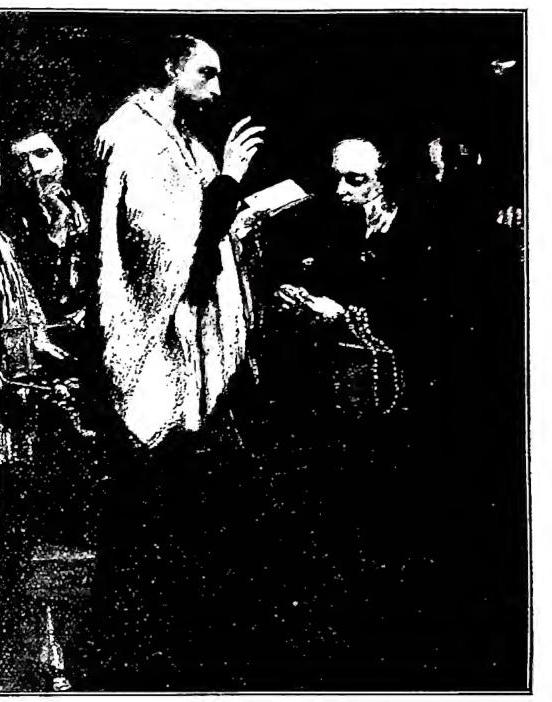
consulta Bulgarorum, 3). A distinction is made between preliminary acts and complementary acts. The preliminary acts, which took place at home, comprised three elements: a) the betrothal, i.e., the mutual promise of future marriage, the declaration of consent by the betrothed and their parents; b) the delivery of the wedding gifts, namely the bridegroom’s ring to the bride; c) the signing of the marriage contracts in the presence of witnesses, the delivery of the marriage tablets or the assignment of the dowry. The complementary acts, or the acts proper to the wedding ceremony, are: a) the celebration of Mass before the betrothed, who take part in the offertory and Communion; b) the joint blessing with the veil; c) upon leaving the church, the crowning. All these rites correspond well to the rites of the ancient Romans, namely the rites of the betrothal, the preparation for marriage, and the rites of marriage itself. The Church accepted customs already in use, purifying them of what was unbecoming and rendering them more solemn. Yet these rites were merely the solemnization of marriage, the solemnization of a marriage contracted outside the church by “mere mutual consent” (Nicholas I).
These rites are still observed today in the celebration of marriage, with this difference: the rite of marriage today includes both the rites of betrothal and those of the wedding. Particular emphasis is placed on the declaration of consent, the only essential element of marriage. In ancient times, both pre-Christian and Christian (e.g., from Pope Nicholas I), consent was given during the ceremonies of betrothal, not during those of the wedding. But after the year 1000 (the precise date cannot be determined), an explicit declaration of consent began to be introduced into the act of marriage itself, with some variation: either the contracting parties pronounced (either alone or together with the blessing priest) the consent, or the priest questioned (once or three times) the contracting parties and they answered. To the priest’s question and the parties’ response, the priest added a solemn formula of ratification in the name of God: “Ego coniungo vos in matrimonium in nomine...” (E. Martène, Ordo Rotomag. sec. XIII, in Antiquae Ecclesiae ritus, II, p. 367).
A rite already used by the ancients, not mentioned by
Pope NICHOLAS I was the conjunction of the right hands. In Tob. 7:15 Raguel joins the hands of Tobias and Sara; among the Romans on the day of the solemnity of marriage, the pronuba would bid the spouses to join hands. Even today in the Church, at the manifestation of consent, the priest bids the spouses to join hands; then, according to some rites, he wraps them with his stole, pronounces the solemn words of ratification, and sprinkles them with holy water. The giving of the ring, among the Romans and also under Pope Nicholas I, being part of the betrothal, passed among the ceremonies of marriage, before or after the consent; the priest blesses the ring, delivers it to the groom to place on the bride’s finger, and then ratifies the consent. In some regions not only does the groom place the ring on the bride, but the bride also on the groom.
The intervention of the Church in the celebration of marriage became known when the tutelary marriage ceased, that is, when the bride herself could enter into marriage without the intervention of the natural guardian, namely the father. A threefold phase must be noted: marriage before or outside the church in the presence of a priest who recited a prayer, then with the intervention of the priest as elected guardian instead of the natural guardian, and finally with the intervention of the priest to witness and elicit the manifestation of consent. From the 13th century, local synods or councils (Treviso 1227, Prague 1350, Magdeburg 1370) forbade lay marriages without the intervention of the Church. Finally, the Council of Trent prescribed the assistance of the parish priest; the new Code of Canon Law (can. 1095 § 1 ad) orders that the parish priest ask and receive the consent (“requirant exciptantque contrahentium consensum”).
The rite of marriage consists of two parts: a) the questioning of the priest regarding the manifestation of consent, b) the consent of the spouses themselves. The betrothal ring has become the nuptial or conjugal ring. This is followed by the religious and complementary parts, the Mass and the solemn nuptial blessing. Formerly the votive Mass was said, e.g., of the Holy Trinity, adding the proper prayers for the spouses, then the votive Mass pro sponsis. The nuptial blessing, a prerogative of the bride’s first marriage, is already found in the most ancient Sacramentaries; it was given after the Pater noster. During the blessing the veil was placed on the bride, the most striking ceremony of marriage among the ancient Romans, also retained by Christian spouses, though later it gave way to the giving of the ring. And also the very ancient ceremony of crowning the spouses with flowers disappeared; it took place after Mass, when the spouses left the church. Today it survives in the flowers with which the bride is customarily adorned when she presents herself at the church. After the Benedicamus Domino, the priest pronounces again a special blessing upon the spouses for their earthly and eternal happiness. Where special or local rites in contracting marriage have been preserved, they may be employed.
Un rito antico è la benedizione e l'uso della bevanda nuziale, presentata agli sposi come simbolo della carità cristiana. Alla sera del giorno nuziale vien poi benedetto il loro talamo, usando fin dal sec. X una formola che si trova già nel Messale di Bobbio (sec. VIII).
M. IN EASTERN LITURGIES. — In today’s marital rites one can still clearly distinguish, though united, the two ancient parts of which they consist: the first may be called betrothal, espousal, and is characterized by the giving of the ring; the second is the wedding with its particular rite of crowning.
In antiquity, and still recently in the Semitic world, these two parts were celebrated separately, and a long interval, even of many years, could elapse between the two ceremonies. That betrothal was not a revocable promise of future marriage, but with that rite the marriage began, already possessing the property of indissolubility, while the right of cohabitation was obtained only through the crowning rite. Before proceeding to the ring rite, the priest ensured the consent of the spouses; in the West this expression of consent followed by the ring rite became the sacramental rite, because the consent of two Christians constitutes the contract elevated to the dignity of a sacrament, and the nuptial blessing given during the Holy Mass was regarded as a sacramental that was not obligatory. In the East, on the contrary, the crowning has always been regarded at least as a conditio sine qua non of the sacrament, and the new Eastern Code (can. 85 § 2) takes this concept into account where it requires for the validity of marriage the intervention of the priest “adstantes ad benedictionem” (cf. AAS, 41 [1949], p. 107).
In the Byzantine rite, according to the Greek Euchologion, the first part consists of the great collect with special questions followed by two prayers, then the giving of the rings with a formula, and a final prayer. The second part begins also with the great collect, with other special questions, followed by three nuptial prayers; then the priest imposes the crowns with a formula and gives a triple blessing; after this there is a kind of Mass of the Presanctified, namely: Epistle, Gospel, Litany, Our Father with an inclination prayer, formerly the admonition: “Praesantificata sanctis” with Holy Communion, today the drinking of a cup of wine; this is followed by a procession around the table before which the ceremony is held, then the removal of the crowns, which in antiquity was done on the eighth day after the marriage; then two more prayers, the kiss of the newlyweds, and the dismissal.
The Eucologio of Benedict XIV (Rome 1754), in its opening rubric, prescribes that the priest should question the spouses regarding their free consent. The Trebnik of the Russians and Serbs provides the formula for this question but places it at the beginning of the second part (first appearing in the Trebnik of Moghilă, Kiev 1646). In the Trebnik of the Ruthenians (from the revised edition of Lviv 1720 onward), the structure of the rite was disrupted (suppression of the first part; however, an abbreviated rite of the ring is intercalated between the nuptial prayers, and an oath upon the Gospel book is added before the crowning); the Malii Trebnik of Rome (1946) restored the clear division between the two ancient parts.
In the other Eastern rites, although very different from one another, one can observe a development—seemingly exaggerated today—of prayers and hymns in the crowning ceremony, which nonetheless underscores the solemnity of this act constitutive of the Christian family.