
Enciclopedia Cattolica Vol. I, 1948 Non-Christian religions Particular topics

Archigallus

ARCIGALLO

Italian original Cite
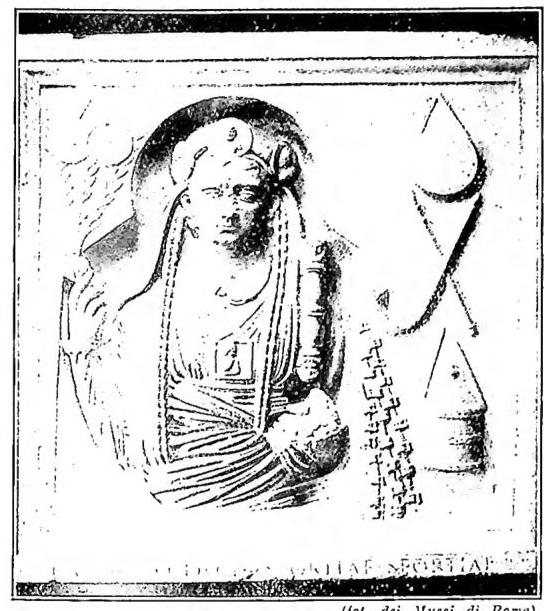
ARCHIGALLUS - He wears the insignia of his priesthood; a crown with the image of Jupiter in the center and the two flanking images of Attis on his head; his hair styled in a feminine manner; on his chest the encolpium of Attis; the pomegranate in his right hand; a dish of fruit, among which the pine cone, in his left. Above, the timpani and the tambourine, beneath which are the flute and the shepherd's staff, the cista and the handled instrument for ritual flagellation. Rome, Capitoline Museum.

ARCHIGALLUS. - Priest of Cybele, of a rank superior to the simple galli. From the rather abundant epigraphic material that has come down to us, it appears that, in the imperial age, the office of archigallus was not only recognized by the authorities, but also held in high esteem; and since the archigalli mentioned in these inscriptions are all Roman citizens, it is evident that they could not have undergone the castration that Roman laws declared incompatible with the enjoyment of Roman citizenship. And if, on the other hand, the writers of the imperial age reproach the archigalli with the same ignominy as the simple galli, it is necessary to conclude that they erroneously believed that one could not attain the rank of archigallus without having passed through that of gallus.

We have four figurative representations of archigalli, which, however, reduce to two, since the first three reproduce the same personage. The latter come from a tomb in the necropolis of Porto on the Isola Sacra, and are interesting above all for the large crown, which we know to have been of gold and which we find often mentioned by the writers. Even more interesting is the relief in the Capitoline Museum, on which the archigallus is depicted with all his attributes: a crown with three medallions: of Jupiter in the center and two of Attis at the sides; the pectoral with the image of Attis, the whip for flagellating himself, the tambourine, the tympana, the flute with the pastoral staff, the mystic cista.

Bibliography4 works
BIBL.: J. Cacopino, in Mélanges d'archéologie et d'histoire, 1923, pp. 237-67; G. Calza, La ostienne, in Historia, 1 (1933), pp. 221-37; there also the relief of the Capitoline Museum; id., La necropoli dell'Isola Sacra, Rome 1940, p. 205 ff.

Paolino Mingazzini

About this entry

By Paolino Mingazzini

How we know signed in print

Translated from the Enciclopedia Cattolica, vol. I (1948), col. 1840.

Printed pages Open in the page viewer
Page 1088
vol. 1, coll. 1839–1840

More by Paolino Mingazzini: Ara · Apaturia (Ἀπατούρια) · Antesteria ('Ανθεστῆρια) · Anterus, Pope · Anna Perenna

Cite this article

Chicago

Mingazzini, Paolino. “Arcigallo.” In Enciclopedia Cattolica, vol. I, col. 1840. Città del Vaticano: Ente per l’Enciclopedia Cattolica e per il Libro Cattolico, 1948. https://azioneromana.com/article/arcigallo.

MLA

Mingazzini, Paolino. “Arcigallo.” Enciclopedia Cattolica, vol. I, Ente per l’Enciclopedia Cattolica e per il Libro Cattolico, 1948, col. 1840. Azione Romana, https://azioneromana.com/article/arcigallo.

BibTeX

@incollection{ec1_arcigallo,
  author    = {Mingazzini, Paolino},
  title     = {Arcigallo},
  booktitle = {Enciclopedia Cattolica},
  volume    = {I},
  pages     = {1840},
  note      = {Cited by column},
  publisher = {Ente per l’Enciclopedia Cattolica e per il Libro Cattolico},
  address   = {Città del Vaticano},
  year      = {1948},
  url       = {https://azioneromana.com/article/arcigallo}
}

One of some 20,000 entries brought back from the twelve printed volumes (1948–54). Spotted something? Help us improve it.

Save for later

Enter your email and we will send you a sign-in link. No password. What you save (articles, verses, chapters, documents) follows you to any device.