
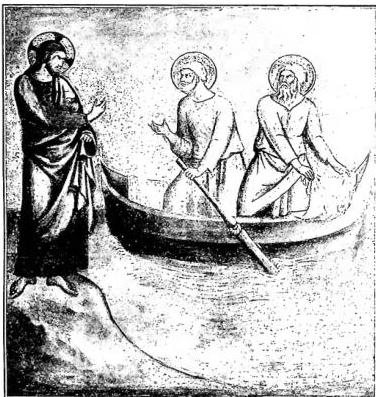
BARNABA (BERNARD) OF SIENA. - Painter of the Sienese school of the 14th century. Mentioned by Ghiberti as "most excellent, most skilled and most learned," it is not known when he was born. Vasari relates that he died in 1381 by falling from a scaffold while frescoing the Stories of the New Testament in the collegiate church of S. Gimignano: so that the cycle had to be completed by his pupil Giovanni d'Asciano. Since documentary information about the painter is completely lacking, there were even those who doubted his historical existence: this opinion is, however, contested by the entirety of scholars, who are agreed in recognizing in the San Gimignano frescoes, despite a very extensive collaboration of assistants, the presence of an artistic personality with well-defined and unmistakable characteristics. It is moreover quite probable that the B. mentioned by the ancient historiographers is to be identified with a B. di Bertino, painter of the parish of S. Pellegrino who, according to a document found by Milanese, in 1340 sat among the jurors at the tribunal of the Mercanzia of Siena. Extremely arduous and controversial, on the other hand, is the chronology of the S. Gimignano cycle: for numerous arguments would oppose that proposed by Vasari, and yet followed and championed by some authoritative Italian scholars, while others would incline to hold that the frescoes were executed around the middle of the century, that is, prior to the Old Testament cycle frescoed by Bartolo di Fredi (v.) in the same church. The recent shifting of the traditional dating of the latter from 1356 to 1367 may constitute a new important argument in favor of the priority of B.'s frescoes over those of Bartolo di Fredi.
Very few are the panel paintings that, on the basis of stylistic analogies with the frescoes of S. Gimignano, can be attributed with some reliability to B.: among these a beautiful Madonna and Child in the church of S. Francesco in Asciano Senese and a Christ Carrying the Cross in the Frick collection of New York. Trained on Simone Martini and Lippo Memmi, B., in the San Gimignano cycle, takes up again with new vigor and spirit of independence the genuine narrative vein that was at the origin of Duccio's inspiration, permeating it nevertheless with a profoundly dramatic breath, not without at times a certain popular roughness. Also for the originality of his position, B. is without doubt the most vivid and important personality of all Sienese painting of the Trecento after the death of the Lorenzetti.
Bibliography5 works
Enzo Carli