
GIACOBBE — The well of G., currently 32 m deep. It is located in a crypt.
JACOB (Hebr. Ja'āqābh). - Patriarch (v.), Israel (v.), from whom the Hebrew people was formed through his 12 sons, the ancestors of the 12 tribes. In Egyptian scarabs from the Hyksos period (1680-1580 B.C.), the name j'āqābh appears, which probably corresponds to Ja'āqābh-'el, considered by some as a geographical name.
The name was originally theophoric; as such, it appears in the list of Palestinian cities conquered by Pharaoh Thutmosis III (1501-1447). E. Meyer regards this name as tribal and explains it as "God follows." Others, like P. Jensen, deny any connection between the presumed theophoric name and the patriarch Jacob. Still others explain the name as "God compensates"; M. Noth: "God has protected." G. Jacob, preceded by Lagarde and Horowitz, thinks of the Arabic name for a bird: ja'āqāb, the male of the ḥaḡal, a name given by the Bedouins of the Sinai highlands to the mountain partridge (Ammoperdix Heyi); the name means "he follows." Since it is a graceful animal, the Arabs would have also given this name to children.
The Bible explains the name Jacob as derived from 'āqābh "heel," and its meaning as supplantator. This explanation is supported by the biblical account in which the child (the future Jacob) grasps "the heel" of his twin brother (Gen. 25:26), and by another concerning the "deceptions" devised by Jacob to obtain the birthright (Gen. 27:36; cf. Hos. 12:4; Jer. 9:3). B. Jacob (Genesis, Berlin 1934, p. 544), referring to Gesenius' Thesaurus: "imitatur formas adiectivorum, quae colores similesque species designant", to Hos. 6:8, and to the fact that in the Genesis narratives Jacob is situated between Edom (red) and Laban (white), and later blends various colors in the rods he places in the watering troughs where the sheep drink, suggests that the name Jacob may mean approximately "speckled." According to Horst, it means "containing traces"; V. Gesenius, Handwörterbuch, 17th ed., p. 613: "full of traces of blood."
The name Jacob (in the manuscripts of 'Ajn Feshah discovered in 1947, where the spelling is consistently "plena" Ja'āqābh) refers especially in prophetic and poetic literature to the entire people (Gen. 49:7), in parallel with "Israel" (cf. Num. 23:10, 21; 24:5; Is. 2:5; 40:27; Jer. 2:4, etc.). Among the prophets, Jacob sometimes refers only to the northern kingdom (Is. 9:7; Mic. 1:5), or only to Judah (Mic. 3:1, 8).
Jacob was born to Isaac and Rebecca (Gen. 25:26; 29:23 ff.). Gen. 25:19-50:25 recounts the story of Jacob's youth and years of migration: his struggle with his twin brother Esau for the birthright; his flight; the dream at Bethel; his service to Laban and his marriage to Laban's daughters, Leah and Rachel; his return and his struggle with the angel, which resulted in Israel (v.); his reconciliation with Esau. Various episodes of Jacob's life are contained in the passages concerning Joseph (v.): his move to Egypt and his encounter with Joseph. In Egypt, Jacob died 17 years after immigrating, at the age of 137, and was later buried in the cave of Makhpelah, the family tomb of the patriarchs.
Regarding the so-called "cunning" of Jacob, it must be remembered that the consequential blessing from Isaac was meant for the future patriarch, not for Esau, a dull and coarse hunter. The firstborn is the bearer of the divine promise and the responsible minister of Abraham's religious heritage. As the patriarch of the chosen people, Jacob must overcome obstacles by any means necessary to secure the future of the people, which could have been compromised had Esau exercised his birthright. Faced with Laban's unjust behavior, Jacob, the weaker party, defends himself with the only means available to him: cunning. Nor should it be forgotten that the narratives of cunning used in the struggle against the unjust and the wicked (the saints in their battle against the devil) teach that in the end, the wicked must succumb and yield to the just.
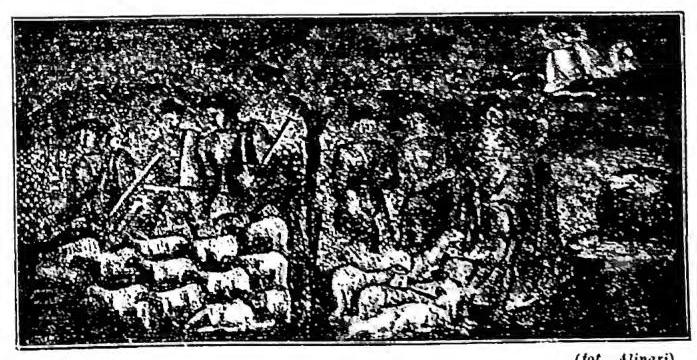
The scene of Jacob blessed by Isaac was depicted in S. Ambrogio in Milan, as known from the distich that illustrated it, and in the basilica of S. Felice in Nola (Paulinus of Nola, Carmen, 27, 62); an entire cycle was in the basilica of S. Maria Maggiore in Rome (Wilpert, Mosaiken, pl. 11 ff.). Jacob and the angel were depicted in the Vienna Genesis (W. von Hartel - F. Wickhoff, Die Wiener Genesis, Vienna 1895, pls. 23-24). Bishop Arculf, who visited Palestine around 670, describes an oratory built at Shechem at Jacob’s well. Thus, Jacob’s dream appears in a 9th-century fresco in the ancient basilica of S. Clemente in Rome (Wilpert, Mosaiken, p. 526); blessed by Isaac in the biblical cycle of S. Paolo fuori le Mura. Scenes from Jacob’s life are later found in the biblical cycles of S. Giovanni ante portam Latinam, in the abbey of S. Pietro in Valle near Ferentillo, in the basilica of Monreale, etc.
ICONOGRAPHY
Although the painting of the catacombs does not include representations of Jacob, already in the Vienna Genesis (5th century), alongside other stories from the Old Testament, there is a complete illustrative cycle of the most important events in Jacob’s life, derived from the biblical account, specifically: Esau selling his birthright to Jacob, Jacob’s father going to Abimelech, Jacob and Rachel, Jacob’s flight and struggle with the angel, the destruction of the idols, the birth of Benjamin, the burial of Rachel, and the death of Isaac. This cycle thus established enjoys considerable success in Christian art; it suffices to recall the panels of Santa Maria Maggiore (5th century), probably derived from Hellenistic models, and the mosaic complexes of Monreale, the Palatine Chapel of Palermo, and the Baptistery of Florence (12th and 13th centuries). It is still repeated in the decoration of Raphael’s Loggias in the Vatican.
However, two scenes from Jacob’s life—the dream and the struggle with the angel, and the meeting with Rachel—can be considered independent of the figurative cycles of the patriarch’s life. In the lipsanotheca of Brescia (4th century), Jacob fights with a man represented as Yahweh. In the frescoes of Santa Maria Antiqua, the adversary is instead already identified as the angel. The scene also appears in Romanesque sculpture of the 11th century, as in the capitals of the collegiate church of Sant’Orso in Aosta. The scene of the struggle is generally accompanied by that of the dream. Jacob is depicted lying down, and before him rises a great ladder on which one or two angels ascend or descend per step, and sometimes it is supported by Yahweh represented as Christ. At times, as in a strange miniature of the Bible of Charles V (1571), Jacob is depicted as an old man lying at the center, with two ladders rising diagonally. Renaissance painting also cherished this theme, which it passed on to Baroque painting, as seen in a painting by Ribera now in Madrid at the Prado, and in a fresco by Tiepolo in the Archiepiscopal Palace of Udine.
The meeting of Jacob with Rachel, due to its bucolic character, is particularly beloved in
Gothic courtly painting, as seen, for example, in the Bible moralisée of the Oxford Library, 13th century, where the two young people shake hands, and in some Tuscan Quattrocento artists, such as Benozzo Gozzoli and Filippo Lippi.