Machine translation of the 1948–1954 Italian original. The original text is authoritative.
GREEN, THOMAS HILL. - English philosopher, b. at Birkin (Yorkshire) on April 7, 1836, d. at Oxford on March 26, 1882. From 1878 until his death he held the White's Chair of Moral Philosophy at Balliol College.
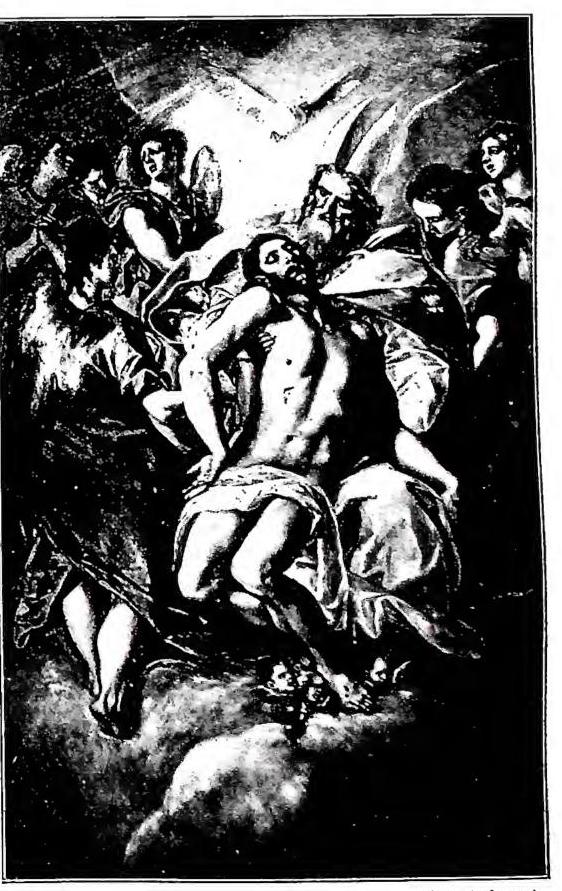
GRECO - The Trinity with the Dead Christ - Madrid, Prado Museum.He may be considered the founder of English idealism inspired by Kant and Hegel (McTaggart and Bradley), rethought through that of Berkeley with influences from Hume's phenomenism. In fact, according to G., what is called "real" is nothing other than the set of perceptions having a constant connection (which, however, is solely of a spiritual and cognitive nature), the foundation of which is a universal Consciousness. The cognitive activity of individual and finite consciousnesses is an effort to adapt to the single universal Consciousness, just as moral activity is the effort by which subjects seek to reach the supreme end. Action is ethical when man perfectly realizes the determined end and, at the same time, feels its inadequacy with respect to the unattainable ultimate end. The universal Consciousness of which G. speaks is not a personal God, but an impersonal first and absolute Cause.
BIBL.: Works: Works, 3 vols., edited by R. L. Nettleship, London 1885-88 (not including the Lectures on the principles of political obligation, published posthumously, ibidem 1901), among which the Introduction to Hume's Treatise on human nature (ibidem 1874) and the Prolegomena to ethics (ibidem 1882, 2nd ed. 1884; Italian transl. by C. Goretti, Milan 1925) are notable. Studies: W. H. Fairbrother, The philosophy of T. H. G., London 1896; H. Sidgwick, Lectures on the ethics of G. Spencer and Martineau, ibidem 1902; C. Goretti, L'opera e il pensiero di T. H. G. (introduction prefixed to the cited Italian transl., pp. 1-27); N. Abbagnano, L'idealismo inglese e americano, Naples 1926.
Cite this article
“GREEN, THOMAS HILL.” Enciclopedia Cattolica, vol. VI (1951), p. 651. Azione Romana digital edition, https://azioneromana.com/article/green-thomas-hill.
 Enciclopedia Cattolica