
ITALY
Carracci-influenced paintings—sometimes tinged with Caravaggism—are found in central and southern Italy.
Among other noteworthy Emilian artists, particular mention should be made of Bartolomeo Schedoni, Cavedone, the Bononi (1569–1632), Lionello Spada (1576–1622), Lorenzo Garbieri (1580–1654), Mastelletta (1575–1655), P. A. Barbieri (1603–49), and the Piacentine F. Boselli (1650–1731).
While in Emilia the Carracci tradition gathered some of the most vigorous pictorial energies of the 17th century, in Florence Cigoli and Passignano likewise attempted—though on a smaller scale—a path parallel to that of the Bolognese Academy. From these beginnings emerged artists such as Biliveret and Corradi, Cristofano Allori (1577–1621), Matteo Rosselli (1579–1651), master of Vignali (1592–1664), Lorenzo Lippi (1606–64), and Carlo Dolci (1616–86). Francesco Furini (1604–49) and Baldassare Franceschini, known as Il Volterrano (1611–89), a witty painter sometimes influenced by Cortona, also descend from Rosselli, as does one of the greatest of them all, Giovanni Mannozzi, known as Giovanni da San Giovanni. While these were the Florentine trends, in Siena Cristofano Rustici, known as Il Rustichino (1595–1625), and Rutilio Manetti (1571–1639) succumbed to the allure of Caravaggio, as did in Pisa Orazio and Artemisia Gentileschi (q.v.) and Orazio Riminaldi (1598–1630), who in Rome also approached Domenichino. In Lucca the leading figures were P. Paolini (1603–81) and the later, more eclectic A. Gherardini.
Meanwhile in Rome, the Carracci taste found an authoritative continuer in Andrea Sacchi and then in Carlo Maratta, vaguely Raphaelesque like Giovan Battista Salvi, known as Il Sassoferrato, while operating alongside them was the contingent of Caravaggisti led by Bartolomeo Manfredi (1572–1605) and Giovanni Serodine of Ascona (1594–1631), a group to which the French-born but Rome-adopted Valentin (1600–32) immediately adhered, followed later by Orazio Borgianni. Caravaggisti also included the Venetian Carlo Saraceni (1585–1620), Angelo Caroselli (1585–1652), and, in sum, Gerrit van Honthorst, known as delle Notti, along with other foreigners such as Terbrugghen, Baburen, and Elsheimer—certainly among the most significant Dutch painters of the 17th century. Pier Francesco Mola (1652–66), exponent of a neo-Venetian tendency also followed by Testa (1611–50), is in many respects a Caravaggist. A painter of broader scope and immense intelligence was Pietro Berrettini of Cortona, who synthesized a vast range of experiences from Venetian painting to the Carracci, from Polidoro da Caravaggio to the study of ancient sculpture. A great architect, in painting he was above all a festive, opulent, and cheerful decorator. He was followed by a host of painters who spread across Italy and much of Europe, though among them—besides the already mentioned Testa—only Francesco Romanelli (1610–62) and Ciro Ferri are worth naming. From Cortona, albeit indirectly, descend the two greatest perspectivists of our tradition, whose works adorn Roman churches with marvels: G. B. Gaulli, known as Baciccia, a Genoese, and Brother Andrea Pozzo, a Trentine. At the same time, there was in Rome an interesting group of landscape painters, both Italian and foreign; suffice it to recall, alongside the already mentioned Elsheimer, Teniers, Nicolas Poussin, Paul Bril, Claude Lorrain, and Agostino Tassi.
The most fascinating chapter of 17th-century painting is in Naples, where Caravaggio himself had left masterpieces in 1607, sparking extraordinarily vital forces that took shape in the personalities of Battistello Caracciolo, Bernardo Cavallino, and Mattia Preti—among the most faithful followers of the master—while operating in parallel were more personal interpretations of Caravaggism and the art of Ribera by Paolo Finoglio, Massimo Stanzione, Cesare Francesco Fracanzano, and later Salvatore Rosa, while Luca Giordano unleashed his decorative imagination with extraordinary talent, drawing on Neapolitan examples as well as those of Lanfranco, Pietro da Cortona, and Paolo Veronese, paving the way for 18th-century painting.
Naples also boasted a formidable group of still-life painters such as Ruoppolo (1620–83) and Giuseppe Recco (1635–95), and flower painters such as Belvedere, De Caro, and Realfonso; and battle painters such as, besides Rosa, Aniello Falcone and Domenico Gargiulo.
In Sicily in the 17th century, the great painter was Pietro Novelli, known as Il Monrealese, who drew on his Neapolitan experiences and encounters with Van Dyck and Ribera. Alongside him should be remembered his daughter Rosalia, Antonio Grano, and Giacomo Lo Verde.
But it is time now to return to the North, especially to Genoa, where the decorative tradition of Luca Cambiaso and Paggi gave rise to the painting of Domenico Fiasella (1589–1669), from which emerged Valerio Carlo Stellato (q.v.), Gregorio de Ferrari (1644–1726), Bartolomeo Biscaino (1632–57), and Domenico Piola (1628–1703), the best-known of a large family of painters.
Meanwhile, Genoa had welcomed and seen great achievements by Peter Paul Rubens and Anthony van Dyck, alongside whom, before and after, worked a substantial group of Flemish artists including Guglielmo Vandeiner, Cornelio de Waal, Giovanni Roos (who Italianized his name to Rosa), Giovanni Hovart, and Pietro Bael. Without considering their contribution, it would be impossible to properly assess not only much of the so-called minor or genre painting—such as that of Anton Maria Vassallo (d. 1675), a painter of flowers, fruit, and animals; Sinibaldo Scorza (1619–1661); and the same Giovan Benedetto Castiglione (1610–1665)—but also the richer art connected with Bernardo Strozzi, Travi, Cassana, Carbone, and Giovanni Andrea De Ferrari (1598–1669). Other Genoese 17th-century artists of notable stature include members of the large Piedmontese-Lombard family of the Carlones, who, like Strozzi, were artistically dependent in Genoa on the Sienese Sarzana, while maintaining ties with Milanese painters such as Giovanni Andrea Ansaldo (1584–1638) and Giacchino Assereto (1600–49). Baciccia has already been mentioned among the followers of Cortona in Rome.
In Lombardy, Caravaggio having emigrated there as a boy, the Bolognese Procaccini family—especially Giulio Cesare, whose origins trace back to Correggio—achieved great renown and authority in Milan at the start of the 17th century, followed by Giovanni Battista Crespi, known as Il Cerano, who developed an austere and solemn manner of drawing, clear and muted in color; then the Mazzuchelli, known as Il Morazzone (1571–1626), powerful and tragic in his rendering of painful attitudes and expressions. From Morazzone descends Del Cairo (1598–1674), while from Procaccini and Cerano comes Daniele Crespi (1590–1630), perhaps a relative of the latter master. Also noteworthy are Carlo Francesco Nuvoloni (1608–61) and Carlo Ceresa (1609–79), who share a similar formation but were also influenced by Guercino, and Evaristo Baschenis (1617–77), an excellent still-life painter.
In Piedmont during the 17th century there were no local painters of merit worth mentioning, aside from the classicizing Moncalvo (1568–1625).
Thus, all things considered, in comparison with what had been done in the 16th century and with what would be done in the 18th, the production of Venetian painting in the 17th century was also meager. Like sculpture, Venetian painting in the 17th century largely lived in the wake of the great art of the 16th century. Alessandro Varotari, known as il Padovanino, already mentioned, died in 1648 and was the last fruit of the tradition of the Vecellio. From him descend the traditionalists Pietro Vecchia (1605–78), Pietro Liberi (1614–87), and Gerolamo Ferabosco (1604–79), portrait painter and master of Lazzarini, from whom Tiepolo would derive, and Giulio Carpioni (1611–74), a witty and lively master.
More interesting, however, was the current that derived from foreigners who moved to the lagoon in the first half of the 17th century. Among them, Domenico Fetti (1589–1624), a Roman Caravaggist, played a leading role, as did Giovanni Liss (1600–30), a free and dry Dutchman who, expert in Italian painting from Titian to Caravaggio, truly anticipated his time, appearing at times like a seventy-five-year-old, and finally Bernardo Strozzi, the Genoese already mentioned. These three painters gave much to Venice but also drew much from Venetian taste, especially Strozzi, who in Venice found the greatest following. From him descend, among others, Francesco Maffei of Vicenza (1620–60), Antonio Carneo (1637–92), Langetti, and Antonio Zanchi (1631–1722): the best Venetians of the 17th century. It is they who prepare the great Venetian painting of the 18th century, even if the latter, compared to their art, may appear more a break than a continuation.
However, before speaking of that painting which truly marked a preeminence over that of other Italian regions and, in many respects, of Europe, it will be necessary to return to Naples and Rome and then to Italy, where during the 18th century much was done and with profit in the field of painting.
In Naples, in truth even before the 17th century concluded, the characteristics of 18th-century painting were fully determined in the work of Francesco Solimena, whose most faithful follower was Francesco de Mura. From Solimena also partly derives Corrado Giaquinto, who met Conca in Rome. Both Paolo de Matteis (1663–1728) and de Mura, like Giaquinto and the later and pleasant Giacinto Diana (1730–1803), sometimes incline toward the Rococo arabesque; while from Solimena himself descend Giuseppe Bonito (1707–89) and Gaspare Traversi. These two painters, with vivacity and vigor, mark the character and nature of their figures with accents that fully revive the finest Caravaggesque vein of the 18th century.
Meanwhile in Rome, the course of painting seemed destined to continue that of the previous century, due to the persistence of the decorative and Venetian-influenced current represented by the Lucchese Giovanni Coli and Francesco Gherardi (1643–1704), by Baciccio and by Brother Pozzo, both of whom died in 1709, and due to the dominant presence of Maratta and a certain Caravaggism present in many, especially among the minor artists. From Maratta, who spanned the century, carrying almost intact the distant heritage of Raphael and the Carracci, descend essentially G. Chiari (1654–1727) and then A. Masucci (1691–1758), from whom derives Pozzi (1708–68). B. Luti (1666–1724), also a Lucchese, is a Marattesque, though tinged with a little Caravaggism, and in Rome Marattesque would also become S. Conca.
Also of interest is the Venetian Francesco Trevisani (1656–1746), the most tasteful Michele Rocca, a Parmigianino (1675–1751), and the Frenchman Pierre Subleyras (1699–1749), followed by the Ascolani Antonio Amorosi (c. 1660–1740), mindful of Fetti, and Giuseppe and his son Pier Leone Ghezzi, better portraitists than church painters.
The classical landscape tradition remained alive, represented notably by Andrea Locatelli (1660–1740), soon joined by the pleasant Giovanni Paolo Pannini (c. 1691–1764), who greatly influenced Venetian view painters, as well as the Frenchman Hubert Robert (1733–1806), active in Rome, and in a certain way also by the great Giambattista Piranesi, who felt ancient classicism in a much livelier, more romantic, and passionate way than many foreigners of his time drawn to Rome by Neoclassical ideals. Thus, one cannot certainly place alongside the early Neoclassicists a Marco Benefial (1684–1764), a verist if ever there was one; while Pompeo Batoni (1752–95) and Giuseppe Cades (1750–99) sought rather to defend 18th-century positions in opposition to the Neoclassical abstractionism of so many foreigners who, following Winckelmann, held sway in Rome. Be they Anton Raphael Mengs, a Bohemian; Angelica Kauffman, a Swiss; or David himself, who in 1784 in Rome painted the famous *Oath of the Horatii*.
In Florence, during the transition from the 17th to the 18th century, it will be necessary to recall Alessandro Gherardini (1655–1723), mindful of Luca Giordano, the less lively Domenico Gabbiani (1652–1726), followed by Sebastiano Galeotti (1676–1746) and Giovan Camillo Sagrestani (1700–1728). These painters were also connected to the decorative and chromatic pleasures of the Bolognese school, such as the later Giovanni Domenico Ferretti (1692–1768), author of sumptuous decorative machines in churches of Florence, Pistoia, and other Tuscan cities.
At the beginning of the century in Bologna, the now elderly Carlo Cignani (1628–1719) was still active and authoritative, as was his favorite pupil Marcantonio Franceschini (1648–1729), G. G. del Sole (1654–1719), and the new Guido, while Vittorio Maria Bigari (1692–1772) soon became the greatest of the Bibbiena vedutisti, to whom in some way the decorative current of the Gandolfi is also connected.
But in Bologna another great master was also working, announcing much more important innovations: Giuseppe Maria Crespi, called lo Spagnuolo, a pupil not only of Canuti and Cignani but also of Giannantonio Burrini (1656–1727). A major master, Crespi, to whom are connected not only the stylistic modes of some of his descendants, sons and grandsons, but also the painting of the Dalmatian Federico Bencovich and, more importantly, that of Piazzetta.
In Liguria, the leading representative of the old Genoese decorative tradition in the 18th century was Gregorio de Ferrari (1644–1726), alongside whom may be recalled Domenico Parodi (1668–1740), who as a young man had also studied in Venice, and Paolo Gerolamo Piola (1666–1724), like de Ferrari a nephew of him. Alongside these decorators, however, one of the most new, significant, and even disconcerting personalities of the time begins to emerge:
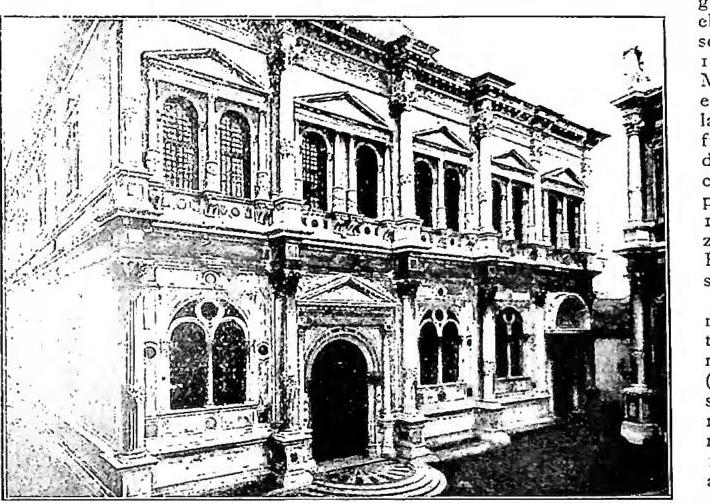
Italy – Façade of the Scuola di S. Rocco. Drawing by Bartolomeo Bon the Younger (16th century) – Venice.
In the 18th century, painting in Italy saw the emergence of several notable figures. In Piedmont, where the court of the Savoys attracted numerous masters from other regions, local painters of distinction included P. F. Beaumont (1699–1766), of French extraction, and Vittorio Amedeo Cignaroli (1747–93), an elegant landscape painter. In Lombardy, the situation was not much better, and genre painters such as Angelo Maria Civelli (d. 1730), Francesco Londoino (1723–83), the landscapist C. A. Tavella (1667–1738), and the flower painter G. Vincenzina were linked to Ligurian artists. However, at Brescia, Giacomo Ceruti was active; at Bergamo, Giuseppe Ghislandi, known as Fra’ Galgario (q.v.); and at Mantua, Giuseppe Bazzani—three exceptionally gifted personalities. With Bazzani, 18th-century Lombard painting assumed a lively and rapid manner, appearing itself as a link with Venetian painting, as did that of some Veronese artists such as Antonio Balestra, Giambettino Cignaroli (1706–70), and Pietro Rotari (1707–62), a refined portraitist who sought his fortune in the courts of Europe. Also connected with the Veronese and Lombard schools were the Trentine Giuseppe Alberti (1664–1730), Paolo Troger (1698–1763), and the group of the Unterbergers. Giambattista Lampi (1751–1830), despite his chromatic pleasantries of an 18th-century flavor, already belongs, as the limiting dates of his life indicate, to more modern times.
It is now time to say something about Venetian painting of the 18th century, one of the greatest glories of Italian art. The connections that Venetian painting had with that of other Italian regions are immediately declared by two great artists: Sebastiano Ricci, who in 1682 was in Bologna, in 1695 in Milan, where he saw Magnasco, and then in Florence and later even in Paris; and Giambattista Piazzetta, “great master of shadows and light,” who was in Bologna as a pupil of Crespi. If Ricci’s art, so delightful, was Venetian in its touch and color, Piazzetta’s was the highest expression of refined pictorial taste; and the deeper one’s knowledge of it, the more necessary it appears for the very expression of Venetian mentality and culture, and indeed for the formation of the personality of G. B. Tiepolo (q.v.), certainly the most famous and also the most gifted artist Venice had in the 18th century. Many were the tenebrists at this time, not only the painter’s son: Giandomenico, a notably gifted artist, sometimes surpassing his father himself; but also Francesco Zugno (1709–1787), Fabio Canal (1703–67) and his son Giambattista (1724–1825), and Jacopo Guarana (1720–1808). Among Piazzetta’s followers were Giuseppe Angeli (1709–1798), Domenico Maggiotto (1713–94), and Francesco Cappella (1714–84); while among Ricci’s direct followers are to be remembered, besides his nephew Marco (1676–1720), Gaspare Diziani (1689–1767) and Francesco Fontebasso (1709–69).
Other Venetians in contact with foreign painting were Jacopo Amigoni (1675–1752), very active abroad, and Giannantonio Pellegrini (1675–1741). Also worthy of mention are two masters born in Carnia: Nicola Grassi (1682–1749) and Giambattista Pittoni (q.v.), and a delicate painting, at the time famous and highly appreciated throughout Europe: Rosalba Carriera (1675–1757), author, like the Longhis (q.v.), of witty portraits. But this rapid survey of Venetian painting in the 18th century would not be, I will not say complete, but not even properly framed with sufficient clarity, if we did not recall the value and importance of the group of landscapists who descend from the painting of Marco Ricci (1673–1729), Sebastiano’s nephew, and continue with that of Giuseppe Zais (1750–84), Francesco Zuccarelli (1702–88), and Francesco Battaglioli; and alongside the landscapists, that of the *vedutisti*, which has its foundation in the painting of Francesco Carlevaris (1658–1730), continues in that of Michele Marieschi and Antonio Canal, called Canaletto (1697–1768), of immense importance for the development of so much European landscape painting, from which derives that of his nephew and pupil Bernardo Bellotto (1720–80), very active also in Germany, and concludes with the great art of Francesco Guardi (1712–93), a pupil also of his brother Giannantonio (1698–1760). Guardi, besides being a *vedutista*, was a painter of figures and above all a great poet of color, of a clear, bright, lively, sparkling color, as in the canvases of the church of the Angelo Raffaele—a true masterpiece.
When Guardi was painting his last splendid canvases, the new Neoclassical ideals found echoes even on the lagoon, and from afar, from Rome, another great Venetian dominated the field of art: Antonio Canova.
9. MODERN ART
Already when speaking of 17th- and 18th-century art, we have had occasion to note here and there clear signs of an anti-Baroque spirit. In other words, the works reflect the need to contain expression within a moderate and composed scale, hence the aspiration toward a simple and straightforward form. The artists of the Enlightenment responded to this aspiration by turning to the past, to a specific past, proposing the imitation of classical antiquity. This gave rise to the spread of an expressive language, connected also with the spirits that would animate the Romantic movement (q.V. ROMANTICISMO), the Neoclassical style (q.V. NEOCLASSICISMO), which spread with the speed and allure of fashion throughout Europe.The liveliest center of this movement in Italy was Rome, from which, in the mid-18th century, G. G. Winckelmann and A. R. Mengs defined and proclaimed the principles and theories of Neoclassicism. It was in Rome that the earliest architectural manifestations imbued with the new taste appeared, in the work carried out by Michelangelo Simonetti (1724–81) and Pietro Camporese the Elder (1726–79) around 1772 in the Vatican, in the construction of the block of buildings that connects the Casino of Innocent VIII with the porticoes of the ancient Belvedere garden, which, once arranged, took the name of Museo Chiaramonti. These were spaces—the Sala rotonda, the Sala ottagonale, the Sala a croce greca, and so on—clearly studied on ancient models. Contemporaneously, certain architectures by Antonio Asprucci (1723–1808) and by Mario (1764–1804) Asprucci in Villa Borghese, and later by A. R. Stern (1771–1820) in the construction of the new wing of the Museo Chiaramonti, were likewise modeled on ancient examples.
Another notable center of Neoclassical architecture at the close of the 18th century and the early years of the 19th was Milan, where, after the Vanvitellian Piermarini, there worked Ludovico Pollack (1751–1806), Giov. Ant. Antolini (1754–1822), Luigi Cagnola (1762–1833), and Luigi Cononica (1762–1844). Meanwhile, in Turin, Ferdinando Bonsignore (1767–1843) was constructing, in imitation of the Pantheon, the church dedicated to the Gran Madre di Dio. His pupil was Luigi Canina (1795–1856), who would later give his greatest proofs in Rome by working on the monumental entrance to the Villa Borghese. In Genoa, Carlo Barabino (1768–1835) worked in Neoclassical forms, while in Florence, Giuseppe Cacalli (1770–1828) and Pasquale Poccanti (1774–1858)—who built his finest works in Livorno—showed tendencies oriented toward the new fashion. Other Tuscan architects of this period were Luigi Combray Oiguy (1779–1843) in Florence, Cosimo Rossi Melocchi (1758–1820) in Pistoia, and Lorenzo Nottolini in Lucca (1787–1851). In Emilia, G. M. Soli (1745–1823), active in Modena and also in Venice, and N. Bettoli (1780–1854) were at work. In the Veneto, the most distinguished, certainly the best known, was G. A. Selva (1751–1819), though the famous temple at Possagno is the fruit of an idea by Canova (v.). In Trieste, Matteo Pertsch (1780–1834), Antonio Mollari, and Pietro Nobile (1774–1845), author of the church of S. Antonio whose façade forms the backdrop to the characteristic Canal Grande of Trieste, were active.
Also worthy of note is the activity of Venanzio Marvuglia (1729–1814) in Sicily, that of Leopoldo Laperuta, and of Pietro Bianchi from Lugano (1787–1849) in Naples, where he built S. Francesco di Paola and where Antonio Niccolini (1772–1850) of S. Miniato also worked, renowned above all for having given the present appearance to the Teatro S. Carlo.
J. J. Winckelmann, who had no sensitivity to, nor appreciation for, corporeal beauty, enunciated the most authoritative precepts of Neoclassicism by proposing the study and imitation of the statues of the golden age of Hellenic art, and he himself formulated a theory to this effect as early as 1745 in his *Pensieri sulla imitazione della pittura e scultura dei Greci*. This book not only confronted the anti-archaizing attitudes evident even in the sculpture of the first half of the 18th century but also encouraged sculptors such as the Roman Giuseppe Cercasi (1751–1802) to copy ancient works, until Antonio Canova came to dominate the field of sculpture. The group of true Canovites, however, was smaller than it seemed, among whom Adamo Tadolini (v.) initially stood out in Rome. Indeed, the more calculated, deliberate, mechanical, and thus easily imitated and repeated Neoclassicism of an Alberto Thorvaldsen exerted a greater influence on young artists; in Rome, Thorvaldsen had a follower in Luigi Bienaimé (1793–1878). At that time, F. M. Laboureur (1767–1831) also worked in Rome with some independence from the two. In Naples, followers of Canova included Antonio Calì (1778–1866) and Gennaro Cali (1799–1877), while in Florence, Stefano Ricci (1765–1837), a pupil of the Carraccis and also a Canovite, worked in a Neoclassical style, as did G. Gaggini (1791–1876) in Genoa. In Milan—where Franchi had already proposed the new taste—the Roman C. Pacetti (1758–1826), who obtained a teaching post at the Brera Academy in 1803, trained the sculptors of the Arco della Pace, some of whom, such as Benedetto Cacciatori (1794–1875) and Pompeo Marchesi (1789–1838), were already turning toward "Purism." Other Neoclassical sculptors of some merit were the Piedmontese G. B. Comolli (1775–1830) and the later Innocenzo Fraccaroli (1805–1822), a Venetian trained in Venice and Rome.
A similar discussion to that which has been made for sculpture and architecture should now be repeated for painting, which, by the mid-18th century and in many respects due to the orientation of even notable artists, showed a certain impatience with the bombast, affectation, pietism, and rhetoric of the Baroque. In this context, the name of P. Batoni is often cited, an emulator or imitator of A. R. Mengs, the latter a true Neoclassicist who went so far as to imitate or even falsify ancient paintings. The greatest Neoclassical achievements in Rome itself were attained by the Frenchman Louis David first, and then by the young Ingres. Among Italians who were distinctly oriented toward Neoclassicism, the painters of the Milanese milieu should be remembered, such as Giuliano Traballesi (1727–1808), Andrea Appiani, the greatest of them all, Giuseppe Bossi (1777–1815), and the Venetians, among whom Canova may also be included, as well as Lattanzio Quarenna (1768–1853) and Domenico Pellegrini (1759–1840). In Venice, there was also a Tuscan pupil of Batoni, Teodoro Matteini (1754–1831), who was the master of M. Grigoletti (1801–1870), author of completely Neoclassical altarpieces and witty portraits.
More than from David and other foreigners active in Rome, Vincenzo Camuccini drew his instruction from Batoni; he was also the author of numerous works of sacred subject. At that time in Rome itself, more traditionally minded artists included B. Pinelli (1787–1835), Gaspare Landi of Piacenza (1756–1830), and Pietro Benvenuti of Arezzo (1769–1844), who, upon returning to Florence in 1804, found an environment shaped by Luigi Sabatelli (1777–1850), the best Neoclassical painter of Tuscany, though his Neoclassicism was often more conceptual than formal.
The term "Purist" (v. PURISMO) was transferred into the field of the figurative arts from that of literature, retaining a meaning very close to the original. It thus serves to indicate those manifestations of the graphic arts that stand between the Neoclassical and those more properly Romantic. The Purists therefore sought their source of inspiration not exclusively in classical antiquity but predominantly in the artistic culture of the 15th and 16th centuries.
Thus, among the architects active in Rome between the end of the 18th century and the beginning of the 19th, one would not hesitate to include among the Purists Giuseppe Valadier, a follower of Palladio, and Luigi Poletti, the architect to whom so much of the reconstruction of the ancient Basilica Ostiense is owed, as well as Antonio Sarti (1797–1880) and then Pietro Camporese the Younger (1807–1873). A Purist from the Marches who was also active in Lazio and Umbria was Ireneo Aleandri.
In Lombardy, Purist forms were employed by Carlo Amati (1776–1832) in the church of S. Carlo in Milan, where, with Zanoja, he designed the façade of the Duomo, and by Giovanni Perego in the Palazzo Rocca Saporiti, as well as by Rodolfo Vantini (1791–1856), active in Milan and his native Brescia, where he erected the lighthouse of the cemetery.
In Tuscany, the appellation of Purist might also be deserved by numerous artists of the Neoclassical period who were always nostalgic for the serene cadences of the 16th century. However, more openly desirous of renewing those forms were generally the architects of the first generation of the century, such as Gaetano Baccani (1792–1867) and Telemaco Bonajuti in Florence. In Emilia, among the Purists should be mentioned Giuseppe Nadi of Bologna (1780–1814), while in Venice, working according to the new aims, were Antonio Diedo, a pupil and collaborator of Selva, but author in forms that were both Neoclassical and Purist of numerous buildings, some of them sacred, as well as Francesco Lazzeri, Gian Alvise Pigazzi, and Lorenzo Santi of Siena, who employed
Palladian forms in the Palazzo del Patriarca in Venice and Neoclassical ones in the pavilion near the Royal Palace, where the Bucintoro Association has its seat. Among the sculptors, Purist ideas first manifested themselves in Tuscany, where Lorenzo Bartolini, taking quattrocento examples as his model, declared that he admired the antique but did not wish to copy II. Among Bartolini’s followers are to be remembered Luigi Pampaloni (1791–1887), Pasquale Romanelli (1812–87), A. Costoli (1803–71), U. Combi (1807–95), and Emilio Demi (1798–1863), the best of them all, of whom a notable work is *Madre educatrice* of the Graban asylum in Livorno; in this sculpture, as in many others by the same masters, one already senses a romantic spirit. Similarly in Rome, in some works by Pietro Tenerani (1789–1869), who after having been a pupil of Thorvaldsen and imitating him turned to Bartolini and thence to an even freer imitation of nature in his portraits, some of them truly beautiful.
Representatives of Purist painting were the “Nazarenes,” grouped in Rome around Overbeck, including Tommaso Minardi of Faenza, Filippo Agricola, and the early Francesco Hayez (v. Venetian, as were some moments in the work of G. Bezzuoli (1784–1855), who succeeded Benvenuti in teaching at the Florentine Academy.
The romantic attitude of spirit that underpins the Neoclassical and Purist movements becomes all the clearer and more defined when it asserts the need for artists to express their creative faculties without constraint. Hence the varied aspect of art in the Romantic period, whether as a predilection for certain themes and forms—medieval ones—or as a need to give free expression to the “tumult of sad thoughts” now troubling souls, or, finally, as a search for new stylistic modes and expressive techniques.
Given this, one must recognize as the fruit of romantic attitudes both the architecture of Amati and Zanoja for the Gothic façade of Milan Cathedral and that of Bacani when, in Florence, he built the medievalizing bell tower of Santa Croce, as well as that of Giuseppe Jappelli (1783–1852), a Venetian and a great architect who introduced and popularized the English garden type in Italy, and finally that of Alessandro Antonelli, who in his works summed up Italian building experience spanning millennia, creating new architectural forms of the highest expressive value.
In the field of sculpture as in that of painting, romantic attitudes manifest themselves essentially both in subject matter and in forms that foreshadow Realism and the new technical researches of the second half of the nineteenth century. Thus among sculptors one may recall, with Pio Fedi (1816–92), author of the famous *Ratto di Polissena* in Florence’s Loggia della Signoria, Vincenzo Canzani (1818–87), and the same G. Dupré. Similarly, in Rome, Filippo Gnaccarini (1804–75) and Ignazio Jacometti (1819–83), author of the group *Il Bacio di Giuda* at the Scala Santa, explored the space between Purism and Romanticism.
In Milan, some followers of Bartolini adopted romantic attitudes, including Alessandro Puttinati (1801–72), Giovanni Pandiani (1809–79), Pietro Magni (1817–77), Antonio Tantardini (1829–79), author of the *Mosè* of the archbishop, Giuseppe Argenti (1819–1901), and Giovanni Strazza (1818–75). At the same time in Milan, Vincenzo Vela was making his first veristic experiments in an environment that was frankly romantic, as was the case in Venice with Luigi Borro (1826–86), one of the best artists of his time.
In painting as well, the academic skill of the Purists proved useful to the Romantics in narrating passionate events and investigating, with methodical acuity, the variety of feelings reflected in human faces. Hence the remarkable results then achieved in the field of portraiture.
Francesco Hayez is a typical expression of Romantic taste between Venice and Milan, where Giovanni Carnevali, known as il Piccio (1804–73), evoked Correggesque chiaroscuro, and Domenico Induno, who soon abandoned his declared derivation from Hayez, composed pictures that are like episodes from little novels. In Tuscany, this taste is well represented, besides the more famous works of Giuseppe Bezzuoli (1784–1855), CHIERICI (v.), as well as by Stefano Ussi (1822–1901) and Antonio Puccinelli (1822–1907). In Rome, it is instead represented by a complex group of fresco painters who, in churches restored or enriched in the time of Pius IX and afterward, painted with composure and academic skill miracles and martyrdoms of saints and draped images of prophets. Francesco Podesti, P. Gagliardi, Cesare Mariani, GRADO (v.), Cesare Fracassini are the most authoritative representatives of the Roman school. Sometimes these painters, when freer—such as Cesare Maccari, a pupil of L. Mussini in Siena—achieved better results, even in portraits and compositions where an uninhibited observation of life is captured in delightful passages of landscape, within which the freest renewal in painting was to occur, as is suggested, even from the early years of the century, by the landscapes of Antonio Pitloo (1796–1837) in Naples; likewise Giacinto Gigante (1804–76), Consalvo Carelli (1808–1900), and the Palizzi brothers.
Among the Romantics, a special mention is owed to Luigi Galli (1822–1900), a Lombard by origin but who studied with Sabatelli and looked restlessly at foreign artists and Correggio, producing a painting that, though fragmentary and at times almost monochrome, is not without its attractions.
The aspirations for freedom, joined to dissatisfaction with the old stylistic languages—whether of the Neoclassical, Purist, or Romantic academies—inevitably led, by the mid-nineteenth century, to the search for new expressive means that would render individual feeling with greater immediacy. From this derives the eclectic architecture and the new technical researches in sculpture and painting.
Nineteenth-century eclectic architecture had two distinct phases. At first, architects adopted and reproduced, according to the function of the building, one or another style; later, cross-fertilizations between styles and arbitrary elaborations of their elements became ever more frequent, until, disarticulated in their logical connections, these languages lost all expressive validity. Among the architects who nonetheless won fame in the second half of the nineteenth century and the first quarter of the present one are: Carlo Ceppi of Turin (1829–1921), who in his native city built the new church of San Giovanni in Corso, that of the Sacro Cuore, the façade of that of San Tommaso, the bell tower, and the flank of the Beata Vergine degli Angeli—a blend of medieval and Renaissance forms; nor were the works of his pupils, Carlo Vescovo and Angelo Reycond, more coherent. Similar concepts were expressed in Genoa by Domenico Cervetto in building the church of the Immacolata (1856–73), while in Lombardy Gothic or Romanesque-Gothic forms were preferred, especially for churches. Among the most active Lombard architects were Carlo Maciachini (1818–99), Giovanni Ceruti (1842–1907), and Giuseppe Mengoni (1829–77), author of the arrangement of Milan’s Piazza del Duomo and of the Galleria; among the Venetians, Pietro Selvatico Estense (1803–80) and Giacomo Franco (1818–95), author of the cathedral of Lonigo, which Boito deemed “the most beautiful church built in Italy in recent years.” In Emilia, Edoardo Collamarini (1846–1928) gained fame as the architect of the church of the Sacro Cuore in Bologna, while in Florence, where Nicola Matas (1798–1872) built the scholarly façade of Santa Croce and E. de Fabris (1808–83) that of the Duomo, the field of architecture was dominated by G. Poggi (1811–1901), author above all of felicitous urbanistic solutions.
In Rome, where Virginio Vespignani, following the death of Poletti, continued work on the basilica of St Paul’s, after 1870 a sizeable group of local architects—such as Gaetano Koch, Pio Piacentini and Raffaello Ojetti—adopted late-Renaissance forms in their civic buildings until Giuseppe Sacconi (1854–1905), a native of the Marches, and Guglielmo Calderini (1837–1916), from Umbria, won the competitions in 1883 and 1888 respectively for the monument to Victor Emmanuel and the Law Courts. These two works exerted a decisive influence on all Italian architecture up to the First World War. During the same period in Rome itself, Luca Carimini (1830–90), Andrea Busiri Vici (1817–1911), Carlo Busiri Vici (1856–1923), Domenico Iannetti (1815–81), the same Vespignani and others were erecting churches in Romanesque or Gothic styles, a practice that has continued to the present day. Yet in recent times, not only in Rome but in many other Italian cities, the theme of the church has been taken up again with passionate interest by architects who follow more modern trends and who have sought to give new expression to ancient religious sentiments, even employing the forms of organic rationalism (v. Architettura; Chiesa; MODERNA, ARTE SACRA).
The rendering of images, pursued with academic care by sculptors and painters, became more acute and methodical when, around the mid-nineteenth century, realistic verism—itself a consequence of Romantic postulates—began to influence artists. Thus, among the sculptors in Tuscany, there were G. Dupré, T. Sarrocchi (1824–1901), his pupil, and Enrico Pazzi (1819–99), followed by Adriano Cecioni; while in Rome Pietro Tenerani continued to work successfully, and in Turin Carlo Marocchetti (1805–67) VELÍ (v.) were succeeded by the Lombard Odorato Tabacchi (1836–1905), who prepared the way for that allegorical, celebratory or illustrative sculpture that brought renown in Lombardy and Piedmont to Giuseppe Cossano of Trecate, Vincenzo Giani of Como (1831–1900), Gabriele Ambrosio (1844–1918), as well as David Calandra (1856–1915) and Leonardo Bistolfi (1859–1933), and finally Pietro Canonica and Edoardo Rubino. Meanwhile, in Venice Annunzio Dal Zotto (1852–1918), a pupil of Borro, was active; in Rome, where in 1865 the Genoese verist G. Monteverde (1837–1917) settled, a movement sprang up independent of the Tuscan Academy, and in 1870 his Tuscan school produced E. Ferrari (1849–1929) and then A. Apolloni (1857–1923) in Bologna.
It is worth recalling, for the accentuation of verist elements, F. Maccagnani (1825–1930), Achille D’Orsi (1845–1929) from Naples, E. Ximenes (1835–1927), M. Rutelli from Sicily, and Domenico Trentacoste, active in Florence like Cesare Zocchi and Raffaello Romanelli (1856–1938), who erected many monuments in the squares of Italy. Yet plastic realism also led sculptors towards other researches, those parallel to Impressionism in painting. Thus from Tabacchi’s school came Giuseppe Grandi (1843–94), who modelled boldly in a continual search for chiaroscuro effects, as did Francesco Berzaghi (1839–1892), a vigorous pupil of Strazza and Vela; and from Grandi descended Medardo Rosso, whose soft, exquisitely delicate sfumato dissolves form (v. MODERNA, ARTE SACRA).
Similar trends to those in sculpture were followed in painting during the second half of the nineteenth century and the early decades of the twentieth, when, building on Romanist expression, veristic research intensified—verism not only formal but also chromatic, as pursued, following Venetian example, by Federico Faruffini (1831–69) in Milan and then by Daniele Ranzani (1849–89) and Tranquillo Cremona (1837–78), who, together with Luigi Conconi, were the most representative exponents of the Milanese Scapigliatura. To this group may also be linked much illustrative and episodic painting, such as that of Vincenzo Gola, Eugenio Gignous, Mosè Bianchi (1840–1904) and, in a certain sense, Giovanni Segantini, whose technique connects with that of the Divisionists (v. Divisionismo), as with V. Grubicy (1851–1920), Angelo Morbelli, Pellizza da Volpedo, Previati (v.).
Nineteenth-century naturalism found especially fertile ground in Campania, which had its own taste for a contingent, episodic, characterising truth. In this sense one may understand certain values in the landscape painting of the Gigante family, the Palizzis and the Carellis—an art more homely than arid, to which the pictorial sculpture of Domenico Morelli, the most illustrious Italian painter of the century, stands almost in contrast, though it accords with that of Bernardo Celentano (1835–63) and Edoardo Tofano (1838–1920), as well as the rough naturalism of Michele Cammarano (1835–1920) and the festive, illusionistic painting of Edoardo Dalbono (1841–1915). Giacchino Toma (1836–1915), however, stands higher for a truly intimate, almost mysterious sense of colour and above all of light, typically Neapolitan. It is along this path—towards a vivid, intense luminism—that one may encounter other among the best painters of the Neapolitan tradition in the nineteenth century: Giuseppe de Nittis (1846–84), who soon emigrated to Paris, F. P. Michetti and A. Mancini.
Meanwhile in Tuscany, in some small compositions by Puccinelli around 1850, one may perhaps discern the first signs of Macchiaioli (v.), certainly the most important of the nineteenth-century Italian pictorial movements, which gathered many painters in Florence, the principal among them being Giovanni Fattori, and who, between 1860 and 1870, like many other Italians—including notably G. Boldini (1845–1931)—were in Paris, already universally recognised before the mid-century as the new artistic capital of Europe. At this time Luigi Serra, a Bolognese, came into contact with the Tuscan milieu; he was the author of the paintings in the apse of the church of Santa Maria della Vittoria in Rome. Also worthy of mention at this point is de Carolis (v.). In the second half of the nineteenth century in Venice, Giacomo Favretto (1849–87), Guglielmo Ciardi (1836–1922), Pietro Fragiacomo (1836–1922) and others revived the modes of the tradition of the vedutisti, while Ettore Tito (1859–1939), with greater ambition, adopted oratorical attitudes of some decorative efficacy, harking back no less than to Tiepolo.
Meanwhile the taste for Impressionism (v. Impressionismo) gradually gained ground everywhere; in Rome with Nino Costa (1826–93), whose painting connects with that of the Macchiaioli and a notable group of local landscape painters; in Lombardy, after Vittorio Avondo, with A. Fontanesi and L. Delleani (1840–1908). From Impressionist modes, in their various gradations and derivations, stems much of the most modern art, from that of Armando Spadini (1833–1925)—splendid for the richness of its colours, a reflection of an intimate, serene world—to that of the bolder and more concentrated painters of today, who, after various futile attempts to revive a past that can no longer be renewed, with many experiments that are sometimes disorganised and strange (v. Cubismo; ESPRESSOINISMO; Futurismo), in a continual alternation of trends and tendencies, seek to render with adequate expression the drama of our age.
Art, like time, has its seasons; periods of greater vigour and splendour are followed by others of poverty and neglect, equally necessary to its progress as are the rigours of winter for the return of spring in all its glory. This is not a hope but a certainty.
VII. SCHOOL SYSTEM.
10. CONFIGURATION
The current configuration of the Italian school system is the result of centuries of development in which four phases can be distinguished: the first began with the sovereign decrees of 4 October 1848, which marked a decisive turning point in the educational policy of Piedmont, and concluded with the Casati Law of 13 November 1859, which established an orderly system outlining institutions that had been sketched over more than a decade of legislative gestation and careful experimentation. The second phase spans the entire period from 1860 to 1922 and is characterized by the slow evolution of the principles and institutions of the Casati Law, gradually adapted to the needs of the political and administrative unification of the country and to the demands arising in the course of social development. Building on this historical foundation of slow and progressive formation, the third phase, that of reforms, begins in 1923. The first, implemented by G. Gentile, reaffirmed the pre-eminent value of humanistic tradition; the second, left unfinished, was inspired by a modern conception of humanism, open to an understanding of the social value and educational efficacy of work: it only began to be implemented with the law of 10 July 1940, which reorganized the middle school in accordance with the provisions of the "Carta della scuola". The last phase, which can be described as a democratic revision of the school system, began in 1943 and heralds a radical transformation inspired by the most modern pedagogical needs and experiences and by the realization of the social principles enshrined in the Constitution of the Republic.The overlapping of reforms and the fragmentary nature of legislation, which is among the most complex and troubled, do not prevent us from discerning the main lines of historical development in the school system.
a) In the field of elementary education. — Two processes appear particularly significant: the gradual extension of compulsory schooling and the progressive nationalization of elementary schools.
Compulsory elementary education, already affirmed by the Casati Law, was reaffirmed by the Coppino Law of 15 July 1877, which set its duration from the 6th to the 10th year of age. The Orlando Law of 8 July 1904 extended it to the 12th year, and the decree of 31 December 1923, no. 3126 to the 14th year. Thus established, the duration of compulsory schooling was confirmed by Article 34 of the Constitution, which prescribes that lower education, provided for at least eight years, is compulsory and free. As for elementary schools, which the Casati Law had left to the municipalities, the Daneo-Credaro Law of 4 June 1911 began their transformation by arranging for the transfer to the State of the schools of smaller municipalities. In 1931 the State took over the burdens of municipalities that had retained autonomous administration of schools, paving the way for direct total management, which was indeed assumed from 1 January 1934. The process of nationalization was completed in 1938 with the transfer to the direct supervision of school inspectors of the so-called "rural schools", which since 1923 had been entrusted to delegated bodies.
b) In the field of secondary education. — The aims and structure of the liceo-ginnasio, despite changes in regulations and programmes, have remained almost unchanged to this day. Studies and projects aimed at countering the encyclopedism of this institution resulted, with the law of 21 July 1911, no. 860, in the establishment of modern liceo-ginnasio sections, which were intended to achieve an essentially formative aim through means different from those of the classical liceo, "opening the minds of young people to the most lively and renewing ideals of modern life". The new sections, also due to the difficulties arising from the world war, failed to establish themselves and were abolished by the Gentile reform. However, the need that had given rise to them did not disappear, and Gentile himself sought to better meet it by establishing the liceo scientifico, which also replaced the physics-mathematics section of the technical institute. The most significant transformations in this sector concern the evolution of the very concept of secondary education, which was once limited to classical education alone.
Under the Casati Law, technical education, although divided into two levels and taught in technical schools and technical institutes, both lasting three years, belonged to the primary branch, and a similar position was held by teacher training, then called "normal" schools. The evolution of technical education towards secondary status began after the radical reorganization of 1885, with the development and affirmation of the physics-mathematics section of technical institutes, which, albeit in a limited field, performed functions similar to those of the liceo as a preparatory school for university studies. With the innovations introduced by the Gentile reform in the organization of technical institutes, which were given a four-year lower course including the teaching of Latin, the secondary nature of technical education was definitively acquired. But the reform went further, including in secondary (or middle) education, as it was defined, the education that, following elementary education, was intended to complete it and was taught in the so-called complementary school, established to replace the old technical school. With this, the humanistic prejudice of secondary education was overcome.
But a similar function of providing elementary instruction was fulfilled by the “integrative classes for vocational preparation,” established by the same Gentile reform, following on from the elementary school itself (sixth, seventh, and eighth grades). The difference between complementary instruction and post-elementary instruction was little more than a nuance. The path was thus opened to the transposition of these integrative classes onto the level of secondary education, which was later realized by the law of 7 January 1929, which merged the aforementioned classes and the complementary school, as well as other related educational institutions under the Ministry of National Economy, into a single secondary school for vocational preparation. This was later reorganized by the Royal Decree-Law of 7 January 1929, no. 8, and by the law of 22 April 1932, no. 490, into the current vocational secondary school.
Meanwhile, another unifying process had been completed with the transfer to the Ministry of Public Education of all vocational schools and institutes dependent on the Ministry of National Economy (1928) and of nautical institutes dependent on the Ministry of the Navy (1929). This created the conditions necessary for a general and uniform reorganization of technical education, which was carried out by the law of 15 June 1931, no. 889. As for teacher training, the law of 21 July 1911, no. 861, made the first attempt to align it with secondary education in the traditional sense of classical education, by establishing two-year teacher training courses following on from isolated gymnasia. Building on the principles of that experiment, the Gentile reform transformed the old normal schools, which had a strictly professional character, into teacher training institutes with a broad humanistic foundation, placed on the same level as lyceums.
c) Higher education. — The historical development of higher education systems was largely influenced by the evolution of the principle of freedom of teaching. The Casati Law was inspired by a “moderate system of freedom, supported by those safeguards that kept it within due bounds,” and sought to establish a hierarchy for each level of study.
With regard to higher education, the law recognized the right of anyone qualified to hold private courses, leaving students free to attend them in preference to official courses.
The Gentile reform extended the concept of freedom of teaching by granting universities administrative, teaching, and disciplinary autonomy and emphasized that particular aspect of freedom which manifests itself in the students’ free choice of their course of study. In the Gentile system, the limit and guarantee of the freedom of study—which was later somewhat restricted in 1935 by the distinction between fundamental (compulsory) and complementary (optional) subjects—was the conferral of mere academic qualifications by degrees and diplomas and the consequent establishment of State examinations for professional qualification. Article 33 of the Constitution adopted the principle of university autonomy, establishing that “institutions of higher learning, universities, and academies shall have the right to establish their own regulations within the limits of State laws.”
11. FREEDOM OF TEACHING
Another essential aspect of freedom of teaching concerns the relationship between the State and private entities in the field of instruction and education.The Casati Law, as mentioned above, adopted a moderate system of freedom and largely admitted the contribution of private initiative, under State supervision, from which only papal instruction—i.e., that imparted within the family—was expressly excluded. In 1929, with the Concordat with the Holy See, it was established that universities, seminaries, academies, colleges, and other Catholic institutes for the training of ecclesiastics depend solely on the Holy See, without any interference from Italian school authorities.
Apart from the aforementioned exclusions, freedom of teaching has hitherto remained circumscribed and subject to administrative authorization or concession. A radical innovation to this system was introduced by Article 33 of the Constitution, which configures freedom of teaching as a true and proper subjective right, establishing that “entities and individuals have the right to establish schools and educational institutions.”
12. RELIGIOUS INSTRUCTION
From its very origins, the Italian school system placed religious instruction, in the form received from Catholic tradition, at the foundation of public education. After the prejudice of secularism, which had interrupted this constant educational tradition with the Coppino Laws of 1877, religious instruction was restored by Gentile through the decree of 10 October 1923, no. 2185, as “the foundation and crown of elementary instruction.” In subsequent years, it was introduced into secondary schools and especially into teacher training institutes as an optional subject. Finally, with Article 36 of the Concordat, the Italian State recognized religious instruction as the foundation and crown of all public education and agreed that the relevant teaching, already provided in elementary schools, should be further developed in secondary schools according to programs agreed upon with the Holy See. It was also agreed that the teaching should be imparted by instructors recognized as suitable by the diocesan ordinary and that the textbooks adopted should have the approval of the ecclesiastical authority. The law of 5 June 1930, no. 824, gave full effect to Article 36 of the Concordat.13. THE CURRENT SYSTEM
a) Elementary education is divided into three levels: preparatory, lower, and upper. The preparatory level has a recreational character and aims to discipline the first manifestations of children’s character and intelligence. It is provided in nursery schools, normally established by moral entities. The lower level covers the first elements of knowledge and is provided in the first three grades of elementary school; the upper level, provided in the fourth and fifth grades, develops and completes the elements acquired in the preceding grades. Elementary education at the lower and upper levels is compulsory and free for children from 6 to 14 years of age. Special schools provide elementary education for blind, deaf-mute, intellectually disabled, and physically handicapped children. Other special schools provide instruction for illiterate adults, such as regimental and prison schools and the courses of the recently established popular school, which serve purposes analogous to those of the prescribed evening, holiday, and summer schools.b) Secondary education, also called higher or second-level education, has as its object the systematic completion of knowledge and is divided into two main branches: the humanistic branch, which is inspired by the values of the spirit and prepares students to continue their studies at universities and higher institutes, and the technical branch, which, with a predominant consideration of practical values, prepares students for professions related to the economic life of the nation.
Secondary education of the first level is provided in the middle school and in the remaining classes of the gymnasium, in the secondary and vocational initiation schools and courses, in technical schools, and in the professional school for women. Secondary education of the second level is provided in the classical lyceum, the scientific lyceum, the teacher-training institute, the technical institute, and the professional teacher-training school for women. The two branches of secondary education of the second level have a common institutional foundation in the three-year middle school, which has a preparatory and orientational character. A concluding manifestation of this character of the school is the opinion that the examination commission expresses regarding each candidate’s aptitude for continuing studies and the appropriate direction to follow. Under certain conditions, access to second-level technical studies is also open to those coming from lower schools of the same branch. Admission to the middle school is by examination upon completion of the tenth year of age.
The humanistic branch of secondary education includes the remaining classes of the gymnasium, the classical and scientific lyceums, and, at least tendentially, the teacher-training institute.
The remaining classes of the gymnasium (4th and 5th year) virtually form, with the classical lyceum to which they are generally attached, a single five-year institute. Access to the gymnasial course, which concludes with an examination for admission to the lyceum, is by the middle school leaving certificate.
The classical lyceum, which is three years in duration, fulfills the traditional task of classical education by preparing students for universities and higher institutes. It concludes with a maturity examination that grants access to all university faculties except that of teacher training.
The scientific lyceum aims to develop and deepen the education of young people aspiring to university studies in the faculties of science and medicine and surgery. The course of the scientific lyceum lasts five years and ends with the scientific maturity examination, which grants access to all university faculties except those of letters and philosophy, law, and teacher training.
The teacher-training institute, which lasts four years, prepares students for teaching in elementary schools and for studies in the faculty of teacher training, to which access is by competitive examination. It concludes with a qualifying examination, which is the legal title for admission to teaching competitions and grants access, in addition to the faculty of teacher training, to university studies for the attainment of a degree in foreign languages.
The professional teacher-training school, which lasts three years, prepares students for teaching in nursery schools. Admission is by middle school leaving certificate or by examination after three years from the attainment of the elementary school leaving certificate or from admission to a middle school.
The technical branch of secondary education includes vocational initiation schools and courses, technical schools, the professional school for women, the professional teacher-training school for women, and the technical institute.
Vocational initiation schools and courses correspond, depending on their duration, to the first one or two years of the complete school. Admission to the first year of these schools and courses is by elementary school leaving certificate or by entrance examination.
The technical school, which lasts two years, completes the preparation of those who have left vocational initiation schools in order to form skilled workers. It is divided into three types: agricultural, industrial and artisan, and commercial. Each type of school may have different specializations. At the end of the course, the titles of rural agent, qualified technician or artisan, and commercial clerk are respectively conferred.
The professional school for women, which lasts three years, prepares students for the good management of the home and for the exercise of practical professions proper to women. Admission is by the leaving certificate of the vocational initiation school or by the middle school leaving certificate. The course of the professional school for women concludes with a leaving examination that confers the diploma of professional suitability for the specialization followed.
The professional teacher-training school for women, which lasts two years, prepares students for teaching women’s crafts and domestic economy. Admission is by the leaving certificate of the professional school for women or by an integrative examination, to which those already holding a maturity diploma or a qualifying certificate are admitted.
The technical institute, which lasts five years, prepares students for the exercise of technical and administrative professions and functions in the fields of agriculture, industry, and commerce. It is divided into five sections: agricultural, industrial, nautical, commercial, and for surveyors.
Admission to all sections of the technical institute is by the middle school leaving certificate. Those who have left the technical school of the corresponding field may enter the third year of the industrial, agricultural, and commercial sections by special aptitude examination. The course of the technical institute concludes with a technical qualifying examination, which, depending on the section in which it is taken, confers the title of agricultural expert, industrial expert, master craftsman or art master, accountant and commercial expert, or surveyor. In the nautical section, the diploma of aspirant for command of merchant ships or for the direction of machinery or for the profession of naval constructor is conferred, depending on the specialization followed during the course of studies. The technical qualifying diploma grants access to the faculties of economics and commerce and of statistical and actuarial sciences.
c) Higher education has the aim of promoting the progress of science and providing the scientific culture necessary for the exercise of offices and professions. It is provided in state and private universities and higher institutes. Universities are composed of a variable number of faculties and schools, as established in their respective statutes. Higher institutes have one or more faculties and related schools.
The faculties that may be established are the following: law; political science; economics and commerce; statistical, demographic, and actuarial sciences; letters and philosophy; teacher training; medicine and surgery; veterinary medicine; pharmacy; mathematical, physical, and natural sciences; engineering; mining engineering; industrial chemistry; architecture; agriculture.
The duration of studies is five years for the attainment of the degree in engineering, architecture, and industrial chemistry; six years for the attainment of the degree in medicine; and four years for all other degrees. Certain degree courses last two years, but access to them is after a two-year propaedeutic course of other university studies. Studies for the attainment of diplomas have a duration varying from one to three years.
Teachings are distinguished into fundamental, which are compulsory, and complementary, which are optional.
Degrees and diplomas have exclusively academic value; professional qualification is obtained by state examinations.
Schools may have special purposes and in such cases grant academic titles like faculties (e.g., schools of aeronautical engineering); or they may have aims of further study and specialization for those who already hold academic titles.
Courses of further education, integration, and general culture may also be established; these usually grant simple certificates of attendance, as well as seminars for practical exercises.
State universities include: Bologna (founded in the 11th century), Modena (12th), Padua (1222), Naples (1224), Siena (1246), Macerata (1290), Rome (1303), Perugia (1307), Pisa (1343), Florence (1349), Pavia (1361), Ferrara (1391), Turin (1405), Parma (1422), Catania (1444), Messina (1548), Sassari (1556), Cagliari (1596), Palermo (1778), Genoa (1812), Milan (1923), Bari (1923), Trieste (1924).
Also under state control are: the Higher Institute of Political Science in Turin (1845), the Higher Institute of Political Science in Milan (1862), the Higher Institute of Economics and Commerce in Venice (1868), and the Higher Institute of Architecture in Venice (1926). Four other state higher institutes have special regulations: the Normal Superior School in Pisa (1813), which trains secondary school teachers; the Oriental Institute in Naples (1888); the Higher Naval Institute in Naples (1920); and the University for Foreigners in Perugia (1925).
For private universities and higher institutes, see below, no. 5.
d) Artistic education forms a separate branch of instruction, with its own particular regulations that have few connections with other branches. It is provided in art schools and art institutes, art lyceums, fine arts academies, music conservatories, the National Academy of Dramatic Art, and the National Academy of Dance.
The art school, which lasts three years, trains specialized craftsmen and may be independent or attached to an art institute, in which case it constitutes the lower course of the institute. Admission requires an elementary school leaving certificate. The art institute, also lasting three years, trains students in applied arts and prepares master craftsmen. It is divided into various sections. The art lyceum, which lasts four years, prepares students for further study at fine arts academies and faculties of architecture. The second two-year period of the four-year course is divided into two sections for this purpose. Admission is by entrance examination. The fine arts academy offers four-year courses in painting, sculpture, decoration, and scenography. Admission requires a secondary school diploma from the corresponding section of the art lyceum or a diploma from an art institute. The music conservatory is a complex of schools lasting between six and ten years. Instruction, which varies by school, is divided into periods of differing lengths. The first period is open to those with an elementary school leaving certificate or by entrance examination.
The system of artistic education includes two special institutes in Rome: the National Academy of Dramatic Art and the National Academy of Dance. The former, which lasts three years, trains actors and directors for dramatic theatre; the latter consists of an eight-year course for the training of dancers and a three-year advanced course for the training of soloists, teachers, choreographers, and dance composers.
14. NON-STATE SCHOOLS
The contribution of institutions and individuals to education and training takes various forms with differing legal effects. A typical expression of the freedom of teaching is the private school, which is subject only to authorization for opening and to government supervision, in order to safeguard state institutions, public order, and morality.Authorization for elementary schools is granted by the provincial school superintendent, and for secondary schools by the Ministry of Public Education. Under conditions that vary according to the branch of instruction, private schools may have their studies and qualifications recognized as legally valid. Elementary schools run by corporations, associations, and moral bodies may be equated with state schools, provided they have a curriculum in conformity with state schools and are public and free. Equating with state schools is achieved through an agreement between the provincial school superintendent and the relevant bodies. In secondary education, a distinction is made between “pareggiate” (approved), “parificate” (equated), and legally recognized schools. “Pareggiamento” may be granted to schools run by moral bodies that have a curriculum in conformity with state schools and recruit teaching staff through public competition. An analogous institution to “parificazione” was the “parificazione,” granted since 1925 to schools conforming to state schools run by certain bodies (boarding schools, etc.), regardless of whether teaching staff were recruited through competition. A further extension of the effects of “parificazione” was the legal recognition introduced by the law of 19 January 1942, which could also be granted to schools run by private individuals, provided their curriculum substantially conformed to that of state schools. “Pareggiamento” and legal recognition are granted by ministerial decree.
In higher education, the legal validity of degrees and diplomas awarded by private universities and higher institutes is a direct consequence of their administrative and educational autonomy, rather than the result of a formal act of recognition or equating. Indeed, Article 1 of the current consolidated text (Royal Decree no. 1592 of 31 August 1933) states that higher education is provided by state universities and institutes and by private universities and higher institutes. It follows that degrees and diplomas awarded by private universities and higher institutes have the same value as those awarded by corresponding state institutions, and formal acts of recognition or equating have only declaratory value.
Private universities include those of Urbino (1564), Camerino (1727), and the Catholic University of the Sacred Heart in Milan (1924). The free higher institute is the Bocconi University of Economics and Commerce in Milan (1902). Analogous status is held by the “pareggiate” higher teacher training institutes of Naples “Suor Orsola Benincasa” (1901), Rome “Maria S.ma Assunta” (1939), Salerno (1944), and Genoa (1947).
A sui generis position is held by universities and higher institutes dependent on the Holy See (which, as noted, are exempt from any interference by Italian educational authorities), in that degrees in Sacred Theology awarded by faculties approved by the Holy See and diplomas awarded by the School of Palaeography, Diplomatics, and Archival Science of the Vatican City are recognized in the Italian state, pursuant to Article 40 of the Concordat.
Substantial modifications to the regulations governing non-state education will be made in accordance with the guiding principles contained in Article 33 of the Constitution. The granting of a true subjective right to open and operate purely private schools is in fact incompatible with the current requirement for prior authorization.
Moreover, the institutions of “pareggiamento,” “parificazione,” and legal recognition will need to be reorganized and adapted to the new concept of “equality,” which, according to the Constitution, while imposing certain obligations, must guarantee “full freedom” to the schools that enjoy II. — See plates XXII–XXVIII.