
4. GOTHIC ART (
V. GOTHIC, ART) AND THE FOURTEENTH CENTURY
While the forms of Romanesque art were evolving as mentioned above, from the late twelfth century onward the modes proper to Gothic culture also reached our peninsula. The first to make them known were the architects of the Cistercian monks. It is certainly a mistake to evaluate the beauty of Italian architecture of the twelfth, thirteenth, and fourteenth centuries, shaped by Gothic style characteristics, according to how closely they adhere to models from beyond the Alps, which were generated by sentiments, aspirations, and tastes foreign to our land. Indeed, the Italian architects of the thirteenth and fourteenth centuries who made use of architectural forms adopted only those elements that were most easily assimilable and in harmony with their mentality and expressive needs.Therefore, it should not be surprising if alongside a series of constructions where Gothic art expresses itself in all its efficacy—such as the church of Santa Maria in Flumine near Ceccano (late twelfth century), the abbey of Fossanova (1208), that of Casamari (1217), that of San Galgano (1218), and another of Santa Maria d’Arabona near Chieti, the later one of San Martino al Cimino—works directed by French architects for the Cistercians—there then arises a series of buildings in Lazio, Abruzzo, Tuscany, in which only some entirely external aspects of Gothic forms are adopted, which immediately blend into the characteristic modes of the local architectural dialect with sometimes very tasteful interpolations. A meeting of Romanesque elements and Gothic forms is to be recognized in San Andrea in Vercelli (1219) and in many other constructions of northern Italy in the thirteenth century, where these encounters also generate buildings of great architectural expressiveness, such as the abbey of Chiaravalle Milanese (v.) and the other great abbeys of Morimondo, of Cerreto near Lodi, and again of Chiaravalle della Colomba near Piacenza. From these, Gothic accents spread to the major centers, where the pride of a Romanesque architectural tradition was more firmly rooted, softening it, until toward the end of the fourteenth century, while in Tuscany forms were already turning toward Renaissance styles, the Duomo of Milan was being founded. Conducted with difficulty over centuries, almost always under the direction of foreign architects, it has nonetheless preserved the unified sense of its style so that the construction is certainly among those in Italy that most vividly reflect transalpine tastes.
In Emilia, Gothic linearism was almost naturally blended with the gentle Romanesque local taste from the thirteenth century onward, not only in buildings completed in the thirteenth century in architectural forms, such as the baptistery of Parma and the cathedrals of Fidenza, Piacenza, and Ferrara, but also assuming distinct characteristics in San Francesco in Piacenza and in the magnificent one in Bologna, from which the very Petronius derives, begun in 1306 by Antonio di Vincenzo.
In the Veneto, Gothic elements arrived through the valleys of Trentino and also from Venezia Giulia. Thus they appeared in Treviso, inserted into San Nicolò, in Verona in Sant’Anastasia and in the Cathedral, in Vicenza in San Lorenzo, and in Venice during the thirteenth century in the two churches of Santi Giovanni e Paolo and Santa Maria Gloriosa dei Frari, solemn, airy, and spacious, a full and complete mastery of architectural elements combined with an entirely Italian sentiment of harmony and color. From these, one might say, all other Venetian constructions of the thirteenth, fourteenth, and fifteenth centuries derive. In the Veneto, however, Emilian architectural elements are also alive, most evident in Padua both in the great church of the Santo and in that of the Eremitani and in the Scrovegni Chapel at the Arena.
A very important center of Gothic-influenced architectural culture during the thirteenth and fourteenth centuries was Umbria, where in 1228, Assisi (v.), work began on the basilica of San Francesco: among the most original Italian Gothic constructions, a model for almost all other churches in Umbria at the time. Even in the cathedral of Orvieto, begun in 1290 but completed nearly a century later in the marvelous façade designed by Lorenzo Maitani, echoes of the great model are still alive.

Umbrian. And from Umbria the forms of San Francesco spread to the Marches, where others of Gothic intonation descended along the coast from the Veneto and Emilia and met with others still, those that the Cistercians had imported into the abbeys of Chiaravalle, della Costagnola, and di Fiastra. San Marco in Jesi and San Francesco in Ascoli Piceno are the two most notable Gothicized monuments of the region, where arched forms, often reflected only in decorative details, continued to be used until the fifteenth century, when Giorgio da Sebenico, sculptor and architect, worked in Ancona in the Loggia dei Mercanti and in the portals of Sant’Agostino and San Francesco delle Scale.
In Abruzzo, the forms of Burgundian architecture, important toward the end of the twelfth century and widespread at the beginning of the thirteenth in numerous buildings, such as the already mentioned Santa Maria di Arabona, were easily accepted, especially in their decorative elements, along with Apulian ones. Thus in San Giovanni in Venere in Fossacesia, in the church of Santa Maria in Atri, in San Clemente in Casauria, in Santa Maria in Lanciano (1227), in the cathedral of Atri (1223), etc. Even in the fourteenth and fifteenth centuries, Abruzzese Gothicized churches had characteristic quadrangular façades, sometimes adorned with elegant cornices or polychrome cladding, such as the masterpiece of architecture in that region, the church of Santa Maria di Collemaggio (1288) near L’Aquila (v.).
In Apulia, Basilicata, Sicily, and Campania, which during the twelfth, thirteenth, and fourteenth centuries were subjected to the rule of Norman, German, or French princes, architects from beyond the Alps often worked. In Apulia, the church of Santi Nicola e Cataldo in Lecce and that of Santa Caterina in Galatina are particularly interesting before the spread of the elegant forms of Frederick II’s time, which find their greatest expression in Castel del Monte; French-influenced Gothic features, evident in Basilicata in San Giovanni Battista in Matera, in Calabria in the cathedral of Cosenza (reconsecrated in 1222), in Sicily in Cefalù in the cathedral and in San Agostino in Trapani, are superimposed on Romanesque forms, as in the cathedral of Castrogiovanni. Thus in Naples in Sant’Eligio, begun around 1250, and in the oldest part, the apse, of San Lorenzo Maggiore, founded before 1285; while other constructions partake of the diverse forms of two monuments: at the beginning of the fifteenth century, such as the Duomo, the church of Santa Maria Donnaregina, and San Pietro a Majella, are to be considered as interpretations of the Gothic language. A language that now, ascending the coast toward Lazio, will be found again, just beyond the borders, in the already mentioned Cistercian basins of Fossanova, Casamari, and Valvisciolo, from which derive the Gothicized constructions of the centers of Ciociaria, such as the churches of Ferentino, Amaseno, Priverno, Sezze, and so on, up to Subiaco, where Gothicized forms are found in San Benedetto. Thus from the Cistercian abbey of San Martino al Cimino derive many Gothicized forms of the Viterbese region.
In Rome, the church of Santa Maria sopra Minerva, built around 1280, is said to have been erected by the two friars Sisto and Ristoro, to whom is also attributed the magnificent Santa Maria Novella in Florence.
Here, then, we come to speak of Gothicizing architectural forms in Tuscany, that is, the region whose architects seemed averse to those forms as elements to be originally elaborated, expressive means that could be bent to express new ideas and reflect new needs. This was the path taken by the two friars already mentioned in Santa Maria Novella, by the Sienese masters who took their model from San Galgano and erected the magnificent Duomo and the churches of San Domenico and San Francesco in their city, by the Pisan interpreters of arched forms, Cambio (v.) in Santa Croce and in Santa Maria del Fiore, so vast and solemn in the grand sweep of its vaults and roofs as to deserve as its logical crowning not a Gothic lantern but the great dome of Filippo Brunelleschi. The soaring of the members, the pointed arch of the vault, the binding of the parts to converge downward, all stand there to indicate the mastery of the elements and tendencies of Gothic art. The clarity of the planes upon which light spreads placidly is the same that governs Romanesque architecture and will imprint itself upon Renaissance architecture. It is fully and entirely Florentine, Italian.
Between the 13th and 14th centuries, arched forms were widely employed even in civil architecture, and in northern Italy they continued to appear well into the Quattrocento. The lines of the larger buildings—such as public and communal palaces, bishoprics, castles, and patrician residences—then exhibited, compared to the Romanesque age, greater height, more elegant ornamentation, and larger windows and doors, though in nearly all these constructions Romanesque and Gothic elements are fused and superimposed. Thus in the Palazzo Pubblico of Piacenza, the communal palace of Bergamo, that of Como, the Broletto of Brescia, the Arengario of Monza, the Palazzo della Ragione of Milan (in which city one should also recall the fine Loggia degli Osti and the Palazzo Borromeo), likewise in the so-called Palazzo di San Giorgio in Genoa, in the Palazzo dei Trecento of Treviso, and in the public palace of Udine. At that time, Venice enthusiastically embraced the decorative delights of Flamboyant Gothic, so much so that it informed not only the external crown of San Marco but became the distinctive element of its civil architecture in a marvelous series of buildings ranging from the Doge’s Palace to the Ca’ d’Oro, culminating in the famous Porta della Carta. In Emilia, in Bologna, the palaces built in Gothicizing forms between the 13th and 14th centuries developed an elegant type of civil construction that would reach its fullest expression in the Palazzo dei Notai and the Loggia dei Mercanti. The same occurred in Tuscany, where civil architecture of that period is exceedingly numerous, culminating in the Palazzo della Signoria of Florence and the Palazzo del Comune of Siena; in Umbria, with the public palaces of Todi, Perugia, and Orvieto; in Lazio, where one need only mention the Papal Palace of Viterbo (13th century); and in Campania, Calabria, and Apulia, a series of splendid castles erected by Frederick II bears witness to the high cultural level of his court.
The Gothic architectures of Central Europe, the great French cathedrals of the 12th and 13th centuries, had been training grounds for an infinite number of sculptors. Their imagery, like their architecture, reflected the sense of soaring and the typical Gothic tendency toward vertical development, while in the friezes, cornices, and capitals, a tangle of raised lines and interlacings gave rise to fabulous anthropomorphic figures. Architecture and sculpture lived united in buildings that found their logical completion in the colored stained glass. Almost always different was the aspect of Gothicizing architectures in Italy, where only in the Duomo of Milan, in the crown of San Marco in Venice, in the Baptistery and the little church of Santa Maria della Spina in Pisa, in the facades of the Duomo of Siena and Orvieto, and in a few other constructions did Gothic decorative taste assert itself in sculptural works inseparably linked to architectural developments in a unified vision, so much so that even the leading personalities of the artists who worked there seem absorbed into the whole of the work. Even in the field of sculpture, Tuscany then assumed a kind of preeminence over other regions of Italy, NICCOLÒ (v.) called Pisano drew his origins from Apulia. In Pisa, as in Siena, a group of pupils and followers worked alongside Nicola in the mid-1200s, but of these, among the greatest, Guglielmo da Pisa (v.) sought to follow the master’s art; for the others, Cambio (v.), who worked chiefly in Rome and Florence, or Giovanni Pisano, Nicola’s son, pursued quite different paths. Yet at the beginning of the 14th century, alongside these great personalities, three distinct trends can be discerned in Tuscany itself, which later in the course of the century intersected and overlapped. One is the Pisan trend, the most faithful to the forms of Giovanni; another is that of the Florentines, upon whom Giovanni exerted a considerable influence despite the looming presence of Giotto, who himself practiced the art of sculpture; the third is that of the Sienese, which, though largely formed by Pisano’s collaborators in the works for the Duomo facade, is the most faithful to the spirit of the art already flourishing in Siena during the 1200s. Among the Sienese masters of the 1300s, the most interesting are Tino di Camaino (v.), MITANNI (v.), Goro di Gregorio, Agostino and Agnolo di Ventura, and Gano; while Andrea (v.) di Ugolino da Pontedera called Pisano, active chiefly in Florence on a door of the Baptistery and in Orvieto, and Nino Pisano, more than great, a most prolific sculptor, are the best-known representatives of a large group of Pisan masters. At that time in Florence, Francesco Talenti and above all Andrea Orcagna pursued in their imagery a sense of massive monumentality, almost in polemical contrast to the affected postures assumed by the sculpture of Sienese and Pisan artists around the mid-1300s. Tuscan plastic modes radiated into Lombardy through the work of Giovanni di Balduccio, whose style was largely adopted by the Campionese masters (v.), to whom is linked Dalle Masegne (v.), a typical expression of 1300s Venetian sculpture. Meanwhile in Florence, Nicolò di Pietro Lamberti da Arezzo worked, and in his monumental sculpture affirmed ideals that foreshadow those of the Renaissance.
Fourteenth-century painting in Italy had stylistic orientations largely foreign to those of Gothic art, even if elements of that culture characterize some of its aspects. GIOTTINO (v.) cannot be said to reflect in his extraordinary expressive power any Gothic elements, which, however, he certainly knew, if only through illumination: the same that, in Siena, Duccio, Simone Martini, Lippo Memmi, Ugolino, Barna, and the Lorenzetti certainly saw and which influenced the development of their art.
This art, precisely because of those tendencies, was soon well received even in Florence, so that exchanges of influence began immediately, as clearly evidenced Daddi (v.), Maso, Giotto, the Master of the Vaults of Assisi, GAIO (v.), among the Florentines who had seen Giotto at work, and the Sienese, among whom were the Lorenzetti themselves, who were also called to work in Florence.
In Florence, among the masters of the second generation of the 14th century, the one who stands out above the others is Andrea Orcagna (v.), already encountered as a sculptor and who, even more than his brother Nardo di Cione, sought to superimpose upon the solid Giottesque forms the pleasing qualities of Sienese decorativeism, which still found favor in the painting of Andrea Bonaiuti, GAIO (v.), Antonio Venanziano, and others who crossed the threshold of the 15th century, such as Lorenzo di Bicci, Starnina (v.), and Spinello Aretino. Among the most direct followers of Andrea Orcagna, one may also recall a group of painters very active at the end of the 14th century, such as Giovanni del Biondo, Pietro Nelli, Niccolò di Pietro Gerini, and his son Lorenzo.
These artists were Milano (v.), a Lombard active in Florence in the middle of the century. Among the Sienese active in the second half of the 14th century, one should instead recall above all Andrea Vanni (v.), Bartolomeo Bulgarini, Bartolo di Fredi, and his son Andrea, Luca di Tomè, then the prolific Taddeo di Bartolo, Lippo Vanni, Mino del Pelliccione, and Paolo di Giovanni Fei, who, along with many others, extended their activity into the Quattrocento while remaining faithful to the figurative tradition of the early century.
If one now considers the painting of the Trecento in the other territories of Tuscany and in the other regions of Italy, one might even gain the impression that its evolution everywhere depended directly or indirectly on Giotto or on Simone and the Lorenzetti. This is because those masters represented essentially the two positions of the spirit that took concrete form in two tendencies that could be followed even by those who knew the paintings of the great Florentine and the great Sienese only by hearsay. Thus, in Pisa, Traini (v.) and other local painters, craftsmen of no greater value than many others active in the various territories of central and southern Italy. In Naples, however, the art of Giotto and Simone, as well as that of Cavallini, was also directly known through the works they left there; and this is demonstrated by Roberto di Oderisio, if the beautiful frescoes of the church of the Incoronata are his. Of great importance at that time was also the activity of the Rimini school of painting, which had in Giuliano da Rimini its oldest master, linked to the Cavallinesque style, and then in Giovanni Barozio (v.), Giovanni da Rimini (v.), Pietro da Rimini, and the great master who painted the Crucifix of the Tempio Malatestiano—assigned by some scholars to Giotto himself—the most characteristic representatives, sometimes inclined toward the forms of the Giottesques, sometimes toward those of the Lorenzetteschi. The painting of the Rimini school connects with that of the Emilians, a notable group of whom worked in Bologna, where the following were active around the middle of the 14th century: Vitale, Jacopo de’ Bavosi, Simone dei Crocifissi, Lippo Dalmazio, and Jacopo degli Avanzi, as well as Jacopo di Paolo, active until 1426. Other Emilian masters of merit were Barnaba and Tommaso da Modena. The latter worked in the Veneto, where the precious forms of the Venetian Madonnari (v.), despite the activity of Giusto de’ Menabuoi (v.) GUARINO, SANTO (v.), had delayed the spread of Giottesque naturalism. But around 1380, in Padua itself, a marked naturalistic sensibility reasserted itself in the work of the Veronese Altichiero and Avanzo. These artists now participated in the forms of a pictorial taste that in Lombardy had created its masterpiece in the frescoes of the Porro chapel at Mocchiorolo, now in the Brera, the work of a painter close to but not to be identified with Giovanni da Milano. The painting of the Lombard and Venetian artists at the end of the 14th century aspired to sumptuous decorative effects and inclined toward the sinuous heraldic elegance—that is, toward a certain acute expressivity characteristic of northern art, whose influences then began to penetrate Italy, contributing to the formation of EVODIO (v.), Pisano (v.), Gentile da Fabriano (v.), and even Masolino da Panicale (v.), as well as other great painters active at the beginning of the 15th century, who belong to the so-called “International Gothic” movement.
5. RENAISSANCE ARCHITECTURE
One of the most characteristic aspects of the Renaissance is a sudden happy change of season, which led to a lively awakening of human personality and thus to a search for what could enhance II. Hence also the passionate study of antiquity, whose fabulous grandeur was a living concept, a study that led artists to imitate ancient models.
In this, culture took on modes sometimes analogous to the Romanesque period. This is evident above all in Florence at the beginning of the Quattrocento, in the fields of architecture and sculpture, in manifestations that must be placed among the highest and most expressive of the Renaissance itself.
Thus BRUNELLESCHI, FILIPPO (v.), which, like the works of the Romanesque period, is closely linked and which, together Alberti (v.), another supreme Italian genius of that age, represents the foundation for the further developments of Renaissance architecture. The work of these two, and even more their different approaches to ancient classicism, are connected to the developments of 15th-century Tuscan architecture and much of Italy that was linked to II.
Thus followers of Brunelleschi’Donatello (v.), Michelozzo Michelozzi (v.), Pagno di Lapo Portigiani (1408–70), a sculptor and architect active also in Bologna with Antonio di Simone of Florence, as well as Maso di Bartolomeo (ca. 1406–56), who worked in Urbino, della Robbia (v.) himself in the architectural elements of his compositions, and Lazzaro Calza, and Antonio Manetti Ciacheri’s Cantoni. There were also architects who, being much younger than the master, never saw him at work, yet were still Brunelleschian. Such were Benedetto and Giuliano da Maiano; the latter, in his later works, indeed included elements of Albertian taste. SAN GALLO (v.) was also well acquainted with Albertian taste. Meanwhile, Simone del Pollaiolo, known as Il Cronaca (30 Oct. 1457–21 Sept. 1508), who may be considered the last true Florentine follower of Brunelleschi, retained almost entirely unchanged that somewhat swollen and rhetorical quality. He was the author, among other works, of the church of the Salvatore and of S. Francesco near S. Miniato, which Michelangelo affectionately called “la bella villanella,” to emphasize its spontaneous grace.
Even Ventura Vitoni preserved the purest Brunelleschian taste well into the early years of the Cinquecento, reflecting the ancient master’s love for the soaring, continuous line, the same that enlivens so much Florentine painting of the Quattrocento.

Beside these architects, a group of followers of Alberti emerges. Their architecture tends toward the exaltation of plastic masses, toward grandeur, which arises from the excess of structured power whose value Alberti knew how to grasp in the architecture of the ancients. Thus ROSSELLI, COSIMO (v.) Agostino di Duccio (v.), as well Pontelli (v.) in Rome and the Marches, and of Matteo Nuti in Fano and Cesena, and in those of Luca Fancelli, who spread the Albertian style in Mantua. Meanwhile, beyond these two fairly homogeneous groups, the activity of two other great artists emerges: Luciano Laurana (v.) MARTINO V, PAPA (v.). But while the former had no successors or followers in his pure art, Francesco di Giorgio had many admirers and imitators, and it suffices to mention Giacomo Cozzarelli, Lorenzo di Mariano known as Il Marrina, and the greatest of all, Peruzzi (v.).
It is well now to turn one’s gaze to the other Italian regions, where Gothic forms had persisted.
Relationships that could be admired but not imitated, as the best understood those who wished to approach with humility of heart the genius, such as Jacopo del Duca, ALAMANNI (v.), and Giovanni Antonio Dosio, Vasari (v.) in his finest works, Bernardo Buontalenti and the other Tuscan mannerists, until Jacopo Barozzi, known as il Vignola, pupil of Serlio, sought new rigor in architecture (v. RIFORMA CATTOLICA, ARTE della), in accordance with what he also theorized in his book on the Orders of Architecture. Giacomo della Porta, Martino Longhi the Elder, Flaminio Ponzio, Domenico Fontana, the great builder and planner of the Rome of Sixtus V, Ottavio Mascarino, and others of lesser note, among whom Pirro Ligorio, the brilliant genius, should not be overlooked, were all direct or indirect followers of Vignola, whose tastes for many aspects converged, towards the end of the 16th century, with those of other architects who looked to Palladio, another powerful genius of Italian architecture. In the Veneto, forms derived from Bramante had already spread, as has been mentioned, in the last years of the 15th century and the very early years of the 16th, until Jacopo Sansovino, a Tuscan who had worked in Rome, after the famous sack of 1527, moved to Venice, where his classicism took on tones of grace and magnificence, a faithful reflection of the new taste that was assuming characteristic aspects on the lagoon. A taste that was reinforced by Sammicheli, whose architecture for many aspects prefigured the truly splendid art of Palladio himself, whose serene art, even towards the end of the century, with its clear measure, had marked a kind of limit to the absolute freedom of fantasy typical of the Venetians. Vincenzo Scamozzi then echoed these accents well into the 17th century, surpassing even Longhena, mindful, despite the forms burdened by Baroque exuberance, of Palladio and perhaps more of Sansovino, almost marking a posteriori the ideal path that connects the art of Tuscany, still Quattrocento in its first Sansovinesque experiments, to the taste of the more opulent Venetian Baroque.
An evolutionary process that has some similarity to that followed by a great Perugian architect but trained in Rome: ALBANESI (v.), who left such a profound mark in Genoa and Milan, also through the work of his followers, ALTDORFER, ALBRECHT (v.), active not only in his native Bologna (a notable architectural center where, towards the end of the 16th century, the work of Francesco Morandi stands out), but also in the Marches, Lombardy, and Piedmont. In Ferrara, Alberto Schiatti and Battista Aleotti were then working; in Parma, Francesco Fornovo, Gian Battista Magnan, and Giovanni Boscoli; in Modena, Francesco Guerra, and others in Romagna and the Marches, marked by a certain purification and austerity of forms, those favored by the Catholic Reformation.
6. RENAISSANCE SCULPTURE
The evolution of sculpture during the 15th and 16th centuries assumed aspects similar to those of architecture; so much so that, even in this brief account, it is appropriate to begin by recalling what was done in the very early years of the Quattrocento in Tuscany. Above all in Florence, where the aforementioned Niccolò di Pietro Lamberti, Ciuffagni (v.), Banco (v.), the best of them all, and Nanni di Bartolo attempted in various degrees to break free from tradition, even if the Gothic taste was not entirely renounced by them. Thus, except for Nanni di Banco, they all seem to remain somewhat uncertain about the path to follow, nor is that taste GHIBERTI, LORENZO (v.), della Quercia (v.), whose plastic force, which at times seems to bind him to the work of Giovanni Pisano, also makes him appear oriented towards the future; and in him one can discern more than a hint of Michelangelo himself.He who, however, fully Donatello (v.), friend and companion of Filippo Brunelleschi and Masaccio; he announces and realizes them, anticipating, even in his luministic and dynamic researches, the goals that sculptors would pursue at the end of the century.
Michelozzo Michelozzi (v.), BERTOLDO, SANTO (v.), who transmitted Donatello’s teachings to Michelangelo, his pupil, and Bellano were all directly marked by the master. While other Florentine sculptors, ROSSELLI, COSIMO (v.) Desiderio da Settignano (v.) above all, Agostino di Duccio (v.), in whom multiple aspects of Gothic linearism revive, sought to capture from Donatello’s art a certain grace that in the master is too spontaneous not to become in the works of his imitators often affected. Mino da Fiesole (v.), ROSSELLI, COSIMO (v.), MAFRIANO (v.), when glazed terracottas were in great vogue in Florence, Luca della Robbia was their founder and greatest artist.
But precisely in the second half of the 15th century, Donatello’s work inspired two other great Tuscan masters: Antonio del Pollaiuolo (v.) and Andrea del Verrocchio (v.), for their researches into motion and light. Antonio del Pollaiuolo sought to achieve these effects through the energetic line of contours, while Andrea del Verrocchio did so through a certain “sfumato” obtained by light diffused over vibrant, caressed surfaces, as LEO, LEONARDO (v.), Verrocchio’s pupil.
Thus the history of sculpture in Florence appears entirely bound and connected by almost internal veins, with a strange if not almost prodigious sense of determination, to generate the works of the greatest geniuses, unless one understands that what was done in the course of the 15th century in Florence truly encapsulates what was pursued in other territories of Tuscany and in other regions of the peninsula. Thus, although Luca Matteo Cividali produced works of merit in Lucca, one senses that his art perhaps would not have existed without the direct inspiration of Antonio Rossellino and Benedetto da Majano. While in Siena, the birthplace of Jacopo della Quercia, one never forgets the works Donatello left in the city. Similarly, Vecchietta, that Lorenzo di Pietro who was also a painter as well as a goldsmith, as were Neroccio di Bartolomeo and even Francesco di Giorgio Martini.
In Emilia, alongside the Tuscans, a great master who had come from elsewhere also worked: Niccolò da Bari, commonly known as Niccolò dell’Arca; from him derive the Modenese Guido Mazzoni, active also in Naples, and, though to a lesser extent, Sperandio Mantovano (1435–95) and Vincenzo Onofri, a Bolognese whose career spanned from 1450 to 1518.
In Lombardy, a particular manner of understanding plasticism was being developed, which can be linked, by analogy, to the search for chromatic values already evident in the Lombard pictorial works of the Trecento and also to local architectural taste. Indeed, the first Lombard sculptors who reflect some Renaissance ideas, such as Matteo Raverti and Jacopino da Tardate, do not show greater interest than the other German or German-speaking sculptors working in Milan on the Duomo in the middle of the century. Nor do the brothers Cristoforo (d. 1542) and Andrea (d. 1495) Mantegazza express different concepts, so that one must reach Antonio Omodeo (1447–1522) to indicate a great sculptor as well as a great architect. His sculpture, like that of Andrea Bregno and Luigi Capponi, working in Rome, sometimes has the delicacy of wax and the softness of ivory and a certain luminosity of surfaces, as will be seen in the painting of the Lombard followers of Leonardo. The Cazzaniga, the Rodari, Pietro di Rho, Benedetto Briosco, depend more or less on Omodeo, exponent of a taste that also flourished in Venice. There, after the Dalle Masagne and the Bon, architects and decorators of the Porta della Carta (1438–42), in which Pietro Lamberti collaborated, sculptors such as Pietro Lombardo with his sons Antonio and Tullio also worked, while from Dalmatia other masters came to work on the opposite shore of the Adriatic: the already mentioned Giorgio da Sebenico, Andrea di Niccolò Alessi from Durazzo, Antonio Rizzo (v.), who left outstanding masterpieces in Venice, Giovanni Dalmata (v.), active in Rome alongside Andrea Bregno, and finally the greatest of all, Francesco Laurana (v.), who also worked in Naples and especially in Sicily, where he met Domenico Gagini (v.), who continued an art already weary of repeating ancient schemes when, for more than thirty years, Leonardo and Michelangelo had been pursuing very different aims even in the field of sculpture: Leonardo continuing the researches of Verrocchio, the fleeting sense of form in movement; Michelangelo, without deviating from the style of Giotto, Masaccio, and Donatello, exalting the plastic force of images, through which he reaches the spirituality of form almost consumed by the very ardor of fantasy.
The antithetical positions of Leonardo and Michelangelo could not fail to mark clearly distinct paths for sculptors; even for those, like Andrea Sansovino (v.), whose vision had already been determined when the two were at the height of their artistic dominance. But the sculptures of Andrea, like the early works of Jacopo Sansovino (v.), had elements of such great attraction. Hence the easy preference of many, who sought from art not so much illustrative and pleasing values, as is told, and the spread of the styles of Andrea di Pietro Ferrucci (1465–1526) and Niccolò Tribolo (1500–50), always mindful, besides the forms of Sansovino, of a certain grandiosity or, at least, the oratorical style of Michelangelo; an oratory that is often found also in other followers of Andrea, among whom should be mentioned, besides Francesco da Sangallo (1494–1576), that Domenico Aimo, called il Bologna or il Varignana (who, according to Vasari, completed at the master’s death the relief of the Transit of the Virgin for the Holy House of Loreto), Ercole Scaccadani, Amico Aspertini the painter, Francesco da Milano, and a few others equally active in Emilia.
Simone Mosca and Pietro Torrigiano, who worked extensively in England and Spain, can also be considered followers of Sansovino. They had affinities of intent with other sculptors; LORENZETTI, AMBROGIO (v.), Raffaello da Montelupo (v.), or Pier Jacopo Bonacolsi of Mantua (d. 1528), RICCI, MAURO (v.) of Padua, Maffeo Olivieri (1484–1500), RICCI, MAURO (v.), active also with his son Pompeo, and many others who in their works assume an order and composure that is neoclassical.
This is especially true of Tullio Lombardo and Alessandro Leopardi (1450–1523), author of the famous pillars of Piazza San Marco, Paolo Savin, Giovanni and Antonio Minelli, Giovanni Dentone, Paolo Stella, Zuan Maria Padovano known as il Mosca, and Zuan Zorzi known as Pirgotele, who, in the first half of the sixteenth century, created between Padua and Venice an environment of the most refined neoclassical plastic culture.
Here one should also recall the late ornamentalists, even from Tuscany, such as Benedetto da Rovezzano of Canapole, Lorenzo di Mariano known as il Marina, and Bernardino di Giacomo of Siena, Silvio Cosini active in Pisa, Florence, Volterra, and Genoa, a very fine sculptor, and others, while one cannot forget the Emilian sculptors, especially Alfonso Lombardi and Antonio Begarelli, whose activity is linked to so much political sculpture in wood and stucco from the beginning of the sixteenth century in Lombardy and Piedmont. Sculpture that has its masterpiece at the Sacro Monte near Varallo Sesia in the compositions that unfold against the backgrounds of Gaudenzio Ferrari.
Then the most ancient tradition of Lombard ornamentalists is maintained in Milan by Agostino Busti known as il Bambaja (1483–1548) and by other minor figures who also worked in Pavia at the Certosa, and traditional elements revive in Naples in the Giovanni da Nola (v.) and his pupil Girolamo Santacroce (1502–37), who worked alongside the master with others such as Giovanni Domenico d'Auria, Giovanni Antonio Tenerello, and Annibale Caccavello. Of these masters and the very numerous others active in southern Italy and Sicily, the best was undoubtedly the son of Domenico Gagini, Antonello, who worked, as has been said, in Sicily: a conservative himself, but sometimes a poet.
But alongside the traditionalists, new sculpture proceeded along other paths, even if the followers and imitators of Michelangelo’s impetuous force grasped only the most superficial and external aspects, often without even suspecting the master’s profound inner drama, through which he reached the very dissolution of form.
Montorsoli, Raffaello da Montelupo, Tiberio Calcagni, Francesco da Sangallo, who were sometimes alongside him and even collaborated with him, derived only principles that became, more than useless, harmful to expression. Better were Daniele da Volterra (1509–66), sometimes of powerful realism, and Jacopo del Duca, most faithful to the memory of the master, and Baccio Bandinelli, who learned pictorial subtleties from Rustici, his master, and from Andrea Sansovino. The latter was also the master of another Florentine soon drawn into Michelangelo’s orbit, that Giovanni Bandini known as dell’Opera, as were drawn Nanni di Baccio Bigio and Domenico Poggini, a diligent and sometimes exquisite sculptor, and Vincenzo de’ Rossi. Among the Tuscan followers of Michelangelo one should also include Pierino da Vinci, sculptor of delightful putti, and Bartolomeo Ammannati. BELLINI (v.) falls within the orbit of the Michelangelesques, despite the proud master’s belief that he was superior even to Buonarroti, DANTE (v.) of Perugia, Francesco Camilliani, Michelangelo Naccherino, active in Naples, and many other masters whose names it would be too long to repeat even here.
Meanwhile in the Veneto, always stemming from the art of Jacopo Sansovino, there arose a strong group of sculptors, among whom Danese Cattaneo, master to the great Venetian portraitists of the sixteenth century, Tiziano Minio and Alessandro Vittoria, whose inspiration and impetuous temperament found no equal except in Tintoretto; while Girolamo Campagna (1550–1623), Francesco Segala (1564–93), and Tiziano Aspetti (1565–1607), together with Camillo Mariani (1556–1611), a strong sculptor active in Rome, and Nicola Roccatagliata, carried the now distant memory of the greatest models to the threshold of the Baroque age.
In Lombardy, where Cristoforo Solari, known as Il Gobbo, had worked in the 16th century by transferring still traditional methods, Leone Leoni (1509–90) Arezzo (v.), who was also active with his son Pompeo in a Mannerist style that, with Annibale Fontana, took on a plastic character in Milan.
In central Italy, the art of the 15th century was characterized by a refined citation of archaizing language, with elegant Gothic inflections at the borders between Umbria and Tuscany. Luca Signorelli of Cortona took up the problem of reconciling form and movement, basing his work on Piero della Francesca. Piero’s art also served as the foundation for Melozzo da Forlì. From Melozzo, the influence of Piero extended to his followers, including Marco Palmezzano, Giovanni da Segna, Giovanni Battista Rositi, and others, while in the Montefeltro region, artists such as Fra Carnevale, Giovanni Santi (Raphael’s father), Evangelista di Pian di Meleto, and Donato Bramante reflected the painter’s art through direct observation.
Piero della Francesca also influenced the best painting in Lazio during the second half of the 15th century, such as the master who frescoed the stories of St. Frances of Rome in the Roman convent of Tor de’ Specchi, Lorenzo da Viterbo, and Antonio degli Aquili, known as Antonazzo Romano, who led a group of very active artists in Lazio until around 1525. At that time, a gentle, resonant, but somewhat monotonous intonation, derived from Umbrian painting, was widespread among minor artists throughout Italy. This style, exemplified by Pietro Vannucci, known as Il Perugino—who, though not a direct descendant, was in his youth a pupil of Piero—had reached its peak. By the time Perugino had reached maturity, he had worked among a group of admirers and followers, including Fiorenzo di Lorenzo, Bernardino di Betto (Il Pinturicchio), Andrea d’Assisi (Il Ingegno), his pupil Tiberio d’Assisi, Il Pastura, F. Melanzio, Sinibaldo Ibi, and Giovanni di Pietro (Lo Spagna). It was to Perugino’s workshop that Raphael himself arrived at the age of seventeen in the year 1500.

Before proceeding to outline further developments in Italian painting, it is worth recalling what had been achieved in the north of the peninsula during the 15th century, particularly in the Veneto. As early as the first half of the century, Paolo Uccello, Filippo Lippi, Andrea del Castagno, and Donatello had worked there, bringing the testimony of the artistic renewal taking place in Tuscany. Andrea Mantegna, who had been a pupil of Francesco Squarcione in Padua, oriented himself toward the achievements of Donatello, achieving a painting with strong plastic reliefs that also influenced the development of painting in Ferrara, where Piero della Francesca himself had worked. Now artists tended toward a tormented plasticism, recalling the elegant Gothic carvings but now enriched with intense color. Bono da Ferrara, Cristoforo and Lorenzo da Lendinara, and above all Cosimo Tura, Francesco del Cossa, and Ercole de’ Roberti created an extremely lively, inventive, bold, and romantic painting—at once languid and sweet—which later, in Lorenzo Costa (who left Ferrara for Bologna), softened and calmed in an environment dominated by the personality of Francesco Raimondi, known as Il Francia, who had been trained in art by Marco Zoppo, who in his youth had been a pupil of Squarcione.
Painting in Lombardy also felt the influence of Mantegna’s style. After an initial preference for forms of International Gothic, represented most notably by Michelino da Besozzo, the Zavattari brothers, and Bonifazio Bembo, the true Renaissance began there with Vincenzo Foppa, from whom derived Zenale and Butinone of Treviglio and Ambrogio da Fossano, known as Il Bergognone, a fine painter of gentle yet strong temperament.
Foppa was connected to the Piedmontese artists: Martino Spanzotti of Casale, Defendente Ferrari of Chivasso, Macrino d’Alba, and, albeit indirectly, the Niçois Ludovico Brea, who was very active in Liguria. Giovanni Antonio Bazzi, known as Il Sodoma, also received his first artistic training from Spanzotti before moving to Siena in the last decade of the 15th century, when Gaudenzio Ferrari, born around 1480 in Valsesia, crowned the art of the early Renaissance in Piedmont and Lombardy with his strong, straightforward, spontaneous, and joyful painting.
Meanwhile, Venetian painting demonstrated far greater potential in the second half of the 15th century. The Venetians were slow to break free from the forms of International Gothic, whose flourishing elegance delightfully merged with the refined expressions of an art still deeply rooted in the East, which at the beginning of the 15th century still prevailed in the lagoon. It was the painters of the Murano school who first showed signs of renewal in a non-Gothic direction: Antonio Vivarini, who collaborated with Giovanni d’Alemagna, and Bartolomeo Vivarini, who certainly considered Mantegna’s works, while Carlo Crivelli persisted in the search for heraldic elegance of Gothic imprint. Yet in Crivelli there are also echoes of his training under Mantegna and the influence of works by Giovanni Bellini, the leading master of early Venetian Renaissance.
Giovanni Bellini belonged to a family of illustrious painters. His father, Jacopo, an archaizing but supremely noble master, had been a pupil of Gentile da Fabriano, and his brother Gentile continually confirmed his fidelity to tradition. However, to explain the originality of Giovanni and his new vision, it is worth recalling that in 1475 Antonello da Messina arrived in Venice, a formidable characterizer of images in the Flemish manner, and a master of color who exalted the plastic values of forms shaped with geometric taste.
Giovanni Bellini had painted by juxtaposing colors within defined fields so that each color fulfilled its own function; now, observing the works of the Sicilian master, he realized that to convey a sense of volume, it was necessary to render the sense of the air vibrating around things, harmonizing colors according to tonal relationships (v. CHIAROSCURO). It was Giorgione of Castelfranco who would take this fundamental discovery to its extreme conclusions, thus giving birth to modern painting.
Nevertheless, between the late 15th and early 16th centuries, Giovanni Bellini remained the dominant figure in the Venetian artistic environment, and nearly all artists depended on him in some way. Among them were Vittore Carpaccio, Alvise Vivarini, Bartolomeo Montagna, Cima da Conegliano, Marco Basaiti, Vincenzo Catena, and many others, though none was more gifted than he, except Giorgione. When Albrecht Dürer visited Venice for the second time in 1506, he noted: “Bellini is very old and is still the best painter.” At that time, the master was 76 years old, but he remained tirelessly active for another ten years. Michelangelo had already painted the Sistine Chapel ceiling, Raphael the Stanze, and Titian—his true heir along with Giorgione—had painted *Sacred and Profane Love* in the Borghese Gallery.
Truly extraordinary were the times of the first two decades of the 1500s, when in Italy there lived and worked simultaneously so many geniuses, each one’s memory sufficient to illuminate an era and render illustrious a country. Architects, sculptors, and painters among the greatest the world has known. Above all, painters—the artists who gave to the dreams, hopes, and even the very images of Faith the forms and faces that still today stand as the supreme standard of beauty.
Rome at the beginning of the century, even in the field of painting, seemed to acquire a kind of preeminence over the other cities of Italy because at that time some of the greatest geniuses of painting converged there and simultaneously worked at the court of the Pope. Yet other centers no less important soon appear before our eyes: particularly Florence, Venice, and Parma, the latter becoming, thanks to Correggio, the principal city of Emilia.
In Florence, at the start of the century, the field of painting, despite the presence and activity of many other masters—even younger than him—yet more strictly bound to traditional forms, was held by Leonardo da Vinci. It was Leonardo, in fact, who resolved in an almost unexpected and novel way the ancient problem of Florentine painting, namely, that of giving to bodies both a sense of volume and of motion. The Pollaiuoli had hoped to achieve this through energetic line. Leonardo, instead,
V. Rome Michelangelo and Raphael and was spurred by them to new grandiosity of composition. Yet the artist whom he most surely understood and loved was Leonardo, even if to the sfumato of Leonardo he substituted a new manner in the scattering and blending of shadows and lights of the precious Venetian pictorial matter. This gives to his harmonious painting a tone of serene happiness.
In Parma, Correggio left, besides outstanding works, a notable school where painters of great quality worked. First among them Francesco Mazzola, called Parmigianino, and Girolamo Bedoli, called Girolamo Mazzola. The latter, gifted with exceptional taste for decoration, sometimes seems truly to anticipate the painters of the Seicento. Alongside those two major figures, one should recall the son of Correggio himself, Pomponio Allegri (1522 – d. after 1589), Francesco Maria Rondani (active 1512–57), Michelangelo Anselmi (active 1522–44), and Giorgio Gandini del Grano (active 1532–38).
While in Parma the followers of Correggio were at work, in Milan a group of painters transmitted to the Cinquecento certain aspects of Leonardo’s art, though Lombard painting of the early Cinquecento may depend less than is generally believed on the great Florentine. Indeed, many of the so-called Lombard Leonardeschi, though drawn to the genius of the master, not only failed to grasp his spirit but reveal themselves rather connected to the local pictorial tradition established before Leonardo’s arrival. On the other hand, one would certainly not consider Leonardeschi painters of clear and Luini (v.), BELTRAFFIO (v.), Cesare da Sesto, and still less the already mentioned G. B. Bazzi, called Sodoma, whose painting has Lombard origins, like that of Gaudenzio Ferrari and, in reflection, that of Bernardino Lanino.
But the moment has now come to mark the position then assumed by the Venetians in the grand tableau of Italian painting of the Cinquecento. A position that, after 1520, may be said to be one of absolute predominance, in quantity and quality of great masters, in novelty of aims, and in richness of future developments.
It has already been noted how decisive was the importance of Giorgione for the development of painting, and not only Venetian. By decisively shifting the structure of a painting from drawing to color—better still, to its chromatic intonation—he conceived the painted work as a harmony of colored lights, so that fantasy gained every right to free expression.
Even Giovanni Bellini, in the full maturity of his happy genius, seemed drawn to the novelties of the master of Castelfranco, but more decisively were absorbed into the luminous halo of his glory the followers and pupils of the great master. Thus Vincenzo Catena and Marco Basaiti, thus Vittore Belliniano, thus the great Sebastiano del Piombo, before being drawn to Rome into the orbit of Michelangelo, and finally the greatest painter Venice ever had: Titian. Titian, who in a moved and supremely free vision of the world exalted the idealizing force of color, of which the plastic masses of his compositions are the material, distributed in a vibrant and luminous atmosphere.
Beside him, initially still bound to the Quattrocento tradition but soon drawn into the orbit of Giorgione, worked Jacopo Palma the Elder, Giovanni Busi, called Cariani, and Bernardino Licinio, and then Domenico Mancini, Giulio and Domenico Campagnola, Girolamo dal Santo, Domenico Capriolo, and Lorenzo Luzzo, called Il Morto da Feltre. At that time, Martino da Udine, called Pellegrino da S. Daniele, and Giovanni Antonio da Portone decisively carried the Giorgionesque novelties of Jacopo Palma and Titian into the Friulian provinces, while Gian Girolamo Savoldo and Girolamo di Romano, called Romanino, in Brescia—on the foundation of their Lombard culture—inserted elements derived from Lotto and Giorgionesque motifs, availing themselves of luministic effects to give plastic prominence to objects or accentuate the effect of movement. Callisto Piazza of Lodi, Ferramola, Andrea da Minerbio, Francesco Prato, Gualtiero Gualtieri, and Alboello Melone were the principal followers

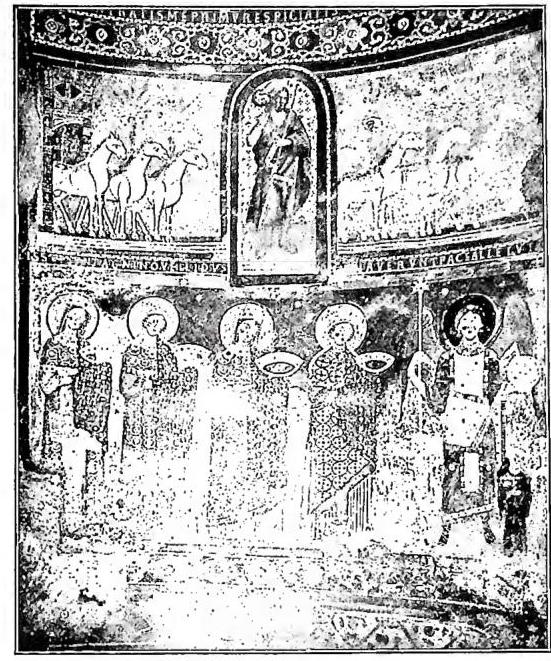
Italy – Apse of the church of S. Fedele (end of the 12th century). Como.
of Romanino. A mingling of Venetian and Lombard elements is also revealed in the Veronese Giovanni and Giovanni Francesco Caroto, Paolo Morando, called Il Cavazzo, and Francesco Torbido, called Il Moro, who in Verona, with Bonifacio Pitati, was the finest interpreter of the Giorgionesque and Titianesque manner. Thus in Treviso, memories of Giorgione, Palma, and Titian nourished the poetics of Paris Bordone and that, less rich in possibilities, of Polidoro da Lanciano, called Lanzani.
The painting of Giovanni Luteri, called Dosso Dossi—the greatest painter Ferrara had in the Cinquecento—and that of his brother Battista di Dosso likewise descend entirely from Venice, from Giorgione and Titian, finding their highest expression in a fantastic richness of precious colors.
Another artist of the greatest importance for the diffusion of Venetian accents—though expressed with a personal, inimitable intonation—was Lorenzo Lotto, active in the Marches, Bergamo, and Brescia, where he decisively contributed to the formation of the two finest painters that city had in the Cinquecento: Moretto and Gian Battista Moroni.
Meanwhile, while so many masters were decisively oriented toward Venetian art, in the first half of the century some Emilian and even Venetian masters lingered under the influence of Roman painting; that is, of a facile and not very profound mannerism. This is evident in certain works by Benvenuto Tisi, called Il Garofalo, Benvenuto da Imola, called Orlando, and Nicola Pisano, as well as in those of Bartolomeo Ramenghi, called Bagnacavallo, and finally in some paintings by Innocenzo Francucci of Imola and Girolamo Pennacchi of Treviso.
But in 1518 there was born in Venice Jacopo Robusti, called Tintoretto, and ten years later in Verona Paolo Caliari, called Veronese. With their art, descending from that of Titian but even more free and fantastic and rich, Venetian painting brought its Renaissance cycle to a close.
However, alongside Tintoretto, one must also recall the activity of his collaborators: Antonio Vasillacci, known as l'Aliense, Andrea Vicentino, Domenico, Marco, and Marietta Tintoretto, and, at times, the more brilliant Andrea Meldola, known as lo Schiavone. Just as one cannot forget, alongside the work of Veronese, that of Antonio Badile, Giambattista Zelotti, Giovanni Antonio Fasolo, Paolo Farinati, Francesco Montemezzano, Domenico Riccio, known as il Brusasorci, and finally that of Veronese’s heirs, his brother Benedetto and his sons Carletto and Gabriele. But it would be unjust not to emphasize the activity of Jacopo da Ponte, known as Il Bassano from his native city: a dazzling painter whose works can at times stand proudly beside the sumptuous paintings of Veronese and the vibrant stage-like compositions of Tintoretto. From Jacopo, the art of painting was passed to his sons: Francesco, a painter of landscapes and genre scenes; Leandro, a portraitist of some pretension; and Giovan Battista and Girolamo, who marked the decline of this workshop at the dawn of the 17th century.
Having thus marked the highest points in the evolution of Italian Renaissance painting in the works of its greatest exponents, it will be necessary once more to return to Tuscany, to Florence, where, in the circle of Fra’ Bartolomeo and Andrea del Sarto around 1510, Jacopo Carucci, known as Il Pontormo, emerges as the most refined and restless of the Florentine painters of the 16th century. Beside him, one must recall Giovanni Battista Rosso and Domenico Puligo, along with their followers Battista Naldini, Farinati, Girolamo Macchietti, Mirabello Cavalori, and Jacopo Coppi—a group of strange, uninhibited, at times tragic painters in whom the widespread, incurable melancholy clearly reveals a sense of crisis born of the awareness of the inevitable decline of art after the glory of its early years (v. MANIERISMO).
How could one resist this decline if not by clinging to the forms of the masters who had achieved the greatest successes? To a tradition consecrated in illustrious works? This was the illusion cultivated by a group of stragglers active between the late 15th and the first half of the 16th century in Siena. It was the illusion of Bernardino Fungai, Giacomo Pacchiarotti, and Girolamo del Pacchia, who clung to the tradition of Sodoma, to which even artists of genuine, if subtle, poetic vein such as Andrea del Bresciano and Arcangelo Salimbeni adhered, as well as masters like Baldassarre Peruzzi, a great architect, and Domenico Beccafumi, in whose strange painting one can also discern the influence of Fra’ Bartolomeo and Mariotto Albertinelli. It was an illusion that inspired confidence in many other painters, more or less craftsmen, of central Italy: from Girolamo Siciolante da Sermoneta, Girolamo Genga of Urbino, Raffaellino del Colle, Livio Agresti of Forlì, and Luca Longhi of Ravenna, who, imitating Raphael’s forms, believed they could preserve some of the master’s felicitous gifts. This illusion spread to southern Italy, to Naples, where Andrea Sabatini of Salerno worked—a painter, indeed, not lacking in quality—and where Pirro Ligorio was born, an antiquarian and architect as well as a painter; and to Sicily, where artists such as Giacomo Aliprandi, Vincenzo degli Anziani, known as da Pavia, Antonello Riccio, and Filippo Paladino were active.
Meanwhile, around Giulio Romano, who was active in Mantua, a host of imitators repeated Raphael’s schemes; in Genoa, alongside Pierino del Vaga, a group of decorators worked. Thus, at the very court of Pierino del Vaga, Taddeo Zuccari and his brother Federico made their first true experiences in Rome. Federico, who was famous in his time, carried forward into the early 17th century the echoes—albeit distant and distinct—of the Urbinesque style. Similarly, in Rome, the painter Giuseppe Cesari, known as Il Cavalier d’Arpino, practiced his art until 1640; the most authoritative and pompous of the Mannerists.
With a very different outcome, Agnolo Bronzino in Florence—initially a pupil of Pontormo—had looked with admiration upon Raphael, and especially Michelangelo, as well as the Flemish painters. One of the greatest portraitists of all time, he died in 1572, leaving behind him a group of imitators and followers who at times, like Alessandro Allori, sought to employ chiaroscuro to give color a plastic function, while at others they dried out and stiffened the models, as did Giovanni Maria Butteri. And it was essentially to Michelangelo that Francesco Salviati, Jacopino del Conte, Daniele da Volterra (v.), Battista Franco, Giorgio Vasari, and Marcello Venusti turned—Venusti, a Lombard by origin, who approached the great master with devout emotion, following the path marked by Sebastiano del Piombo. Pellegrino Tibaldi of Emilia can also be placed among the Michelangelesque group, while other Emilian Mannerists—such as Niccolò dell’Alunno, Lelio Orsi of Novellara, Girolamo da Carpi, Giacomo Zanguidi, Prospero Fontana and his daughter Lavinia, Dionisio Calvaert, and Bartolomeo Passarotti—had ties to the tradition of Dosso, Correggio, and Parmigianino. Nor should we forget the group of masters active in Cremona within the Lombard-Venetian tradition of Boccaccio Boccaccino, Pordenone, and Correggio, including Galeazzo Alessi, Francesco Bembo, Altobello Melone, Camillo Boccaccio, Bernardino and Gervasio Gatti, Giulio, Antonio, Vincenzo, and Bernardino Campi, who left so many works in the churches of Cremona and trained in the art of painting alongside Andrea Mainardi and Giovanni Battista Trotti, known as Malosso, as well as Sofonisba Anguissola.
Masters who repeated old forms academically and in a Mannerist vein, such as in the Veneto Girolamo da Santacroce, Cesare da Conegliano, and Stefano dell’Arzere of Padua—where Venetian painting also received some reflection of the Roman and Tuscan developments in the works of Giovanni Frattini and Giulio Licinio, an imitator of Vasarian forms, as well as Bernardino India of Verona. Painters without genius, like many in the Vecellio family, descendants and relatives of Titian, and in general the continuators and epigones of the Venetian tradition. Among them, however, Jacopo Palma the Younger may be recalled, though he was surpassed by Tintoretto, while Alessandro Varotari, known as Il Padovanino, repeated Titianesque and Veronese ideas.
Others in the second half of the 16th century sought compromise between the Venetian-Lombard tradition and the Roman-Tuscan one, such as Giuseppe Porta, known as Il Salvatini, and Girolamo Muziano. Then, in mid-century Tuscany, some truly notable painters, intensifying the elements of their eclecticism, gained new freedom: Santi di Tito, Bernardino Poccetti, Domenico Cresti, known as Il Passignano, Jacopo Chimenti of Empoli, Lodovico Cardi, known as Il Cigoli, Andrea Boscoli, and Aurelio Lomi. Beside them, others also sought an escape from imitative Mannerism through eclecticism: Scipione Pulzone of Gaeta, a most noble portraitist; Nicolò Circignani; Cristoforo Roncalli, known as delle Pomarane; Ippolito Scarsella, known as lo Scarsellino of Emilia; Luca Cambiaso of Genoa; and finally a true great painter, one of the most significant of his time: Federico Barocci, who managed to move away from the plasticism typical of Roman Mannerists to focus instead on the study of Correggio, seeking mutable effects of light and color. As his circle gathered other painters of the Emperor—such as the Sienese Francesco Vanni, Ventura Salimbeni, Alessandro Casolani, and Pietro Sorri—the announcement of new times for the art of painting had already been given by the Carracci in Bologna. They, too, placed Correggio’s painting as the solid foundation of their eclecticism.

8. Baroque and Rococo. Among the typical aspects of the spiritual attitude of 16th-century artists was the almost unanimous conviction that at the beginning of the century art had exhausted its last expressive possibilities. From this conviction it was deduced that it was not possible to achieve beauty by deviating from the manner of the great masters (v. MANNERISM), and that a new beauty could only be attained by assimilating into a single manner the essential characteristics of the great masters of the past (v. ECLECTICISM). It is unnecessary to add that neither of these assumptions could lead to the results hoped for, since the former was based on the concept of the immobility of artistic language, while the latter imagined that a new one could be created by combining or contaminating the forms of different languages, each of which, logically, excluded the others. What was positive, in any case, was a sense of dissatisfaction that spurred the freest spirits to break free from these constraints, overcoming the concepts that had determined them and continuing along the path already taken by the great masters. Therefore, once again, it is not appropriate to speak of decline when referring to the evolution by which 16th-century art was transformed into the art known as Baroque (v. ARTE). An attribute that in the past had even a pejorative meaning, but which today serves above all to indicate the artistic manifestations of the 17th century and much of the 18th. During this period, particularly in the 17th century, Rome assumed an undisputed preeminence in the artistic field even over other European nations. Rome was then the place in the world where the Baroque language was spoken with the purest and most authentic accent, even though elsewhere the same language produced expressions of considerable value.
a) 17th-Century Architecture. — Already in the architecture of the second half of the 16th century, there was a manifest massive and heavy sense of form, born of a rhetorical exaltation of masses. The force and grandeur of Michelangelo’s architecture became a kind of inert materiality in the work of his followers; in the best among them, especially in Giacomo della Porta, Carlo Maderno, and Flaminio Ponzio, it served to arouse a taste for the movement of surfaces and even of plastic masses, realized above all in function of light. But these three architects, who crossed the threshold into the 17th century, nourished all the foundations of their culture in the previous century, even if their work seems truly to conclude one era and open another. Carlo Maderno, in particular, who had worked under Domenico Fontana and thus had directed and guided in their early endeavors both Borromini and Bernini.
Nevertheless, alongside Maderno, until the mid-century, the elements of Mannerist architectural culture persisted in the work of a group of architects who opposed Baroque modes with a severe and dignified firmness of expression, mindful, but not slavish, of the forms of the great masters of the 16th century. Thus Giovanni Battista Soria (1581–1651), Vincenzo della Greca, Fausto Rughesi, Martino Longhi the Younger, Algardi in his architectural works, the notable Carlo Rainaldi—mindful also of Pietro da Cortona and author of the splendid church of Santa Maria in Campitelli—Antonio del Grande (active 1652–71), who recalls Maderno in the façade of the Palazzo Doria on Piazza del Collegio Romano, and even Carlo Antonio de’ Rossi (1610–95), who likewise displays 16th-century dignity in the façade of Palazzo Altieri. While these builders were at work in Rome during the 17th century, two true geniuses were enunciating new architectural modes in the same city: Francesco Borromini and Gian Lorenzo Bernini. Beside them stood Pietro da Cortona, of slightly lesser stature than the masters but who knew how to move along parallel paths to those of Bernini.
Borromini is a free, bold, and uninhibited inventor of supremely flexible forms reminiscent of the elastic projections of Gothic architecture; Bernini, and also Pietro da Cortona, were builders who, in their search for a new monumental dignity in architectural analysis, grasped from ancient architecture a sense of powerful rhythm more than formal elements, and they accentuated that rhythm with a new, free eloquence that in their followers sometimes became boisterous, gesticulating, and bombastic.
From Borromini and his somewhat floral taste there sprang many aspects of 18th-century architecture, not only Italian, while from Bernini and Pietro da Cortona—once the immediate circle of collaborators had dispersed—one can say that only a general lesson of analytical dignity descended, one that remained valid even for architects who in the 18th century still looked to Borromini himself. Among the former, besides the aforementioned de’ Rossi, were Ciro Ferri, Cosimo Fancelli, Giovan Battista Contini, and Antonio Gherardi, and above all Carlo Fontana (1634–1714); among the latter, besides Francesco de Sanctis, author of the successful arrangement of the steps of Piazza di Spagna (1723–26), were Giuseppe Sardi (1680–1753), Gabriele Valvassori (1683–1761), Domenico Gregori (1700–1777), and Filippo Raguzzini, author of the theatrical little palaces in Piazza Sant’Ignazio, and finally Paolo Amalfi, who in the mid-18th century executed the façade of Palazzo Doria on Via del Plebiscito, as well as other lesser or later architects such as the brilliant Carlo Marchionni.
But even before the mid-18th century, forms of late 17th-century architecture still flourished in Rome, such as those of Nicola Salvi (v. 1697–1751), author of the façade of the Trevi Fountain, VANVITELLI, LUIGI (v.), Neapolitan by birth but Roman by training, and the two Florentines Alessandro Galilei (1691–1736) and Ferdinando Fuga (1699–1781; v.). Late 17th-century forms that would take on a new aspect in Cosimo Morelli and in Pietro Camporesi the Elder, active in the second half of the 18th century, when the world of culture was already thoroughly imbued with the new Neoclassical ideals, of which a reflection is seen in Rome in the work of Giovanni Battista Piranesi, more a decorator than an architect.
The architectural developments of the 17th and 18th centuries were no less lively in Tuscany, where, not so much the taste for classical antiquity as the conviction of an undisputed, though fading, preeminence kept architects more than elsewhere tied to Cinquecento forms. And not only Giovan Antonio Dosio (1533–1609), a Michelangelesque epigone, but Bernardo Buontalenti (1536–1608), who instilled the same reverence in his many pupils and followers, among them Giulio Parigi (1580–1635) and Matteo Nigetti (1560–1649). The latter, collaborating with Gherardo Silvani (1579–1675), raised the façade of the church of San Gaetano, which represents the greatest approximation of Florentine scientific architecture to Roman taste; an approach also taken by Giovanni Battista Foggini (1633–1737), author of the Cappella Feroni in the church of Santissima Annunziata, while Ferdinando Ruggeri (1670–1715) and Filippo Ruggieri (1670–1715) worked on a new façade for San Firenze, later completed by Zanobi del Rosso, creating a model of Florentine Baroque taste, dry and linear, which enjoyed fortune and notable diffusion.
Other Florentine architects active between the 17th and 18th centuries were Matteo Segaloni, Francesco Silvani (1620–85), Paolo Falconieri (1670–1702), Alessandro Ceccchini, Giuseppe Ruggeri, and Bernardo Fallani, author of the small palace known as the Palazzetto della Livia (1775), of such thoroughly 16th-century intonation that in not too distant times it even merited an attribution to Michelangelo.
In the other cities of Tuscany, attachment to tradition was no less strong. Thus at Empoli, where Simone Bonistalli was active in the first half of the 17th century; at Siena, where Baldassare Peruzzi (1601–76) raised the celebrated Cappella Chigiana in the Duomo; and at Pisa, where Cosimo Pucini built the most noble palace known as “Alla Giornata.”

ITALY – Central nave of Milan Cathedral (14th–15th centuries).
Architecture. More interesting are G. B. Bergonzoni (1629–92), who rebuilt the Oratory of S. Maria della Vita, G. B. Natali, F. Dotti (1670–78)–1759), author among other works of the sanctuary of the Madonna di S. Luca, and Alfonso Torreggiani (d. 1764), who also designed the fine dome and the slender tower of S. Giorgio in Reggio Emilia. It is worth recalling also the Galli da Bibbiena family (v.), architects and scenographers renowned throughout Europe for the theatres, palaces and churches they constructed.
In other Emilian cities between the 17th and 18th centuries there worked, besides G. B. Aleotti called l’Argenta (1546–1636) in Parma, Bartolomeo Luigi Avanzini from Rome in Modena, and Luca Danesi of Ravenna (1598–1672) active in Ferrara with Francesco Mazzarelli, while toward the end of the 18th century an interesting activity heralding Neoclassical traits was carried on by Giuseppe Pistocchi (1744–1814) of Faenza, who studied in Rome and worked also in Ravenna and Milan.
Venetian architecture in the 17th and 18th centuries assumed and maintained a character altogether distinctive, for the memory of Andrea Palladio, of Sammicheli and even of Sansovino was never extinguished there, partly because Vincenzo Scamozzi, a faithful Palladian, echoed his master’s accents well into the 17th century and instructed Baldassarre Longhena, who never forgot Palladio or Sansovino. Nor did they forget him—neither Giuseppe Sardi (1620–90) nor Alessandro Tremignon, designer of the church of S. Moisè—until Andrea Tirali (1660–1737) and then Andrea Mazzari (1686–1766) brought back into their buildings the purest Palladian forms, as did Giovanni Scalfarotto (1700–64) in S. Simeone Piccolo and his nephew Tommaso Temanza (1705–89), author of the beautiful church of the Maddalena. Throughout the Veneto the echoes of Palladio resounded; above all in Vicenza, where Vincenzo Scamozzi had a continuator in Antonio Pizzocaro and the Muttoni, Francesco and Antonio, and later in Ottavio Bertotti Scamozzi (1719–90) and Attone Calderari (1730–1803), while in Verona Domenico Curtoni, nephew and pupil of Sammicheli, worked, followed by Adriano Cristofoli (1717–88), designer of the perspectives of Villa Bettoni on Lake Garda inspired by distant recollections of Vignola. At that time the Bergamasque Giacomo Quarenghi (1744–1817), after making his Palladian experiments even at Subiaco, emigrated like many architects of his age to Russia and helped give a modern face to St Petersburg and Moscow. It was in those years that Andrea Memmo, Temanza and Algarotti, basing themselves on the theories of Carlo Lodoli, expressed in their writings some fundamental ideas for the further development of architectural art.
b) Sculpture. – In the 17th century, too, Rome from the very beginning of the century assumed an air of absolute predominance over other Italian cities in sculpture. Stefano Maderno (1571–1636) has already been recalled, but here it will be well to mention also Camillo Mariani of Vicenza, who recalls Vittoria in the statues of S. Bernardo alle Terme, and Francesco Mochi, whose modelling is marked by impetus, motion and even a Baroque theatricality that seems truly to anticipate Gian Lorenzo Bernini, whose importance as a sculptor perhaps surpasses even that as an architect. And Bernini, with whom only the academic sculpture of the Bolognese A. Algardi can be contrasted, was truly the master of the century, which he dominated through the vast output of collaborators, pupils and followers, both Italian and foreign.
Among the collaborators are recalled his brother Luigi (1612–1677) and his son Paolo (1647–72), Giacomo Antonio Fancelli (1606–71), who worked on the statue of the Nile in the fountain of Piazza Navona beside Lazzaro Morelli (1608–1690), Claudio Adam, Francesco Baratta, Antonio Raggi and Andrea Bolgi; Ercole Ferrata collaborated with G. Lucenti, A. Giorgetti and L. Morelli also on the angels of Ponte Sant’Angelo and other enterprises of the master.
Of these sculptors some were more or less ready imitators of Bernini, while others, such as Ferrata, knew how to follow their own path, an example of which is also provided by Algardi himself, who, despite his pose as an anti-Berninian and academic, did not succeed in remaining altogether immune from Berninian influences to which the Fleming Duquesnoy also yielded. A satellite of Algardi was Giuseppe Peroni (1626–63), and his follower was the notable Domenico Guidi (1625–1701), who worked on the monument to Clement IX in S. Maria Maggiore designed by Rainaldi. At that time in Rome there was also Francesco Cavallini, memorable for the works he left in the church of Gesù e Maria, Giuliano Finelli (1601–57) and Giuseppe Mazzuoli, a Berninian despite having been a pupil of Ferrata together with Tommaso Amantini and Melchiorre Caffà Maltese.
In the second half of the century Camillo Rusconi (1658–1728), a Lombard, emerges as an artist of outstanding importance in Rome; he happily combines Bernini’s suggestions with the pictorialism of a Pietro da Cortona and, at times, a solemn oratory inspired by Algarotti. Beside him may be placed, among others, Giuseppe Rusconi (1687–1758), the Lombard E. B. Maini, author of the monument to Innocent X in S. Agnese, the Ligurian Francesco Schiaffino, as well as Monnot and Le Gros, two Frenchmen who became Romanized, and then Carlo Monaldi and Bernardino Cametti (1682–1736), author of lively portraits. At that time there were making their first experiments in sculpture, besides Agostino Cornacchini, two great masters of 18th-century Roman sculpture: Filippo della Valle (1698–1770) of Florence, elegant and composed, a pupil in Florence of G. B. Foggini, and Pietro Bracci of Rome. Both worked on the Trevi Fountain together with other 18th-century Roman or Romanized sculptors such as B. Pincellotti, F. Queirolo, B. Ludovisi and A. Corsini.
It was in those years that new Neoclassical ideals were consecrated in Rome by the theories of Winckelmann, and Giuseppe Ceracchi (1751–1802), even before Canova arrived in Rome, was carving figures that display strange insertions—copies of ancient sculptures—mingled with opulent Baroque draperies reminiscent of C. Rusconi.
More lively and interesting is the story of sculpture in Campania, where, after Michelangelo Naccherino and Pietro Bernini, Tuscans active in Naples between the end of the 16th and the beginning of the 17th centuries, the Bergamasque Cosimo Fanzago—already remembered as an architect—and Giuliano Finelli, who in Rome drew close to Bernini, were active. Indeed, Fanzago himself soon turned to Bernini’s style, becoming a disseminator of the new forms among many who frequented his extremely busy workshop, such as Innocenzo Mangani, a Florentine who later emigrated to Sicily, and his collaborators in the works of the Certosa of S. Martino and the abbey of Montecassino.
A characteristic Neapolitan environment of the 18th century is the chapel of the Sansevero di Sangro family, known as the Pietatella; founded in 1590, it was rebuilt at the beginning of the 17th century and decorated between 1749 and 1766. Several artists worked there: Queriolo, Corradini, Paolo Persico, Francesco Celebrano (1729–1824), and Giuseppe Sammartino (1720–1791), the best and most active of all the sculptors Naples had in the second half of the century. Alongside Persico, they included Andrea Violani, G. Salomoni, A. Brunelli, and others whose names are sometimes recalled alongside those of Celebrano, the Vaccaros, and the Sammartinos, even among the modelers and figurine-makers of the nativity scenes that then enjoyed great popularity in Naples.
Meanwhile, in Sicily, from a group of craftsmen who throughout the 17th century disseminated distant echoes of Bernini, there suddenly emerged the most luminous figure of the greatest sculptor Italy may have had between the end of the 17th and the beginning of the 18th centuries: Serpotta (v.), a Palermitan who left a number of imitators and followers, among whom it is worth naming, besides his son Procopio, Domenico Castelli, Paolo Corso, Vincenzo Messina, and finally, though later, the best of them, Ignazio Marabitti (1719–1797).
Now we must turn our gaze to northern Italy, from which so many sculptors had descended at the end of the 16th century to work in Rome. In Emilia, at the beginning of the century, Giulio Cesare Conventi (1577–1640) was active, master of Algardi, to whom the sculpture of Camillo Mazza (1602–172) is linked as a pupil, while with Giuseppe Mazza (1653–1741) and Andrea Ferretti (1673–1744), his pupil, we enter fully into the 18th century. In Bologna, the century had a curious sculptor in Hercole Lelli (1702–1766), supremely skilled in making anatomical models, écorchés, of which specimens are preserved in the anatomical amphitheater of the Archiginnasio in Bologna.
In Lombardy, the 17th century in sculpture is affirmed with Dionigi Bussola (1612–1687), who, after studying in Rome, returned to Milan to carve statues for the Duomo. Giovanni Battista Maestri, called il Volpino, was also active in the Milanese Duomo between 1662 and 1680, though he also worked in the Certosa of Pavia and the sanctuary of Varallo. Giuseppe Rusnati, who died in 1713, also worked in Milan and Pavia. In Alzano Maggiore, near Bergamo, Andrea Fantoni of Rovetta left a famous pulpit, while Giovanni Battista Barberini of Laino made a great name for himself at the end of the 17th and beginning of the 18th centuries as a stucco decorator. Of the Lombard sculptors of the 18th century, little need be said; their activity was almost entirely absorbed by the decoration of the Milan Cathedral.
In Liguria, the French Berninian Pierre Puget worked in Genoa between 1661 and 1667, where Daniele Solari (1634–1698) was his assistant. But of greater prestige was the art of Filippo Parodi (1630–1700), who also lived in Rome alongside Bernini and was then called to work in the Veneto. Francesco Biggi often worked alongside Parodi. Also worthy of mention are Bernardo (1680–1725) and Francesco Maria Schiaffino (1691–1765), P. Bocciardo (1710–1791), and N. Traverso (1745–1823), who, after a trip to Rome, returned to Genoa steeped in Neoclassicism.
Baroque sculpture in Piedmont is almost entirely the work of artists from elsewhere, and in the church of Superga one finds French and Roman Berninians. Local artists, however, included the Clementes, among whom Stefano Marzia (1719–1794) is notable, as well as the artists of the Bernero family, including Giovanni Battista (1736–1796), who also worked in Rome, as did Ignazio and Filippo Collino in the mid-18th century.
Far more interesting, for the heights it reached, is sculpture in Venice during the 17th and 18th centuries. In the 17th century, in fact, with the deaths in 1608 of Vittoria, in 1607 of Tiziano Aspetti, and in 1623 of Girolamo Campagna, the links with tradition were broken. Indeed, as in painting, there was a momentary setback, and it is necessary to reach the mid-century to find, alongside sculptors who had immigrated from Bologna, Genoa, and elsewhere, the names of some Venetians of merit. One of these is Francesco Penso, called il Cabianca (1665–1737), a pupil of the Fleming Giuseppe Le Court, as were also, in Venice, Francesco Cavrioli, Michele Ungaro, and Tommaso Ruer.
An expressive work of the plastic culture of the Venetians at the beginning of the 18th century is the colossal funerary monument of the Valier family, designed by Andrea Tirai in SS. Giovanni e Paolo at the start of the century. Alongside the Carrarese Pietro Baratta, Antonio Tarsia (1663–1739) and Giovanni Bonazza (1695–1730) worked there; the latter, with his sons Tommaso and Antonio, worked on the chapel of the Rosary in the same church of SS. Giovanni e Paolo, alongside the Trevisan Giuseppe Torretti (1660–1743), Alvise and Carlo Tagliapietra. While A. Corradini, famous for his veiled statues, sought and found fortune far from his homeland, two great sculptors worked in Venice who had an independent spirit and adopted new forms even with respect to earlier Berninism: they were Giovanni Maria Morlaiter and Giovanni Marchiori, who derived from BRUSTOLON, ANDREA (v.). It was these two, Morlaiter and Marchiori, who were the true masters of the best of Canova.
**Painting.** — The picture we have just sketched of the Italian painting situation around 1590 was, in general terms, anything but encouraging. Mannerism in the ascendant offered little hope that the closed formulas and conventions would be transcended.
Only the most modern artists at the time could Carracci (v.), drawing benefit from their eclecticism, and only the most daring applauded the first revolutionary enterprises of Caravaggio.
The Carracci, in fact, represented the possibilities of a sufficiently conformist modernist painting, while it was clear to the more daring that true novelty was then being proclaimed by Caravaggio. His great reform did not refer merely to the object of art—that is, its naturalistic realism—but above all to its new chiaroscural sense, its “luminism,” whereby what the light does not enliven is lost in shadow, and the pictorial compositions take on new aspects, with light itself generating a touching vitality of space.
With these positions clarified, it will be permissible to group together