
Enciclopedia Cattolica Vol. V, 1950 Literature

Little Flowers of Saint Francis

FIORETTI DI SAN FRANCESCO

Italian original Cite

Brunforte, Ugolino redirects here.

Also known as: The Little Flowers of St. Francis; Italian: Fioretti di S. Francesco; Latin: Actus Beati Francisci et sociorum eius

LITTLE FLOWERS OF SAINT FRANCIS. - The complete title, according to the manuscripts, would be: Fioretti, miracoli et esempi divoti del glorioso poverello di Cristo messer santo Francesco e d'alquanti suoi santi compagni, and it comprises the flower (selection) and the translation of 53 chapters of a Latin work: Actus 8. Francisci et sociorum eius, begun by friar Ugolino da S. Maria in Montegiorgio (Marche) in the last decades of the 13th century, then continued by other friars with the addition of later episodes that make it possible to establish the extreme limits of the translation, that is, not before 1370, not after 1396.

The translator of the 53 selected chapters is an unknown Florentine or Sienese friar (some suppose him to be from the Marche and a nephew of friar Ugolino) who began his work perhaps around 1380, and perhaps it was he himself who wrote directly in the vernacular the five Considerazioni delle sacre stimmate di s. Francesco, which complete the F. The protagonists of the first 40 chapters are St. Francis and his companions; of the last 13, the Franciscans of the Marche, most faithful to the most austere tradition. In the first part the human and superhuman originality of St. Francis prevails, which is in itself a prodigy; in the second, the mysticism of the followers, interwoven with miraculous visions. The historical value of the F. is very slight, if one attends to the facts; it is great if by history one means the ideal significance and the spirit of the narrative: in reality few books express, as this one does, the Franciscan conception of life. Hence also its spiritual value; the F. present nature in its original beauty, creatures in their creative goodness, human relations in the simplicity of the Gospel, and they radiate the joy of poverty (that is, of self-forgetfulness in the love of God) even upon the sharpest sorrow, as emerges from ch. 8, which represents in a dialogue famous the Pauline saying: « Mihi absit gloriari nisi in cruce Domini Nostri Jesu Christi ». Such a meaning has had efficacy on readers of every mentality, especially non-Catholics, they would not be despised without an adequate aesthetic value. The F. are a jewel of art. The translation does nothing but restore to the original conception (in the vernacular) the bloodless Latin of the Actus and pours into the simple, terse prose, now veristic and intimate, now sweet and lyrical, the candor and ardor of the first Franciscans and the enchantment of a holiness that loves God without renouncing life.
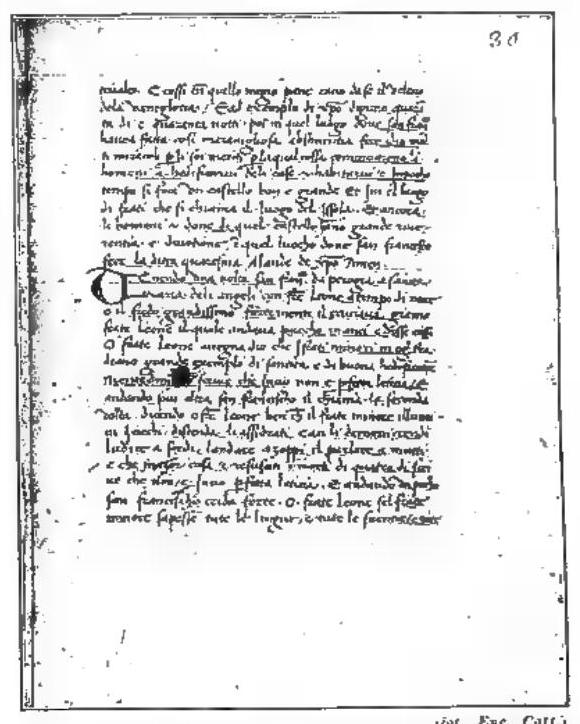
30 FIORETTI OF ST. FRANCIS - End of chapter 7 and beginning of chapter 8, where it deals with the Lent spent by St. Francis on an island in Lake Perugia and with St. Francis's discourse to Brother Leo on perfect joy - Va
30
FIORETTI OF ST. FRANCIS - End of chapter 7 and beginning of chapter 8, where it deals with the Lent spent by St. Francis on an island in Lake Perugia and with St. Francis's discourse to Brother Leo on perfect joy - Vatican Library, cod. Vat. lat. 1010, f. 30e (15th century).(phot. Enc. Catt.)
Bibliography13 works
BIBL.: Modern editions of the F., notable for introduction and commentary, are those edited by: A. Cesari, Verona 1822; L. Manzoni, Rome 1901 (according to the codex of Amoretto Manzelli of 1396, the oldest); A. Della Torre, Turin 1909; F. Maggini, Milan 1923 (with good philological notes and references to Dante); M. Casella, Florence 1946 (with critical reconstruction of the text); B. Bughetti, ibid. 1926 (integrated by the translation of 20 added chapters and of other texts of primitive Franciscanism and accompanied by obtained historical notes); A. Gemelli, Milan 1945 (with spiritual interpretation of the work); G. Gatto, ibid. 1946. Studies: on the text and its authors: B. Bughetti, Alcune idee fondamentali su F. di s. F., in Arch. Franc. hist., 19 (1926), pp. 321-33; id., Una nuova complicazione di testi intorno alla vita di s. Francesco, ibid., 20 (1927), pp. 321-33; id., Una parziale nuova traduzione degli « Actus » accoppiata ad alcuni capp. dei F.», ibid., 21 (1928), pp. 315-32; 22 (1929), pp. 63-111; id., Descriptio novi codici: « Actus B. F. » exhibentia, ibid., 32 (1930), pp. 412-38. Aesthetic evaluation: A. Monigliano, Studi di poesia, Bari 1938, pp. 10-20; F. Fiora, Storia della lett. it., I, Milan 1948, pp. 338-49.

Maria Sticco

About this entry

By Maria Sticco

How we know signed in print

Translated from the Enciclopedia Cattolica, vol. V (1950), coll. 1398–1399.

Printed pages Open in the page viewer
Page 833
vol. 5, coll. 1397–1398
Page 834
vol. 5, coll. 1399–1400

More by Maria Sticco: James of Varazze (Jacobus a Voragine), Blessed · Iacopone da Todi · Macinghi Strozzi, Alessandra · Panziera, Ugo · Paruta, Paolo

Cite this article

Chicago

Sticco, Maria. “Fioretti di San Francesco.” In Enciclopedia Cattolica, vol. V, coll. 1398–1399. Città del Vaticano: Ente per l’Enciclopedia Cattolica e per il Libro Cattolico, 1950. https://azioneromana.com/article/fioretti-di-san-francesco.

MLA

Sticco, Maria. “Fioretti di San Francesco.” Enciclopedia Cattolica, vol. V, Ente per l’Enciclopedia Cattolica e per il Libro Cattolico, 1950, coll. 1398–1399. Azione Romana, https://azioneromana.com/article/fioretti-di-san-francesco.

BibTeX

@incollection{ec5_fioretti_di_san_francesco,
  author    = {Sticco, Maria},
  title     = {Fioretti di San Francesco},
  booktitle = {Enciclopedia Cattolica},
  volume    = {V},
  pages     = {1398--1399},
  note      = {Cited by column},
  publisher = {Ente per l’Enciclopedia Cattolica e per il Libro Cattolico},
  address   = {Città del Vaticano},
  year      = {1950},
  url       = {https://azioneromana.com/article/fioretti-di-san-francesco}
}

One of some 20,000 entries brought back from the twelve printed volumes (1948–54). Spotted something? Help us improve it.

Save for later

Enter your email and we will send you a sign-in link. No password. What you save (articles, verses, chapters, documents) follows you to any device.