
CAVALIERI DI COLOMBO. — An association of apostolate, assistance, and mutual aid among Catholic men of North America, Canada, and the rest of the continent. It is now the most notable Catholic association because of the multiplicity of its initiatives, the scope of its activity, and the program it pursues in almost every field of social activity.
Founded in New Haven, in the State of Connecticut, by the Rev. M. McGivrey, on February 2, 1882, with an initial group of only eleven members, it expanded rapidly. On May 15 it was constituted as the « Supreme Committee », since in the meantime the first subordinate Council had been founded in the same city of New Haven. From then on, other Councils were founded in every city and state of the United States, and the Supreme Committee established that a Supreme Council should be created, composed of the Supreme Committee and delegates from the subordinate Councils; subsequently, it became necessary to provide for a more complex form of representation.
The immediate purpose of the association is to promote the practice of Catholic life among its members, provide insurance against illness and accidents, assist the families of deceased members, and in particular provide for the moral and social education of its associates.
(phot. Alinari)
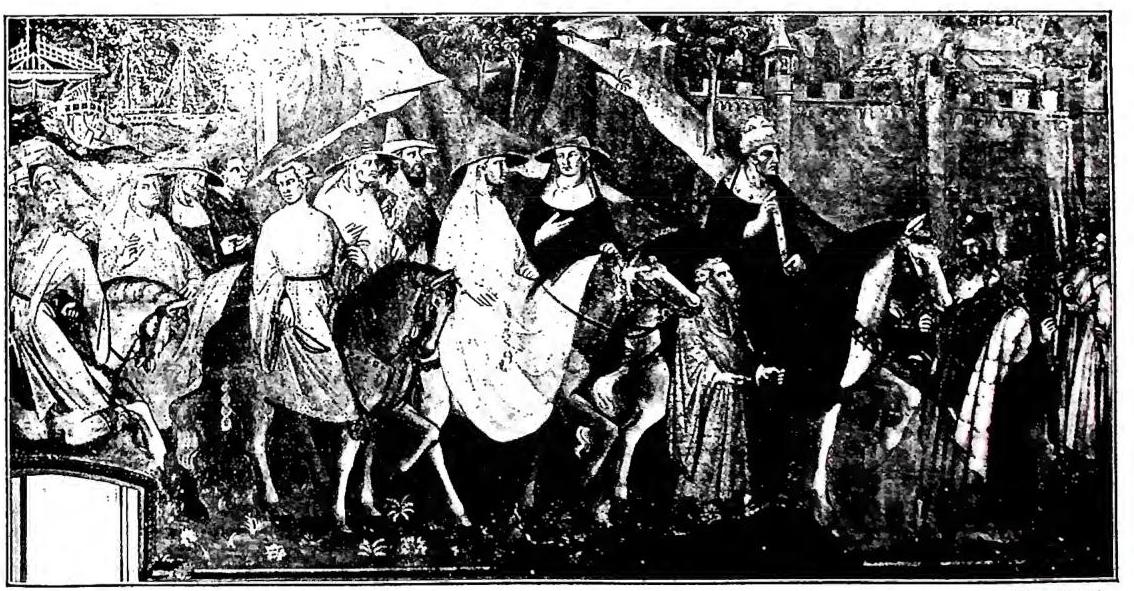
PAPAL CAVALCADE—Return to Rome of Alexander III. Fresco by Spinello Aretino (14th century)—Siena, town hall.
to establish a chair of American history, also allocating a substantial sum for the purchase of books for the University library. The C. di C. did not limit themselves to promoting greater education among the masses of Catholic immigrants, but devoted a considerable part of their activities to fostering a greater understanding of Catholic doctrine among Protestants, thus contributing substantially to dispelling existing prejudices against Catholicism.
One of their principal merits was the campaign conducted to establish “Columbus Day”; nearly all the American states joined the initiative, decreeing that October 12, the anniversary of Christopher Columbus’s landing on the new American continent, should be a public holiday. Among their recent initiatives, the program of “Catholic publicity” in widely circulated newspapers and magazines deserves mention. An initial sum of 350,000 dollars was allocated for this purpose. The Apostolic Delegate in Washington, applauding the initiative, said that he hoped it “would bring immeasurable good by enlightening non-Catholics and leading them into the one Church of Christ.” Archbishop Joseph E. Rummel of New Orleans, praising it, expressed the wish that the publicity campaign might be extended further to newspapers of substantial circulation in each individual state.
At the meeting of the Supreme Council of the association held in August 1948, it was decided to organize conferences and “discussion meetings” on current Catholic questions and orientations in the major American centers. Another decision called for the expulsion from United States territory of Soviet diplomats guilty of espionage and subversive activities against the American democratic system, in violation of the treaty by which the United States recognized the Soviet government in 1933. The meeting of the Supreme Council recommended that the American government apply the measures concerning the admission of displaced persons to the United States in a “prompt and liberal” manner.
Another initiative of the C. di C., undertaken at the beginning of 1948 and now continually expanding, is the dissemination of radio programs entitled “Family Theater Radio Program,” inspired by the motto “the family that prays together is the family that stays together.” The program, which aims to strengthen family bonds and Catholic ethics, is directed by the Rev. Patrick Peyton and is broadcast by the major radio station “Mutual Broadcasting Corporation” and by 352 smaller stations. Through an active press and radio campaign, the C. di C. are urging the adoption of a “code” for comic books, in order to counter the often harmful effect of the content of such “comic strips” on young people. The “code” has been defined by the C. as a “great step toward protecting American youth from reading filled with seeds of immorality.” At the beginning of 1949, the Association had more than 700,000 members and was governed by a “Supreme Council” and a “Supreme Board of Directors,” as its executive body. There were 2,540 provincial Councils and 61 “State Councils.”