
TESTAMENT. - It is the act by which a person disposes, for the time when he shall have ceased to live, of all his substance or of part of it (Italian Civil Code, art. 587).
1. Notion
The testament is a solemn and formal act; that is, its validity is subject to the observance of determinate forms which the law establishes and which are mandatory. It produces in the person instituted the status of heir in the strict sense when the attribution of the goods is made on a universal title, that is, comprising the universality of the testator's goods or a quota share of the whole; it is understood, however, that single goods or complexes of single goods may also be left by testament as inheritance, when it is expressly stated or clearly apparent that they are attributed as a quota share of the patrimonial estate; if instead one disposes of single goods as such, that is, on a particular title, there is a simple legacy (v. art. 588). The law prohibits a single testament being made by different persons, even if the heir or legatee is possibly a single person; it likewise prohibits the same act containing a reciprocal testament, that is, reciprocal testamentary dispositions (art. 589); nevertheless it is not prohibited to draw up two or more testaments in favor of the same and of a different person, or even with reciprocal disposition of two or more testators, on the same sheet or series of sheets.
The testament is essentially revocable, that is, it is not permitted that it be conceived and carried out in such a way that the testator cannot subsequently change what he has disposed by testament; every clause or condition contrary to this rule is by law devoid of effect (art. 679). The revocation of the testament may be carried out with a new testament or with an act received by a notary before two witnesses, provided that in this second case the testator says he wishes to revoke the previous testament in whole or, as the case may be, in part (art. 680); the aforesaid revocations may in turn be revoked under the same conditions, juridically reviving the testament that had been previously revoked (art. 681). A new testament that does not expressly revoke the previous one or ones annuls only those previous dispositions that are incompatible with it (art. 682). Likewise the testament may be revoked by means of destruction, tearing or erasures; however this may be done only by the testator with the intention of changing in whole or in part the previous dispositions (art. 684); finally "the dispositions on a universal or particular title, made by one who at the time of the testament had no children or descendants or was unaware of having them, are revoked by law through the existence or subsequent birth of a legitimate child or descendant of the testator, even though posthumous, or legitimated or adopted, or through the acknowledgment of a natural child" (art. 687), unless the testator has equally provided for the case of the possible existence or acknowledgment of children and in any case provided that in fact the children or descendants actually come to the succession.
Suspensive or resolutory conditions are lawful in the testament (art. 633); however they are considered as not appended if they are impossible or contrary to mandatory rules, to public order and to good morals (art. 634), or prevent first or further marriages (art. 636), or are subject to reciprocity (art. 635).
Both ordinary substitution (art. 688-91) and fideicommissary substitution (art. 692-99) are admitted: with the first the testator may substitute for the heir instituted by him another person should the instituted person be unable or unwilling to accept the inheritance; with the second the testator imposes on his own child the obligation to preserve in whole or in part the goods constituting the disposable portion (not therefore the legitime, which cannot be bound) in favor of all the children already born or to be born of the heir or in favor of a public body; analogously he may impose this on a brother or sister likewise instituted as heirs: in matters of inheritance no other cases of fideicommissary substitution are admitted (art. 692).
2. Forms
The Italian legislator provides for two different forms of testament, the ordinary and the special. The ordinary form comprises two kinds of testament, of which the first, the classic one, is that constituted by the holograph testament; the second by that by act of a notary. The special form is reserved for wholly exceptional cases and those exhaustively contemplated by the law.
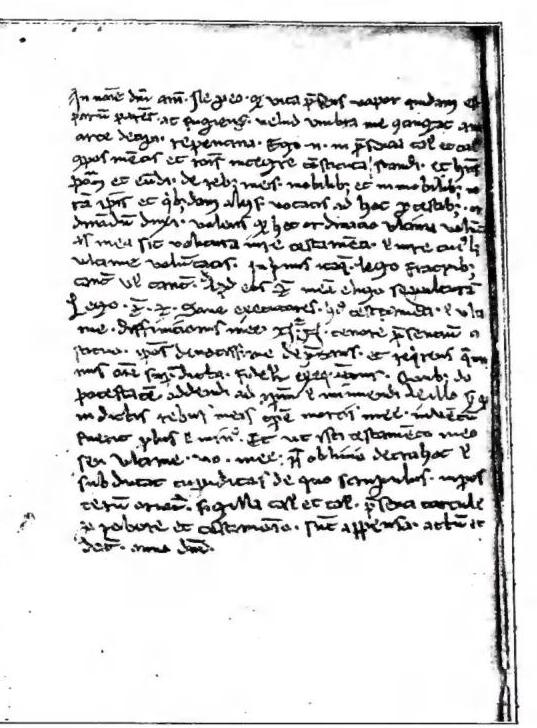
The holograph testament (art. 602) must be written entirely in the testator's own hand, from beginning to end, by the testator; the writing must be such as to be able to furnish proof: therefore block-letter writings, stenographic and similar writings are excluded; nevertheless the testament written in pen, in pencil, on paper, metal, skins and similar materials is holograph, thus excluding all printed matter, typewritten matter or in any case writings produced by mechanical means. The signature is also required for the holograph testament; besides name and surname, pseudonyms that leave no doubt whatsoever as to the identity of the testator are recognized as signatures; and under the same condition signatures with only a nickname or with a simple initial or with attributions that, put in relation to the heir, entail the identification of the testator (for example, your father, your mother, your paternal grandfather, your maternal grandmother and the like); in every case the signature must be affixed at the end of the testamentary dispositions. The indication of the date, comprising the day, month and year, is also indispensable; such indication may also be implicit provided it is of certain interpretation (for example, the day of Christmas of the first year of the pontificate of Pius XII); the indication of the hour is not required.
The testament by act of a notary may be public or secret: a) in the public testament (art. 603) the testator declares orally to the notary, before two witnesses, what he intends to dispose; the notary puts it or has it put by others in writing by hand; then the notary himself personally, never therefore by substitution, reads to the testator what he has written or had written under his own dictation and containing the testamentary dispositions; in the public testament it is indispensable to add to the date also the hour at which the testator signed, with the indication of the place where the testament was received; b) the secret testament (arts. 604-605) may be written, even by mechanical means, by the testator or by a third party at his dictation; if it is written by third parties or in any case mechanically the testator must sign in his own hand each single half-sheet; the whole is then closed in an envelope or other packet and sealed; then it is brought to the notary to whom, in the presence of two witnesses, the testator declares that the packet itself contains his testament; finally the notary draws up the act which is preserved according to law.
As regards the special forms: 1) in case of epidemic, public calamities or accidents the testament is drawn up by the one who receives it, who signs together with the testator and two witnesses; the testament must be received mandatorily either by a notary or by the praetor or by the conciliator of the place or by the mayor or by a minister of worship; in in all cases, however, in the presence of at least two witnesses aged sixteen or over (art. 609); 2) the t. on board a ship is received by the commander: it must be drawn up in two original copies before two witnesses and signed by the testator, by the person receiving it, and by the two witnesses (arts. 611-12); 3) the t. on board an aircraft is received by the commander, but a single witness suffices (art. 616); 4) the t. of soldiers belonging to mobilized corps or services or employed in war or who are in captivity is received by an officer or by a military chaplain or by an officer of the Red Cross in the presence of two witnesses and signed by the testator, by the recipient and by the witnesses (arts. 617-18). Wills in special forms are valid until the end of the third month from the moment when the testator can have recourse to the ordinary forms, in accordance with what is established in arts. 610, 615, 616, 618.
3. Subject
There is an active subject: the testator, and a passive one: the person in whose favor the t. is made.
All those who are not expressly excluded by law are capable of making a t. Under art. 591 those incapable of testating are: a) those who have not completed eighteen years; b) those interdicted for mental infirmity, under art. 427; c) those who, although not interdicted, are proved to have been, for any cause, even a transitory one, incapable of understanding or willing at the moment when they made the t. (art. 591); the t. made by one of the preceding subjects may be declared null on the application of the interested parties within five years from the moment when the t. itself was given effect; d) under art. 32 of the penal code, those who have been sentenced to life imprisonment are also incapable of testating, and any earlier t. made by them is likewise invalidated; the nullity is by law and may be raised without limit of time by anyone having an interest therein.
Passive subjects are those who by law are not excluded from being able to receive by t. Some are subjects by law and necessarily; to these, according to the rules referred to in arts. 565-86, a determined quota share of the testator's estate must necessarily be attributed, and they are called forced heirs. Others may be freely called to succeed by t. by the testator as regards his disposable property. Nevertheless particular limitations are provided in arts. 592-600. Besides those born, or at least conceived, at the moment of the opening of the succession, the children of a determined person living at the time of the testator's death may also be passive subjects of a t., even though not yet conceived (art. 462).
Certain categories of persons expressly named in art. 463 are excluded from succession as unworthy, even though named in any t.
Bibliography5 works
Lorenzo Simeone