
FIORETTI DI SAN FRANCESCO. – The complete title, according to the manuscripts, would be: Fioretti, miracles and devout examples of the glorious poor man of Christ, Messer Saint Francesco, and of some of his holy companions; it comprises the flower (selection) and translation of 53 chapters of a Latin work: Actus 8. Francisci et sociorum eius, begun by Friar Ugolino da S. Maria in Montegiorgio (Marche) in the last decades of the 13th century, and subsequently continued by other friars with the addition of later episodes, which make it possible to establish the limits of the translation, namely, not before 1370 and not after 1396.
The translator of the 53 selected chapters is an unknown Florentine or Sienese friar (some suppose him to have been from the Marche and a nephew of Friar Ugolino), who began his work perhaps around 1380; perhaps he himself also wrote directly in the vernacular the five Considerations on the sacred stigmata of s. Francesco, which supplement the F. The protagonists of the first 40 chapters are s. Francesco and his companions; those of the final 13 are the Franciscans of the Marche, utterly faithful to the more austere tradition. In the first part, the human and superhuman originality of s. Francesco prevails, which is itself a prodigy; in the second, the mysticism of his followers, woven through miraculous visions. The historical value of the F. is extremely slight if one considers the factual data; it is great if by history one means the ideal significance and spirit of the narrative: in reality, few books express the Franciscan conception of life as this one does. Hence also its spiritual value: the F. present nature in its original beauty, creatures in their creative goodness, and human relationships in the simplicity of the Gospel, and they radiate the joy of poverty (that is, of self-forgetfulness in the love of God) even over the most acute suffering, as appears from chap. 8, which represents in a dialogue—
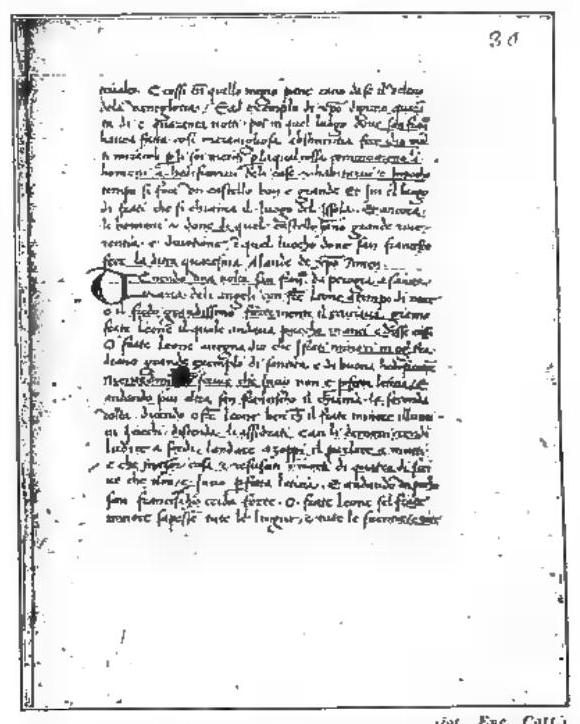
FIORETTI DI S. FRANCESCO — End of chapter 7 and beginning of chapter 8, concerning the Lent observed by S. Francesco on an island in Lake Perugia and S. Francesco’s discourse to Brother Leone on perfect joy — Vatican Library, cod. Vat. lat. 1010, f. 30e (15th century).
FIORETTI DI S. FRANCESCO - FIRENZE
moso il detto paolino: « Mihi' absit gloriari nisi in cruce Domini Nostri Jesu Christi ». Tale significato è stata efficacia su lettori di ogni mentalità, specie scattolici, non si spregherebbero senza un adeguato valore estetico. I F. sono un gioiello d'arte. La traduzione non fa che riportare al concepimento originario (in volgare) l'esinanito latino degli Actus e trasfonde nel periodare semplice, torso, ora veristico e intimo, ora soave e lirico, il candore e l'ardore dei primi francescani e l'incanto di una santità, che ama Dio senza rinnegare la vita.