
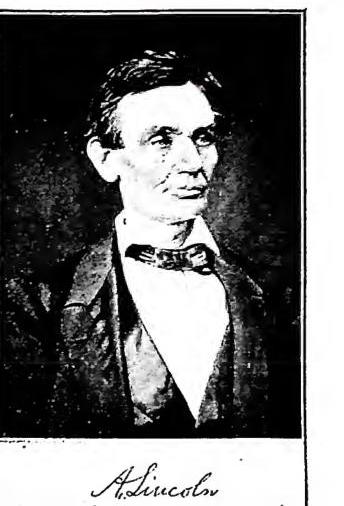
LINCOLN, ABRAHAM. - American statesman, b. at Big South Fork (Kentucky) on 12 Feb. 1809, d. at Washington on 15 Apr. 1865. Of very humble origins, he spent a nomadic and adventurous youth, during which he practiced the most disparate trades to earn a living. Self-taught, in 1837 he became a lawyer in the State of Illinois and soon distinguished himself for his probity and ability. Having entered political life as early as 1832, he was for some years a member of the federal Congress.
After an interval of private activity, he returned to politics in 1854, drawn back by the bitter conflict between slavery and abolitionists, which in the following decade was to carve a tragic division within the Confederation. He fought the measures aimed at extending slavery to the new States that were being constituted, and to the economic argument, on which the slavery policy of the southern States was substantially based (slavery being for them not only a deep-rooted institution but the foundation on which their economy rested), he opposed a humanitarian argument and the democratic ideal, which demanded, if not the immediate suppression of that scourge, at least that it be circumscribed.
The abolitionist currents gave rise to the Republican Party, which, gathering its adherents in the northern States, set itself against the Democratic Party, dominated by the southern States. L. joined it, at first suggesting a policy of moderation. Having become its leader, his victory in the presidential elections of 1860 provoked the rebellion of the seven southern States, which founded an independent Confederation. Despite L.'s efforts to resolve the crisis peacefully and preserve the unity of the country, the increasingly grave tension made the outbreak of the civil war, or war of secession, inevitable. L. entered it at first in the name of national unity. Only later, also in order to make European recognition of the southern Confederation untenable (France and England favored the secessionist States with the aim of permanently dividing the United States), did he transform it into a struggle against slavery, and on 1 Jan. 1863 he issued the proclamation emancipating the four and a half million negroes then in the United States. Re-elected to the presidency in 1864, he was struck dead on 14 Apr. 1865, when the war was by then about to end victoriously, by a fanatical secessionist.
Bibliography4 works
Gabriele Musatti