TIMOTHY II, Nestorian patriarch. — He succeeded the celebrated Mongol patriarch Jabballahà III in 1318 and held the office until 1332.
After him begins the rapid decline of the Nestorian Church. T. is of some importance for the

TIMOTHY of Jerusalem. — A fictitious name of a Byzantine sacred orator.
To T., a priest of Jerusalem, is attributed in some manuscripts (while others bear the names of Methodius and Hesychius, also designated as priests of Jerusalem) a homily for the feast of the Hypapante, or Presentation of Jesus in the Temple (PG 86, 1, 237-252), in which the orator, paraphrasing with rhetorical emphasis the evangelical narrative and illustrating in particular the prophecy of Simeon, alludes to the immortality and to the present assumption of the Virgin (245 D).
Based on the silence regarding the legend of Mary’s tomb in Jerusalem and regarding the Nestorian controversy, Fr. M. Jugie (La mort et l'assomption de la Vierge [Studi e testi, 114], Città del Vaticano 1944, pp. 76) judged this homily to have been composed at the end of the 4th or the beginning of the 5th century. This dating was accepted by Fr. O. Faller (De priorum saeculorum silentio circa assumptionem B. Mariae Virginis [Rome 1948], col. 130 sg.), who nevertheless raised criticisms regarding the interpretation of the assumptionist passage. Reviewing this work, B. Altaner (Theol. Revue, 44 [1944], col. 130 sg.) upheld the earlier commonly accepted dating to the 6th century. Dom B. Capelle (Ephem. Liturg., 63 [1949], pp. 5-26) has demonstrated that the author of this homily, whose true name is unknown, is responsible for at least four other homilies, which closely resemble it in vocabulary, style, and rhetorical devices, revealing a common origin. One, transmitted under the name of Timothy (PG 86, 1, 256-65), extols the virtue of the Cross prefigured by Moses’ prayerful posture, comments on Jesus’ exhortation to follow Him by taking up the Cross, and illustrates the Transfiguration, in which the Saviour wished to show the victory of Himself and His followers over death. Of the other three, which bear the name of St. Athanasius but were already recognized as spurious by the Maurists, the first (PG 28, 905-14) comments on the angel Gabriel’s annunciation to Zechariah and the Virgin. The second (ibid., 943-58), after narrating and commenting, with abundant rhetorical amplifications, on Mary and Joseph’s journey to Bethlehem, dwells on the birth of Jesus, insisting particularly on Mary’s virginity after childbirth. The third (ibid., 1001-24) treats of the healing of the man born blind. Some slight indications would suggest Egypt as the author’s homeland; the date may be inferred approximately (according to Capelle) from the abundant use of apocryphal sources and from the linguistic and stylistic features, which point to the Byzantine age, between the 6th and 8th centuries. Michele Pellegrino.
TIMOTHY I, Nestorian patriarch. — Born in 727 or 728 at Hazza near Arbela, died in 823. A monk at
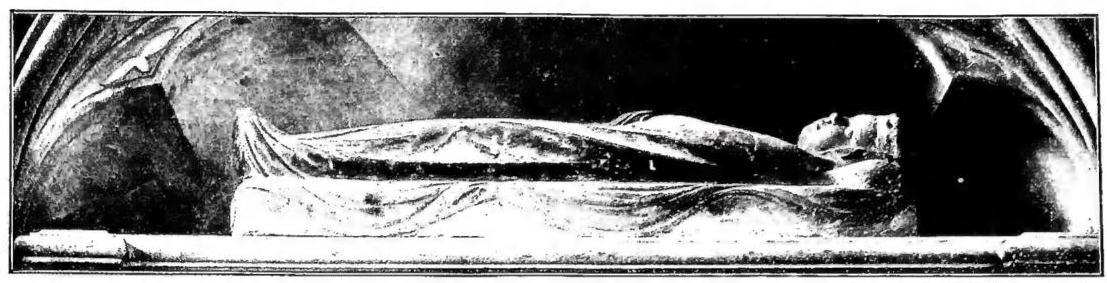
TINO DI CAMAINO DI CRESCENZIO DI DIOTISALVI — Recumbent statue of Mary, daughter of Charles of Calabria. Detail of the tomb. Naples, Church of S. Chiara.
his treatise on the Sacraments (On the Seven Causes of Ecclesiastical Mysteries) which summarizes the related Nestorian doctrine.