
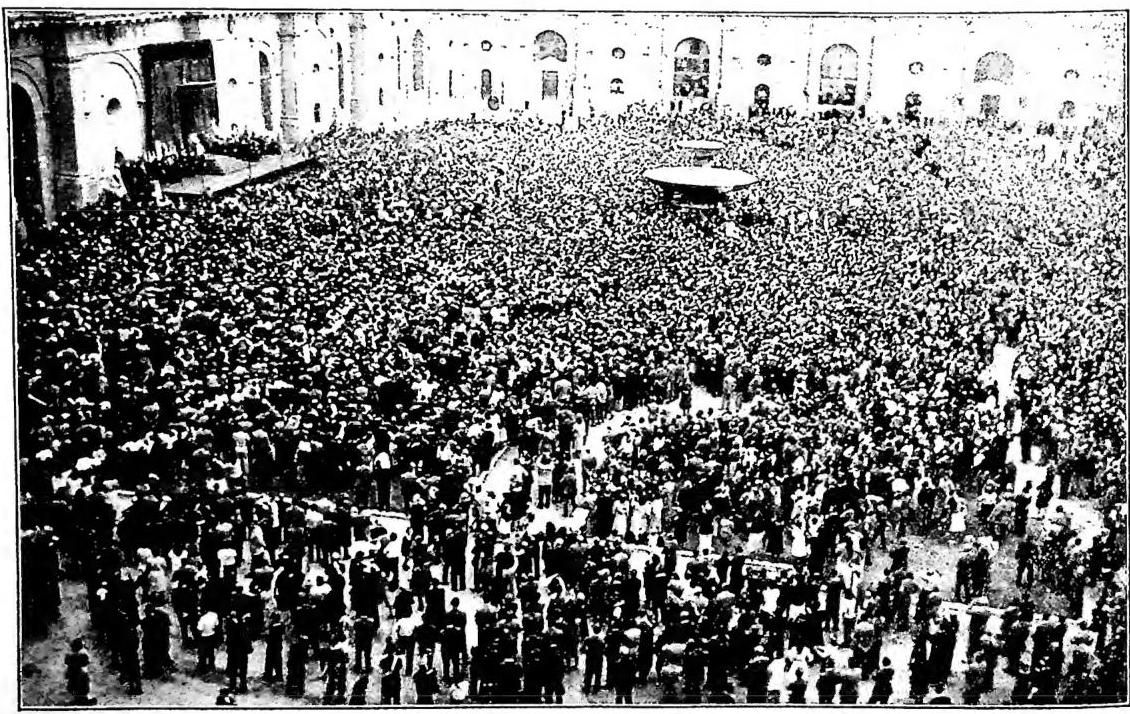
CHRISTIAN ASSOCIATIONS OF ITALIAN WORKERS (A.C.L.I.). - They are groupings of workers with the aim of promoting the affirmation of Christian principles in life, in institutions, and in legislation, integrating and supporting the work of the trade unions of each category in everything that falls outside the specific tasks reserved to the unions themselves.
The rise of the A.C.L.I. is connected to the unitary trade union by category agreed upon between the Christian current and the social-communist current with the pact of Rome of June 4, 1944. Before Fascism the trade-union field in Italy was divided between the whites, answering to the Italian Confederation of Workers, and the reds, answering to the General Confederation of Labor. Fascism suppressed both confederations in 1926 and replaced them with the single State union. At the moment of the fall of the totalitarian regime the old union leaders Achille Grandi (Christian current), Bruno Buozzi (socialist) and Giovanni Roveda (communist) agreed to give life to a unitary trade-union body, in which workers could coexist, independently of their religious or political convictions.
In the Catholic camp trade-union unity was accepted as an experiment, and also as a contingent necessity due to the scarcity of cadres of Catholic trade-union organizers, in the face of the wealth of specialists on the communist side. However, the necessity was immediately understood of protecting Catholic workers from the religious and moral dangers arising from cohabitation in the union with atheist and materialist workers. Moreover, since the union, by its very nature, must limit itself to the defense of the worker's economic interests, it leaves uncovered other needs of a cultural, recreational, etc. character. Hence the necessity of an organization that would respond to these pre-and para-trade-union needs. Hon. Achille Grandi was its originator and first president.
Yet cohabitation in the unitary union with the communists proved increasingly difficult for the workers of the Christian current. The rupture of the pact of unity, which occurred clamorously with the attempted insurrectional strike of July 14-15, 1948 on the part of the communists under the pretext of the attempt on the life of P. Togliatti, provoked the withdrawal of the Christian current from the C.G.d.L. Consequently the A.C.L.I. became the pivot of the new trade-union organization. Having decided at the Congress of the A.C.L.I. of Sept. 13, 1948 the constitution of a free union, democratic and independent of the political parties and of the Government, and therefore a non-confessional, or white, union, as some would have wanted, the A.C.L.I. remained in their physiognomy and function of an organization with a religious, moral, cultural and recreational purpose for Christian workers, whether or not enrolled in the union of their category.
Organization. - The A.C.L.I. consist of two distinct organizational forms:
1) the organization by category;
2) the workers' circles.
The organization by category comprises:
a) the Company Nuclei which gather all the workers, men and women (manual workers, technicians, employees) of one and the same firm, factory, office, farm or other work environment; b) the Communal Groups by category which gather all the members of a given category and of the same Commune, whether or not they are united in Company Nuclei; c) the Provincial Groups by category;
d) the National Groups by category.
The secretaries of the groups by category constitute the pre-trade-union technical council, which can be formed at the communal, provincial and national level.
The Circles gather the workers of a determined zone and of any category. As a general rule they have Communal Houses, but where it appears opportune they can also have District Houses. In every circle a Women's Section is constituted.
Aims and activity. - In conformity with the statutory purpose, the A.C.L.I. carry out work of education and of religious, moral, social and cultural elevation on behalf of the members; and they strive so that the frank and practical profession of the Catholic faith and morals may be safeguarded in work environments. They perfect the technical and professional capacities of the workers in order to improve their living conditions. They promote institutions of an economic character (cooperatives). They have their own patronato (v.) for every form of social assistance. They develop healthy initiatives of a recreational, artistic, sporting and touristic character. The A.C.L.I. carry out their activity by means of the Circles.
Moreover they prepare Christian workers for trade-union life. Therefore they carry out the very important and often decisive action relating to the elections for the internal commissions, for trade-union and political representations. When it is a question of a problem - whether of those that fall within the content of a collective contract, such as wage increases or the lifting of dismissals; or of those that concern the interests of workers on a broader scale, such as management councils, social security, insurance, the Marshall Plan, etc. - the problem is for the most part resolved in the A.C.L.I. forum, then the solution is supported by the representatives of the Christian current in the trade-union organization. The A.C.L.I. carry out their para-trade-union activity for the most part in the Groups by category.
The central presidency publishes the Giornale dei lavoratori in different editions for the various specialties; a bulletin entitled « Le A.C.L.I. » and a review: Informazioni sindacali.
Bibliography2 works
Luigi Cardini