
DEMONOLOGIA. – Demonology studies beliefs concerning spirits or demons. Primitive peoples imagine that everything is alive insofar as it is endowed with an animating spirit; and they trace back to spirits or souls, such as those of the dead who wander, all effects whose cause cannot be plainly grasped. Moreover, the attribution to spirits of an extraordinary and mysterious power, which always arouses reverential fear in the soul, has led to their being introduced as demons into the sphere of religion, where, alongside the gods, they have ultimately become intermediaries between them and human beings.
Many demons are of human origin, being the souls of the dead who have remained on earth, outside Ade. Such were the souls of heroes, protectors of a people or a city, who were believed to dwell beside their burial place, often in the form of a serpent, the animal that inhabits the underworld.
Generally, the souls of the unburied or of those who died by violence wander the earth, troubling the living, especially anyone who was the cause of their misfortune. Among the Greeks, the Erinni were the souls of the slain, desirous of vengeance, later becoming infernal Furies who avenged parricide and perjury.
Spirits are invisible, having a body formed of subtle matter, such as air, vapor, etc., and they live freely, although they are sometimes joined to an object of nature. When they appear, they assume forms that are often indeterminate and confused: giants, dwarfs, corpulent or thin figures, and so forth.
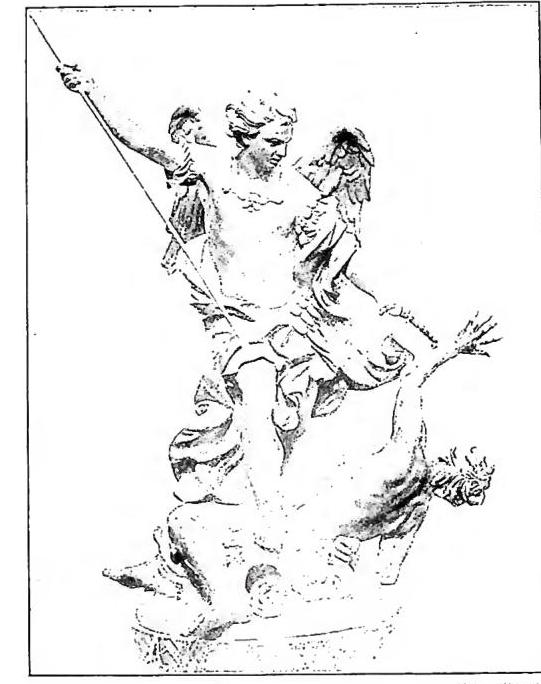
DEMONIO - St Michael the Archangel killing the demon, by A. Algardi (17th century) - Bologna, Civic Museum.
to man, obscuring the sun and moon, producing squalls, storms, floods, earthquakes, drought, famines, diseases, and the death of human beings and animals; it may be said that every misfortune has its own special demon. At times one or more spirits obsess the body of an individual, depriving him of all freedom of action. The existence of demons was invoked to explain many physical phenomena, as well as to resolve the problem of the origin of evil, which, in the polydaemonistic stage, was attributed to evil spirits. In polytheism, the good was reserved for the gods, and evil for the demons, in continuous conflict with the former.
In Greece, demons entered philosophy, especially Stoic and Neoplatonic philosophy, as rational beings intermediate between the gods and human beings. Some monotheistic religions, too, accepted demonology, in the manner and to the extent that it is compatible with the idea of a single God.