Machine translation of the 1948–1954 Italian original. The original text is authoritative.
HUIZINGA, JOHAN. – Dutch historian, born on 7 December 1872 in Groningen, died on 1 February 1945 in De Steeg.
He initially studied comparative philology and Sanskrit, then devoted himself to historical studies, obtaining the chair of history at the University of Groningen (1906), with a study on the origins of Haarlem; from there he moved in 1915 to the University of Leiden.
The work that brought him universal fame and established him as a classic of «Kulturgeschichte» was Herfstij der middeleeuwen (Italian trans., «Autumn of the Middle Ages», Florence 1940), a masterly description of Burgundian society in the 14th and 15th centuries. H. studies the transition, within that society, from the Middle Ages to the Renaissance, focusing his examination on the «way» of life of the knights and the people, on symbolisms and allegories, on forms of devotion, on concepts of life and death, on myths and dreams. With this work he provided, in opposition to historicist intellectualism, a prototype and model of a historiography attentive to inner human resonances.
In the following years his scholarly activity did not
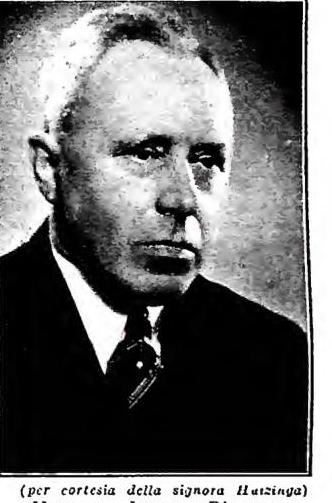
(courtesy of Mrs Hussinga) HUIZINGA, JOHAN - Portrait.His activity did not come to a halt in the following years: among his works may be mentioned Erasmus (Haarlem 1924, Italian trans.: Erasmo, Turin 1941), a profile perhaps somewhat impaired by the humanist’s insufficient placement within the historical and political problems of his time, but exquisite in its delineation of the man of «half-tones», of the word «never completely uttered», «master of mental reservation»; Homo ludens (Italian trans., Turin 1946), in which he portrayed life as play, as style, resolving the initial formula «Kultur als Spiel, nicht Kultur aus Spiel»; Patriotisme en nationalisme in de Europeesche geschiedenis tot het einde der 19e eeuw (Haarlem 1940), as well as various essays collected by W. Kaegi, in German translation, in Wege der Kulturgeschichte (Munich 1930), in Im Bann der Geschichte (Basel 1943), and in Parerga (Basel 1945). His other writings, In de Schaduwen van Morgen (1935, Italian trans. La crisi della civiltà, Turin 1937), Wenn die Waffen schweigen (Basel 1945), and Mein Weg zur Geschichte (ibid. 1947), are not merely expressions of a sensibility, but testimony to a sadness, often without hope, for a world of culture and civilization that is collapsing.
During the Second World War H. was arrested and confined in a concentration camp because of his opposition to the «new German order»; after his release, he was assigned compulsory residence near Arnhem.
BIBL.: R. Koebner, Zur Begriffsbildung der Kulturgeschichte. 1. Kulturform und Kulturbewegung (J. H. und Jacob Burckhardt), in Historische Zeitschrift, 149 (1934), pp. 10-34; C. Antoni, Problemi e metodi della moderna storiografia: J. H., in Studi germanici, 1 (1935), pp. 5-21, reprinted in Dallo storicismo alla sociologia, Florence 1940, p. 191 ff.; M. Petrocchi, Ricchezze di J. H., in Il libro italiano, 6 (1942), p. 144 ff., reprinted in L'uomo e la storia, Bologna 1944, p. 139 ff.; W. Kaegi, Historische Medizationen, II, Zurich 1946, pp. 9-42, 345-86; K. Köster, J. H., Oberursel 1947 (with the complete list of H.’s works and bibliography); F. Chabod, J. H., in Rivista storica italiana, 60 (1948), pp. 342-44. Silvio Furlani-Massimo Petrocchi
Cite this article
“HUIZINGA, JOHAN.” Enciclopedia Cattolica, vol. VI (1951), p. 873. Azione Romana digital edition, https://azioneromana.com/article/huizinga-johan.